June 22, 2026
The trajectory of American hydrocarbon extraction has reached an inflection point where technological advancement intersects with global energy security concerns. Natural gas liquids represent a critical bridge between traditional fossil fuel infrastructure and evolving petrochemical manufacturing demands, positioning these compounds at the center of strategic economic planning. Understanding the mechanics of NGL production reveals how extraction efficiency improvements can dramatically alter long-term market dynamics and international trade patterns.
Recent analytical revisions by the Energy Information Administration demonstrate how rapidly evolving shale technologies continue reshaping EIA US NGL production demand forecasts, with implications extending far beyond domestic energy markets into global petrochemical supply chains and manufacturing competitiveness.
Understanding the Strategic Significance of Natural Gas Liquids in America's Energy Portfolio
Defining NGLs and Their Economic Impact
Natural gas liquids encompass a diverse group of hydrocarbon compounds extracted during natural gas processing, each serving distinct industrial applications that drive economic value creation. Ethane functions primarily as a petrochemical feedstock for ethylene production, while propane serves both residential heating markets and industrial processes. Butanes (normal and isobutane) contribute to gasoline blending and alkylation processes, and natural gasoline provides additional blending components for transportation fuels.
The economic value chain extends from wellhead extraction through specialised processing facilities to end-user applications across multiple industries. Current market valuations for NGLs reflect their dual role as energy commodities and chemical feedstocks, with pricing structures often tracking both natural gas and oil price movements while maintaining distinct supply-demand dynamics.
Revenue contribution to the broader US energy sector has grown substantially as extraction technologies improve and processing capacity expands. Furthermore, the Canada energy transition demonstrates how regional energy shifts influence market dynamics. The integrated value proposition combines energy content utilisation with chemical manufacturing applications, creating multiple revenue streams from single extraction operations.
The Petrochemical Manufacturing Connection
Industrial demand drivers across chemical production sectors demonstrate the critical importance of NGLs in maintaining manufacturing competitiveness. Ethylene production facilities rely heavily on ethane feedstock availability, with cost advantages directly tied to domestic NGL supply security. Propylene manufacturing similarly depends on propane processing capacity and pricing stability.
Integration with plastics, fertilisers, and speciality chemical industries creates a complex web of supply dependencies that extend throughout the US manufacturing base. Geographic concentration of processing facilities along the Gulf Coast reflects both infrastructure advantages and proximity to export terminals, enabling efficient distribution to both domestic and international markets.
For instance, the petrochemical manufacturing ecosystem demonstrates how NGL availability influences broader industrial competitiveness, with feedstock costs representing significant portions of total production expenses across multiple chemical sectors.
When big ASX news breaks, our subscribers know first
What Do the Latest EIA Production Projections Mean for Market Dynamics?
Analysing the 14.4% Upward Revision in Long-Term Outlook
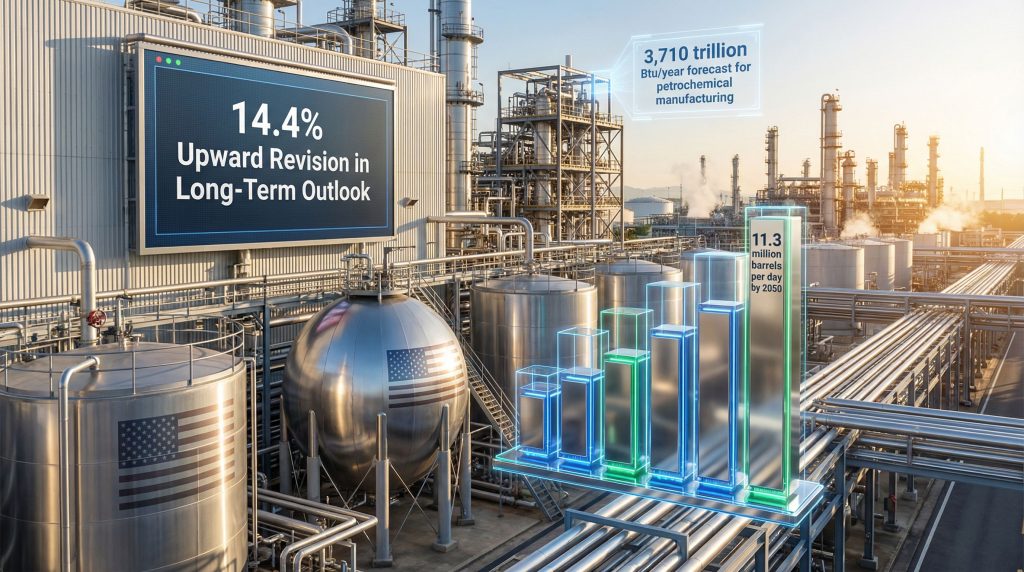
The Energy Information Administration's substantial upward revision reflects emerging data on extraction efficiency improvements and reservoir productivity assessments. Production forecasts for 2026-2035 now average 8.85 million barrels per day, representing a significant increase from previous projections of 7.74 million barrels per day.
| Forecast Period | Previous Projection | Revised Projection | Percentage Change |
|---|---|---|---|
| 2026-2035 Average | 7.74 million b/d | 8.85 million b/d | +14.4% |
| 2050 Target | 8.54 million b/d | 11.3 million b/d | +32.3% |
Regional production growth patterns across major shale formations indicate concentrated increases in Permian Basin, Marcellus, and Utica formations. Technology improvements driving extraction efficiency gains include enhanced completion techniques, improved drilling precision, and optimised processing methods that increase NGL recovery rates from existing wells.
The magnitude of these revisions suggests that previous forecasting models may have underestimated the pace of technological advancement and its impact on commercially recoverable reserves. Additionally, these US natural gas forecasts provide valuable insights into related market dynamics.
Breaking Down the 2050 Production Surge
The projected 32.3% increase to 11.3 million barrels per day by 2050 represents a fundamental shift in long-term energy planning assumptions. Infrastructure investment requirements for sustained growth include expanded processing capacity, enhanced transportation networks, and upgraded storage facilities capable of handling increased throughput volumes.
Environmental and regulatory considerations for long-term expansion encompass emissions management technologies, water usage optimisation, and compliance with evolving environmental standards. The scale of projected growth necessitates coordinated planning between extraction operations, processing facilities, and transportation infrastructure.
Capital allocation priorities must address both near-term production increases and long-term sustainability requirements, balancing immediate revenue opportunities with environmental compliance costs and technological upgrade investments.
How Are Demand Patterns Reshaping the NGL Market Landscape?
Industrial Sector Consumption Trends
Industrial sector consumption projections indicate robust growth across petrochemical manufacturing applications. The forecast of 3,710 trillion Btu per year for petrochemical manufacturing from 2026-2035 represents an increase from previous projections of 3,630 trillion Btu per year, demonstrating sustained industrial demand growth.
Key industrial applications driving consumption growth include:
- Ethylene production facilities expanding capacity to meet plastics demand
- Propylene manufacturing supporting polypropylene and chemical intermediate production
- Butane processing for gasoline blending and alkylation operations
- Speciality chemical manufacturing requiring high-purity NGL feedstocks
- Fertiliser production utilising NGLs in ammonia synthesis processes
The geographic distribution of industrial consumption reflects established petrochemical corridors along the Gulf Coast whilst expanding into emerging manufacturing regions as infrastructure develops.
Residential and Commercial Propane Market Evolution
Domestic propane demand projections show 727 trillion Btu per year from 2026-2035, up from previous estimates of 697 trillion Btu per year. The increase stems primarily from residential sector consumption, which is forecast to reach 485 trillion Btu per year, significantly above the previous projection of 456 trillion Btu per year.
Regional distribution patterns across heating and transportation sectors reflect:
- Rural residential heating markets maintaining steady demand
- Commercial applications in hospitality and food service industries
- Industrial heating processes requiring reliable propane supply
- Transportation fuel usage in forklift and fleet applications
- Agricultural operations utilising propane for crop drying and equipment
Energy transition impacts on traditional propane applications present both challenges and opportunities, as some heating applications face competition from electric alternatives whilst industrial uses remain largely insulated from substitution pressures.
What Are the Macroeconomic Implications of Increased NGL Production?
Export Market Opportunities and Trade Balance Effects
Global NGL trade flows position the United States as a major supplier to international markets, with competitive advantages stemming from abundant domestic production and advanced processing capabilities. Revenue potential from international market expansion depends on transportation infrastructure development and trade relationship stability.
Infrastructure development for export terminal capacity requires substantial capital investment in specialised handling, storage, and loading facilities. Current export capacity constraints limit the ability to fully capitalise on production increases, creating investment opportunities in terminal expansion and transportation networks.
However, global trade impacts and recent oil price rally analysis suggest that geopolitical factors may influence market dynamics. The trade balance implications of increased NGL exports extend beyond direct commodity revenues to include associated services, equipment exports, and technology licensing opportunities that multiply economic benefits.
Employment and Regional Economic Development
Job creation across extraction, processing, and transportation sectors demonstrates the multiplier effects of NGL industry expansion. Direct employment includes drilling operations, processing plant operations, and transportation logistics, whilst indirect employment encompasses equipment manufacturing, maintenance services, and support industries.
Economic multiplier effects in major production regions create sustainable economic development patterns that extend beyond the energy sector itself. Skills development and workforce training requirements necessitate coordinated educational programmes and apprenticeship initiatives to meet technical staffing needs.
Regional economic development benefits include:
- Tax revenue generation from production and processing operations
- Infrastructure investment in roads, utilities, and communication systems
- Service sector growth supporting increased economic activity
- Technology development centres focusing on extraction and processing innovation
- Supply chain development creating local manufacturing and service opportunities
How Do These Forecasts Compare with Global Energy Transition Goals?
NGL Role in Transitional Energy Systems
Petrochemical feedstock security during renewable energy scaling represents a critical consideration in long-term energy planning. NGLs provide essential chemical building blocks that remain necessary regardless of electricity generation sources, positioning these commodities as transition-resilient components of the energy system.
Carbon intensity considerations across the NGL value chain encompass extraction methods, processing efficiency, and end-use applications. Advanced extraction technologies increasingly focus on minimising environmental impacts whilst maintaining economic viability.
Policy framework alignment with climate objectives requires balanced approaches that recognise both the necessity of chemical feedstocks and the importance of minimising environmental impacts throughout the production and consumption cycle.
Investment Climate and Capital Allocation Trends
Private sector response to revised production forecasts indicates renewed confidence in long-term NGL market fundamentals. Infrastructure financing requirements necessitate significant capital commitments across the entire value chain, from wellhead to end-user delivery systems.
Risk assessment for long-term capital commitments must account for:
- Regulatory evolution and compliance cost changes
- Technology advancement rates and competitive positioning
- Market demand shifts and substitution risks
- Environmental compliance requirements and associated costs
- International trade policy changes and market access
Funding sources for infrastructure development include traditional energy sector financing, infrastructure investment funds, and public-private partnerships focused on strategic energy security objectives. Consequently, investment strategy insights become increasingly valuable for market participants.
What Market Risks and Uncertainties Could Impact These Projections?
Technology and Regulatory Variables
Drilling technology advancement rates directly influence the economic viability of projected production increases. Cost structure improvements in extraction and processing operations determine profitability margins and investment attractiveness across different geological formations.
Environmental regulation evolution presents both compliance costs and operational constraints that could influence production economics. Carbon pricing mechanisms may alter the competitive positioning of different extraction methods and processing technologies.
"The pace of regulatory change remains a critical uncertainty factor in long-term production planning, with potential impacts on operational costs and market access."
Technological risk factors include:
- Extraction efficiency improvement rates and cost reduction potential
- Environmental control technology development and implementation costs
- Processing optimisation advances affecting product yields and quality
- Transportation innovation improving logistics efficiency and reducing costs
Competitive Dynamics and Alternative Feedstock Development
Bio-based chemical production scaling represents a potential source of demand erosion for traditional NGL applications. Market penetration rates for alternative feedstocks depend on cost competitiveness and performance characteristics compared to petroleum-derived inputs.
International NGL production capacity expansions could influence global market dynamics and pricing structures. Competitive positioning requires continuous efficiency improvements and cost management to maintain market share in price-sensitive applications.
Demand substitution risks from circular economy initiatives include:
- Recycling technologies reducing virgin feedstock requirements
- Bio-based alternatives competing in specific application segments
- Process efficiency improvements reducing overall feedstock consumption
- Product redesign initiatives minimising material usage requirements
The next major ASX story will hit our subscribers first
Frequently Asked Questions About US NGL Market Forecasts
Why Did EIA Significantly Increase Its Production Estimates?
Technical factors driving upward revisions include improved understanding of reservoir characteristics and enhanced extraction efficiency data from operational wells. Market data improvements and forecasting methodology updates incorporate more sophisticated analytical models and real-time production information.
Industry feedback integration into projection models provides ground-truth validation of theoretical forecasting approaches, resulting in more accurate representation of technical and economic factors influencing production potential. Furthermore, the EIA's latest energy outlook provides comprehensive data supporting these revised forecasts.
Which Regions Will Drive the Majority of Production Growth?
Shale formation productivity rankings indicate Permian Basin operations leading growth projections, followed by significant contributions from Marcellus and Utica formations. Transportation infrastructure development priorities focus on connecting high-productivity regions with processing facilities and export terminals.
State-level policy environments supporting production growth include:
- Texas maintaining favourable regulatory frameworks and infrastructure investment
- Pennsylvania balancing environmental considerations with economic development
- West Virginia providing streamlined permitting and operational support
- North Dakota offering tax incentives and infrastructure development programmes
How Will Increased Supply Affect NGL Pricing Dynamics?
Supply-demand balance implications suggest potential price moderation in periods of rapid production increases, offset by growing industrial demand and export market expansion. Regional price differential trends reflect transportation constraints and local market conditions.
Long-term contract structures increasingly incorporate volume flexibility provisions and pricing mechanisms that adjust to market conditions, providing stability for both producers and consumers whilst maintaining competitive pricing.
Strategic Implications for Energy Market Participants
Investment Decision Framework for NGL Sector Exposure
Portfolio allocation considerations across the value chain require careful assessment of different market segments' risk-return profiles. Upstream production investments offer direct exposure to commodity price movements, whilst midstream infrastructure provides more stable cash flows with longer development timelines.
Timing considerations for capital deployment strategies must account for production growth trajectories, infrastructure development schedules, and market demand evolution patterns. Moreover, EIA US NGL production demand forecasts serve as critical inputs for strategic planning decisions.
Risk-return profiles vary significantly across market segments:
- Production operations offer high returns with commodity price and operational risks
- Processing facilities provide stable margins with capital intensity and capacity utilisation risks
- Transportation infrastructure delivers steady returns with regulatory and volume risks
- Export terminals present growth opportunities with international market and policy risks
Policy and Regulatory Monitoring Priorities
Key legislative developments affecting production forecasts include environmental regulations, tax policy changes, and infrastructure development programmes. International trade policy impacts on export market access require ongoing monitoring of trade relationships and tariff structures.
Environmental compliance evolution necessitates proactive planning for regulatory changes and associated cost implications. Investment in advanced environmental control technologies may provide competitive advantages as regulations become more stringent.
Regulatory monitoring priorities should encompass federal environmental policies, state-level production regulations, international trade agreements, and infrastructure development funding programmes that could influence market dynamics and investment opportunities. Additionally, insights from natural gas intelligence provide valuable market intelligence for strategic decision-making.
In conclusion, the substantial upward revisions to EIA US NGL production demand forecasts reflect the dynamic nature of America's energy landscape. These projections underscore the importance of technological advancement, infrastructure investment, and strategic planning in capturing the value creation opportunities presented by expanded NGL production capacity.
This analysis examines the economic implications of recent EIA forecast revisions, providing strategic insights for market participants navigating the evolving NGL landscape. Investment decisions should consider the complex interplay of production growth, demand patterns, and regulatory developments that shape long-term market dynamics.
Looking to Capitalise on Energy Sector Opportunities?
Whilst energy markets like NGLs present compelling investment narratives, the fastest wealth-building opportunities often emerge from mineral discoveries on the ASX. Discovery Alert's proprietary Discovery IQ model delivers instant notifications on significant mineral discoveries, transforming complex geological data into actionable investment insights that position subscribers ahead of market movements. Explore how historic mineral discoveries have generated exceptional returns and begin your 14-day free trial today to secure your market-leading advantage.