May 15, 2026
Global energy markets face unprecedented volatility when critical supply chokepoints experience prolonged closure, forcing rapid adjustments in domestic production strategies. The oil price rally following the April 2026 Strait of Hormuz disruption exemplified how U.S. oil production increase amid Strait of Hormuz closure scenarios reshape strategic energy planning. Understanding these adaptation mechanisms reveals how domestic production systems respond to extreme external pressures.
Energy security frameworks operate on multiple temporal scales simultaneously. While spot markets react to immediate supply shocks within hours, the underlying production infrastructure requires weeks to months for meaningful capacity adjustments. This temporal mismatch creates unique investment and operational challenges that distinguish emergency production scenarios from normal market cycles.
What Drives Emergency Production Response in Global Energy Crises?
Crisis-driven production responses emerge from the intersection of market signals, regulatory flexibility, and operational capability. The April 2026 Strait of Hormuz closure demonstrated these dynamics in real time, with 16 million barrels per day removed from global markets triggering immediate administrative coordination between government officials and major operators including ExxonMobil, Chevron, Continental Resources, Diamondback Energy, Devon Energy, and Occidental Petroleum.
Market response indicators during emergency conditions operate differently than standard price elasticity models. Interior Secretary Doug Burgum's observation that producers respond when receiving price signals to invest captures the fundamental mechanism. Yet industry response during the 2026 crisis remained measured despite elevated prices, revealing that emergency production decisions integrate multiple risk factors beyond immediate price levels.
Critical Decision Factors During Energy Emergencies:
- Futures curve analysis indicating price sustainability beyond immediate crisis periods
- Capital availability during periods of market volatility and credit tightening
- Equipment and workforce capacity available for rapid deployment
- Regulatory certainty regarding emergency authorities and permitting flexibility
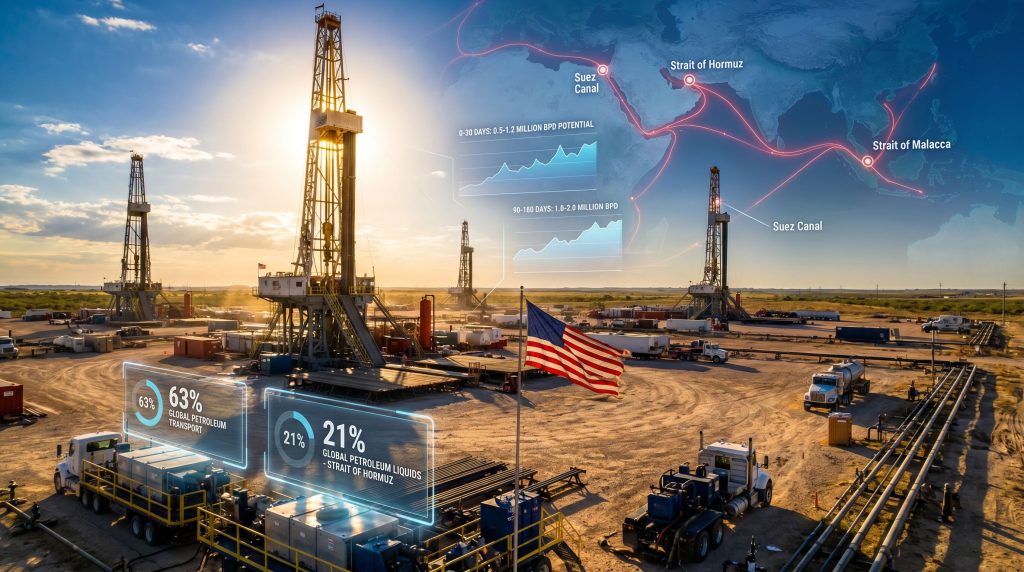
The temporal structure of emergency response follows predictable patterns, though actual activation speeds depend heavily on regulatory coordination. Reactivation of shut-in wells represents the fastest response mechanism, potentially adding significant capacity within 30 days. However, the April 2026 response revealed that even well reactivation faces permitting delays and regulatory restrictions that can extend project timelines beyond theoretical minimums.
Completion of drilled but uncompleted wells (DUCs) provides the next tier of emergency capacity, typically requiring 30-90 days for full activation. This inventory represents pre-positioned drilling investment that can be monetised rapidly when price signals justify completion costs. The strategic value of DUC inventory became evident during 2026 crisis discussions, where administration officials emphasised opportunities to increase output in the near term.
Production Response Timeline Analysis:
- 0-30 days: Shut-in well reactivation (constrained by permitting processes)
- 30-90 days: DUC completion programmes (dependent on service sector capacity)
- 90-180 days: Accelerated drilling on proven acreage (requires equipment mobilisation)
- 180+ days: Major field development programmes (capital-intensive, regulatory-dependent)
When big ASX news breaks, our subscribers know first
How Do Geopolitical Chokepoints Transform Domestic Energy Strategy?
Strategic chokepoints concentrate global energy vulnerability into narrow geographic corridors, creating systemic risks that transcend normal supply chain management. The Strait of Hormuz exemplifies this concentration, handling approximately one-fifth of global oil and liquefied natural gas supplies according to 2026 crisis reporting. When such chokepoints face disruption, the immediate impact cascades through global energy networks within days.
The April 2026 closure of the Strait of Hormuz, combined with damage to regional energy infrastructure, demonstrated how single-point failures can reshape entire energy markets. The effective removal of 16 million barrels per day from global commerce triggered immediate policy responses, including temporary Jones Act waivers to allow foreign vessels to transport crude and refined products between U.S. ports.
Major Global Energy Chokepoints:
- Strait of Hormuz: Critical for Gulf region petroleum exports
- Strait of Malacca: Essential for Asian LNG trade flows
- Suez Canal: Key route for Mediterranean and European deliveries
- Bab el-Mandeb: Strategic passage connecting Red Sea and Arabian Sea
Emergency production authorisation mechanisms activate through established but rarely-used statutory authorities. The 2026 response included specific regulatory adjustments: temporary Jones Act suspension, discussions of natural gas flaring restriction modifications, and coordinated meetings between federal officials and industry executives. However, comprehensive emergency permitting authorities were not fully deployed, suggesting that crisis response protocols operate incrementally rather than through wholesale regulatory suspension.
Strategic petroleum reserve coordination represents a critical bridge between immediate supply shortfalls and longer-term production increases. While specific SPR drawdown decisions were not detailed in 2026 crisis reporting, the coordination mechanisms between federal agencies and private operators became evident through high-level industry meetings convened by Interior and Energy secretaries.
Federal Emergency Response Mechanisms:
- Jones Act suspension protocols for domestic transportation flexibility
- Expedited permitting consultations for critical infrastructure projects
- Strategic reserve coordination with private sector operators
- Cross-border cooperation agreements with allied nations during supply disruptions
Infrastructure bottleneck management often constrains emergency production more than drilling capacity itself. The 2026 crisis highlighted specific infrastructure limitations, particularly around natural gas flaring restrictions that prevent additional oil production from wells lacking sufficient gas takeaway capacity. This technical constraint demonstrates how environmental regulations can create binding production limits even during acknowledged energy emergencies.
What Are the Economic Thresholds for Emergency Production Increases?
Emergency production economics operate within a complex framework where spot price signals compete with forward curve expectations for capital allocation decisions. The 2026 Strait of Hormuz crisis created substantial immediate price incentives, yet industry response remained cautious due to futures markets indicating lower prices in the months ahead, reinforcing conservative approaches to capital spending. Furthermore, tariffs impact markets by creating additional uncertainty for long-term investment planning.
Investment decision frameworks during crisis periods integrate multiple analytical components beyond simple breakeven calculations. Companies evaluate 6-24 month price expectations through futures curve analysis, assess equipment availability and service sector capacity, examine transportation infrastructure constraints, and analyse regulatory stability for project development timelines.
Economic Threshold Analysis Components:
- Spot price signals providing immediate revenue incentives
- Forward curve structure indicating price sustainability expectations
- Capital availability during volatile market conditions
- Operational capacity including equipment, crews, and infrastructure access
- Regulatory certainty affecting project development timelines
The relationship between price signals and production response reveals asymmetric decision-making patterns. While elevated prices create incentives for increased output, uncertainty about disruption duration and price sustainability creates powerful countervailing forces. Industry executives during 2026 crisis meetings expressed reluctance to significantly expand drilling activity amid uncertainty over disruption duration, despite strong immediate price signals.
Capital allocation speed during emergency periods depends heavily on company-specific factors including cash flow generation, debt capacity, and existing drilling programmes. Major integrated operators typically maintain greater financial flexibility for rapid expansion compared to independent producers operating with higher leverage ratios and more constrained access to capital markets.
During emergency production scenarios, the decision matrix extends beyond immediate economics to include confidence about price regime sustainability and operational risk management across uncertain time horizons.
Production Scaling Constraints:
- Equipment mobilisation time requirements for drilling and completion operations
- Workforce availability for expanded operations across multiple basins
- Service sector capacity including hydraulic fracturing and completion services
- Transportation infrastructure capacity for increased crude and product movements
Technology integration accelerates production response through optimisation of existing infrastructure before new drilling begins. Advanced analytics enable 8-15% productivity improvements from existing wells through enhanced recovery techniques, automated completion systems reduce time-to-production by 25-40%, and real-time monitoring systems enable immediate response to changing market conditions.
How Do Regulatory Frameworks Enable Rapid Production Scaling?
Regulatory flexibility during energy emergencies operates through established but seldom-activated statutory authorities that balance immediate security needs with longer-term environmental and safety standards. The 2026 response demonstrated partial deployment of these mechanisms, with administration officials implementing temporary Jones Act waivers while maintaining most standard permitting processes for new drilling operations.
Emergency permitting protocols create tension between accelerated project timelines and maintained environmental oversight. Industry representatives during 2026 crisis discussions highlighted the importance of permitting reform to accelerate development, particularly for new drilling projects, whilst acknowledging that comprehensive regulatory suspension was not implemented despite acknowledged supply disruptions.
Streamlined Approval Mechanisms:
- Categorical exclusions for well recompletion operations on existing locations
- Expedited environmental assessments for projects within previously-approved field boundaries
- Fast-track coordination between multiple federal agencies for complex projects
- Temporary operational variances for specific technical constraints like gas flaring
Infrastructure bottleneck management through regulatory adjustment addresses constraints that bind production increases even when drilling capacity is available. The request to ease restrictions on natural gas flaring during 2026 represents a specific example where environmental regulations created operational constraints preventing additional oil production from wells lacking adequate gas transport infrastructure.
Multi-agency coordination during emergency response requires sophisticated information sharing and decision-making processes. The videoconference meetings between Interior Secretary Doug Burgum, Energy Secretary Chris Wright, and senior executives from major operators demonstrates the coordination architecture. However, specific outcomes regarding permitting acceleration were not detailed in available reporting.
Federal Coordination Mechanisms:
- Interagency task forces for complex project approvals during emergency periods
- Expedited consultation processes between federal and state regulatory authorities
- Industry liaison protocols for real-time communication during crisis response
- Strategic reserve integration with private sector production planning
Regulatory certainty affects investment decisions as much as price signals during emergency scenarios. While elevated prices create immediate incentives for production increases, structural constraints including permitting delays continue to affect project timelines even during acknowledged energy crises. This suggests that regulatory frameworks remain partially binding even under emergency conditions.
What Role Does Technology Play in Emergency Production Response?
Digital optimisation technologies enable rapid production scaling through enhancement of existing infrastructure capacity before new drilling operations begin. Advanced reservoir modelling and artificial intelligence applications can increase productivity from current wells by optimising completion parameters, adjusting production rates, and identifying opportunities for enhanced recovery techniques across existing field developments.
Automated completion systems reduce the time required to bring new production online by standardising complex operational procedures and reducing human resource requirements during periods of workforce constraint. These systems become particularly valuable during emergency response when experienced personnel may be spread across multiple simultaneous projects requiring rapid completion.
Technology-Enabled Production Acceleration:
- Real-time reservoir optimisation maximising output from existing wells
- Automated drilling systems reducing completion times and human resource requirements
- Predictive maintenance protocols preventing equipment failures during high-utilisation periods
- Digital twin modelling for rapid scenario analysis and optimisation planning
Unconventional resource development offers unique advantages during emergency production scenarios due to shorter development cycles and modular expansion capabilities. In addition, shale and tight oil formations typically require 30-90 days from drilling to production, compared to 12-24 months for conventional offshore projects, making unconventional resources particularly responsive to crisis-driven market signals.
Data integration across multiple production systems enables coordinated response to market signals whilst maintaining operational safety and environmental compliance. Integrated monitoring systems provide real-time feedback on production optimisation efforts, equipment utilisation rates, and infrastructure capacity constraints that might limit emergency response effectiveness.
Unconventional Resource Advantages:
- Rapid development timelines enabling quick response to price signals
- Modular expansion capability allowing incremental capacity additions
- Extensive proven reserve base reducing exploration risk during time-sensitive periods
- Established infrastructure networks supporting rapid expansion in major basins
Technology deployment during emergency response requires careful balance between speed and safety considerations. While automation can accelerate operations, the pressure for rapid production increases must not compromise safety protocols that protect workforce and environmental resources during expanded operations.
How Do Market Dynamics Influence Long-Term Production Strategy?
Futures market integration in production planning creates sophisticated response mechanisms that consider both immediate crisis signals and longer-term price expectations. The 2026 crisis demonstrated this tension, where futures markets indicating lower prices in months ahead reinforced cautious industry responses despite elevated spot prices and government pressure for increased production. Similarly, Saudi exploration licenses play a crucial role in global supply chain planning.
Supply chain resilience building requires domestic equipment manufacturing capabilities and strategic inventory management to reduce dependence on global logistics networks that may face disruption during geopolitical crises. The 2026 experience highlighted how traditional supply chains can become vulnerable during the same geopolitical events that drive emergency production demand.
Market Signal Integration Framework:
- Contango and backwardation analysis informing optimal drilling timing decisions
- Volatility premium assessment for flexible production scheduling optimisation
- Hedge ratio optimisation balancing price exposure with production commitments
- Storage arbitrage evaluation during supply chain disruption periods
Long-term strategic positioning must account for the cyclical nature of geopolitical supply disruptions. Companies developing emergency response capabilities invest in flexible infrastructure and maintain operational capacity that can be rapidly scaled during crisis periods. This occurs even if such capacity remains underutilised during normal market conditions.
Financial market integration affects production response through multiple channels including equity valuations, debt capacity, and cost of capital during volatile periods. Energy companies must balance immediate production opportunities with longer-term financial stability, particularly when crisis-driven price spikes may not represent sustainable pricing regimes. Meanwhile, Canada's energy transition creates additional regional considerations for North American energy security.
Strategic Resilience Components:
- Domestic supply chain development reducing dependence on global logistics
- Flexible infrastructure investment enabling rapid scaling during emergency periods
- Financial capacity preservation for opportunistic expansion during crises
- Technology integration maximising existing asset productivity before new investment
Inventory management becomes critical during supply disruptions when equipment availability and service sector capacity face constraints from simultaneous industry expansion efforts. Companies that maintain strategic inventories of critical components can respond more rapidly than competitors dependent on just-in-time supply chains.
How Do Energy Storage Solutions Support Emergency Response?
Energy storage technology provides crucial buffer capacity during supply disruptions, enabling more stable grid operations whilst emergency production increases come online. Pumped hydro storage and battery systems create strategic reserves that bridge the gap between immediate crisis response and sustained production increases.
Grid integration capabilities allow energy storage systems to provide frequency regulation and voltage support during periods when traditional power generation faces constraints. This technological backup becomes essential when emergency production scenarios strain existing infrastructure capacity.
Storage system deployment requires coordination between multiple stakeholders including grid operators, emergency response agencies, and private energy companies. Strategic placement of storage capacity near critical infrastructure creates resilience networks that support both emergency response and longer-term energy security planning.
The next major ASX story will hit our subscribers first
What Are the Environmental and Social Considerations During Emergency Production?
Environmental management during emergency production requires sophisticated protocols that maintain protection standards whilst enabling necessary production increases. The 2026 crisis discussions included industry requests for easing restrictions on natural gas flaring, demonstrating how environmental regulations can become binding constraints during emergency response periods.
Accelerated environmental review processes must balance urgency with thoroughness to avoid long-term environmental damage whilst addressing immediate energy security needs. Emergency protocols typically maintain environmental assessment requirements while compressing review timelines and enabling temporary operational variances for specific technical constraints.
Environmental Balance Mechanisms:
- Enhanced monitoring requirements during emergency operations to ensure compliance
- Restoration bonding increases for expedited projects requiring temporary environmental impacts
- Community engagement protocols maintaining social licence during expanded operations
- Cumulative impact assessment for multiple simultaneous projects in concentrated areas
Workforce mobilisation during emergency production requires rapid scaling whilst maintaining safety standards that typically require extensive training periods. Cross-training programmes enable skill transfer across different operational areas, while safety protocol acceleration must maintain standards without compromising worker protection during high-pressure operational periods.
Social licence considerations become particularly important when communities experience rapid increases in industrial activity during emergency production responses. Maintaining community relationships requires transparent communication about temporary versus permanent operational changes and ensuring that local infrastructure can support increased activity levels.
Workforce Management During Emergency Response:
- Accelerated training protocols for rapid workforce expansion without safety compromise
- Regional labour mobility programmes enabling workforce reallocation during emergency periods
- Safety system enhancement during periods of increased operational tempo
- Community impact mitigation for areas experiencing rapid industrial expansion
Long-term environmental planning must account for infrastructure and operational changes implemented during emergency response periods. Some emergency measures may become permanent features of production systems, requiring comprehensive environmental impact assessment for sustained operations beyond immediate crisis periods.
How Do Water Resources Factor Into Emergency Production Planning?
Water resource management becomes critical during emergency production scaling as hydraulic fracturing operations require substantial volumes for completion activities. Strategic water sourcing agreements and recycling infrastructure enable sustainable expansion whilst minimising environmental impact during crisis response periods.
Regional water availability constraints can limit emergency production response in arid regions where competition exists between industrial, agricultural, and municipal users. Pre-planning water allocation agreements ensures that emergency production capabilities remain viable during extended crisis periods.
How Do International Partnerships Support Domestic Production Goals?
Strategic alliance coordination provides crucial technological and logistical support during domestic production emergencies through established cooperation frameworks that enable rapid resource sharing. Technology transfer agreements accelerate deployment of advanced production techniques, whilst equipment sharing protocols provide access to specialised resources during supply chain constraints.
International energy partnerships facilitate coordinated market management during global supply disruptions. The 2026 Strait of Hormuz crisis demonstrated how continued instability in the Middle East creates sustained market volatility that requires coordinated response among allied nations to prevent cascading economic effects, particularly given how oil prices surge during regional conflicts.
Partnership Support Mechanisms:
- Technology sharing agreements for rapid deployment of advanced production techniques
- Equipment access protocols during global supply chain disruptions
- Coordinated strategic reserve management for optimal global market stabilisation
- Joint infrastructure development improving long-term supply security for allied nations
Cross-border energy cooperation becomes particularly valuable when domestic emergency production must integrate with global supply chain recovery efforts. Coordination with allied nations enables more effective market stabilisation than unilateral production increases, particularly when disruptions affect multiple supply routes simultaneously.
Energy infrastructure integration with allied nations provides redundancy that enhances emergency response capabilities. Joint development of transportation infrastructure, shared storage capacity, and coordinated emergency response protocols create system-wide resilience that supports individual national emergency production efforts.
International Coordination Benefits:
- Market stabilisation through coordinated rather than competitive emergency response
- Technology advancement through shared research and development efforts
- Supply chain diversification reducing dependence on potentially unstable regions
- Emergency response coordination maximising effectiveness of individual national efforts
Long-term energy security strategy increasingly requires international cooperation to address geopolitical risks that affect multiple allied nations simultaneously. The concentration of global energy supplies in politically unstable regions creates shared vulnerabilities that benefit from coordinated preparedness and response capabilities.
Consequently, U.S. oil production increase amid Strait of Hormuz closure scenarios demonstrate the complex interplay between domestic capabilities and international cooperation in maintaining energy security during geopolitical crises.
This analysis is based on publicly available information and should not be considered investment advice. Energy markets involve significant risks and uncertainties that can affect investment outcomes. Readers should conduct independent research and consult qualified professionals before making investment decisions.
Considering Investments in Energy Security Companies?
Discovery Alert's proprietary Discovery IQ model delivers real-time alerts on significant ASX mineral discoveries, instantly empowering subscribers to identify actionable opportunities in energy transition metals and critical resources ahead of the broader market. Understand why major mineral discoveries can lead to significant market returns by exploring Discovery Alert's dedicated discoveries page, showcasing historic examples of exceptional outcomes, and begin your 14-day free trial today to position yourself ahead of the market.