June 25, 2026
US Political Risk Emerging as Primary Currency Market Driver
US political risk and dollar weakness have become inseparable in contemporary foreign exchange markets, fundamentally altering how traders price the world's reserve currency. Currency markets are experiencing a fundamental shift as traditional economic models fail to explain current dollar weakness. For decades, foreign exchange pricing relied on predictable patterns: interest rate differentials, growth comparisons, and trade balances.
Today, these conventional metrics increasingly pale beside a more powerful force reshaping global currency dynamics: political risk premium. When institutional credibility erodes, currency markets respond with surgical precision. Traders who once viewed political stability as a given now actively hedge against governance uncertainty.
This transformation extends far beyond typical election cycles or policy debates, representing a structural change in how markets evaluate sovereign currencies in an era of increasing policy unpredictability.
When big ASX news breaks, our subscribers know first
What Makes Political Risk a Currency Market Driver?
Political risk premium in foreign exchange markets represents the additional return investors demand to compensate for uncertainty about future policy direction. Unlike economic fundamentals, which markets can analyse through data and forecasting models, political risk involves human decision-making under pressure, making it inherently more volatile and difficult to quantify.
The Plaza Accord of 1985 serves as the definitive historical precedent for coordinated currency intervention. This multinational agreement deliberately drove the dollar lower through systematic intervention, demonstrating that major economies could successfully engineer currency weakness when political consensus emerged.
The accord reduced the dollar's value by approximately 50% against the Japanese yen and German Deutsche Mark over two years, proving that political coordination could override market fundamentals. Understanding the US economy & tariffs relationship provides crucial context for current market dynamics.
Institutional credibility forms the foundational basis for reserve currency status. Markets require confidence that policymakers will not deliberately undermine their own currency for short-term political gains. This credibility operates through several mechanisms:
• Central bank independence protecting monetary policy from electoral cycles
• Fiscal discipline preventing currency debasement through excessive money printing
• Policy predictability allowing investors to forecast future conditions
• Legal framework stability ensuring contract enforcement and property rights
Currency markets price governance uncertainty through sophisticated mechanisms that extend beyond simple supply and demand. Options pricing models incorporate political event probability distributions, while institutional positioning data reveals systematic hedging patterns when governance concerns rise.
Forward exchange rates embed political risk discounts that increase with longer time horizons, reflecting greater uncertainty about distant policy outcomes. The current environment demonstrates how quickly currency dominance can shift when institutional predictability deteriorates.
Reserve currency status requires ongoing market confidence, not just economic size or military strength. Furthermore, examining tariffs impact on markets reveals how policy uncertainty translates directly into financial market volatility.
Why Is the US Dollar Experiencing Unprecedented Political Pressure?
The erosion of institutional predictability in Washington policymaking represents a fundamental departure from post-war governance patterns. Markets previously operated under assumptions that certain policy boundaries would remain stable regardless of electoral outcomes.
Federal Reserve independence, fiscal constraint mechanisms, and trade policy consistency formed the institutional framework supporting dollar confidence. Current political pressure manifests through multiple channels that collectively undermine these institutional foundations.
Federal Reserve independence faces scrutiny through direct pressure campaigns targeting interest rate decisions and attempts to influence FOMC composition. When political actors explicitly pressure monetary authorities toward specific policy outcomes, markets interpret this as reducing de facto central bank autonomy.
Policy Uncertainty Factors Driving Dollar Weakness
Universal tariff proposals create dual pressures on currency markets. While tariffs might theoretically support the dollar through inflationary pressures and reduced import volumes, they simultaneously fragment international trade relationships and invite retaliatory measures.
This fragmentation reduces long-term demand for dollar-denominated trade financing and settlement. The shift from economic fundamentals to policy uncertainty as the primary driver represents a historic change in currency market dynamics.
Traditional models focused on:
- Interest rate differentials between countries
- Growth rate comparisons and productivity trends
- Trade balance impacts on currency demand
- Inflation rate differences affecting purchasing power parity
Political uncertainty now dominates these factors because it affects the reliability of all other metrics. When policy becomes unpredictable, investors cannot confidently forecast future economic conditions, making traditional analysis less valuable for positioning decisions.
Explicit currency devaluation rhetoric from administration officials directly undermines the dollar's safe-haven status. When government representatives discuss engineering weaker currencies to boost exports, markets interpret this as abandoning the institutional commitment to currency stability.
This rhetoric operates independently of actual policy implementation, affecting market psychology through expectations alone. Additionally, the broader trump tariff implications extend far beyond immediate economic effects.
Treasury obligation restructuring discussions raise questions about debt sustainability and government commitment to existing obligations. Even preliminary discussions about changing terms on existing Treasury securities create uncertainty about future fiscal policy direction and debt management practices.
How Do Currency Markets Price Political Instability?
Options markets provide the most sensitive barometer for political risk pricing, with record-high dollar weakness hedging costs since 2011 reflecting elevated uncertainty levels. Put options protecting against dollar decline now trade at implied volatility levels significantly above historical averages.
This indicates that market participants assign elevated probability to substantial dollar weakness scenarios. Positioning data shows systematic shift away from greenback across multiple trader categories.
CFTC positioning reports reveal that non-commercial traders (typically hedge funds and asset managers) have reduced net long dollar positions. Meanwhile, commercial traders (often multinational corporations) have increased hedging activities protecting against dollar exposure in their operations.
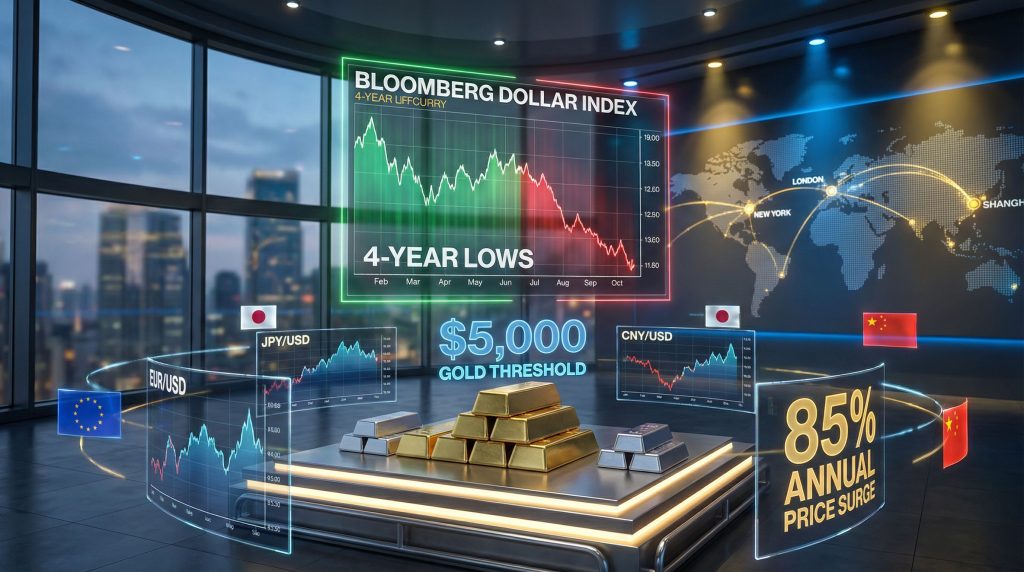
The Bloomberg Dollar Index approaching COVID-era lows provides quantitative context for current weakness levels. Despite the absence of economic crisis conditions comparable to the 2020 pandemic, currency weakness has reached similar magnitude, highlighting the severity of political risk concerns.
Technical Analysis: Dollar Performance Metrics
Political risk premium embedding in exchange rates operates through multiple technical mechanisms:
| Risk Channel | Market Expression | Measurement Method |
|---|---|---|
| Volatility Premium | Options pricing | Implied volatility levels |
| Positioning Risk | Futures markets | CFTC commitment data |
| Forward Discount | Currency swaps | Forward rate spreads |
| Flow Diversification | Central bank reserves | IMF COFER statistics |
Four-year weakness milestone despite stable domestic economy illustrates the disconnect between economic performance and currency valuation. US unemployment rates, GDP growth, and corporate earnings remain within normal ranges, yet currency weakness persists.
This gap between fundamentals and performance quantifies the political risk premium embedded in current exchange rates. Peer currency outperformance across major trading partners demonstrates systematic dollar avoidance rather than relative strength in specific alternatives.
The euro, pound sterling, Japanese yen, and major emerging market currencies have all appreciated against the dollar simultaneously. This suggests broad-based US political risk and dollar weakness rather than strength in particular alternatives.
What Role Does Gold Play as a Political Risk Hedge?
The $5,000 gold threshold serves as an institutional confidence barometer, representing a psychological level that institutional investors monitor for signals about monetary system stability. Gold's 85% annual price surge substantially exceeds typical volatility ranges, indicating systematic rather than speculative buying pressure.
Gold's independence from policy manipulation provides its fundamental appeal during periods of institutional uncertainty. Unlike currencies, which governments can influence through monetary policy, fiscal policy, or direct intervention, gold operates outside political control mechanisms.
This independence becomes increasingly valuable when investors question the predictability or consistency of government economic policy. The strategic importance of gold prices as inflation hedge extends beyond traditional portfolio protection.
Monetary Asset Reallocation Trends
Central bank and sovereign wealth fund accumulation patterns indicate strategic rather than tactical repositioning. These institutions typically execute investment decisions based on multi-year or multi-decade time horizons.
Their gold purchases reflect long-term assessment of monetary system risks rather than short-term speculation. Strategic diversification by institutional investors extends beyond traditional portfolio hedging.
Insurance companies, pension funds, and endowments are increasing precious metals allocations not just as inflation hedges, but specifically as protection against currency system instability. This represents a qualitative change in how institutional money managers assess monetary risk.
The distinction between retail and institutional buying proves crucial for understanding gold's current role. Silver's parallel movement as secondary monetary metal confirms that institutional demand extends beyond gold alone, encompassing precious metals as an asset class serving monetary hedge functions.
Key factors driving institutional precious metals demand include:
• Monetary independence from government policy control
• Historical performance during currency instability periods
• Liquidity characteristics allowing large position adjustments
• Storage and custody infrastructure supporting institutional requirements
• Central bank precedent providing legitimacy for allocation decisions
How Is Dedollarisation Accelerating Under Political Pressure?
Dedollarisation operates as a gradual diversification process rather than sudden collapse scenarios. The transition involves systematic reduction in dollar dependence across multiple economic functions: trade invoicing, reserve holdings, financial market development, and payment system infrastructure.
Trade invoicing shifts to non-dollar currencies occur primarily in bilateral arrangements between countries seeking to reduce dollar exposure. China and Russia have expanded trade settlements in their domestic currencies, while European companies increasingly invoice intra-regional trade in euros.
These changes happen incrementally but represent structural shifts in global trade financing patterns. Reserve composition changes among US allies indicate that even traditionally aligned nations are diversifying currency holdings.
Central banks in developed economies have increased gold reserves and reduced dollar concentration, seeking to balance alliance relationships with financial risk management objectives. The evolving US-China trade war impact accelerates these diversification trends.
SWIFT Transaction Data: Misleading Strength Indicators
The increase in dollar share of SWIFT transactions from approximately 38% to over 50% in recent years creates misleading impressions about dollar adoption patterns. Higher US inflation mechanically lifts nominal dollar transaction values without indicating increased confidence or broader adoption of dollar-denominated trade.
Several factors distort SWIFT data interpretation:
| Distortion Factor | Impact on Data | Reality Check |
|---|---|---|
| Inflation effects | Inflates nominal transaction values | Real trade volumes may be stable |
| Crisis repatriation | Temporary settlement spikes | Driven by risk-off positioning |
| Legacy conventions | Slow invoicing changes | Marginal flows diversify elsewhere |
| Settlement concentration | Technical dollar routing | Not indicative of currency preference |
Crisis-driven repatriation inflating settlement volumes occurs during periods of geopolitical stress when investors liquidate international positions. They repatriate capital through dollar channels, creating temporary spikes in dollar settlement activity that do not reflect underlying demand for dollar-denominated investments.
Asian currency strength and emerging market indices at records demonstrate that dedollarisation benefits specific currency blocs. Asian currencies collectively have reached multi-year highs against the dollar, while emerging market currency indices have achieved record levels.
This indicates systematic capital flows toward dollar alternatives. Real trade-weighted dollar decline despite SWIFT dominance reveals the distinction between settlement activity and currency preference.
The next major ASX story will hit our subscribers first
What Are the Economic Consequences of Currency Politicisation?
Currency politicisation creates fundamental trade-offs between short-term competitive advantages and long-term financial stability. Export competitiveness versus financial market confidence represents the central tension facing policymakers who consider currency intervention as an economic tool.
Tariff retaliation fragmenting trade relationships operates through multiple channels that ultimately weaken currency demand. When trading partners implement retaliatory tariffs, they simultaneously seek alternative payment and settlement mechanisms, reducing structural demand for dollars in international commerce.
The economic consequences manifest across several dimensions:
• Borrowing cost increases as investors demand higher yields for political risk
• Capital flow volatility as international investors hedge currency exposure
• Trade relationship instability affecting long-term commercial partnerships
• Inflation expectation uncertainty complicating monetary policy effectiveness
Federal Reserve credibility erosion raising borrowing costs occurs when markets question the Fed's ability to maintain independent monetary policy. If investors believe political pressure will influence interest rate decisions, they demand additional compensation for uncertainty about future monetary policy direction.
Comparative Analysis: Policy Tools and Market Reactions
Different policy approaches generate distinct market reactions with varying short-term benefits and long-term risks:
| Policy Approach | Immediate Market Impact | Long-term Institutional Risk |
|---|---|---|
| Currency intervention hints | 2-5% dollar weakness | Reserve status credibility damage |
| Fed pressure campaigns | 0.25-0.50% rate speculation | Central bank independence erosion |
| Universal tariff implementation | Export sector support | Trade relationship fragmentation |
| Fiscal expansion | GDP growth stimulus | Debt sustainability questions |
Inflation expectation anchoring risks emerge when monetary policy credibility weakens. The Federal Reserve's ability to maintain stable long-term inflation expectations depends on market confidence in Fed independence.
Political pressure on monetary policy decisions undermines this anchoring mechanism, potentially leading to higher long-term interest rates. Investors demand compensation for inflation uncertainty when US political risk and dollar weakness intersect.
How Do International Partners Respond to US Policy Unpredictability?
Allied nation hedging strategies against dollar exposure have evolved from theoretical contingency planning to active portfolio management. European central banks have increased gold reserves while reducing dollar concentration, seeking balance between alliance relationships and financial stability objectives.
Euro strength driven by relative stability perceptions reflects market preference for predictable policy frameworks over absolute economic performance. Despite economic challenges within the Eurozone, the euro has strengthened against the dollar as investors value institutional predictability over growth differentials.
Asian currency bloc formation tendencies manifest through expanded currency swap agreements and bilateral trade settlement arrangements. Central banks in the region have established mechanisms for conducting trade without dollar intermediation, creating infrastructure for reduced dollar dependence.
International responses follow several patterns:
- Diversification of reserve holdings toward gold and alternative currencies
- Development of non-dollar payment systems for bilateral trade
- Expansion of currency swap networks providing dollar alternatives
- Strengthening of regional financial institutions reducing dependence on dollar-based systems
Commodity pricing diversification initiatives represent another dimension of international response to US policy uncertainty. Major commodity producers are exploring pricing mechanisms in currencies other than dollars, particularly for energy and agricultural products traded primarily within specific regions.
According to recent analysis by Reuters, this diversification trend reflects deeper concerns about US political risk and dollar weakness continuing into the medium term.
What Historical Parallels Exist for Reserve Currency Transitions?
Sterling's gradual decline post-World War II provides the most relevant historical parallel for understanding reserve currency transitions. The British pound maintained reserve status for decades after Britain's economic dominance ended, demonstrating that reserve currency transitions occur slowly through incremental diversification rather than sudden collapse.
The Bretton Woods system breakdown in 1971 illustrates how institutional frameworks can unravel when political objectives conflict with monetary system stability. President Nixon's decision to suspend gold convertibility prioritised domestic economic objectives over international monetary system stability, fundamentally altering global currency arrangements.
Multi-polar currency system emergence patterns historically develop through three phases:
• Initial diversification as market participants seek alternatives to dominant currency
• Infrastructure development creating technical capability for alternative settlement
• Network effects reaching critical mass for widespread adoption
Historical analysis reveals that reserve currency transitions typically span multiple decades, with the declining currency retaining significant market share throughout the transition period. However, political risk can accelerate these transitions when institutional credibility erodes rapidly.
Can Dollar Dominance Recover from Political Risk Concerns?
Institutional reform requirements for confidence restoration involve rebuilding the predictable policy framework that historically supported dollar dominance. This requires demonstrable commitment to central bank independence, fiscal discipline, and policy consistency across electoral cycles.
Federal Reserve independence restoration pathways include both formal and informal mechanisms. Formal approaches involve legislative reinforcement of Fed autonomy, while informal approaches require political restraint in public commentary about monetary policy decisions.
Market confidence requires evidence that monetary policy operates according to economic criteria rather than political objectives.
Recovery Scenarios and Market Implications
Short-term volatility versus structural decline assessment depends primarily on institutional reform implementation. Currency markets can recover quickly from temporary political uncertainty, but structural credibility damage requires longer rebuilding periods.
Recovery scenario analysis reveals several potential pathways:
"Rapid Recovery Scenario: Policy uncertainty resolves through institutional reform demonstration, restoring confidence within 12-18 months as markets observe consistent policy implementation"
"Gradual Recovery Scenario: Institutional credibility rebuilds slowly over 3-5 years as new policy frameworks demonstrate durability through multiple electoral cycles"
"Structural Decline Scenario: Political risk premium becomes permanently embedded as policy unpredictability persists, leading to multi-year diversification away from dollar dependence"
Alternative reserve currency development timelines typically require decades for full implementation. The infrastructure supporting global dollar usage developed over 80 years and cannot be rapidly replicated.
However, cryptocurrency adoption in international settlements could potentially accelerate transition timelines by providing technical infrastructure that bypasses traditional currency system development requirements.
Policy predictability as competitive advantage emerges as the crucial factor distinguishing recovery scenarios. Countries that maintain consistent institutional frameworks gain relative advantage when others experience governance uncertainty, creating incentives for policy stability that extend beyond domestic considerations.
As noted by Bloomberg's analysis, official statements regarding dollar policy continue to influence market perceptions significantly.
What Investment Strategies Address Currency Political Risk?
Portfolio diversification across currency blocs represents the primary institutional response to political risk concerns. Rather than concentrating in single currencies, investment strategies now emphasise geographic and institutional diversification to reduce exposure to any single government's policy decisions.
Precious metals allocation for monetary uncertainty serves multiple portfolio functions beyond traditional inflation hedging. Gold and silver provide exposure to monetary assets independent of government policy, offering protection specifically against currency system instability rather than general economic volatility.
Effective political risk hedging strategies incorporate several elements:
• Multi-currency exposure reducing dependence on single monetary policy decisions
• Real asset allocation protecting against currency debasement scenarios
• Geographically diversified equities providing currency exposure through international business operations
• Commodity exposure offering protection against monetary system instability
Emerging market exposure for dollar alternative positioning allows investors to benefit from dedollarisation trends while maintaining exposure to growing economies. Emerging market currencies and equity markets have reached record highs as capital flows seek alternatives to dollar-denominated assets.
Real asset positioning against debasement risks includes infrastructure, real estate, and commodity investments that maintain value independent of currency fluctuations. These assets provide protection against scenarios where currency weakness accelerates beyond current levels.
The investment framework for political risk management requires balancing protection against currency system instability with participation in economic growth. This balance shapes portfolio construction toward assets and geographies that offer both defensive characteristics and growth potential in a multi-polar currency environment.
Disclaimer: The analysis presented reflects current market conditions and political developments as of the publication date. Currency markets and political situations evolve rapidly, and future developments may differ significantly from current trends. Investment decisions should consider individual circumstances and risk tolerance. Political risk assessments involve inherent uncertainty about future policy directions and market responses.
Looking to Capitalise on Currency-Driven Market Opportunities?
Discovery Alert's proprietary Discovery IQ model delivers real-time alerts on significant ASX mineral discoveries, helping investors navigate volatile markets driven by political uncertainty and currency fluctuations. As traditional forex patterns shift, smart investors are positioning themselves in alternative assets and sectors that can thrive during periods of dollar weakness and dedollarisation trends.