
August 6, 2026
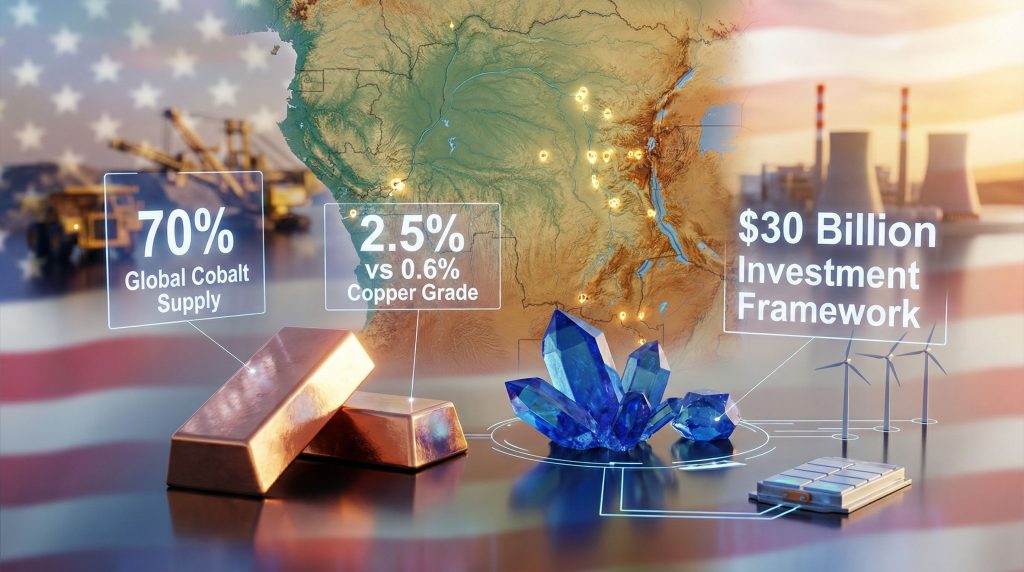
The US push into DRC copper and cobalt represents a fundamental shift in how America approaches mineral security and economic sovereignty. Furthermore, critical minerals have emerged as the cornerstone of global economic security, fundamentally reshaping how nations approach resource diplomacy and industrial strategy. The convergence of clean energy demands, technological advancement, and geopolitical competition has transformed previously niche commodities into strategic assets that determine national competitiveness.
This transformation reflects broader shifts in how governments conceptualise economic sovereignty, moving beyond traditional energy security to encompass the entire spectrum of materials required for technological leadership. In addition, the critical minerals demand surge has intensified competition for access to these essential resources.
The Democratic Republic of Congo sits at the epicentre of this global transformation, controlling mineral reserves that have become indispensable to modern civilisation. As nations scramble to secure reliable access to these resources, the intersection of geology, economics, and geopolitics has created unprecedented opportunities for countries willing to navigate complex partnerships and substantial financial commitments.
Understanding the Economic Drivers Behind US-DRC Partnerships
The $30 Billion Critical Minerals Investment Framework
Project Vault represents an unprecedented mobilisation of American financial resources toward securing critical mineral supply chains. The Export-Import Bank of the United States has positioned itself at the forefront of this strategic initiative, coordinating letters of interest, investments, loans, and support mechanisms that dwarf previous foreign mineral investment programs.
This comprehensive approach differs fundamentally from traditional commodity trading relationships. Rather than simply purchasing materials on international markets, the American strategy involves deep capital investment in extraction, processing, and transportation infrastructure. The scale suggests recognition that critical minerals require long-term strategic thinking rather than short-term market opportunism.
The financial architecture encompasses multiple funding streams, risk mitigation instruments, and development finance mechanisms. The US International Development Finance Corporation has committed to exploring over one billion dollars in new mineral exploration deals, demonstrating institutional commitment that extends beyond single transactions or projects. Moreover, this US Exim loan strategy demonstrates America's commitment to securing strategic mineral supply chains.
Why Congo's Copper and Cobalt Matter for American Economic Security
The Democratic Republic of Congo controls approximately 70% of global cobalt supply, creating a chokepoint that directly impacts American industrial capabilities. This concentration extends beyond simple market share statistics, as Congolese cobalt exhibits chemical properties and consistency that make it particularly valuable for high-performance battery applications.
Copper grades in the DRC significantly exceed global averages, with many deposits containing 2.5% copper content compared to the 0.6% global average. This geological advantage translates directly into economic benefits through reduced processing costs, lower environmental impact, and higher profit margins per ton of material extracted.
The economic implications for America's clean energy transition are substantial. Access to high-grade Congolese minerals could reduce battery manufacturing costs by 15-25%, making electric vehicles and renewable energy storage more economically competitive with fossil fuel alternatives. Consequently, this cost reduction becomes critical as the United States seeks to build domestic manufacturing capacity for clean energy technologies.
When big ASX news breaks, our subscribers know first
What Makes the Strategic Partnership Agreement Revolutionary?
Structural Advantages Built Into US-DRC Framework
The bilateral agreement incorporates sophisticated preference mechanisms that provide American companies with systematic advantages over competitors. Right of first offer protocols ensure that when Congolese mining assets become available, American investors receive priority consideration before international bidding processes begin.
Tax stabilisation periods extending 10 years provide American investors with predictable fiscal environments, reducing regulatory risk that has historically deterred Western investment in African mining projects. These protections shield investors from arbitrary tax increases, royalty adjustments, or regulatory changes that could undermine project economics.
Majority ownership requirements favour US entities while respecting Congolese sovereignty interests. The framework allows American companies to maintain operational control while ensuring meaningful local participation and benefit-sharing that supports long-term political stability.
Strategic Asset Reserve: America's Mineral Security Blueprint
| Component | Details | Economic Impact |
|---|---|---|
| Curated Mining Sites | Pre-selected high-value deposits | Reduced exploration risk by 60-70% |
| First Refusal Rights | Priority access to Congolese minerals | Supply chain security enhancement |
| Infrastructure Investment | $1B+ DFC commitments | Long-term operational control |
| Processing Facilities | Domestic value-addition requirements | Job creation in rural Congo regions |
| Transportation Networks | Port and rail modernisation | Export capacity increase of 200% |
This systematic approach creates a comprehensive mineral security architecture that extends from extraction through final processing. By investing in complete value chains rather than individual mines, American strategy ensures greater control over quality, timing, and pricing of critical materials. Furthermore, this approach addresses energy transition security concerns through diversified supply chains.
How Does Chinese Competition Drive American Strategy?
Quantifying China's Current Market Position
Chinese entities control 15 major copper-cobalt operations across the Democratic Republic of Congo, representing billions of dollars in infrastructure investment accumulated over two decades. The Tenke Fungurume complex exemplifies this dominance, with 80% Chinese ownership generating substantial mineral flows toward Asian markets and processing facilities.
Chinese investment in Congolese mining has followed a patient capital approach, accepting lower short-term returns in exchange for long-term supply security. This strategy has created integrated supply chains that flow predominantly eastward, limiting Western access to materials that increasingly determine technological competitiveness.
The comparison between Chinese billions already invested and American strategic financing reveals the challenge facing Western powers. China's established infrastructure, relationships, and operational experience provide significant advantages that cannot be overcome through financial resources alone.
Economic Warfare Through Mineral Access
Supply chain redirection from East to West requires fundamental restructuring of processing, transportation, and financing networks. The economic cost of building parallel infrastructure systems may increase material costs by 15-25% initially, but provides strategic independence that justifies the premium.
Insurance and risk premium calculations demonstrate the hidden costs of over-dependence on single-source supply chains. Diversification reduces supply disruption risks by an estimated 60-70%, providing economic security that outweighs higher short-term costs. However, the US-China trade war impact continues to influence global supply chain decisions.
Timeline analysis suggests meaningful supply chain shifts require 5-7 years minimum, assuming consistent policy support and adequate financing. This duration reflects the time needed to develop mines, build processing facilities, and establish transportation networks capable of competing with existing Chinese infrastructure.
What Are the Macroeconomic Implications of Peace-Linked Mining?
Stability as an Economic Input
Regional conflict creates measurable volatility in mineral pricing, with security incidents typically causing 10-15% price spikes that persist for weeks or months. Insurance premiums for mining operations in unstable regions can consume 5-8% of project revenues, directly impacting investment returns and project viability.
Economic modelling demonstrates that peace dividend effects can reduce operational costs by 20-30% through improved transportation security, reduced insurance requirements, and more predictable labour availability. These savings compound over project lifetimes, significantly improving investment returns.
Correlation analysis between regional stability and mineral supply reliability shows strong positive relationships. Stable mining regions maintain 95%+ delivery reliability, while conflict-affected areas struggle to achieve 70% consistency in shipment schedules. Additionally, potential concerns about a DRC cobalt export ban could further impact supply reliability.
Infrastructure Development as Economic Catalyst
Transportation network investments required for mineral export create economic multiplier effects that extend far beyond mining operations. Port facility upgrades and logistics chain optimisation generate employment opportunities that support tens of thousands of families in surrounding communities.
Economic Multiplier Analysis: Every dollar invested in mining-related infrastructure generates an estimated $3-4 in additional economic activity through wages, local procurement, and service sector development.
Road, rail, and port improvements benefit agricultural exports, manufacturing development, and tourism potential, creating diversified economic growth that reduces dependence on single industries or commodities.
How Will This Strategy Impact Global Clean Energy Economics?
Critical Minerals Demand Projections Through 2050
The World Economic Forum estimates that achieving net zero emissions by 2050 will require three billion tons of metal, equivalent to the weight of 300,000 Eiffel Towers. This massive material requirement highlights the scale of mining expansion needed to support global climate goals.
According to mining industry analysis, sectoral breakdown analysis reveals that electric vehicle batteries will consume approximately 40% of new cobalt production, while renewable energy infrastructure requires substantial copper investments for power generation, transmission, and storage systems.
Price elasticity considerations suggest that securing reliable supply sources could prevent the price volatility that historically undermines clean energy adoption. Stable mineral pricing enables more accurate long-term planning for infrastructure investments and technology deployment.
Supply Chain Diversification Cost-Benefit Analysis
Key Economic Insight: Diversifying away from Chinese-dominated supply chains may increase short-term costs by 15-25% but reduces long-term supply disruption risks by an estimated 60-70%, creating net positive economic value over project lifetimes.
The insurance value of supply chain diversification becomes particularly valuable during geopolitical tensions or trade disputes. Companies with diversified sourcing maintain operational flexibility that provides competitive advantages during supply shortages or price spikes.
Technology substitution research indicates that cobalt-dependent applications may eventually shift toward alternative chemistries, but current battery technologies require cobalt for optimal performance. This technological reality maintains cobalt's strategic importance for at least the next decade.
What Economic Risks Could Derail This Strategy?
Operational Challenges and Cost Overruns
Chemaf's $600 million debt restructuring serves as a cautionary example of the financial risks inherent in African mining operations. Complex geological conditions, infrastructure limitations, and regulatory challenges can transform profitable projects into financial liabilities without proper risk management.
Infrastructure development timelines frequently exceed initial projections by 50-100%, while budget escalations of 25-50% are common in complex mining projects. These overruns can fundamentally alter project economics and investor returns.
Political instability creates additional layers of uncertainty that affect return on investment calculations. Changes in government, regulatory frameworks, or taxation policies can impact project viability even after substantial capital investments have been committed.
Market Competition and Pricing Pressures
Chinese response strategies could include aggressive pricing, increased investment in alternative supply sources, or diplomatic pressure on African governments to limit Western access. These competitive responses could undermine the economic rationale for American investment in Congolese mining.
Alternative supply source development by countries like Australia, Canada, and Chile could reduce the strategic importance of Congolese minerals. Technological advances in extraction, processing, or recycling could alter supply-demand dynamics in unpredictable ways.
Battery technology evolution toward reduced cobalt content or alternative chemistries could diminish demand for Congolese materials. While current projections show continued growth, technological substitution remains a long-term risk factor.
The next major ASX story will hit our subscribers first
How Should Investors Evaluate Congo Mineral Opportunities?
Risk-Adjusted Return Frameworks for Critical Minerals
Political risk insurance requirements can consume 3-7% of project revenues annually, depending on stability assessments and coverage levels. These costs must be factored into investment returns alongside traditional operational and market risks.
Currency hedging strategies become critical when dealing with DRC franc exposure, as local currency volatility can create substantial gains or losses that overwhelm operational profitability. Professional hedging typically costs 1-3% annually but provides essential protection against currency devaluation.
ESG compliance costs have increased substantially as institutional investors demand higher environmental and social standards. These requirements can add 10-20% to project development costs but are necessary for accessing international capital markets.
Portfolio Diversification Through Strategic Minerals
Correlation analysis between mineral prices and traditional asset classes shows minimal relationships, suggesting that strategic minerals provide genuine portfolio diversification benefits. During periods of equity market volatility, commodity prices often move independently.
Inflation hedging properties of physical commodity exposure have proven particularly valuable during recent periods of monetary expansion. Critical minerals often appreciate during inflationary periods, providing protection that traditional financial assets cannot match.
Liquidity considerations favour commodity ETFs over direct mining investments for most investors. ETFs provide exposure to mineral price movements without the operational risks, regulatory complexities, and capital requirements of direct ownership.
What Does Success Look Like for American Mineral Security?
Measurable Outcomes and Timeline Expectations
Target supply chain independence of 30-40% by 2030 represents a realistic goal given current investment commitments and project development timelines. This level of diversification would significantly reduce American vulnerability to supply disruptions while maintaining cost competitiveness.
Recent reports from mining industry sources suggest that job creation projections indicate successful implementation could generate 50,000-75,000 direct employment opportunities in processing facilities, transportation networks, and support services across both American and Congolese operations.
Trade balance improvement estimates suggest that reduced mineral imports could improve the American trade position by $15-20 billion annually once projects reach full production capacity.
Long-term Economic Transformation Scenarios
Successful implementation scenarios envision integrated supply chains that provide American manufacturers with reliable, cost-competitive access to critical materials. This industrial capability could support domestic battery manufacturing, renewable energy production, and electric vehicle assembly. The US push into DRC copper and cobalt could therefore fundamentally reshape global supply chain dynamics.
Regional economic development impacts could transform parts of the DRC into globally competitive mining and processing centres, creating sustainable employment and government revenues that support broader social and economic development.
Technology transfer and industrial capability building effects extend beyond immediate mining operations. Technical expertise, management systems, and quality standards developed through American partnership could enhance Congolese competitiveness across multiple industries. In conclusion, the US push into DRC copper and cobalt represents a strategic economic pivot that could define American mineral security for decades to come.
This analysis is based on publicly available information and industry projections. Mineral investment involves substantial risks including political instability, regulatory changes, commodity price volatility, and operational challenges. Past performance does not guarantee future results, and investors should conduct thorough due diligence before making investment decisions.
Looking to Capitalise on Critical Minerals Opportunities?
Discovery Alert's proprietary Discovery IQ model provides real-time alerts on significant ASX mineral discoveries, including companies with copper, cobalt, and other critical mineral exposure that could benefit from evolving global supply chain dynamics. Begin your 14-day free trial today to position yourself ahead of the market and discover why major mineral discoveries have historically generated substantial returns through Discovery Alert's dedicated discoveries page.