August 4, 2026
When Diplomacy Moves Oil: Understanding the Multi-Variable Stakes of the US Qatar Iran Draft Deal
Energy markets rarely move on fundamentals alone. When geopolitical architecture shifts, crude prices often respond faster than physical supply can adjust, creating windows where sentiment outpaces reality by weeks or months. The current diplomatic momentum surrounding the US Qatar Iran draft deal represents exactly this kind of inflection point: a framework where market psychology, supply arithmetic, and regional power dynamics are all pulling in different directions simultaneously.
Understanding what this deal actually means for oil prices, refining margins, and global supply chains requires separating the diplomatic signal from the physical market reality. For a broader crude market overview, the context of trade and geopolitics is essential to understanding how we arrived at this moment.
When big ASX news breaks, our subscribers know first
What the US Qatar Iran Draft Deal Actually Contains
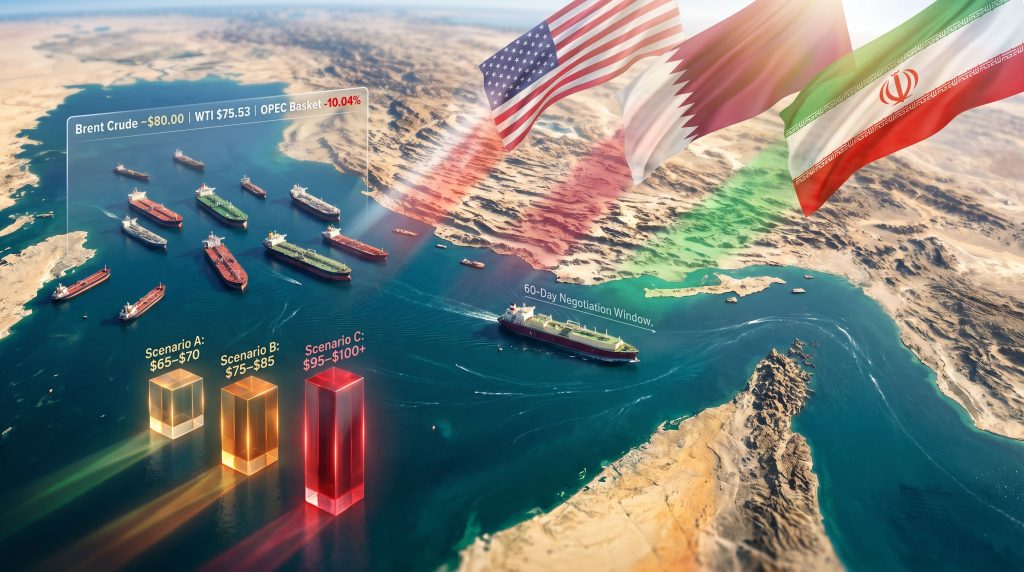
Before assessing market implications, precision about what the draft framework represents is essential. This is not a ratified treaty. It functions as a preliminary memorandum of understanding, establishing conditional commitments from both Washington and Tehran while deferring the most technically complex disputes into a structured 60-day follow-on negotiation window.
The six core pillars reportedly embedded in the draft include:
- A Strait of Hormuz reopening protocol, including a single-corridor arrangement with separate entry and exit lanes discussed between Tehran and Muscat
- Easing of US naval interdiction measures on Iranian ports
- Temporary sanctions relief on Iranian crude exports
- Release of approximately $25 billion in frozen Iranian sovereign assets
- Iran's non-proliferation commitment, specifically the non-acquisition and non-construction of nuclear weapons
- A 60-day structured negotiation period to resolve outstanding disputes on nuclear architecture and sanctions sequencing
The draft framework does not represent a final agreement. It functions as a preliminary memorandum of understanding, with both parties committing to a follow-on negotiation period of approximately 60 days to resolve the most contentious outstanding issues, particularly Iran's nuclear file and the sequencing of sanctions relief.
Qatar has emerged as the primary diplomatic conduit for these indirect talks, with Pakistan playing a secondary intermediary function in the Doha-based process. The choice of Doha as the negotiating venue is not coincidental. Qatar's unique geopolitical positioning — simultaneously a major LNG exporter, host of US Central Command, and a historically trusted interlocutor with Tehran — makes it structurally suited for this role in ways that few other states could replicate. According to reporting from The Guardian, talks have continued to progress through these intermediary channels with notable momentum.
How Crude Markets Priced the Diplomatic Signal
The War Premium Unwind in Real-Time
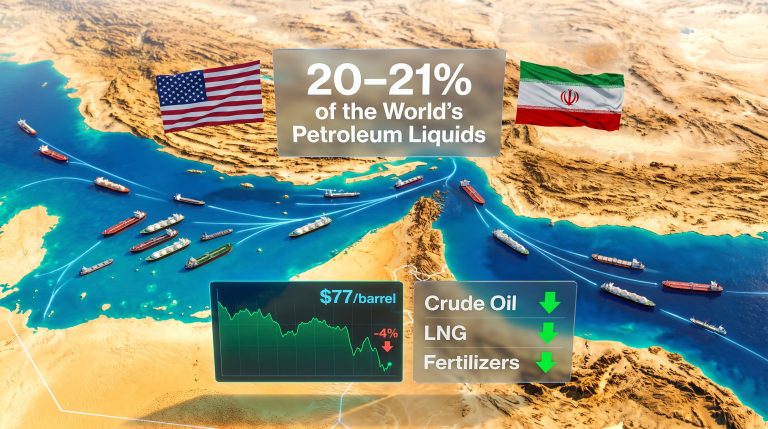
The market reaction to renewed diplomatic signals was swift and broad-based. Crude benchmarks across the board registered sharp single-session declines as traders began unwinding the geopolitical risk premium that had been embedded since conflict erupted in March 2026.
| Benchmark | Price (USD) | Session Change | % Move |
|---|---|---|---|
| Brent Crude | ~$80.00 | -$4.77 | -5.69% |
| WTI Crude | $75.53 | -$4.81 | -5.99% |
| Murban Crude | $76.94 | -$4.11 | -5.07% |
| OPEC Basket | $79.50 | -$8.87 | -10.04% |
| Natural Gas | $2.666 | -$0.115 | -4.14% |
The OPEC Basket's single-session decline of 10.04% stands as one of the largest one-day drops recorded during the current conflict cycle. Brent's retreat to approximately $80 per barrel represents a meaningful compression of the war premium that drove a 20% monthly surge in crude prices during the preceding period.
The Refining Margin Paradox: Why Haven't Consumers Felt Relief?
Here lies one of the most structurally important and least understood dynamics of the current energy market cycle. Lower crude prices have not translated proportionally into consumer fuel cost reductions, and the reason traces directly to refinery economics rather than crude supply.
The 3-2-1 crack spread, an industry metric representing the refinery margin on converting three barrels of crude into two barrels of gasoline and one barrel of distillates, has doubled since early March 2026 to reach $60 per barrel. Over the same period, crude oil prices rose by only $11 per barrel, meaning the vast majority of the consumer fuel price increase was captured at the refinery level, not the wellhead.
Average US retail gasoline reached $4.08 per gallon as of August 4, 2026, reflecting a 30% year-on-year increase. This prompted an unusual political confrontation, with President Trump publicly targeting ExxonMobil and Chevron over their combined $26.5 billion in quarterly earnings, demanding that companies return profits to consumers. This is a politically charged intervention that sits uneasily against the structural reality that refinery margins expanded primarily due to constrained crude throughput, not deliberate pricing strategy.
The divergence between crude price movement and consumer fuel costs reflects a structural refining margin expansion, not simply a supply shock. This distinction is critical for understanding why diplomatic progress on the Iran deal compresses crude prices but may not immediately reduce pump prices for consumers.
Scenario Modelling: Three Pathways and Their Oil Market Consequences
Scenario A: Full Deal Ratification
Under a complete resolution, Hormuz reopens under a jointly monitored single-corridor protocol. Iranian crude re-enters global markets, but the supply recovery arithmetic is sobering. Saudi Aramco's CEO indicated that cumulative lost output since February 2026 equals approximately 2.6 billion barrels, equivalent to roughly one month of total global crude consumption. Even at a recovery rate of 2.1 million barrels per day, full replenishment would require approximately 18 months under ideal conditions.
Brent price trajectory under this scenario could compress toward the $65-$70 range as supply expectations reset, while European natural gas prices, which already fell sharply on Iran reversal signals, would face additional downside pressure.
Scenario B: Partial Agreement with Phased Implementation
This represents the most likely near-term outcome. Hormuz partially reopens under a provisional maritime corridor arrangement, with sanctions relief applied selectively to specific buyers under monitored conditions. Oil markets would likely stabilise in the $75-$85 range as they price partial supply recovery against residual geopolitical uncertainty.
Tanker shipping dynamics would partially improve. Hormuz transits dropped to a two-month low following the targeting of the Liberia-flagged dry bulk tanker Minoan Pioneer, with one seafarer missing. Panama Canal slot auction costs, which surged to a record $2.5 million per Neopanamax slot (with some bids reaching $3.8 million) due to simultaneous Hormuz and Suez disruptions, would moderate but not immediately normalise.
Scenario C: Diplomatic Collapse
A breakdown within the 60-day window would see the war risk premium reassert fully. Six Saudi tankers have already been rerouted around Africa to avoid Houthi threats, and those rerouting constraints are approaching physical capacity limits. ADNOC has already acquired five supertankers to manage Hormuz disruption logistics, signalling that Gulf state operators are actively planning for extended closure scenarios. Brent could re-test the $95-$100+ range under this outcome.
| Scenario | Probability | Brent Range | Hormuz Status | Iranian Supply Recovery |
|---|---|---|---|---|
| A: Full Deal | Lower near-term | $65-$70 | Fully reopened | 18+ months |
| B: Partial Deal | Most likely | $75-$85 | Partially open | Selective, monitored |
| C: Collapse | Elevated tail risk | $95-$100+ | Closed/disrupted | None |
How Global Supply Chains Are Already Adapting
The Rerouting Economy
The physical market has not waited for diplomatic resolution. Adaptive procurement and logistics decisions are already reshaping global crude trade flows in ways that will persist regardless of the deal's outcome. Furthermore, the geopolitical supply risks driving these adaptations extend well beyond the current Iran negotiations:
- India's HPCL has shifted crude procurement toward West African grades, specifically Nigerian crude, to reduce Hormuz dependency
- India is simultaneously expanding strategic oil storage infrastructure in response to supply disruption shocks
- Iraq and Turkey formalised a one-year agreement through the Kirkuk-Ceyhan pipeline, targeting a quadrupling of export flows to 750,000 barrels per day through the Mediterranean as a Hormuz bypass
- Russia's seaborne crude exports dipped below 4 million barrels per day to 3.9 million b/d as Ukrainian drone activity moderated and domestic refinery throughput rebounded to 4 million b/d
- Dark tanker transits at Bab el-Mandeb have surged as Houthi threat dynamics persist
ADNOC's Pricing Architecture Overhaul
One of the least widely reported but structurally significant market developments has been ADNOC's decision to price all crude grades against Platts Dubai from November 1, abandoning its futures-based IFAD Murban mechanism entirely. The commercial rationale is revealing: buyers demanded prompter, more transparent pricing signals during Hormuz disruption, and futures-based mechanisms became operationally impractical under physical market stress. This represents a meaningful shift in Middle Eastern crude pricing architecture and signals how conflict periods can permanently alter market infrastructure.
Insurance Market Realignment
Global insurers are actively redirecting coverage capacity toward oil projects outside the Middle East, with war risk premiums reshaping project economics across the region. This repricing of risk is not simply a short-term adjustment. If it persists, it will influence long-term investment decisions in Middle Eastern upstream development regardless of the conflict's diplomatic resolution.
Qatar's Commercial Interests as a Diplomatic Motivator
Qatar's role as the primary architect of the US Qatar Iran draft deal framework is not purely altruistic. Doha has direct commercial incentives to stabilise the region. Contractors Chiyoda and Technip Energies have resumed construction on Qatar's North Field East LNG expansion, a 32 million tonne per annum megaproject with first volumes anticipated by summer 2027. Regional instability directly threatens the commercial viability of this project and Qatar's broader LNG market positioning.
Additionally, the draft deal reportedly provides Qatar with a monitoring role over implementation compliance through linked financial oversight mechanisms, giving Doha structural influence over the deal's execution beyond its initial mediation function. This is a diplomatically unusual arrangement that elevates Qatar from facilitator to stakeholder in the agreement's success. Indeed, the OPEC production impact from any successful resolution will be closely shaped by how Qatar navigates this dual role.
The next major ASX story will hit our subscribers first
OPEC+ Dynamics: A Potential Double Supply Shock
Seven OPEC+ member nations have agreed to raise collective output targets by 188,000 barrels per day in September 2026, completing the phased unwinding of the 1.65 million barrels per day in voluntary production cuts first announced in 2023. The strategic tension here is significant: OPEC+ is unwinding cuts into a market where diplomatic progress on Iran could simultaneously re-introduce Iranian barrels, creating a potential double supply shock that could push Brent meaningfully below current levels in a full-deal scenario.
Saudi Arabia occupies a paradoxical position within this dynamic. Saudi Aramco's Q2 profits jumped 33% to $33.4 billion, with an average realised barrel price of $108.10, meaning Riyadh's fiscal position remains robust even with production volumes constrained by conflict. This revenue paradox — lower production but significantly higher prices — means Saudi Arabia has limited financial urgency to accelerate Hormuz resolution even as it publicly supports diplomatic efforts.
Corporate Energy Strategy in the Shadow of Hormuz
Major energy companies are not waiting passively for geopolitical resolution. Strategic repositioning is already underway, and the broader oil market disruption from simultaneous geopolitical and trade pressures is accelerating these corporate decisions:
- Shell agreed to sell its European onshore renewables portfolio to TotalEnergies, comprising 0.5 GW of operational assets plus a 3.5 GW development pipeline, in a strategic pivot back toward core hydrocarbon operations
- BP completed the sale of its Gelsenkirchen refinery in Germany to Klesch Group, reducing its European refining footprint and leaving it with five operational refineries across the US and Europe
- BP's Q2 earnings surged to $5.7 billion, reflecting elevated oil prices combined with expanded refining margins
- The political pressure on refinery operators from the Trump administration adds a new variable: if margin compression is forced through political channels, deferred investment in refinery capacity maintenance could create longer-term supply vulnerability that outlasts the current geopolitical episode
The Nuclear Verification Problem: The Hardest Unresolved Issue
Iran's commitment against nuclear weapons acquisition and construction is reported within the draft framework. However, verification mechanisms — not the commitment itself — represent the most technically and politically complex element of the 60-day follow-on negotiations. How inspections are structured, who conducts them, and what triggers constitute violations are questions that have derailed Iran nuclear negotiations repeatedly across multiple prior diplomatic cycles.
Regional actors, particularly Israel and Saudi Arabia, will scrutinise this verification architecture closely. The precedent established by whatever verification regime is agreed will carry implications beyond the immediate deal, influencing regional proliferation dynamics for years.
Syria's parallel diplomatic engagement adds another layer of complexity. The al-Julani-led Syrian government has agreed to drastically reduce Russian crude imports, averaging approximately 60,000 barrels per day in 2026, as part of its own sanctions relief discussions with Washington. This secondary diplomatic track intersects with the Iran framework in ways that could either reinforce or complicate the primary negotiation timeline.
Key Takeaways for Energy Market Participants
- The US Qatar Iran draft deal is a preliminary framework, not a binding resolution. The 60-day negotiation window carries genuine uncertainty and should be treated as a period of elevated volatility, not confirmed normalisation
- Iranian supply recovery will take 18 months or longer even under best-case conditions, meaning near-term price compression from deal optimism may overshoot fundamental supply realities
- The refining margin story is structurally independent of geopolitical resolution. Crack spreads will only normalise when crude throughput recovers sufficiently to reduce refinery utilisation pressure across the system
- OPEC+ cut reversal combined with potential Iranian supply re-entry creates a credible double supply shock risk in a full-deal scenario, with Brent potentially moving toward the $65-$70 range
- Qatar's role extends beyond mediation to stakeholder, giving Doha a unique structural interest in the deal's successful implementation
- Corporate energy majors are already repositioning through asset sales, refinery divestitures, and procurement diversification, signalling a sector recalibrating for a structurally different post-Hormuz-crisis operating environment
Disclaimer: This article is for informational and educational purposes only and does not constitute financial, investment, or legal advice. Energy market forecasts and scenario projections involve inherent uncertainty. Readers should conduct independent research and consult qualified advisors before making investment decisions. All price data and statistics referenced are sourced from publicly available market data as reported by OilPrice.com and associated newswires.
Want to Stay Ahead of the Next Major Market-Moving Discovery?
While geopolitical shifts reshape energy markets, significant mineral discoveries on the ASX can deliver equally dramatic returns — and Discovery Alert's proprietary Discovery IQ model sends real-time alerts the moment these opportunities emerge, turning complex data across 30+ commodities into clear, actionable insights. Explore historic discovery returns on Discovery Alert's dedicated discoveries page and begin your 14-day free trial today to position yourself ahead of the broader market.