
June 22, 2026
Enforcement Architecture Against Cross-Border Energy Networks
Global energy markets operate through intricate webs of financial intermediaries, shipping networks, and regulatory jurisdictions that create both opportunities and vulnerabilities for sanctions enforcement. When examining how US sanctions Chinese entities over Venezuelan oil trade, the Treasury Department's approach reveals sophisticated targeting mechanisms that extend far beyond simple trade restrictions. Furthermore, these enforcement strategies reflect broader patterns seen in US-China global trade impact across multiple sectors.
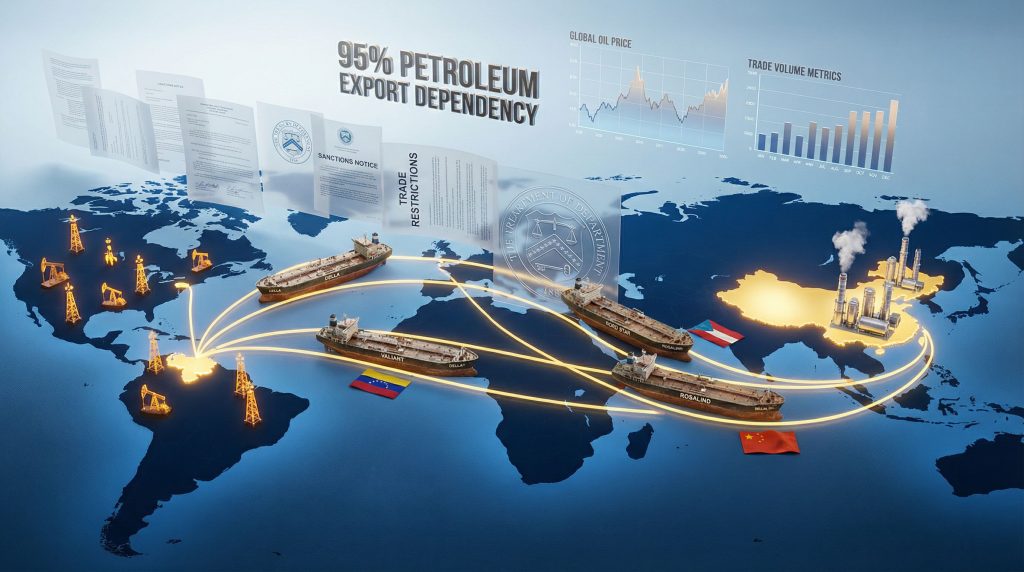
The Office of Foreign Assets Control employs a multi-layered enforcement strategy centered on its Specially Designated Nationals list, which serves as the primary legal mechanism for asset freezes and transaction prohibitions. On January 1, 2026, OFAC designated four companies with Venezuelan oil connections: Zhejiang-based Corniola Ltd., Hong Kong-based Aries Global Investment Ltd., Krape Myrtle Co., and Winky International Ltd., alongside four associated vessels including the Della, Nord Star, Rosalind, and Valiant.
This targeting approach demonstrates how sanctions enforcement has evolved beyond traditional state-to-state measures toward network-based disruption strategies. The designation of specific vessels alongside their controlling entities creates operational chokepoints that force entire shipping networks to restructure their activities or face asset seizure. Financial institutions processing transactions for sanctioned entities face secondary sanctions exposure, creating ripple effects throughout international banking systems that extend enforcement reach beyond direct US jurisdiction.
Maritime Infrastructure as Enforcement Leverage Points
Modern sanctions architecture recognizes that maritime assets represent critical infrastructure nodes that cannot easily relocate or disguise their operations. The targeting of vessels like the Rosalind, which specializes in short-haul coastal operations known as cabotage, illustrates how enforcement officials identify specific operational roles within broader evasion networks.
Ship-tracking data reveals significant gaps in maritime surveillance capabilities, with only one of the four newly sanctioned vessels showing recent proximity to Venezuelan waters according to transponder records. This enforcement challenge highlights how vessels can operate without transmitting automatic identification system data, effectively disappearing from standard monitoring systems during critical operational phases.
The complexity of vessel ownership structures adds additional enforcement challenges. Aries Global Investment Ltd., based in Hong Kong, controls multiple sanctioned vessels operating under different flag states, demonstrating how single entities can manage geographically dispersed maritime assets through corporate holding arrangements. This structure requires sanctions officials to designate both holding companies and individual vessels to achieve comprehensive network disruption.
When big ASX news breaks, our subscribers know first
Strategic Dependencies in Global Oil Markets
Venezuela's economic structure creates unique vulnerabilities that shape both sanctions enforcement strategies and evasion responses. With petroleum exports representing approximately 95 percent of government revenue, any disruption to oil trade directly impacts state fiscal capacity and regime stability. This dependency relationship makes Venezuela particularly susceptible to maritime enforcement but also creates powerful incentives for sophisticated circumvention efforts. In addition, these dynamics intersect with broader OPEC production dynamics affecting global energy markets.
China's role as Venezuela's primary oil customer reflects broader strategic considerations beyond simple commercial relationships. Chinese refiners, particularly independent "teapot" facilities that account for approximately one-fifth of China's total refining capacity, have maintained Venezuelan crude purchases despite sanctions risks. These facilities offer operational flexibility that state-owned refineries cannot provide, creating structural demand for discounted Venezuelan supplies regardless of official policy positions.
Evolution of Chinese Import Patterns
Chinese engagement with Venezuelan oil markets demonstrates how sanctions reshape but do not eliminate trade relationships. While China officially ceased Venezuelan crude imports following 2019 US sanctions, unofficial channels maintained supply flows through product reclassification schemes. Venezuelan crude was frequently disguised as bitumen mix in shipping documents and customs declarations, exploiting the legitimate bitumen trade to mask sanctioned petroleum movements.
The resumption of official Chinese imports in February 2024 after a five-year interruption suggests that sanctions create temporary compliance periods rather than permanent trade cessation. This pattern indicates that Chinese entities view sanctions as operational costs rather than absolute prohibitions, adjusting their activities based on enforcement intensity and geopolitical considerations.
| Import Pattern | Timeline | Mechanism | Volume Impact |
|---|---|---|---|
| Official imports | 2019-2024 | Complete cessation | Documented zero flows |
| Unofficial channels | 2019-2024 | Bitumen disguise | Estimated continued supply |
| Resumed imports | February 2024+ | Direct purchases | Return to official channels |
Private Chinese refiners operate with different risk tolerances than state-owned enterprises, creating market segments that absorb Venezuelan crude regardless of sanctions pressure. These "teapot" refineries lack the diplomatic exposure of state entities but possess processing capabilities that make them reliable customers for heavy crude varieties like Venezuelan petroleum.
Shadow Fleet Operations and Maritime Evasion Techniques
The emergence of shadow fleet operations represents a fundamental adaptation to sanctions enforcement that transforms how illicit oil trade functions in international waters. These networks employ sophisticated evasion techniques that exploit gaps in maritime monitoring systems and international jurisdiction frameworks. Consequently, the effectiveness of Trump tariffs implications becomes limited when dealing with such complex evasion networks.
Transponder manipulation stands as the primary technical method for avoiding detection during critical operational phases. Vessels can deactivate automatic identification systems during ship-to-ship transfers or while entering restricted waters, effectively creating surveillance blackouts that prevent enforcement agencies from tracking movements in real-time. The Treasury Department's acknowledgment that sanctioned vessels may have "traveled without sending transponder data" reveals official recognition of these capability gaps.
Corporate Structure Obfuscation Methods
Shadow fleet operators employ complex corporate arrangements that distribute ownership across multiple jurisdictions to complicate enforcement targeting. The involvement of Hong Kong-based Aries Global Investment Ltd. in controlling vessels flagged under different states demonstrates how single entities can manage international shipping networks while maintaining legal distance from sanctioned activities.
Flag state selection provides additional operational advantages for evasion networks. Vessels operating under Panama, Guinea, and other flag-of-convenience jurisdictions can exploit regulatory arbitrage opportunities where enforcement capabilities vary significantly between different maritime authorities. This jurisdiction shopping allows operators to position their assets under regulatory frameworks that provide maximum operational flexibility and minimum enforcement scrutiny.
Recent enforcement operations reveal both the capabilities and limitations of interdiction efforts. According to official Treasury statements, US forces intercepted two carriers in recent weeks while a third vessel retreated to the Atlantic Ocean when pursued, demonstrating that physical enforcement can achieve tactical successes but cannot comprehensively monitor vast ocean areas where transfers typically occur.
Enforcement Reality: The intersection of maritime surveillance limitations and sophisticated evasion techniques creates persistent gaps in sanctions compliance that require constant adaptation of both enforcement methods and regulatory frameworks.
Geopolitical Escalation and Regional Security Implications
The expansion of enforcement operations beyond traditional sanctions mechanisms signals a fundamental shift toward militarised responses that carry significant escalation risks. Recent operations demonstrate how economic enforcement has evolved into coordinated military campaigns involving multiple US agencies and operational domains. However, these developments also contribute to broader trade war supply chain effects across global markets.
Military strikes against Venezuelan coastal facilities represent the most significant escalation in enforcement methodology. Confirmed strikes on loading docks used for alleged narco-trafficking operations mark the first time US forces have targeted fixed infrastructure within Venezuelan territory rather than limiting operations to vessel interdiction in international waters. This operational expansion creates new precedents for sanctions enforcement that blur traditional boundaries between economic measures and military action.
Multi-Agency Coordination Mechanisms
The integration of Treasury Department sanctions with CIA drone operations and Coast Guard interdiction activities demonstrates unprecedented coordination across traditionally separate enforcement domains. Recent CIA strikes targeting Tren de Aragua organisation infrastructure indicate that counterterrorism, counternarcotics, and sanctions enforcement have merged into unified operational campaigns.
Chinese diplomatic responses characterise US enforcement operations as "unilateral bullying" that violates international law, creating friction that extends beyond bilateral US-China relations to implicate broader questions about sanctions authority and maritime enforcement jurisdiction. These characterisations suggest that China views the enforcement regime as exceeding legitimate regulatory authority, potentially justifying countermeasures or non-compliance responses.
The operational evolution from vessel interdiction to facility strikes demonstrates how sanctions enforcement can escalate beyond economic measures toward direct military confrontation. As reported by Reuters, US Southern Command documented multiple recent operations that resulted in casualties, including strikes that killed three individuals on December 30 and five additional people in subsequent operations.
Market Dynamics and Price Discovery Mechanisms
Sanctions enforcement creates complex market dynamics that reshape pricing mechanisms, supply chain structures, and risk assessment frameworks throughout global oil markets. The continued viability of Venezuelan oil trade despite extensive enforcement efforts reveals how market forces adapt to regulatory constraints through sophisticated pricing and logistics arrangements. For instance, these dynamics significantly influence oil price movements analysis across international markets.
Risk premiums incorporated into Venezuelan crude pricing reflect the operational costs of evasion activities, including vessel charter rates for sanctions-exposed shipping, insurance coverage gaps, and transaction processing fees for specialised financial services. However, the persistence of trade activity suggests that these premium costs remain below the economic advantages that Venezuelan heavy crude offers to Chinese refiners seeking feedstock diversity.
Supply Chain Restructuring Effects
The requirement for product disguise mechanisms, such as bitumen reclassification, creates additional processing and documentation costs that flow through to end-user pricing. These administrative costs represent dead-weight economic losses that reduce overall trade efficiency while generating no productive value for market participants.
Alternative routing requirements force Venezuelan exports through longer shipping distances and indirect pathways that increase transportation costs and delivery timeframes. The use of ship-to-ship transfers in remote ocean locations adds operational complexity and weather-related risks that traditional direct-delivery arrangements avoid.
Insurance market responses create additional structural challenges for sanctions evasion networks. Traditional maritime insurance coverage excludes sanctioned activities, forcing shadow fleet operators to either self-insure their vessels or seek coverage through specialised insurers willing to accept sanctions exposure at premium rates.
Compliance Architecture for International Market Participants
The complexity of modern sanctions regimes creates substantial compliance burdens for international companies operating in global energy markets, even those with no direct Venezuelan exposure. Enhanced due diligence requirements extend throughout supply chains and financial networks, creating operational costs that affect all market participants.
Vessel screening protocols require shipping companies to maintain sophisticated database systems that cross-reference vessel identification numbers, ownership structures, and operational histories against multiple sanctions lists maintained by different jurisdictions. These systems must update continuously as new designations occur and existing entries modify their corporate structures or operational patterns.
Technology Integration Requirements
Financial institutions face particularly complex compliance challenges that require integration of transaction monitoring systems with sanctions screening databases and beneficial ownership registries. The involvement of Hong Kong and mainland Chinese entities in Venezuelan oil trade creates specific risks for banks processing transactions that may appear legitimate but involve sanctioned counterparties through indirect ownership structures.
Supply chain transparency obligations extend beyond direct contractual relationships to encompass entire logistics networks, including intermediate storage facilities, ship-to-ship transfer operators, and documentation service providers. Companies must demonstrate that their Venezuelan oil exposure occurs through compliant channels rather than shadow fleet operations.
The dynamic nature of sanctions designations requires real-time monitoring capabilities that can identify when previously compliant counterparties become sanctioned entities. The January 1, 2026 designations of Aries Global Investment Ltd. and associated vessels demonstrate how compliance status can change without advance warning, creating retroactive exposure risks for ongoing transactions.
The next major ASX story will hit our subscribers first
Future Evolution of Enforcement Mechanisms
The trajectory of current enforcement operations suggests several potential escalation pathways that could fundamentally reshape how sanctions function in global energy markets. The integration of military capabilities with traditional economic enforcement creates precedents for expanded operational authorities that extend beyond Venezuelan-specific applications.
Technological advancement in maritime surveillance systems may reduce the effectiveness of current evasion techniques, particularly transponder manipulation and ship-to-ship transfer operations in remote ocean areas. Satellite-based tracking systems and artificial intelligence analysis of shipping patterns could provide enforcement agencies with enhanced detection capabilities that close existing surveillance gaps.
Multilateral Coordination Potential
The expansion of sanctions enforcement to target Chinese entities creates opportunities for coordination with allied nations that maintain their own sanctions regimes against Venezuelan oil trade. European Union and United Kingdom sanctions frameworks could complement US enforcement efforts through coordinated designations and information sharing arrangements.
However, the characterisation of current enforcement operations as violations of international law by Chinese officials suggests that escalation could generate diplomatic costs that outweigh enforcement benefits. The risk of retaliatory measures against US companies operating in Chinese markets creates economic incentives for calibrated enforcement that avoids triggering broader trade conflicts.
Alternative de-escalation pathways might involve humanitarian exemptions for essential supplies or multilateral dialogue frameworks that address underlying political disputes rather than focusing exclusively on enforcement mechanisms. Regional stability initiatives involving neighbouring countries could provide political solutions that reduce the economic incentives driving sanctions evasion activities.
Long-Term Strategic Implications for Global Energy Security
The current enforcement campaign against Venezuelan oil exports creates precedents that extend beyond bilateral US-Venezuela relations to implicate broader questions about how sanctions function in globally integrated energy markets. The targeting of Chinese entities demonstrates how sanctions can become tools for broader geopolitical competition rather than focused policy instruments.
Energy market restructuring effects may accelerate global diversification away from concentrated supply sources that create sanctions vulnerabilities. Chinese refiners may develop alternative heavy crude suppliers to reduce Venezuelan dependency, while Venezuelan revenue sources may shift toward non-energy exports or digital payment systems that circumvent traditional financial monitoring.
The operational success of shadow fleet networks demonstrates the limitations of traditional regulatory enforcement in globalised markets where sophisticated actors can exploit jurisdictional gaps and technological limitations. This reality suggests that effective sanctions enforcement may require fundamental changes to international maritime law and financial oversight mechanisms.
In conclusion, the enforcement of US sanctions Chinese entities over Venezuelan oil represents a significant evolution in how economic penalties function within complex international networks. The operational challenges revealed through current enforcement efforts highlight both the capabilities and constraints of traditional sanctions mechanisms in addressing sophisticated evasion strategies.
Disclaimer: This analysis is based on publicly available information and should not be construed as investment advice or legal guidance. Sanctions regulations change frequently and require consultation with qualified legal counsel for compliance decisions. The situations described involve ongoing legal and political developments that may evolve significantly.
Looking to Capitalise on Energy Market Volatility?
Discovery Alert's proprietary Discovery IQ model provides instant notifications on significant ASX mineral discoveries, including energy-related opportunities that emerge during periods of geopolitical uncertainty and sanctions-driven market restructuring. Explore how major mineral discoveries have delivered exceptional returns for investors who positioned themselves ahead of broader market recognition, and begin your 30-day free trial today to gain an actionable advantage in volatile energy markets.