June 26, 2026
The Refinery as a Weapon: How Gold Processing Infrastructure Enables Conflict Finance in Central Africa
Most discussions about conflict minerals focus on the mines themselves, the armed groups that control them, and the civilians caught in between. Far less attention lands on the critical commercial infrastructure that sits between a rebel-held mine and a legitimate global commodity market. Refineries occupy that precise chokepoint, and it is why the US sanctions Rwandan refinery in Congo gold smuggling network designation on June 25, 2026, targeting Gasabo Gold Refinery Ltd., represents a calculated escalation in how Western regulators are choosing to fight the illicit mineral trade.
The decision to target the processing node, rather than just the armed group extracting the ore, reflects a maturing enforcement philosophy. Armed groups are difficult to isolate financially when their revenues flow through seemingly legitimate commercial entities. Close the refinery, and you collapse the laundering interface between conflict zones and international markets. That is the logic now driving US sanctions strategy in the Great Lakes region.
When big ASX news breaks, our subscribers know first
Rwanda's Gold Paradox: A Nation Exporting What It Does Not Mine
Rwanda's geography and geology make its status as a gold export powerhouse structurally implausible. The country possesses negligible domestic gold reserves, yet for several years it ranked among Central Africa's most significant gold exporters by value. This anomaly is not accidental; it is the product of a deliberate cross-border mineral absorption system.
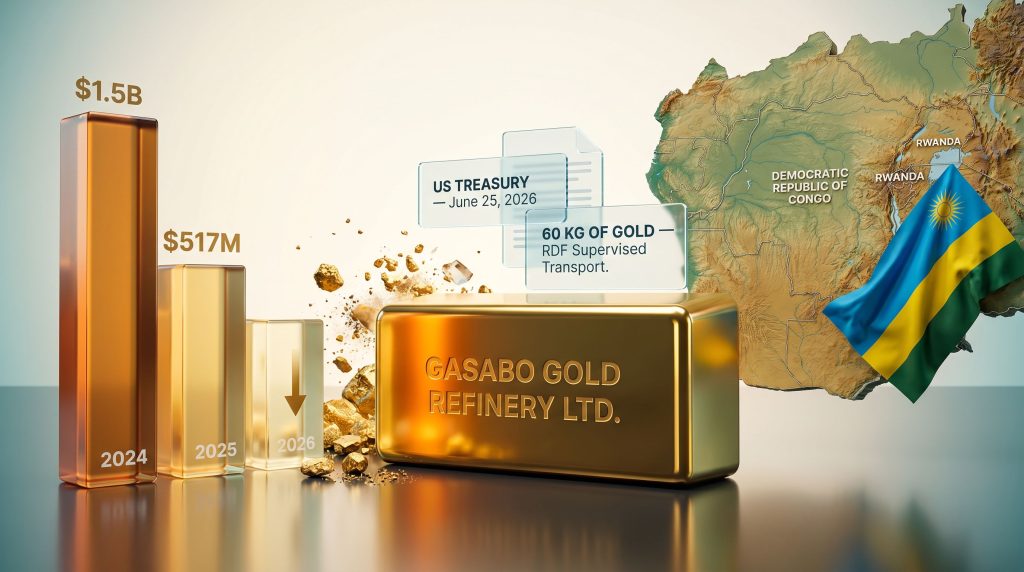
Before coordinated international intervention, the IMF projected Rwanda was on course to export more than $2 billion in gold in a single year. That figure collapsed dramatically after the European Union sanctioned Gasabo in March 2025 for processing smuggled gold from rebel-controlled mines in eastern DRC. Rwanda's gold exports fell to $517 million in 2025, representing approximately one-fifth of total national export earnings, down from $1.5 billion the prior year.
The $983 million year-on-year decline is one of the most acute commodity export contractions in Rwanda's recent history, and it came before the United States added its own designation layer. The arithmetic alone tells the story: a country with little gold in the ground cannot legitimately export billions of dollars worth of the metal unless it is sourcing from somewhere else.
"The structural impossibility of Rwanda's pre-sanction gold export volumes, measured against its known domestic reserve base, constitutes perhaps the most publicly visible indicator of how deeply embedded the illicit supply chain had become."
Furthermore, understanding the broader gold market outlook helps contextualise how illicit supply chains distort legitimate price discovery and market integrity across the region.
Anatomy of the June 2026 Sanctions Package
The US Treasury Department's action on June 25, 2026 drew on authority under Executive Order 13413, which empowers Washington to designate entities whose conduct threatens the peace, security, or stability of the Democratic Republic of Congo. The designation blocked all US-held assets and property interests of the named parties and prohibited any US person or institution from transacting with them.
The package was deliberately structured to reach across the full corporate network connected to the refinery, not just the facility itself. The simultaneous designations covered:
| Sanctioned Entity | Role in the Network |
|---|---|
| Gasabo Gold Refinery Ltd. | Primary gold processing and laundering node |
| Jean Malic Kalima | Chairman of Gasabo Gold Refinery |
| Gasabo General Manager | Operational oversight of refinery |
| Bugambira Mines Ltd. | Kalima-controlled mining entity |
| Wolfram Mining and Processing Ltd. | Kalima-controlled processing entity |
| Rwinkwavu Mining Corporation Ltd. | Kalima-controlled mining entity |
The multi-entity architecture spread across Kalima's corporate holdings reflects a common risk-distribution strategy seen in high-scrutiny industries globally. Legal separation between entities creates the appearance of arm's-length relationships while operational control remains centralised. The Treasury's simultaneous designation of all four companies alongside Kalima personally signals a deliberate effort to neutralise this structural defence.
The Evidentiary Foundation
The sanctions were not issued in the abstract. US Treasury documentation identified a specific, traceable event: in early 2026, a minimum of 60 kilograms of gold, valued at millions of dollars at prevailing market prices, was physically transported from eastern DRC to Gasabo under the operational supervision of the Rwanda Defence Force (RDF).
The documented chain of custody ran from M23-controlled extraction zones through RDF-supervised transit to delivery at Gasabo's facility. This is not a peripheral compliance concern; it is a documented institutional linkage between a national military force, a rebel group, and a commercial refinery. For further context, the US State Department's announcement provides additional detail on how these networks were fuelling conflict and mineral theft across eastern DRC.
The M23 Mineral Revenue Machine
M23 forces have held territorial control over eastern Congo's two largest cities for more than a year. That territorial footprint is not merely a military achievement; it is an economic asset. Control of territory in eastern DRC means control of artisanal mining zones, transport corridors, and the informal taxation systems that armed groups impose on miners, traders, and transporters.
Gold in particular suits armed group financing strategies because of its high value-to-weight ratio. A relatively small physical volume of metal represents significant financial resources, making it far easier to move covertly than bulkier commodities. The mineral revenue derived from eastern DRC's gold zones has been documented as funding weapons procurement, fighter compensation, and operations targeting civilian populations.
What makes the eastern DRC situation structurally different from other conflict mineral environments is the estimated scale of informal extraction. More than 90% of gold mined in the DRC is believed to exit the country through illicit channels, flowing primarily through Uganda and Rwanda before reaching onward markets, most notably the United Arab Emirates, which functions as a global gold trading and refining hub with historically limited traceability requirements for inbound metal.
The artisanal and small-scale mining sector, which accounts for the vast majority of DRC gold output, operates in a governance vacuum. Miners in remote eastern provinces have limited access to formal certification systems, and the monitoring infrastructure required to verify origin claims at source remains chronically underfunded relative to the scale of the problem. In addition, gold safe-haven demand in global markets inadvertently increases the financial incentive for illicit actors to launder conflict gold through seemingly legitimate channels.
A Sanctions Timeline: Building Enforcement Architecture Layer by Layer
The Gasabo designation did not emerge in isolation. It is the latest increment in a progressively escalating enforcement architecture that has been constructed over several years:
| Date | Action |
|---|---|
| 2022 | US sanctions African Gold Refinery (Uganda) and Alain Goetz for illicit DRC gold trade |
| March 2025 | EU sanctions Gasabo Gold Refinery for processing smuggled rebel-zone gold |
| December 2025 | Rwanda-DRC peace agreement signed, witnessed by President Donald Trump |
| March 2, 2026 | US Treasury sanctions the entire Rwanda Defence Force |
| June 25, 2026 | US Treasury sanctions Gasabo, Kalima, and four affiliated entities |
The 2022 Uganda precedent is instructive for understanding the current moment. The African Gold Refinery sanctions established the enforcement template: designate the commercial processing facility, its leadership, and its affiliated corporate network simultaneously to maximise disruption and minimise workaround capacity. The Gasabo action is a direct replication of that framework, applied for the first time to Rwanda.
Critically, the March 2, 2026 designation of the entire RDF was without precedent in DRC-related conflict mineral enforcement. Placing a sovereign nation's national military apparatus under US sanctions is an extraordinary diplomatic and legal instrument. The subsequent Gasabo designation, three months later, demonstrates that the March RDF action was not a ceiling but a foundation.
The Diplomatic Contradiction
The timing of these enforcement actions creates an unusual diplomatic tension. Rwanda and the DRC formalised a peace agreement in December 2025, with US diplomatic involvement at the highest levels. Yet within months of that agreement, the Trump administration imposed the most sweeping sanctions yet applied against Rwandan entities.
Treasury Secretary Scott Bessent was direct in linking enforcement to accountability, stating publicly that the US would not allow armed groups to profit from illicit mineral trade or destabilise the region. The administration's public posture made clear that a signed peace agreement does not provide insulation from enforcement where material support for M23 continues. Consequently, the central bank gold reserves dynamic globally means that any further reputational damage to gold supply chain integrity could have wider systemic implications.
Economic Consequences: The Cost of Sanctions Exposure
The financial impact on Rwanda's economy is already measurable, and the June 2026 US designation adds a second layer of multilateral pressure to an export sector already severely constricted by EU action:
| Period | Estimated Gold Exports | Key Driver |
|---|---|---|
| Pre-EU Sanction (Projected) | $2 billion+ | IMF forward projection |
| 2024 | $1.5 billion | Pre-EU baseline |
| 2025 | $517 million | Post-EU Gasabo designation |
| Gold Share of Total Exports (2025) | ~20% | Proportion of Rwanda's total earnings |
Beyond direct export revenue, the secondary consequences of an active and expanding US sanctions perimeter include:
- Heightened correspondent banking risk for Rwandan financial institutions with gold-linked exposures
- Compliance liability for international commodity traders handling Rwandan-origin gold
- Potential secondary sanctions exposure for non-US firms that continue transacting with designated entities
- Reputational risk for downstream buyers who cannot demonstrate origin traceability
Risk Warning: Any business operating within the Central or East African gold supply chain, including logistics providers, traders, refiners, and downstream manufacturers, should conduct immediate enhanced due diligence on Rwandan-origin gold given the active and expanding US sanctions perimeter.
The next major ASX story will hit our subscribers first
Refinery-Level Targeting: A New Enforcement Standard for Conflict Minerals
The strategic logic of sanctioning refineries rather than limiting enforcement to armed groups reflects a fundamental insight about how illicit mineral supply chains generate value. Armed groups extract ore, but that ore becomes economically meaningful only when it is processed into a form tradeable on global commodity markets. Refineries are where conflict gold becomes marketable gold.
This chokepoint enforcement strategy is consistent with the OECD Due Diligence Guidance for Responsible Supply Chains of Minerals from Conflict-Affected and High-Risk Areas, which identifies refinery-level traceability as a critical intervention point. When refineries cannot demonstrate that their input material is conflict-free, the entire downstream chain becomes legally and commercially exposed.
The simultaneous application of EU sanctions in March 2025 and US sanctions in June 2026 against the same facility creates a multi-jurisdictional compliance barrier with meaningful practical consequences. Gasabo is now effectively isolated from Western financial systems, and the reputational deterrent effect extends well beyond the immediate designations. However, understanding the key gold price drivers in 2025 and 2026 reveals how geopolitical conflict and sanctions activity have amplified volatility in global gold pricing.
The UAE Problem: The Remaining Vulnerability
Despite the escalating multilateral enforcement effort, significant structural vulnerabilities persist in the regional gold system. The UAE's role as a primary destination for Central African gold represents the most significant gap in the current enforcement architecture.
Dubai-based trading infrastructure has historically absorbed large volumes of gold with limited origin verification requirements, providing a viable exit route for metal that cannot pass through Western-aligned refining systems. This means that refinery-level sanctions in Rwanda, while impactful, may redirect rather than eliminate illicit flows.
The 2022 Uganda precedent demonstrated this adaptation dynamic: sanctioned networks tend to identify alternative processing nodes in jurisdictions with weaker enforcement capacity. Closing this gap would require a fundamentally different type of international engagement, one that brings Gulf-state financial regulators into the multilateral sanctions coordination framework. Furthermore, investors weighing exposure to gold should consider the differences between physical gold vs ETFs when assessing supply chain risk in their portfolios.
What Genuine Reform Would Require
Sanctions are a necessary but insufficient instrument. Meaningful, durable disruption of the conflict gold trade in eastern DRC would require a combination of measures operating simultaneously across multiple regulatory levels:
- Source-level traceability investment: Funding and deploying mineral origin certification systems at artisanal mining sites in eastern DRC, where most gold extraction begins
- Gulf-state regulatory engagement: Integrating UAE and regional financial authorities into multilateral sanctions coordination to close the primary alternative trading route
- Corporate supply chain accountability legislation: Extending extraterritorial due diligence obligations to downstream buyers, comparable to the EU's Conflict Minerals Regulation framework
- Sanctions relief linkage: Structuring future sanctions relief for Rwanda explicitly around verifiable, monitored compliance with peace agreement obligations
- Sustained multilateral pressure: Ensuring that EU and US designations remain coordinated and that enforcement timelines do not allow for network reconstitution through alternative corporate structures
The eastern DRC gold economy has demonstrated remarkable resilience to partial interventions over many years. Disrupting it durably will require enforcement tools that are equally adaptive and persistent. The Sentry's conflict gold trade resources offer further advocacy context for those seeking to understand how civil society organisations are pushing for stronger accountability measures.
Frequently Asked Questions: US Sanctions on Rwanda's Gasabo Gold Refinery
What is Gasabo Gold Refinery and why was it sanctioned?
Gasabo Gold Refinery Ltd. is a Rwanda-based gold processing facility designated by the US Treasury Department on June 25, 2026, for processing gold sourced from rebel-controlled mining zones in eastern DRC. US documentation established that the metal was transported to Gasabo under the oversight of the Rwanda Defence Force and M23 rebel forces.
What legal authority underpins the Gasabo designation?
The designations were issued under Executive Order 13413, which authorises the US government to sanction individuals and entities whose conduct threatens the peace, security, or stability of the Democratic Republic of Congo.
How much gold was documented as being smuggled to Gasabo?
US Treasury documentation identified a minimum of 60 kilograms of gold moved from eastern DRC to Gasabo in early 2026, representing millions of dollars in market value at prevailing prices.
What happened to Rwanda's gold exports after EU sanctions were applied?
Rwanda's gold exports declined from approximately $1.5 billion in 2024 to $517 million in 2025 following the EU's March 2025 Gasabo designation. The subsequent US action in June 2026 is expected to impose additional constraints on remaining export capacity.
Which entities were sanctioned alongside Gasabo Gold Refinery?
The US Treasury simultaneously designated Gasabo chairman Jean Malic Kalima, Gasabo's general manager, and three Kalima-controlled companies: Bugambira Mines Ltd., Wolfram Mining and Processing Ltd., and Rwinkwavu Mining Corporation Ltd.
Is this the first time the US has targeted a refinery for DRC conflict gold?
No. The US sanctioned Alain Goetz and the African Gold Refinery in Uganda in 2022 for structurally equivalent illicit gold trade activities involving DRC-origin material. The Gasabo designation extends this enforcement template into Rwanda for the first time.
What does this mean for companies sourcing gold from Central Africa?
Businesses operating in the Central or East African gold supply chain face elevated compliance obligations. Transactions involving US-designated entities are prohibited for US persons, and companies with any exposure to Rwandan gold supply chains should conduct immediate enhanced due diligence on origin traceability and counterparty relationships.
Want to Know Which ASX Mineral Discoveries Are Worth Your Attention Right Now?
Discovery Alert's proprietary Discovery IQ model delivers real-time alerts on significant ASX mineral discoveries — cutting through the noise across more than 30 commodities to surface actionable opportunities the moment they're announced. Start your 14-day free trial today and explore historic discoveries that have generated substantial returns to understand what early positioning in a major find can mean for a portfolio.