
August 4, 2026
What Makes U.S. Sanctions on Venezuelan Oil So Economically Devastating?
The global energy sector operates within an intricate web of geopolitical pressures that can rapidly transform production dynamics across entire regions. When economic sanctions target petroleum-dependent economies, the ripple effects extend far beyond immediate production statistics, creating cascading impacts across infrastructure systems, financial networks, and international supply chains. Furthermore, the U.S. sanctions impact on Venezuelan oil production demonstrates how regulatory frameworks interact with technical realities in complex hydrocarbon extraction environments.
The vulnerability of Venezuela's economy to petroleum sanctions stems from an extreme concentration of government revenue streams that few other nations experience. With over 95% of government revenue dependent on oil sales, the country lacks the economic diversification that might otherwise provide resilience against targeted sanctions pressure. This dependency ratio far exceeds even other major oil-producing nations, where petroleum typically represents 60-80% of government income.
The Strategic Targeting of Revenue Streams
Economic warfare through sanctions leverages this dependency by systematically disrupting the financial pathways that connect petroleum exports to government coffers. The U.S. Treasury Department's Office of Foreign Assets Control (OFAC) has developed sophisticated mechanisms that target not just direct sales, but the entire ecosystem supporting oil transactions. For instance, understanding OPEC's influence on oil markets helps contextualise how sanctions can disrupt global energy coordination.
• Banking and payment processing restrictions that prevent standard international financial transfers
• Maritime insurance limitations that increase shipping costs and reduce vessel availability
• Secondary sanctions on third-party entities that create compliance risks for international businesses
• Technology transfer restrictions that limit access to specialised equipment and expertise
The cumulative effect creates what economists term a "financial isolation cascade," where each restriction compounds the impact of others. When Venezuelan crude cannot access normal banking channels, buyers must arrange alternative payment mechanisms that typically involve significant discounts to market prices, further reducing government revenue.
Legal Framework Behind Current Enforcement Actions
The sanctions architecture relies on multiple legal authorities that provide flexibility in enforcement approaches. The Countering America's Adversaries Through Sanctions Act (CAATSA) enables targeting of third-party entities engaging in significant transactions with designated Venezuelan institutions. This secondary sanctions authority creates particular leverage because it affects the global banking and shipping sectors that facilitate oil trade.
Maritime interdiction operations operate under international law provisions that permit vessel inspection on the high seas when sanctions violations are suspected. These legal mechanisms have proven particularly effective because they create uncertainty for shipping companies and their insurers, leading to voluntary compliance that extends beyond direct enforcement actions.
The targeting of four additional crude oil tankers and four entities from Hong Kong and mainland China represents an escalation in enforcement scope. According to recent enforcement measures, this demonstrates how sanctions frameworks can expand to address circumvention attempts through alternative trading relationships.
When big ASX news breaks, our subscribers know first
How Have Production Metrics Changed Under Intensified Sanctions Pressure?
Recent production data reveals the acute stress that sanctions pressure places on operational systems when combined with infrastructure constraints. The Orinoco Belt, which traditionally produces approximately two-thirds of Venezuela's total oil output, has experienced particularly severe disruptions as export limitations create storage bottlenecks.
Orinoco Belt Production Collapse Analysis
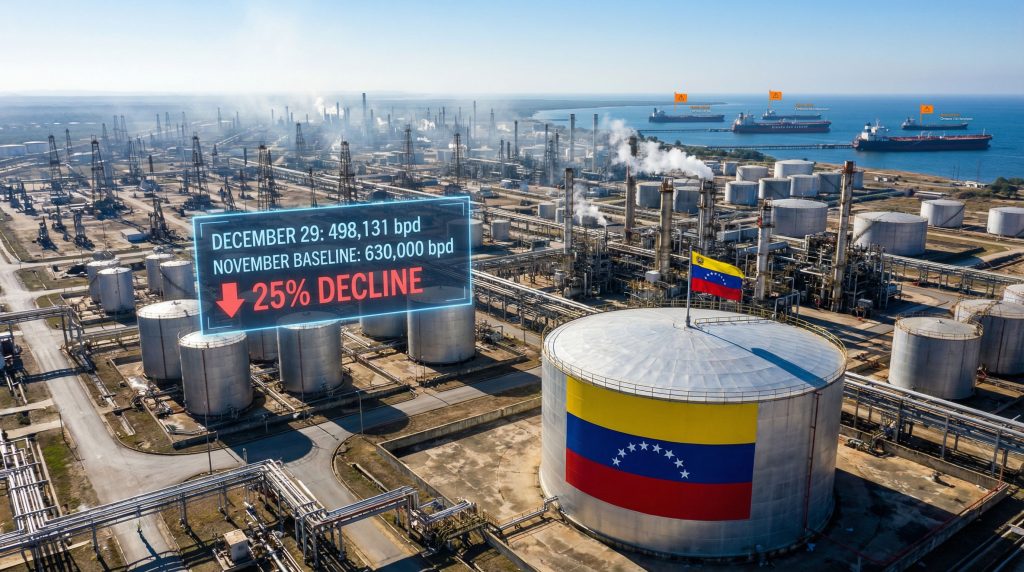
| Date | Production (bpd) | Change from Baseline |
|---|---|---|
| November 2025 | 630,000 | Baseline |
| December 29, 2025 | 498,131 | -25% (14-day period) |
This production decline reflects more than simple export restrictions. The Orinoco Belt contains extra-heavy crude reserves with API gravity ratings of 8-14 degrees, making them among the heaviest petroleum products in global markets. This extreme viscosity creates unique operational challenges:
• Thermal recovery requirements that demand continuous production to maintain reservoir temperatures
• Pipeline flow characteristics that become problematic when production is intermittent
• Specialised refining needs that limit potential buyers and transportation options
When wells producing extra-heavy crude are shut down, restarting production requires significant remediation work. The bitumen-like consistency can solidify in wellbores and surface facilities, creating expensive restart procedures that can take weeks or months to complete successfully.
National Production Trajectory Assessment
| Period | National Production (bpd) | Historical Context |
|---|---|---|
| 1997-2002 Peak | 3,200,000 | Pre-sanctions baseline |
| November 2025 | 1,142,000 | Recent peak |
| Q4 2025 Projected | 1,000,000 | Current trajectory |
The broader national production picture reveals how the U.S. sanctions impact on Venezuelan oil production extends beyond the Orinoco Belt to affect the entire petroleum sector. Traditional light crude production from Lake Maracaibo and other conventional fields has also declined as sanctions limit access to enhanced recovery technologies and replacement equipment.
Storage capacity constraints have become a critical limiting factor as PDVSA approaches maximum utilisation of tank farm facilities. With estimated total storage capacity of 40-50 million barrels across the country's major terminals, current production rates would saturate available storage within 80-100 days if export activities were completely suspended.
Which Enforcement Mechanisms Are Proving Most Effective?
The effectiveness of sanctions enforcement depends on creating multiple pressure points that make circumvention both costly and risky for potential violators. Recent enforcement actions demonstrate a coordinated approach that targets vessel operations, financial transactions, and third-party facilitators simultaneously. Additionally, broader patterns in US‑China trade war impacts influence how Chinese entities assess Venezuela-related risks.
Maritime Interdiction Operations
Naval enforcement activities in the Caribbean represent a significant escalation in direct intervention capabilities. The boarding and inspection of tankers attempting to load Venezuelan crude creates immediate operational disruptions while establishing legal precedents for future enforcement:
• Vessel detention procedures that can immobilise tankers for extended periods during investigations
• Flag state coordination that leverages international maritime law enforcement cooperation
• Insurance compliance verification that creates additional documentation requirements for ship operators
• Cargo documentation auditing that identifies sanctions violations through shipping manifests
The psychological impact of maritime interdiction extends beyond individual vessel encounters. Shipping companies and their insurers must now factor enforcement risks into operational planning, leading many to voluntarily avoid Venezuelan trade regardless of potential profits.
Financial System Isolation Strategies
Banking restrictions create particularly severe obstacles because they affect the fundamental mechanics of international commodity trade. Venezuelan oil sales traditionally required:
- Letters of credit from international banks to guarantee payment
- Currency exchange services to convert proceeds into usable currencies
- Wire transfer capabilities for payment settlement
- Trade finance facilities to fund logistics and transportation
With major international banks unwilling to risk sanctions violations, Venezuelan crude sales must rely on smaller financial institutions or alternative payment mechanisms that typically involve significant transaction costs and price discounts.
"The targeting of Chinese entities represents a strategic expansion of enforcement scope, as Beijing's energy security planning increasingly includes Venezuelan heavy crude to supply coastal refineries designed for high-sulfur feedstocks."
What Are the Broader Geopolitical Implications for Global Oil Markets?
Venezuelan production disruptions create ripple effects across international energy markets that extend far beyond the immediate volume reductions. Heavy crude markets operate with limited supplier alternatives, making Venezuelan output particularly important for refineries designed to process high-sulfur, low-gravity petroleum. Moreover, these developments occur alongside complex oil price movements influenced by global trade tensions.
Supply Chain Disruption Analysis
The 0.4-0.5% share of global production that Venezuelan oil represents understates its market significance because heavy crude constitutes a specialised market segment with limited substitution options:
• U.S. Gulf Coast refineries in Louisiana and Texas are specifically configured for heavy crude processing
• Caribbean refining centres in Curaçao and Aruba have reduced throughput capacity without Venezuelan feedstock
• Chinese coastal refineries designed for high-sulfur crude face supply sourcing challenges
• Canadian oil sands production cannot rapidly scale to fill heavy crude supply gaps
Heavy crude typically trades at discounts to benchmark prices like West Texas Intermediate, but supply restrictions can reduce these discounts significantly. Refiners dependent on heavy crude feedstocks face margin pressure when forced to purchase higher-cost alternatives or modify their processing configurations.
China's Strategic Response Calculations
Chinese energy companies face particularly complex risk assessments when considering Venezuelan oil trade. Beijing's energy security strategy emphasises supply diversification, but U.S. secondary sanctions create potential conflicts with broader economic interests. Furthermore, the trade war oil market impact complicates these strategic calculations.
| Risk Factor | Strategic Consideration |
|---|---|
| Financial sector exposure | Major Chinese banks face U.S. market access restrictions |
| Technology transfer implications | Energy sector cooperation affects broader tech relationships |
| Alternative supplier availability | Middle Eastern and Russian heavy crude provides options |
| Long-term energy security | Venezuelan reserves remain strategically valuable |
The sanctions targeting of four entities based in Hong Kong and mainland China signals U.S. willingness to impose costs on Chinese companies engaging in Venezuelan trade, potentially affecting Beijing's broader energy security calculations.
How Do Infrastructure Constraints Amplify Sanctions Impact?
The technical realities of petroleum production create vulnerabilities that sanctions pressure can exploit effectively. Venezuelan oil infrastructure operates with limited redundancy and minimal maintenance reserves, making it particularly susceptible to disruption. Additionally, broader US economy tariffs create additional economic pressures on the global energy sector.
Storage Capacity Crisis Management
Tank farm operations approaching maximum capacity create cascading operational problems that extend throughout the production system:
• Well shutdown protocols must be implemented to prevent storage overflow
• Reservoir pressure maintenance becomes problematic when production is intermittent
• Pipeline system balancing requires constant adjustment as flow rates change
• Refinery feedstock coordination suffers when crude supply becomes unreliable
"PDVSA's storage limitations force production cuts across multiple fields, creating a situation where the U.S. sanctions impact on Venezuelan oil production creates self-reinforcing production constraints through infrastructure bottlenecks."
The Orinoco Belt's extra-heavy crude presents particular storage challenges because high viscosity requires heated storage tanks and specialised handling equipment. When export capacity is restricted, these facilities can reach capacity rapidly, forcing immediate production reductions.
Export Terminal Operational Challenges
Venezuelan export terminals face increasing operational constraints as sanctions limit access to replacement equipment and technical services:
• Loading equipment maintenance requires specialised parts often subject to export controls
• Dredging operations needed for deep-draft tanker access face contractor availability issues
• Pipeline integrity management suffers from limited access to inspection technologies
• Safety system compliance becomes problematic without proper equipment updates
These infrastructure constraints create a deteriorating cycle where reduced export capacity leads to storage problems, which force production cuts, which reduce revenue available for infrastructure maintenance.
What Economic Recovery Scenarios Could Venezuela Face?
Analysing potential recovery trajectories requires understanding both the immediate impacts of sanctions relief and the long-term rehabilitation requirements facing Venezuelan oil infrastructure. However, according to strategic analysis, enforcement may continue to intensify.
Short-Term Stabilisation Projections
| Scenario | 2026 Production Target | Key Assumptions |
|---|---|---|
| Base Case | 1,200,000 bpd | Limited sanctions relief, gradual recovery |
| Optimistic | 1,500,000 bpd | Partial sanctions lifting, international investment |
| Pessimistic | 800,000 bpd | Continued enforcement escalation |
Even under optimistic scenarios, Venezuelan production recovery faces significant technical constraints. Wells shut down for extended periods require remediation work that can take months to complete. The specialised nature of Orinoco Belt operations means that restarting production requires specific technical expertise and equipment that may not be readily available.
Storage infrastructure improvements would need to precede any significant production increases. Current tank farm capacity represents a binding constraint that limits how quickly production can be restored even if sanctions are modified.
Long-Term Rehabilitation Requirements
Comprehensive recovery of Venezuelan oil production would require addressing multiple infrastructure categories:
- Reservoir management systems to optimise recovery from partially depleted fields
- Surface facility upgrades to improve processing and storage capacity
- Export terminal modernisation to handle increased throughput volumes
- Pipeline network rehabilitation to ensure reliable transportation capacity
- Refining capacity restoration to add value to crude production
Industry experts estimate that full rehabilitation could require $100-200 billion in investment over 10-15 years, assuming access to international capital markets and technology providers.
The next major ASX story will hit our subscribers first
Which Lessons Apply to Other Sanctions-Targeted Energy Producers?
Venezuelan experience provides insights into how economic sanctions interact with petroleum sector vulnerabilities in other producing countries facing similar pressure. The U.S. sanctions impact on Venezuelan oil production offers a case study for evaluating effectiveness across different regulatory frameworks.
Comparative Analysis Framework
| Country | Production Decline | Key Vulnerability Factors |
|---|---|---|
| Venezuela | 80%+ (2012-2025) | Storage constraints, heavy crude specialisation |
| Iran | 60%+ (2018-2020) | Financial system isolation, tanker fleet restrictions |
| Russia | 15%+ (2022-2024) | Technology access, Western market exclusion |
Each sanctions regime targets different vulnerabilities based on the specific characteristics of the targeted country's petroleum sector. Venezuela's dependence on specialised heavy crude infrastructure creates unique pressure points that differ from Iran's export-dependent light crude production or Russia's pipeline-based distribution system.
Policy Effectiveness Evaluation Metrics
Measuring sanctions effectiveness requires considering multiple dimensions beyond simple production statistics:
• Government revenue reduction relative to baseline projections
• International trade relationship disruption affecting broader economic sectors
• Infrastructure degradation rates that create long-term recovery obstacles
• Alternative supplier market development that reduces target country leverage
The Venezuelan case demonstrates how sanctions can create self-reinforcing cycles where production constraints lead to infrastructure deterioration, making recovery increasingly difficult even if political situations change.
Frequently Asked Questions
How quickly can Venezuelan oil production recover if sanctions are lifted?
Recovery timelines depend heavily on infrastructure condition and investment availability. Wells shut down for extended periods require 3-6 months for restart procedures, while storage and export facility upgrades could take 2-3 years. Full recovery to pre-sanctions levels would likely require 5-10 years under optimal conditions.
What role do Chinese companies play in circumventing current restrictions?
Chinese entities provide alternative trading and financing mechanisms that can partially offset Western sanctions pressure. However, U.S. secondary sanctions create significant compliance costs and risks that limit Chinese companies' willingness to engage in large-scale Venezuelan oil trade.
How do storage constraints specifically impact Orinoco Belt operations?
Extra-heavy crude requires heated storage tanks and specialised handling equipment. When export capacity is restricted, these facilities reach maximum capacity rapidly because the viscous crude cannot be easily transferred or processed through alternative pathways.
What makes Venezuelan heavy crude particularly vulnerable to sanctions?
Heavy crude markets have limited supplier alternatives and require specialised refining capacity. This creates dependency relationships that sanctions can exploit more effectively than in light crude markets where substitution options are more readily available.
Strategic Economics of Energy Sanctions: Long-Term Market Implications
Key Takeaways for Policy Analysis
The Venezuelan sanctions experience demonstrates how economic pressure can leverage technical vulnerabilities in petroleum production systems to create effects that extend far beyond immediate political objectives. The 25% production decline in the Orinoco Belt within a two-week period illustrates how infrastructure constraints can amplify sanctions impact when properly targeted.
Future sanctions design must consider the technical realities of petroleum production, particularly for countries dependent on specialised extraction technologies or unique crude grades. The storage capacity crisis facing PDVSA shows how understanding operational bottlenecks can enhance sanctions effectiveness while creating long-term economic consequences.
Unintended Consequences on Regional Energy Security
Heavy crude supply disruptions affect multiple countries and refining centres throughout the Caribbean and North American markets. U.S. Gulf Coast refineries optimised for Venezuelan feedstock face margin pressure and operational adjustments that create costs for domestic energy consumers.
The development of alternative trading relationships between sanctions-targeted countries may create new geopolitical alignments that persist beyond current policy disputes. Chinese involvement in Venezuelan oil trade, despite sanctions risks, reflects broader strategic calculations about energy security and geopolitical influence.
Disclaimer: This analysis is based on publicly available information and should not be considered as investment advice. Production figures, sanctions enforcement actions, and political developments are subject to rapid change. Readers should consult current government sources and professional advisors for the most up-to-date information regarding sanctions compliance and market conditions.
Ready to Navigate Energy Market Volatility from Geopolitical Events?
Discovery Alert's proprietary Discovery IQ model delivers real-time alerts on significant ASX mineral discoveries, helping subscribers identify actionable opportunities when global energy disruptions create market volatility. Stay ahead of commodities market movements by exploring Discovery Alert's discoveries page to understand how major mineral finds can generate substantial returns during uncertain geopolitical periods.