
July 21, 2026
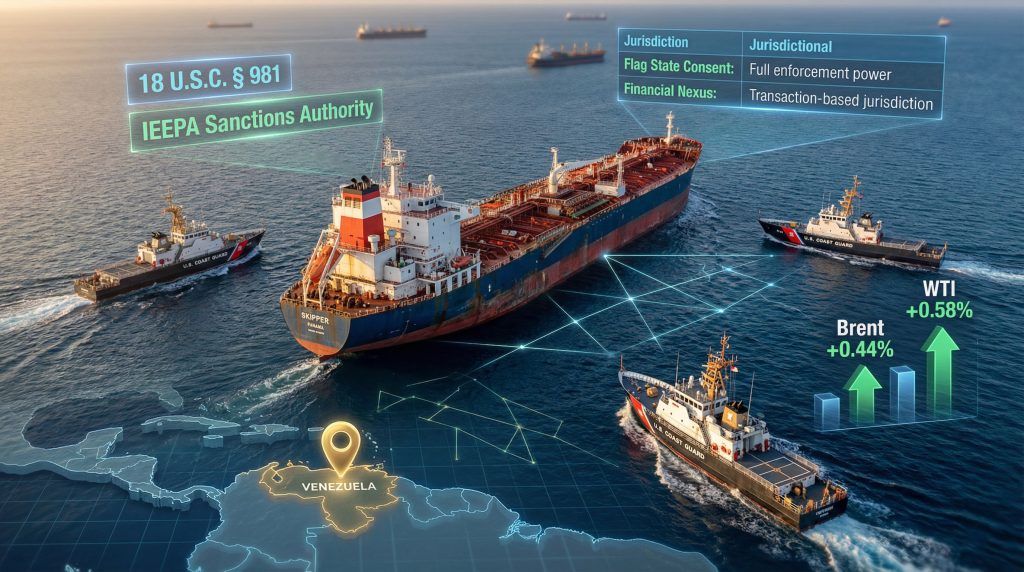
The U.S. seizes tanker off Venezuelan coast represents a significant escalation in maritime enforcement operations, demonstrating how traditional sanctions policy has evolved into direct physical asset interdiction in international waters. This enforcement action reflects broader strategic shifts toward kinetic sanctions implementation that bypasses gradual compliance mechanisms in favour of immediate supply disruption.
Maritime law enforcement has evolved significantly in recent decades, transforming from traditional naval operations to sophisticated interdiction strategies that blur the boundaries between economic sanctions and physical enforcement. This shift reflects broader changes in how nations project power in an interconnected global economy where financial systems, shipping networks, and energy supplies intersect across multiple jurisdictions.
The intersection of international waters, flag state sovereignty, and extraterritorial sanctions creates complex legal terrain where traditional maritime law meets modern economic warfare tactics. Understanding these dynamics requires examining both the historical development of maritime enforcement authority and the contemporary expansion of financial sanctions into physical asset seizure operations.
How Maritime Enforcement Authority Operates Beyond Territorial Waters
Legal Foundations for International Seizure Operations
The seizure of vessels in international waters relies on multiple overlapping legal frameworks that have developed through decades of drug enforcement, counterterrorism operations, and sanctions implementation. The Ship and Port Facility Security Act (46 U.S.C. § 70001 et seq.) provides fundamental authority for Coast Guard boarding operations, while Title 18 U.S.C. § 981 establishes civil forfeiture procedures applicable to vessels engaged in sanctions violations.
Key Legal Mechanisms Table:
| Legal Framework | Scope of Authority | Jurisdictional Basis |
|---|---|---|
| Federal Warrant Authority | Asset seizure and criminal enforcement | U.S. financial nexus |
| Maritime Drug Law Enforcement Act | Boarding and inspection powers | Narcotics trafficking nexus |
| International Emergency Economic Powers Act | Sanctions enforcement authority | National security determination |
| Flag State Cooperation Agreements | Consensual enforcement operations | Bilateral treaty arrangements |
The International Emergency Economic Powers Act (IEEPA) of 1977 provides presidential authority to regulate international commerce during national emergencies, including maritime asset seizure when U.S. persons or financial systems are involved. This statutory foundation enables enforcement actions against vessels utilising dollar-denominated transactions, American insurance mechanisms, or U.S. banking infrastructure, regardless of vessel location.
Flag state cooperation represents a crucial component of enforcement operations. Panama, which maintains one of the world's largest merchant vessel registries accounting for approximately 18-20% of global fleet tonnage by deadweight, has increasingly cooperated with U.S. enforcement actions through bilateral maritime agreements and International Maritime Organisation participation.
Jurisdictional Complexity and International Law Boundaries
The enforcement of sanctions through maritime seizure generates significant tension between unilateral national authority and international law principles. Under the United Nations Convention on the Law of the Sea (UNCLOS), flag states retain ultimate jurisdiction over vessels flying their flags, creating potential conflicts when enforcement states act without explicit flag state consent.
Venezuela's characterisation of maritime seizures as "international piracy" reflects fundamental disagreement with U.S. extraterritorial sanctions doctrine. UNCLOS Article 101 narrowly defines piracy as acts of violence or detention performed for private gain, not government enforcement activities. However, the Venezuelan position argues that unilateral seizure without international consensus constitutes illegal appropriation of sovereign property.
Legal Precedent Consideration:
The 2019 seizure of the Iranian tanker "Grace 1" off Gibraltar demonstrated similar jurisdictional disputes, ultimately resolving through diplomatic negotiation rather than enforcement completion, highlighting the contested nature of extraterritorial maritime seizure authority.
U.S. legal doctrine maintains that financial nexus creates legitimate jurisdiction independent of vessel location. When sanctioned activities involve U.S. financial infrastructure, SWIFT messaging systems, or dollar-denominated transactions, enforcement jurisdiction attaches under OFAC regulations (31 C.F.R. § 500-598) regardless of where vessels operate physically.
When big ASX news breaks, our subscribers know first
Strategic Resource Interdiction as Modern Economic Warfare
Evolution from Financial to Physical Enforcement
Contemporary sanctions policy demonstrates a clear escalation from regulatory restrictions to direct physical asset seizure, representing what policy analysts characterise as "kinetic sanctions enforcement." This progression moves beyond traditional compliance mechanisms toward immediate supply disruption and psychological signalling effects on global markets. Furthermore, this evolution parallels developments in US economic tariffs and their broader implications for international trade relationships.
Sanctions Escalation Hierarchy:
- Financial Sanctions – OFAC entity designations blocking U.S.-based assets and restricting dollar transactions
- Secondary Sanctions – Third-party penalties creating global compliance pressure through extraterritorial application
- Asset Freezing – Specific property immobilisation limited to U.S. or U.S.-controlled jurisdictions
- Maritime Interdiction – Physical vessel and cargo seizure in international waters using law enforcement assets
- Naval Blockade – Comprehensive shipping restrictions enforced by military vessels, approaching acts of war
The shift from gradual financial pressure to immediate physical interdiction trades long-term compliance incentives for immediate market impact. Traditional economic sanctions theory predicted that gradual pressure would incentivise regime behavioural change, but modern analysis suggests regimes can sustain financial sanctions when they control alternative networks and receive support from non-aligned nations.
Market Psychology and Disproportionate Price Effects
Energy markets exhibit extreme sensitivity to supply disruption signals that far exceed actual volume impacts. The December 10, 2025 seizure drove Brent crude prices up 0.44% to $62.21 per barrel and WTI up 0.58% to $58.78 per barrel, despite minimal physical supply disruption. Additionally, this price movement correlates with broader oil price rally analysis examining how geopolitical tensions affect energy markets.
Volume vs. Price Impact Analysis:
- Physical Volume: Single tanker carrying 1.0-2.2 million barrels
- Global Daily Production: Approximately 100 million barrels per day
- Actual Supply Impact: 0.001-0.002% of daily global production
- Price Response: 0.4-0.6% increase representing 400-600x multiplier effect
This disproportionate market response reflects what behavioural economists term "precedent anxiety," where traders price not immediate incident impact but probability of escalating enforcement actions. Energy futures markets operate with tight supply-demand balances in specific crude quality categories, particularly for heavy sour crude from Venezuela that feeds specialised refineries requiring expensive reconfiguration for alternative sourcing.
The psychological fear of repeated seizures affects insurance pricing and charter costs for suspect vessels, creating persistent cost premiums that exceed incident-specific supply impacts. Maritime insurance rates for vessels operating in sanctioned regimes typically increase 200-500% above baseline rates, demonstrating market adaptation to enforcement risks.
Shadow Fleet Circumvention and Regulatory Response
Technical Methodologies of Maritime Sanctions Evasion
The "Skipper" tanker seizure revealed sophisticated evasion techniques employed across sanctioned regime shipping networks. These vessels typically undergo frequent identity changes, ownership transfers, and technological manipulation to obscure activities from monitoring systems developed by maritime authorities. Moreover, these techniques intersect with broader patterns observed in US-China trade war impacts where alternative supply chains emerge to circumvent restrictions.
Primary Evasion Techniques:
- Ship-to-ship transfers conducted in international waters to obscure cargo origins
- AIS transponder manipulation including signal jamming, spoofing, and complete shutdown
- Flag shopping among non-cooperative jurisdictions offering minimal oversight
- Shell company ownership structures spanning multiple jurisdictions with opaque beneficial ownership
- Cargo blending operations mixing sanctioned crude with permitted oils to obscure origin sources
The "Skipper" vessel, formerly named "Adisa," exemplifies the flag-hopping strategy common among shadow fleet operations. Panama's registry system, while cooperating increasingly with enforcement actions, historically provided flag-of-convenience services with minimal operational oversight, enabling vessels to maintain legitimate registry status while engaging in sanctioned activities.
Advanced tracking systems now integrate satellite surveillance, financial transaction monitoring, and maritime intelligence to create comprehensive vessel monitoring capabilities. The combination of synthetic aperture radar imagery, automatic identification system tracking, and financial intelligence allows authorities to identify suspicious patterns across multiple enforcement jurisdictions.
Technological Arms Race in Maritime Monitoring
Maritime enforcement agencies have developed sophisticated tracking methodologies to counter evasion techniques. Modern sanctions enforcement combines satellite tracking, financial transaction monitoring, and maritime intelligence through integrated databases that can identify suspicious vessel behaviours across multiple jurisdictions.
Satellite surveillance technology enables monitoring of ship-to-ship transfers in remote ocean locations where traditional patrol vessels cannot maintain constant presence. Synthetic aperture radar systems can detect vessel positions regardless of AIS transponder status, while financial intelligence tracks payment flows associated with cargo transactions.
The regulatory response evolution demonstrates increasing coordination between maritime authorities, intelligence agencies, and financial regulators. Information sharing agreements enable real-time tracking of suspect vessels across international boundaries, while legal assistance treaties facilitate coordinated enforcement operations.
Regional Power Dynamics and Geopolitical Implications
Latin American Energy Security Strategy
The tanker seizure occurs within the context of renewed U.S. focus on Latin American influence as outlined in the 2025 National Security Strategy. This strategic document emphasises strong U.S. engagement in the region, representing a more assertive approach compared to previous diplomatic-focused strategies toward regional energy security. This assertive stance also connects to the implementation of the Russian uranium ban as part of comprehensive energy security measures.
Venezuela's crude oil production has declined dramatically from approximately 3.1 million barrels per day in 2011 to current estimates of 750,000-850,000 bpd as of late 2024. U.S. sanctions enforcement targeting Venezuelan oil exports operates within this context of already-severe production decline, amplifying economic pressure on the Maduro regime.
Venezuelan Production Decline Timeline:
- 2011: Peak production of 3.1 million bpd
- 2017: Comprehensive sanctions implementation begins
- 2019: Oil-specific sanctions introduced
- 2024: Production estimated at 750,000-850,000 bpd
- Revenue Impact: Estimated $100+ billion cumulative reduction
Heavy sour crude from Venezuela, specifically Merey blend and other Orinoco Belt crudes, represented approximately 15-20% of some U.S. Gulf Coast refinery input prior to sanctions implementation. This crude quality remains economically significant for refinery configurations specialised in heavy crude processing, creating continued market demand despite sanctions restrictions.
International Law Precedent Establishment
The enforcement action establishes important precedents for future maritime interdiction operations that will influence how similar situations develop globally. Legal justifications and international responses shape the boundaries of extraterritorial enforcement authority and acceptable levels of unilateral action in international waters.
Historical precedent exists in multiple previous seizures, including the Iranian tanker "Grace 1" (later "Adrian Darya 1") seized off Gibraltar in July 2019 under EU sanctions against Syria. This case involved similar jurisdictional disputes and ultimately resulted in diplomatic resolution rather than completed enforcement, demonstrating the contested nature of extraterritorial maritime seizure operations.
The role of international bodies, particularly the UN Sanctions Committee and International Maritime Organisation, becomes crucial in determining whether current enforcement actions align with or exceed established international mandates. Non-U.S. state responses to maritime seizures provide valuable precedent-setting information regarding acceptable boundaries of unilateral enforcement.
Energy Market Adaptation to Supply Chain Disruption
Commodity Price Formation Under Enforcement Risk
Oil futures markets demonstrate complex price formation mechanisms that amplify enforcement actions far beyond their physical supply impact. Risk premiums embedded in futures prices reflect trader assessments of potential escalation rather than immediate volume disruption, creating sustained market effects that persist beyond individual incidents. These dynamics mirror the broader tariff impact on markets where policy uncertainty creates sustained volatility.
Price Formation Factors:
- Risk premium calculation incorporating probability of future enforcement actions
- Alternative sourcing costs reflecting expense of substitute supply routes
- Insurance rate impacts with premiums increasing 200-500% for high-risk operations
- Strategic inventory management adjustments by major consuming nations
The June 2019 tanker attacks in the Strait of Hormuz, where two vessels were damaged but not seized, caused Brent crude to spike 6.0% in a single trading session despite minimal actual production impact. This historical precedent demonstrates market sensitivity to perceived supply security threats, validating the disproportionate response to enforcement actions.
Energy market participants develop alternative supply chains and risk mitigation strategies in response to repeated enforcement actions, potentially creating permanent structural changes in global energy flows. These adaptations include expanded storage capacity, diversified supplier relationships, and modified refinery configurations to handle different crude qualities.
Long-term Structural Market Changes
Sustained maritime interdiction campaigns force fundamental adaptations in global energy trade patterns that extend far beyond immediate enforcement targets. Market participants invest in alternative transportation routes, modified refinery capabilities, and expanded strategic storage to mitigate enforcement risks.
The development of alternative shipping networks creates parallel infrastructure designed to avoid enforcement jurisdiction. These networks often involve smaller vessels, circuitous routing through non-aligned nations, and increased reliance on overland transportation where maritime routes become too risky.
Insurance market adaptation reflects industry assessment of enforcement risks through premium structures that price geopolitical uncertainty. Lloyd's of London and other major maritime insurers have developed specialised products for high-risk shipping operations, with rates reflecting both traditional maritime perils and sanctions enforcement probability.
Legal Challenge Pathways and Compensation Issues
International Court Jurisdiction Questions
Venezuela's characterisation of maritime seizures as "international piracy" raises fundamental questions about unilateral enforcement action limits in international waters. These disputes could potentially reach international arbitration forums, creating binding precedents for future enforcement operations.
Potential Legal Challenge Venues:
- International Court of Justice for state-to-state maritime law disputes
- International Tribunal for the Law of the Sea addressing UNCLOS violations
- Commercial arbitration panels for property rights and contract disputes
- Domestic courts in flag state jurisdictions for asset recovery claims
The distinction between civil forfeiture procedures and criminal prosecution creates different legal pathways with varying evidentiary standards and procedural requirements. Civil forfeiture operates under preponderance-of-evidence standards, while criminal prosecution requires proof beyond reasonable doubt, affecting enforcement strategy selection.
International legal challenges focus on extraterritorial jurisdiction expansion, flag state sovereignty preservation, and proportionality of enforcement responses to alleged violations. These challenges test the boundaries between legitimate sanctions enforcement and unlawful seizure of sovereign property in international waters.
Asset Disposition and Revenue Distribution
Maritime seizures create complex liability questions regarding compensation if legal challenges succeed, while raising procedural issues about asset disposition during extended legal proceedings. Seized vessels and cargoes require maintenance, storage, and potential sale to preserve value during litigation.
The U.S. federal forfeiture system provides mechanisms for asset liquidation and revenue distribution, but international seizures complicate traditional procedures when multiple jurisdictions claim interest in seized property. Flag state laws, cargo owner rights, and insurance company subrogation claims create overlapping legal interests requiring coordinated resolution.
Precedent from previous international seizures suggests that diplomatic resolution often provides more practical outcomes than extended litigation. The Iranian tanker case demonstrates how diplomatic negotiation can resolve complex jurisdictional disputes while preserving face for all parties involved.
The next major ASX story will hit our subscribers first
What Are the Future Expansion Possibilities for Maritime Enforcement Strategy?
Potential Target Networks and Escalation Scenarios
The success of Venezuelan tanker seizures may encourage similar operations against other sanctioned regimes' shipping networks, particularly those involving Iranian, North Korean, and Russia-linked vessels engaged in comparable evasion strategies. NBC News reports indicate that this enforcement action represents part of a broader strategic approach toward maritime interdiction.
Iranian tanker networks demonstrate similar operational patterns to Venezuelan shadow fleets, utilising frequent flag changes, ownership transfers, and transponder manipulation to circumvent sanctions monitoring. The U.S. has already implemented maritime interdiction against Iranian vessels, suggesting expanded enforcement represents natural progression rather than novel strategy.
Expansion Target Analysis:
- Iranian networks: Similar evasion patterns with established enforcement precedent
- Russian oil shipments: Sanctions circumvention routes through third countries
- North Korean vessels: Coal and petroleum smuggling operations
- Third-party facilitators: Enabling entities across multiple jurisdictions
Russian oil shipments present particularly complex enforcement challenges due to the scale of operations, involvement of major international shipping companies, and resistance from key consuming nations. Maritime interdiction against Russian vessels could trigger significant escalation in economic warfare between major powers.
International Cooperation Framework Requirements
Effective maritime enforcement requires extensive international cooperation, particularly from flag states, port authorities, and intelligence agencies across multiple jurisdictions. The expansion of enforcement operations demands strengthened cooperation frameworks and information sharing agreements.
Critical Cooperation Elements:
- Intelligence sharing agreements enabling real-time vessel tracking
- Joint patrol operations coordinating enforcement activities across regions
- Legal assistance treaties facilitating asset seizure and forfeiture procedures
- Asset sharing arrangements distributing enforcement costs and recovered revenues
The development of multilateral enforcement coalitions could provide greater international legitimacy for maritime interdiction operations while distributing political and operational costs among participating nations. NATO maritime partnerships and regional security organisations offer potential frameworks for expanded cooperation.
Intelligence integration becomes increasingly important as shadow fleet operations become more sophisticated. The combination of signals intelligence, financial intelligence, and maritime domain awareness requires coordination between military, law enforcement, and regulatory agencies across multiple nations.
Flag state cooperation remains the critical factor determining enforcement feasibility. Nations providing flag-of-convenience services face increasing pressure to implement meaningful oversight of vessels flying their flags, potentially transforming the global ship registry system toward greater transparency and accountability.
As the U.S. seizes tanker off Venezuelan coast demonstrates escalating enforcement strategies, maritime law will continue evolving to address the complex intersection of sovereignty, sanctions, and international commerce. The precedent established by this action will significantly influence future enforcement operations and reshape global energy trade patterns for years to come.
Disclaimer: This analysis is based on publicly available information and should not be considered as legal, investment, or policy advice. Maritime law enforcement operations involve complex legal and geopolitical considerations that may evolve rapidly. Readers should consult qualified professionals for specific guidance related to maritime operations, sanctions compliance, or international law matters.
Looking to Capitalise on Energy Market Volatility?
Discovery Alert's proprietary Discovery IQ model instantly identifies significant ASX mineral discoveries, including those in energy-critical commodities that benefit from global supply disruptions and geopolitical tensions like maritime sanctions enforcement. With markets increasingly sensitive to supply chain risks, subscribers gain immediate access to actionable insights that help position portfolios ahead of major market movements driven by resource scarcity and strategic commodity demand.