
July 14, 2026
Emergency Reserves and the Arithmetic of Vulnerability
The US Strategic Petroleum Reserve lowest level since 1983 is not simply a headline statistic — it is a structural warning signal embedded in four decades of energy security architecture. The true measure of a nation's strategic resilience only becomes visible when supply corridors fracture, geopolitical calculations shift overnight, and the infrastructure built to absorb shocks begins absorbing them in earnest. What the current data reveals is that the buffer is shrinking faster than at almost any comparable point in the reserve's history, and the conditions driving that depletion show no immediate sign of reversing.
Understanding what this means for energy markets, crude oil price trends, and broader economic stability requires looking beyond the headline inventory figure and examining the structural mechanics behind the drawdown.
When big ASX news breaks, our subscribers know first
The Architecture of the Reserve: What Most People Don't Know
The SPR is not simply a tank farm. It is a network of 62 underground salt caverns distributed across four storage sites along the Gulf Coast of Texas and Louisiana: Bryan Mound, Big Hill, West Hackberry, and Bayou Choctaw. Salt caverns are used because of their natural impermeability, their ability to maintain crude quality over decades, and their rapid drawdown capability. Under full operational pressure, the SPR can release crude at a maximum rate of approximately 4.4 million barrels per day.
The reserve was established by the Energy Policy and Conservation Act of 1975, a direct legislative response to the 1973 Arab oil embargo. The original authorised capacity was set at 1 billion barrels, later revised downward to the current 713.5 million barrels following legislative changes in the 1990s. These changes also mandated periodic sales to fund government operations — an often-overlooked factor in the reserve's long-term decline even before any emergency release programme was activated.
Salt Cavern Storage: A Technical Advantage With Operational Limits
The salt cavern design is not without constraints. Crude must be injected and withdrawn at controlled rates to maintain cavern structural integrity. Rapid or repeated cycling between fill and drawdown phases can accelerate cavern wear, and at critically low inventory levels, operators must maintain minimum heel volumes of crude inside each cavern to preserve internal pressure and prevent collapse.
This means the functional minimum for the SPR is not zero, and not even a simple percentage of total capacity. It is a geologically determined threshold governed by the physics of each individual cavern. According to the EIA's historical data, this distinction carries significant operational implications for long-term reserve management.
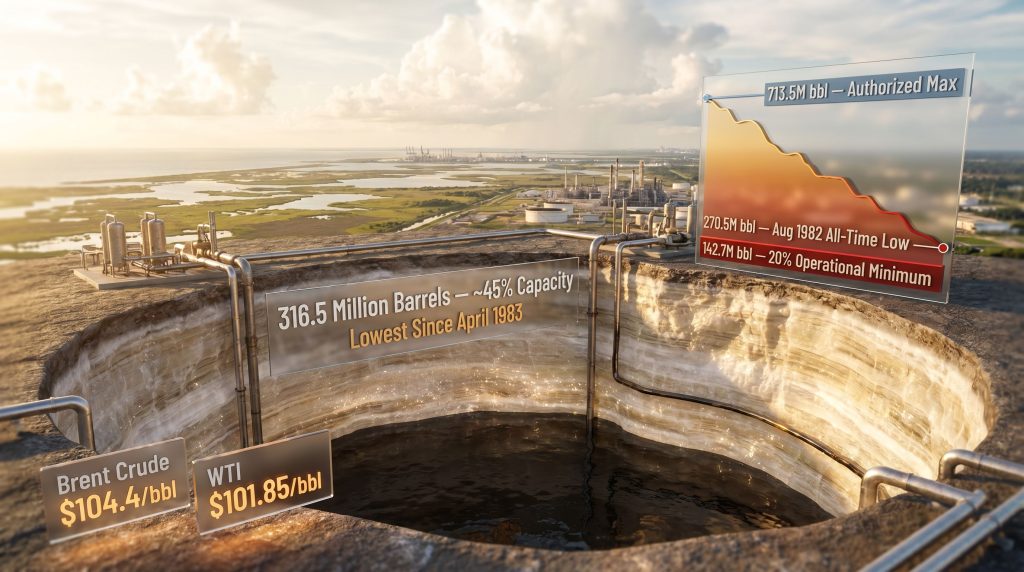
This is precisely why industry bodies including the American Petroleum Institute have stressed that the reserve must maintain at least 20% of its authorised capacity to remain operationally meaningful. At 713.5 million barrels maximum capacity, that floor sits at approximately 142.7 million barrels. Current inventory of roughly 316.5 to 319.5 million barrels is above that threshold, but the velocity of depletion changes the risk calculus significantly.
How the US-Iran Conflict Accelerated a Pre-Existing Problem
It would be inaccurate to characterise the current SPR situation as solely a product of the 2026 conflict with Iran. The reserve entered this crisis already well below its historical operating range. A series of release programmes spanning multiple administrations — including legislated sales to fund budget deficits and emergency releases tied to the Russia-Ukraine conflict in 2022 — had already drawn inventories down from their operational peak of approximately 695 million barrels in the mid-2000s.
The US-Iranian military conflict that began at the end of February 2026 triggered an authorised release programme of 172 million barrels, one of the largest single drawdown mandates in the reserve's history. The effect on inventories was immediate and sustained. Furthermore, geopolitical trade tensions have compounded the complexity of both supply access and reserve replenishment decisions.
| Drawdown Period | SPR Change | Context |
|---|---|---|
| Post-2022 Ukraine releases | Approx. -180 million bbl | Emergency price mitigation |
| Feb to July 10, 2026 | -98.9 million bbl | US-Iran conflict release programme |
| Week ending July 3, 2026 | -3 million bbl (single week) | Ongoing drawdown acceleration |
The weekly drawdown rate during the most intense release phases reached approximately 6.2 million barrels, an extraordinary pace that, if sustained, would exhaust the buffer above the operational minimum within roughly 12 to 18 months. Even at a moderated pace of 3 million barrels per week, meaningful deterioration continues.
The 1st Percentile Problem
Perhaps the most sobering statistical framing of the current situation is this: at approximately 316 to 320 million barrels, the SPR is now operating within the 1st percentile of its entire recorded 44-year history. That means current inventory levels are lower than 99% of all weekly readings ever recorded by the Department of Energy. The only period with lower absolute inventory was the reserve's initial fill phase in the early 1980s, when the infrastructure was still being commissioned and the caverns were not yet at operating capacity.
The critical distinction between the 1982 historical low of 270.5 million barrels and today's inventory is one of direction. In 1982, the reserve was being filled. In 2026, it is being emptied from a position that was already compromised.
Total US Inventories: The Dual-Layer Cushion Is Compressing
The SPR does not exist in isolation. The US oil supply system relies on a dual-layer buffer: the federally managed strategic reserve and the commercially held crude stocks distributed across the refining and distribution network. When both decline simultaneously, the country's capacity to absorb supply shocks shrinks in a compounding, non-linear fashion.
As of the week ending July 3, 2026, combined US inventories — encompassing both SPR and commercial crude holdings — fell by 123.9 million barrels to approximately 730.8 million barrels. According to Reuters, this represents the lowest aggregate crude inventory reading since 1984.
The significance of this convergence cannot be overstated. During past supply disruptions, including Hurricane Katrina in 2005 and the COVID-19 demand collapse in 2020, commercial stocks provided a partial offset when SPR drawdowns alone proved insufficient. That redundancy is now severely compressed, and the loss of this dual-buffer structure elevates today's inventory situation from a policy concern to a structural energy security risk.
IEA Obligations and the 90-Day Coverage Threshold
The United States is a founding member of the International Energy Agency, established in 1974 as a direct institutional response to the same 1973 oil embargo that led to the SPR's creation. IEA member nations are required to maintain emergency oil stocks equivalent to 90 days of net imports. As drawdowns accelerate, questions are emerging in energy policy circles about the long-term sustainability of that commitment.
This interconnectedness creates a multiplier effect on risk. The SPR is not only a domestic buffer — it functions as a de facto stabilisation mechanism for global oil markets. Allied nations in Europe and Asia have historically relied on coordinated US releases during crises, and a significantly depleted reserve reduces the US government's capacity to fulfil that role.
Oil Price Dynamics: What the Market Is Already Pricing In
Despite short-term corrections in crude benchmarks, oil prices remain structurally elevated. In addition, OPEC's market influence continues to shape how supply deficits translate into sustained price pressure across global benchmarks.
| Benchmark | Price (July 2026) | Movement |
|---|---|---|
| Brent Crude | $104.4/bbl | -4.21% (near-term correction) |
| WTI Crude Oil | $101.85/bbl | -3.06% (near-term correction) |
The persistence of Brent above $100 per barrel despite active SPR releases is itself an important market signal. It suggests that the releases are providing price relief at the margin, but are not sufficient to offset the underlying supply disruption created by Iranian crude exiting global markets. Energy futures traders have begun incorporating a structural supply premium into forward curves, reflecting reduced confidence in the government's ability to deploy additional emergency barrels at scale.
This dynamic has critical implications for the replenishment question. The US government can repurchase crude for the SPR, but doing so at prices above $100 per barrel imposes a substantial fiscal cost. Historical replenishment programmes have generally targeted sub-$80 per barrel trigger prices. Consequently, the longer prices remain elevated, the longer the practical window for cost-effective replenishment remains closed.
Three Scenarios for What Comes Next
The trajectory of the SPR over the next 12 to 24 months depends on a relatively small number of critical variables, each carrying significant uncertainty. The following scenarios represent a structured framework for thinking through the range of outcomes.
Scenario A: Conflict Resolution and Managed Replenishment
- A diplomatic or military resolution restores Iranian supply to global markets
- Brent prices fall back toward the $75 to $85 range, opening a replenishment window
- The Department of Energy begins purchasing crude under existing statutory authority
- Inventories recover toward the 350 to 380 million barrel range within 18 to 24 months
- IEA obligations remain intact; structural risk recedes
Scenario B: Prolonged Conflict With Managed Drawdowns
- Military operations continue at reduced intensity; weekly SPR releases moderate to 1 to 2 million barrels
- Inventories stabilise in the 280 to 310 million barrel range
- Brent remains structurally elevated between $90 and $110 per barrel
- Replenishment is deferred; the buffer above operational minimum narrows further
- Market participants adjust long-term price expectations upward
Scenario C: Escalation and Accelerated Depletion
- Regional conflict broadens to include Saudi Arabian, UAE, or Iraqi supply disruption
- Weekly drawdowns accelerate beyond 6 million barrels
- Inventories approach the 1982 all-time low of 270.5 million barrels within 6 to 9 months
- IEA emergency coordination is activated; coordinated allied reserve releases are deployed
- Oil prices potentially breach $130 per barrel, with significant macroeconomic consequences
Scenario C is not the base case, but its probability is not negligible given the geographic proximity of active military operations to the world's most critical shipping chokepoints, including the Strait of Hormuz, through which approximately 21 million barrels per day of oil and petroleum products flow under normal conditions.
The next major ASX story will hit our subscribers first
The Replenishment Gap: A Structural Policy Problem
One dimension of the SPR crisis that receives insufficient analytical attention is the absence of any legislated mandatory replenishment timeline. The US government has statutory authority to purchase crude for the reserve, but Congress controls the appropriations required to fund those purchases. Post-2022, replenishment efforts were slowed significantly by elevated oil prices, and the political will to commit fiscal resources to rebuilding a strategic buffer competes against more immediately visible budget priorities.
There is also a longer-term structural debate emerging around whether the SPR framework itself requires modernisation:
- Should the authorised capacity be expanded through new cavern development?
- Should the US formalise allied reserve coordination mechanisms to distribute the burden of emergency supply across partner nations?
- Should the SPR mandate be narrowed to exclude legislated sales for budget purposes, which have historically eroded the reserve during non-emergency periods?
- Should a minimum fill requirement be legislated, preventing the reserve from falling below a defined threshold without a formal emergency declaration?
These are not abstract questions. They represent the core policy architecture that will determine whether the SPR remains a credible energy security instrument over the next decade. However, the trade war oil effects on global procurement costs add yet another layer of complexity to any near-term replenishment strategy.
Domestic Production as a Long-Term Variable
US shale production, particularly from the Permian Basin, remains a critical long-term variable. Sustained oil prices above $80 to $85 per barrel create strong economic incentives for incremental production growth. However, production ramp-up timelines in shale typically span 6 to 18 months from capital commitment to meaningful volume delivery. In the immediate term, domestic production cannot substitute for SPR releases, reinforcing the reserve's role as the essential bridge between demand shock and supply response.
The US shale drilling slowdown adds further uncertainty to domestic supply projections. The Permian Basin alone produced approximately 6.3 million barrels per day in early 2026, but logistical constraints — including pipeline takeaway capacity and refinery configuration — limit how rapidly incremental output can reach the market segments most affected by supply disruption.
Key Metrics at a Glance
| Metric | Figure |
|---|---|
| SPR Inventory (July 3, 2026) | ~316.5 to 319.5 million barrels |
| Authorised Maximum Capacity | 713.5 million barrels |
| Current Fill Rate | ~45% |
| Total US Inventories (SPR + Commercial) | ~730.8 million barrels |
| Historical All-Time Low (August 1982) | 270.5 million barrels |
| Last Comparable SPR Level | April 1983 |
| Operational Minimum (20% threshold) | ~142.7 million barrels |
| Buffer Above Operational Minimum | ~174 to 177 million barrels |
| SPR Decline Since Feb 2026 | 98.9 million barrels |
| Total US Inventory Decline | 123.9 million barrels |
| Brent Crude (July 2026) | $104.4/bbl |
| WTI Crude (July 2026) | $101.85/bbl |
The convergence of these data points tells a clear story. The US Strategic Petroleum Reserve lowest level since 1983 reflects a reserve operating within the 1st percentile of its historical range, with commercial stocks simultaneously at their weakest combined position since 1984. The reserve retains operational capacity above its functional minimum, but the margin is narrowing. The variables that will determine whether it narrows further or begins to recover lie largely outside the direct control of US energy policy makers.
Disclaimer: This article contains forward-looking scenario analysis and market commentary intended for informational purposes only. It does not constitute financial or investment advice. Commodity prices, geopolitical developments, and policy outcomes are inherently uncertain. Readers should conduct their own research and consult qualified advisers before making investment decisions.
Want to Stay Ahead of Energy-Driven Commodity Opportunities on the ASX?
When structural shifts in global oil markets reshape commodity demand and investor sentiment, the window to act on emerging mineral discoveries can be razor-thin. Discovery Alert's proprietary Discovery IQ model delivers real-time alerts on significant ASX mineral discoveries — explore the historic returns major discoveries have generated and begin your 14-day free trial today to ensure you're positioned before the broader market moves.