
August 5, 2026
Understanding America's Emergency Oil Buffer System
Strategic energy reserves represent one of the most complex policy instruments in modern governance, balancing immediate market interventions against long-term national security imperatives. The US Strategic Petroleum Reserve release mechanics involve intricate calculations that extend far beyond simple volume mathematics, encompassing geopolitical coordination, infrastructure constraints, and political risk assessment. Furthermore, oil price movements demonstrate how emergency reserves interact with broader market dynamics during periods of international tension.
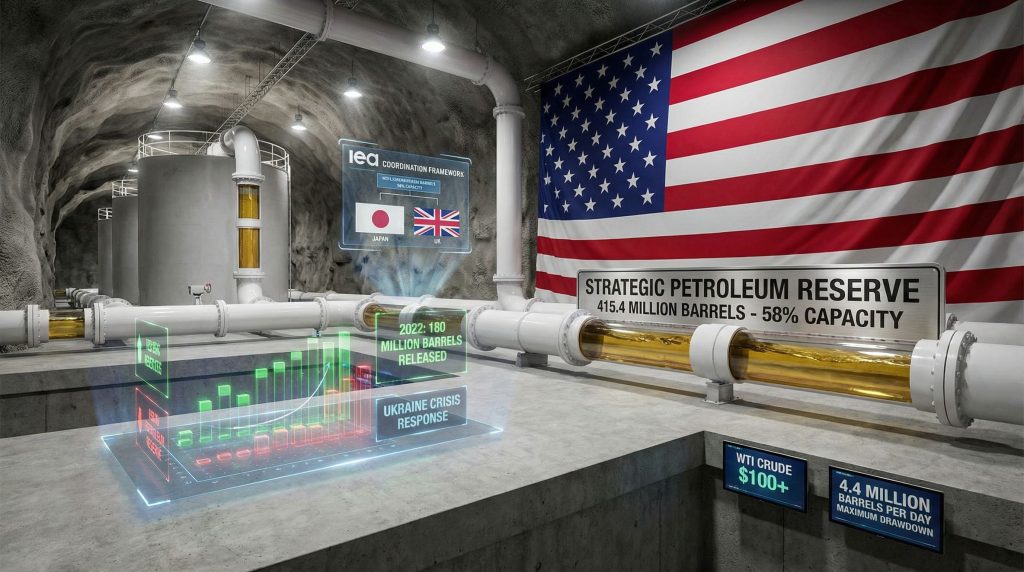
The US Strategic Petroleum Reserve currently maintains 415.4 million barrels of crude oil, representing approximately 58% of its operational capacity. This inventory level reflects a significant gap between current holdings and the authorized maximum of 714 million barrels, highlighting the ongoing tension between budgetary constraints and strategic preparedness. However, the reserve's maximum drawdown capability allows for 4.4 million barrels per day over 90 consecutive days, providing substantial emergency response capacity during acute market disruptions.
SPR Infrastructure and Distribution Networks
The Strategic Petroleum Reserve operates through a sophisticated network of salt cavern facilities concentrated along the Gulf Coast, utilizing underground storage technology that provides both security and operational efficiency. These geological formations offer natural protection while maintaining the crude oil's quality over extended periods.
Key Infrastructure Metrics:
- Maximum authorized capacity: 714 million barrels
- Current inventory: 415.4 million barrels (58% capacity utilization)
- Daily drawdown potential: 4.4 million barrels for 90-day periods
- Geographic concentration: Gulf Coast salt cavern complexes
The International Energy Agency's framework requires member countries to maintain emergency stocks equivalent to at least 90 days of the prior year's net imports. As of late 2025, total IEA member public stocks reached 1.25 billion barrels, accounting for roughly 30% of total OECD oil inventories. This distributed approach ensures coordinated response capabilities during global supply disruptions.
Maximum Drawdown Capabilities and Operational Readiness
The strategic reserve's operational design prioritizes rapid deployment during emergency scenarios. The 4.4 million barrels per day maximum withdrawal rate represents the system's upper limit under optimal conditions, though actual deployment rates depend on pipeline capacity, refinery processing capabilities, and market demand dynamics.
Salt cavern storage technology provides unique advantages for emergency reserves, including minimal maintenance requirements and protection against external threats. However, these facilities require periodic operational assessments to ensure sustained readiness, particularly regarding pipeline connections and pumping infrastructure that facilitate crude oil movement to refineries. Consequently, crude oil price trends often reflect market confidence in the availability and effectiveness of these strategic resources.
When big ASX news breaks, our subscribers know first
How Do Geopolitical Crises Trigger Emergency Release Protocols?
International coordination mechanisms play a decisive role in determining when and how strategic reserves are deployed during geopolitical emergencies. The March 11, 2026 IEA coordinated release of 400 million barrels demonstrates how alliance structures translate crisis response into collective action, even when individual member participation remains discretionary.
The 32 IEA member countries unanimously approved this unprecedented release following disruptions from the US-Israel conflict with Iran. This decision represents the largest emergency release in IEA history, surpassing the previous record of 182 million barrels released during the 2022 Ukraine crisis. Japan committed to releasing 80 million barrels beginning March 16, 2026, while the United Kingdom pledged 13.5 million barrels to the coordinated effort.
Historical Precedent Analysis and Response Patterns
Emergency release decisions follow established patterns that reflect both crisis severity and political calculations. The 2022 Ukraine response involved 180 million barrels from US reserves alone, while earlier releases included 30 million barrels during the 2011 Libya conflict and 11 million barrels following Hurricane Katrina in 2005.
Historical SPR Release Comparison:
| Year | Volume Released | Trigger Event | Estimated Price Impact |
|---|---|---|---|
| 2026 | 400 million barrels (IEA coordinated) | Iran conflict | TBD |
| 2022 | 180 million barrels | Ukraine invasion | -15% crude prices |
| 2011 | 30 million barrels | Libya conflict | -8% crude prices |
| 2005 | 11 million barrels | Hurricane Katrina | -3% crude prices |
The current crisis involving the de facto closure of the Strait of Hormuz disrupts approximately 25% of global seaborne oil trade in the Middle Eastern Gulf region. This level of supply disruption creates what the IEA characterized as oil-market challenges unprecedented in scale, justifying the largest coordinated response in the organization's history.
Decision-Making Authority and International Obligations
Despite unanimous IEA support for coordinated releases, individual member participation remains subject to national decision-making processes. Interior Secretary Doug Burgum's statement that US participation represented a presidential decision rather than an automatic obligation illustrates the voluntary nature of these frameworks, despite America's historical participation in every coordinated release since IEA creation.
The IEA framework specifies that released stocks be made available over timeframes appropriate to each member country's national circumstances, providing implementation flexibility rather than mandating simultaneous global deployments. This structure balances collective action benefits with sovereign decision-making authority. In addition, OPEC market influence factors significantly into these calculations, as member countries consider the broader implications of emergency releases on global market dynamics.
What Are the Economic Thresholds for SPR Activation?
Market volatility indicators often serve as primary triggers for strategic reserve deployment, though political considerations frequently override purely economic calculations. The week ending March 9, 2026 witnessed unprecedented diesel price surges of nearly $1 per gallon, representing the highest weekly increase on record according to federal data.
These dramatic fuel price movements preceded the March 11 IEA announcement by approximately two days, illustrating the lag between market pressure manifestation and policy response. The timing suggests that retail fuel impacts, rather than wholesale crude prices alone, influence release timing decisions.
Oil Price Volatility and Consumer Impact Assessment
Strategic reserve releases typically occur when crude oil prices exceed $100 per barrel WTI benchmarks, though specific trigger points remain discretionary rather than automatic. Consumer impact metrics, particularly retail gasoline and diesel prices, often carry greater political weight than wholesale commodity movements due to their direct visibility to voters.
The differentiation between temporary price spikes and sustained supply disruptions shapes release decisions significantly. President Trump's initial assessment that prices would decline automatically due to military conflict outcomes reflects the administration's preference for market-based solutions over government intervention, making the eventual US Strategic Petroleum Reserve release a recognition that market forces alone proved insufficient.
Market Psychology versus Actual Supply Shortages
Speculative trading activity can amplify or dampen price movements independent of physical supply conditions. Futures market positioning during crisis periods often reflects risk premium calculations rather than immediate supply-demand imbalances, creating potential disconnects between paper market prices and physical market realities.
Critical Market Insight: SPR releases serve dual functions as physical supply augmentation and psychological market stabilisation, with the announcement effect often providing immediate price relief before physical oil reaches refineries.
Emergency release decisions must account for whether elevated prices reflect genuine supply shortages or speculative positioning. The March 2026 situation involved actual supply disruptions through Strait of Hormuz closure, providing clear justification for physical supply intervention rather than purely psychological market support. Moreover, oil price rally analysis reveals how various factors beyond immediate supply concerns influence strategic release timing.
Why Do Administrations Hesitate to Deploy Emergency Reserves?
Political implications of strategic reserve depletion create significant reluctance toward emergency releases, particularly when refill costs exceed original acquisition prices. The Trump administration purchased only 900,000 barrels of crude for SPR replenishment in the prior year, despite inaugural commitments to refill reserves to maximum capacity.
The tax legislation signed by President Trump provided funding for approximately 3 million barrels of purchases, representing roughly 1% of the 298 million barrels needed to reach the authorised capacity of 714 million barrels from current levels. This funding gap illustrates the fiscal challenges associated with maintaining strategic reserves at optimal levels.
Refill Cost Considerations and Budget Allocation Challenges
Strategic reserve replenishment requires congressional appropriations that compete with other budgetary priorities, creating structural vulnerabilities to political obstruction. Republicans attributed the current depleted state (58% capacity) to Democratic actions during Trump's first term, with Senator Tom Cotton specifically citing Democratic unwillingness to provide billions of dollars for refill purchases.
SPR Funding and Capacity Analysis:
- Current inventory: 415.4 million barrels
- Authorised capacity: 714 million barrels
- Funding gap: 298.6 million barrels unfunded
- Recent purchases: 900,000 barrels (prior year)
- Approved funding: 3 million barrels capacity
The mechanics of reserve replenishment involve purchasing decisions tied to congressional appropriations, creating timeline separation between authorisation capacity and operational reality. Budget constraints fundamentally shape whether SPR releases constitute temporary supply interventions or permanent inventory reductions. Furthermore, US oil production decline considerations influence refill strategies and timing.
Strategic Timing and Political Risk Assessment
SPR deployment requires implicit acknowledgment that supply disruptions will persist rather than resolve quickly through military or diplomatic means. Trump's initial statements downplaying market effects created political contradictions when reserve releases became necessary, forcing administrations to balance crisis response against previous public positions.
The eventual decision to participate with a little bit of SPR drawdown represented a compromise acknowledging market pressures without fully endorsing substantial intervention needs. This measured approach reflects political calculations about minimising acknowledgment of crisis severity while providing some market relief.
How Does International Coordination Shape Release Strategies?
The 400 million barrel IEA release demonstrates sophisticated burden-sharing mechanisms among alliance partners, though country-specific allocations remain voluntary rather than mandated. Japan's 80 million barrel commitment and the UK's 13.5 million barrel pledge occurred before US announcement specifics, potentially creating diplomatic pressure for proportional American participation.
The unanimous approval by all 32 IEA member states masks the complexity of individual country decision-making processes, where domestic political considerations intersect with international obligations. The US holds 415.4 million barrels in strategic reserves, exceeding the combined commitments of Japan and the UK, yet demonstrated hesitation regarding participation specifics.
IEA Framework and Member Obligations
The International Energy Agency framework allows member countries discretionary control over deployment timing and volume, despite the appearance of coordinated decision-making. Released stocks must be made available over timeframes appropriate to national circumstances of each member country, providing substantial implementation flexibility.
IEA Member Contribution Analysis:
- Total coordinated release: 400 million barrels
- Japan commitment: 80 million barrels (20% of total)
- UK commitment: 13.5 million barrels (3.4% of total)
- US reserves available: 415.4 million barrels
- Combined IEA reserves: 1.25 billion barrels
The voluntary nature of participation allows countries to calibrate responses based on domestic political considerations while maintaining alliance solidarity. This structure accommodates different national circumstances while enabling collective action during supply emergencies.
Diplomatic Signalling Through Energy Policy Coordination
International energy policy coordination serves diplomatic signalling functions beyond immediate market intervention. The timing of country-specific announcements within the coordinated framework reflects broader geopolitical positioning and alliance commitment demonstrations.
Japan's early commitment to 80 million barrels starting March 16, 2026, signals strong alliance support while potentially pressuring other members toward proportional contributions. The UK's 13.5 million barrel pledge, though smaller in absolute terms, demonstrates European participation in transatlantic crisis response.
What Infrastructure Constraints Limit SPR Effectiveness?
Physical infrastructure limitations create significant bottlenecks between reserve authorisation and practical delivery to end markets. Energy Secretary Chris Wright's emphasis on logistics considerations highlights that released oil must reach refineries in Europe and Asia, suggesting geographic distribution challenges beyond simple volume availability.
Pipeline capacity from Gulf Coast storage facilities to major refining centres represents a critical chokepoint between SPR authorisation and practical crude oil delivery. The maximum drawdown rate of 4.4 million barrels per day establishes operational capacity limits that exist independently of total inventory levels.
Pipeline Capacity and Distribution Networks
The salt cavern storage technology utilised by SPR facilities requires specific pipeline configurations and pumping infrastructure to facilitate crude oil movement during emergency deployments. These systems must maintain operational readiness despite extended periods of minimal utilisation between emergency releases.
Infrastructure Capacity Constraints:
- Maximum daily drawdown: 4.4 million barrels per day
- Sustained capacity: 90-day maximum drawdown period
- Geographic concentration: Gulf Coast facilities
- Distribution challenge: European and Asian refinery delivery
Refinery processing limitations during supply chain stress periods mean that released crude cannot automatically transform into consumer-facing refined products. Regional refining capacity and product demand patterns influence the practical effectiveness of crude oil releases in addressing retail fuel price concerns.
Storage Facility Maintenance and Operational Requirements
Salt cavern storage facilities require periodic maintenance and integrity assessments to ensure continued operational capability. These underground formations provide natural security and crude oil quality preservation, but demand specialised technical management to maintain readiness for emergency deployment.
The technical specifications of SPR crude oil must match refinery processing capabilities, creating potential compatibility constraints between available reserve grades and specific refinery configurations. This technical matching requirement can limit the practical utilisation of released crude depending on refinery access and processing flexibility.
The next major ASX story will hit our subscribers first
Which Market Factors Influence Release Timing Decisions?
Seasonal demand patterns significantly influence strategic reserve release timing, particularly during periods preceding summer driving season when fuel demand typically increases. The March 11 announcement timing coincided with spring preparation periods when elevated demand projections heighten market price sensitivity to supply disruptions.
The $1 per gallon weekly diesel price increase ending March 9, 2026, preceded the IEA decision by approximately two days, suggesting policy response lags behind acute market pressure manifestation. This timing pattern reflects the institutional decision-making processes required for coordinated international responses.
Regional Price Disparities and Market Dynamics
Regional price differentials between Gulf Coast production centres and Northeast consumer markets create targeting opportunities for strategic releases. Areas experiencing acute supply constraints may benefit disproportionately from reserve deployments, influencing decisions about release timing and distribution strategies.
Market Timing Considerations:
- Weekly diesel price surge: $1 per gallon (record increase)
- Timing lag: 2 days between peak prices and IEA decision
- Seasonal factor: Spring preparation for summer driving season
- Regional impact: Gulf Coast to Northeast distribution priorities
Futures market positioning and speculative trading activity during crisis periods can amplify or dampen price movements independent of physical supply conditions. Technical factors in derivatives markets may influence the magnitude of price responses to strategic release announcements.
Speculative Trading Impacts and Market Response
Energy futures markets often incorporate risk premiums during geopolitical crises that may exceed the actual supply disruption impacts. Strategic release announcements serve dual functions as physical supply augmentation and speculative position unwinding catalysts.
The effectiveness of strategic releases depends partly on market participants' confidence in their sustained availability and government commitment to market stabilisation. Previous release experiences influence trader positioning and price response patterns to new release announcements.
How Do Congressional Politics Shape SPR Policy?
Congressional control over SPR funding creates leverage points where legislative majorities can constrain executive branch energy policy implementation. The requirement for appropriations to fund reserve replenishment means that refill commitments depend on annual budget approval processes, creating structural vulnerabilities to political obstruction.
Republican criticism of Democratic SPR policies during Trump's first term illustrates how strategic reserve management becomes a vehicle for partisan blame allocation. Senator Tom Cotton's characterisation of Democrats undermining the reserve by declining to provide billions in refill funding demonstrates the politicisation of emergency preparedness infrastructure.
Bipartisan Criticism Patterns and Legislative Oversight
The bifurcation of SPR policy into partisan frameworks rather than technical emergency management reflects broader political dysfunction around national security infrastructure. Cotton's criticism of Biden's 180 million barrel release during the 2022 Ukraine crisis suggests Republican positioning that such releases represent strategic errors rather than legitimate emergency responses.
Congressional Political Dynamics:
- Trump inaugural commitment: Fill SPR to 714 million barrel capacity
- Actual purchases: 900,000 barrels (prior year)
- Legislative funding: 3 million barrels authorised
- Funding shortfall: 295+ million barrels unfunded
- Partisan blame: Democratic billions of dollars refusal alleged
Legislative oversight mechanisms include authorisation for SPR purchases and sales, creating multiple intervention points where congressional majorities can influence executive energy policy. This structure ensures political accountability but may compromise rapid emergency response capabilities during acute crises.
Funding Authorisation Challenges and Political Constraints
The gap between presidential commitments to refill strategic reserves and actual congressional appropriations illustrates the institutional constraints on executive energy policy. Trump's inaugural address commitment to fill reserves to the top contrasts sharply with the limited funding provided through subsequent tax legislation.
Democrats controlled appropriations during portions of Trump's first term according to Republican statements, though the specific mechanisms of SPR funding obstruction require verification through legislative records. The political dynamics surrounding reserve management reflect broader tensions over government spending priorities and energy policy direction.
What Role Does Energy Security Play in Modern SPR Strategy?
Contemporary energy security calculations must balance traditional petroleum emergency preparedness against evolving supply patterns and climate policy objectives. Import dependency metrics continue influencing SPR strategy despite increased domestic oil production, as global market integration maintains vulnerability to international supply disruptions.
The integration of domestic production capabilities with strategic reserve planning creates complex optimisation challenges. Higher domestic production reduces import dependency ratios but doesn't eliminate exposure to global price volatility during international crises. Consequently, the US Strategic Petroleum Reserve release remains a critical tool for managing both physical supply shortages and market psychology during geopolitical tensions.
Import Dependency and Domestic Production Integration
Modern SPR strategy must account for the changing composition of US energy consumption and production patterns. While domestic crude oil production has increased substantially, refined product imports and global price integration maintain strategic vulnerabilities requiring emergency buffer capacity.
Energy Security Metrics:
- Current SPR inventory: 415.4 million barrels (58% capacity)
- IEA requirement: 90 days of prior year net imports equivalent
- Global integration: 25% of seaborne trade affected by Strait of Hormuz closure
- Domestic production: Increased but globally price-integrated
The geographic concentration of strategic reserves along the Gulf Coast reflects historical import patterns but may require reconsideration given changing domestic production centres and consumption patterns. Infrastructure development linking production regions with strategic storage creates supply chain resilience improvements.
Climate Policy Tensions and Next-Generation Storage
Climate policy objectives create tensions with expanded fossil fuel emergency planning, particularly regarding long-term investment in petroleum-based strategic reserves. The transition toward renewable energy sources raises questions about optimal reserve sizing and composition over multi-decade timeframes.
Strategic Policy Consideration: Future energy security frameworks must balance immediate petroleum emergency preparedness against long-term renewable transition objectives, potentially requiring next-generation storage technologies beyond traditional crude oil reserves.
Alternative energy storage considerations include strategic materials for renewable energy infrastructure, grid-scale battery reserves, and hydrogen storage capabilities. These emerging technologies may complement or partially substitute for traditional petroleum reserves in comprehensive energy security strategies.
How Should Investors Interpret SPR Release Signals?
Strategic reserve releases provide multiple investment signals extending beyond immediate energy sector implications. The announcement of 400 million barrels in coordinated IEA releases suggests policy commitment to price stabilisation that may establish effective price floors for crude oil futures.
Market timing indicators from SPR releases include both immediate price impact and longer-term supply-demand rebalancing effects. Historical release patterns show -15% crude price impacts from large releases like the 2022 Ukraine response, though effectiveness varies with market conditions and release size relative to disrupted supplies.
Market Timing Indicators and Price Floor Establishment
The scale of coordinated releases relative to disrupted supply volumes influences their market effectiveness. The current 400 million barrel release addresses supply disruptions affecting 25% of seaborne Gulf trade, suggesting adequate scale for meaningful price stabilisation.
Investment Signal Analysis:
- Release magnitude: 400 million barrels (largest IEA coordinated release)
- Historical price impact: -15% (2022 release reference)
- Supply disruption: 25% of Strait of Hormuz seaborne trade
- Market psychology: Government commitment to price stability demonstration
Sector rotation opportunities during energy volatility periods often favour refined product companies with inventory flexibility over upstream crude producers facing supply disruption uncertainty. Strategic releases may benefit downstream refining operations through improved crude oil availability and price stability.
Long-Term Energy Transition Implications
Strategic petroleum reserve policies signal government priorities regarding energy security infrastructure investment during the renewable transition. Large reserve releases may indicate policy preferences for managing fossil fuel price volatility rather than accelerating renewable adoption through higher prices.
The intersection of strategic reserve management with broader energy policy creates investment implications across multiple sectors. Renewable energy development may benefit from price stability that reduces fossil fuel competition, while traditional energy infrastructure maintains strategic importance through emergency preparedness requirements.
What Does the Future Hold for Strategic Petroleum Reserve Policy?
Strategic petroleum reserve modernisation faces competing pressures from budget constraints, energy transition objectives, and evolving security threats. The current inventory gap of 298 million barrels between actual holdings and authorised capacity illustrates the fiscal challenges associated with maintaining optimal emergency preparedness levels.
Capacity expansion debates must consider whether current authorisation levels reflect appropriate emergency buffer sizing given changing import patterns and domestic production capabilities. The 714 million barrel authorised capacity originated during periods of higher import dependency that may not reflect current or projected future energy trade patterns.
Modernisation Proposals and Technology Integration
Future strategic reserve systems may incorporate advanced monitoring technologies, alternative storage locations, and integration with renewable energy infrastructure. Salt cavern technology remains effective for petroleum storage, but next-generation reserves might include strategic materials for clean energy technologies.
Future Policy Considerations:
- Capacity optimisation: Current 58% utilisation vs. optimal sizing
- Technology integration: Advanced monitoring and distribution systems
- Alternative storage: Geographic diversification beyond Gulf Coast concentration
- Renewable integration: Strategic materials for clean energy infrastructure
The geographic concentration of current facilities along the Gulf Coast creates potential vulnerabilities to regional weather events or infrastructure attacks. Future expansion might prioritise geographic diversification while maintaining operational efficiency and cost-effectiveness.
Global Reserve Coordination Evolution
International coordination mechanisms may evolve toward more binding commitment structures given the increasing scale of global supply disruptions. The current voluntary participation framework allows national discretion but may prove insufficient for coordinating responses to larger future crises.
Alternative energy buffer systems including renewable energy storage, strategic mineral reserves, and grid resilience infrastructure represent emerging components of comprehensive energy security strategies. These systems may complement traditional petroleum reserves while supporting broader energy transition objectives.
The development of multipolar energy markets with diverse supplier relationships may require new coordination frameworks beyond traditional Western alliance structures. Future strategic reserve policies must account for changing geopolitical alignments and energy trade patterns extending beyond current IEA membership.
This analysis is based on publicly available information and should not be considered investment advice. Energy markets involve substantial risks, and strategic reserve policies may change based on political and economic developments. Investors should conduct independent research and consult qualified advisors before making investment decisions.
Are You Positioned for Energy Market Disruptions?
Strategic petroleum reserve releases offer crucial insights into energy market dynamics, particularly for investors tracking geopolitical risks and commodity price movements. Discovery Alert's proprietary Discovery IQ model delivers real-time alerts on significant ASX mineral and energy discoveries, transforming complex market data into actionable investment opportunities ahead of broader market recognition. Start your 14-day free trial today to gain a market-leading advantage in volatile energy and commodity markets.