July 16, 2026
The Persian Gulf's Most Critical Chokepoint Is Now a War Zone for Oil Shipping
Few waterways on earth carry the weight of the Strait of Hormuz. Roughly one-fifth of the world's petroleum liquids pass through this narrow stretch of water annually, threading between Iran and the Arabian Peninsula before reaching the tankers and terminals that supply energy to Europe, Asia, and beyond. For decades, the strategic calculus around this chokepoint has been defined by deterrence and calculated restraint. That calculus is now being openly tested.
The US strikes Iranian-linked oil tanker in Persian Gulf incident of July 2026 represents more than a single military action. It signals a fundamental shift in the geographic and doctrinal scope of American maritime enforcement, one with cascading consequences for global energy markets, shipping economics, and international maritime law. Furthermore, the geopolitical trade tensions underpinning this escalation have been building for months across the broader region.
When big ASX news breaks, our subscribers know first
From the Gulf of Oman to Kharg Island: How the Enforcement Perimeter Expanded
When the US first reimposed its naval blockade of Iranian shipping, enforcement was concentrated at a designated line beyond the Strait of Hormuz in the Gulf of Oman. The operational logic was containment at the periphery, intercepting vessels before they could enter or exit Iranian territorial approaches.
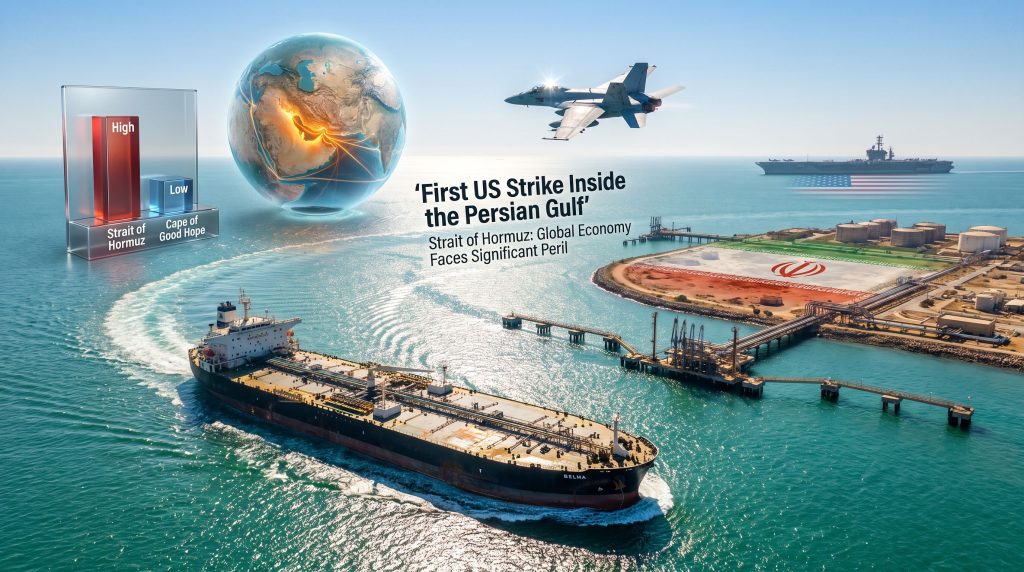
That perimeter has since moved decisively inward. On 16 July 2026, US Central Command confirmed strikes that an American aircraft fired missiles at the Belma, a US-sanctioned supertanker sailing unladen through international waters toward Kharg Island, Iran's primary crude oil export terminal. The vessel had repeatedly ignored CENTCOM warnings before the strike was executed.
This was not the first time the US had acted against Iranian-linked tankers. Earlier operations had targeted vessels in the Gulf of Oman specifically:
| Date | Action | Location | Vessels Targeted |
|---|---|---|---|
| May 2026 | Precision munitions from US Navy F/A-18 | Gulf of Oman | M/T Sea Star III and M/T Sevda |
| July 2026 | Airstrikes on 80+ Iranian targets | Iranian coastal positions | IRGC radar, air defences, 60+ fast boats |
| July 16, 2026 | Missile strike | Persian Gulf (Kharg Island approach) | Supertanker Belma |
The distinction matters enormously. Striking a vessel in the Gulf of Oman is an act of peripheral enforcement. Striking one on a direct course toward Iran's central oil export hub inside the Persian Gulf is a qualitatively different posture. Jennifer Parker, an adjunct professor at the University of Western Australia Defence and Security Institute, described this as consistent with the stated US goal of blockading all Iranian ports and coastal areas, even if the geographic execution was new.
Ship-tracking data added a layer of operational detail to the event. The Belma was observed moving northward toward Kharg late on Wednesday before making a slight northwest deviation and then executing a sharp course change following the strike, a pattern consistent with a vessel sustaining damage or responding to an immediate threat.
Why Kharg Island Is the Strategic Prize in This Standoff
What Makes Kharg Island So Critical?
Understanding the significance of the US strikes Iranian-linked oil tanker in Persian Gulf event requires understanding what Kharg Island actually represents within Iran's petroleum infrastructure. The island, located in the northeastern Persian Gulf, functions as the central processing and loading hub for the overwhelming majority of Iran's seaborne crude exports. It is not one terminal among many — it is effectively the singular point through which Iran converts its oil reserves into export revenue.
Following an interim peace agreement signed in mid-June 2026, independent monitoring recorded at least 11 shipments of oil and petrochemicals loaded from Kharg Island. This demonstrated Iran's continued determination to monetise its energy assets despite the blockade. In a detail that underscores the contested nature of the situation, a supertanker was observed actively loading crude at Kharg on the very same day the Belma was struck.
The simultaneous loading operation at Kharg Island on 16 July 2026 illustrates a persistent reality: Iran continues to pursue export revenue through every available channel, even as US enforcement operations tighten around those channels.
This creates a strategic dynamic that goes beyond simple interdiction. The US is not merely disrupting individual shipments; it is attempting to sever the financial pipeline that connects Iranian oil production to global markets, with Kharg Island representing the most critical node in that pipeline. The OPEC market influence over pricing and production decisions adds yet another layer of complexity to this standoff.
How the Blockade Defines Compliance: Permitted and Prohibited Transits
The US enforcement framework distinguishes between categories of cargo and vessel behaviour, creating a structured compliance architecture rather than a blanket prohibition:
| Category | Blockade Status | Notes |
|---|---|---|
| Bulk food shipments | Permitted after vetting | Grain, soybean meal carriers eligible |
| Medical supplies | Permitted after vetting | Humanitarian cargo exempted |
| Iranian crude oil exports | Prohibited | Primary target of enforcement |
| LPG carriers (sanctioned) | Monitored | Outbound transits with active transponders |
| Non-compliant vessels | Subject to interdiction | Vessels ignoring CENTCOM warnings |
CENTCOM confirmed that in the first 24 hours after the renewed blockade took effect at 4:00 PM Washington time on Tuesday, 15 July 2026, it had redirected two compliant commercial vessels and disabled one non-compliant ship. By July 17, a US-sanctioned LPG carrier had completed an outbound transit with its transponder active, and an Iran-bound bulk carrier loaded with soybean meal crossed into the Persian Gulf under the permitted-goods framework.
The humanitarian carve-out serves a dual function. It provides a legal and diplomatic buffer by demonstrating US compliance with international humanitarian law obligations, while simultaneously maintaining maximum pressure on Iranian state revenues by prohibiting all commercial energy cargo.
The IEA Warning and the Global Economic Stakes
Regional military operations rarely generate systemic economic warnings from multilateral institutions. However, the head of the International Energy Agency issuing a formal caution about global economic peril is a different category of signal entirely.
The IEA's warning that the global economy could face serious consequences if the Strait of Hormuz conflict is not resolved within weeks elevates this beyond a bilateral US-Iran dispute into a systemic risk for energy importing nations worldwide.
The underlying arithmetic is stark. Approximately 20 to 21 percent of global petroleum liquids transit the Strait of Hormuz annually. Any sustained disruption to that flow ripples outward through:
- Crude oil pricing across all benchmark markets, with crude oil price trends already reflecting heightened uncertainty
- LNG supply chains serving European and Asian importers, where LNG supply chains are under particular strain
- Refined product availability in markets dependent on Persian Gulf refining capacity
- Energy security frameworks that underpin economic planning in both developed and emerging economies
Visible shipping traffic through the strait remained notably light in the immediate aftermath of the Belma strike. This is a direct reflection of the chilling effect that active enforcement operations create on commercial maritime activity, regardless of whether individual vessels are targeted.
A Dual-Threat Environment: US Enforcement and Iranian Retaliation
How Has the Risk Landscape Changed for Shipping Operators?
What makes the current Persian Gulf situation structurally different from previous periods of US-Iran maritime tension is the emergence of a dual-threat environment that commercial operators must navigate simultaneously. The broader oil market disruption context has compounded these pressures considerably.
Iranian attacks on vessels transiting the Strait of Hormuz and surrounding waters — including a strike on a US-flagged vessel in March 2026 — have forced shipowners to fundamentally reassess their risk calculations. This creates a compounding dynamic:
- US interdiction operations create enforcement risk for vessels attempting to serve Iranian ports
- Iranian retaliatory attacks create kinetic risk for all commercial vessels transiting the broader region
- Gulf energy producers are reviewing export ramp-up plans as security conditions deteriorate
- War risk insurance premiums are under significant upward pressure
The result is a shipping market operating under conditions of unprecedented dual-vector risk in the modern era of commercial maritime operations.
Comparative Route Risk Analysis for Persian Gulf Shipping
| Route | Current Risk Level | Cost Premium | Transit Time Impact |
|---|---|---|---|
| Strait of Hormuz (direct) | High | Elevated war risk premiums | Standard baseline |
| Cape of Good Hope (diversion) | Low | +15 to 25% voyage cost | +10 to 14 additional days |
| Suez Canal approach (partial) | Moderate | Variable, context-dependent | Moderate delay |
The economics of diversion are significant but not prohibitive for many operators. A 15 to 25 percent voyage cost increase via the Cape of Good Hope route, combined with 10 to 14 additional transit days, creates a meaningful but potentially preferable alternative to the compounded risks of Persian Gulf passage during active enforcement operations.
The next major ASX story will hit our subscribers first
What This Blockade Means for International Maritime Law
The legal dimensions of the US enforcement posture deserve careful examination. US operations have consistently occurred in international waters, a jurisdictional context that generates genuine tension with customary international maritime law frameworks governing the right of innocent passage and freedom of navigation.
The US has historically grounded unilateral maritime enforcement in executive authority and has invoked precedents from UN Security Council resolutions addressing weapons proliferation financing. Consequently, enforcement has been framed as consistent with existing international legal obligations rather than a departure from them. Legal analysts note, however, that targeting vessels in international waters based on their ownership or destination remains a contested area of international law, regardless of the framing employed by the enforcing state.
The blockade's humanitarian carve-out addresses a separate but related legal obligation. Under international humanitarian law, blockading forces are required to allow passage of goods necessary for civilian survival. The US vetting mechanism for food, medicine, and civilian necessities is designed to demonstrate compliance with this obligation, though critics have noted that any bureaucratic vetting process introduces delays that could affect time-sensitive humanitarian shipments. For further context on the legal and strategic dimensions of this crisis, the 2026 Strait of Hormuz crisis provides a comprehensive overview of the unfolding situation.
Frequently Asked Questions: US Strikes on Iranian-Linked Oil Tankers
What vessel did the US strike in the Persian Gulf in July 2026?
The US military struck the Belma, a US-sanctioned supertanker that was sailing unladen toward Kharg Island. The vessel had repeatedly ignored CENTCOM blockade warnings before the strike was carried out.
Is this the first US strike on an Iranian-linked vessel?
No. In May 2026, the US Navy disabled two Iranian-flagged tankers, the M/T Sea Star III and M/T Sevda, in the Gulf of Oman. The Belma strike is notable because it occurred inside the Persian Gulf rather than the Gulf of Oman, representing a geographic expansion of enforcement.
Why is Kharg Island strategically significant?
Kharg Island is Iran's principal crude oil export terminal, handling the vast majority of the country's seaborne petroleum shipments. Disrupting access to Kharg directly targets Iran's primary mechanism for generating oil export revenue.
What cargo is permitted through the blockade?
Bulk food shipments, medical supplies, and other civilian necessities are permitted after a US Navy vetting process. Commercial oil shipments and petrochemical cargo remain prohibited.
What did the IEA warn about the conflict's economic impact?
The head of the International Energy Agency cautioned that the global economy faces significant risk if the conflict disrupting the Strait of Hormuz is not resolved within weeks. This reflects the waterway's outsized role in global energy supply chains.
How has Iran responded to the US blockade?
Iran has conducted attacks on commercial vessels transiting the Strait of Hormuz and surrounding waters, compelling shipowners to reassess Persian Gulf transit plans and pushing Gulf energy producers to reconsider export expansion strategies.
Key Strategic Takeaways
- Geographic escalation is confirmed: The Belma strike establishes that the instance of US strikes Iranian-linked oil tanker in Persian Gulf now sets enforcement deep within the Gulf, not only at the Gulf of Oman perimeter
- Kharg Island is the strategic focal point: Targeting vessels approaching Iran's primary export terminal directly attacks the country's oil revenue generation capacity
- Commercial shipping faces compounding risks: Both US interdiction and Iranian retaliatory strikes create simultaneous operational hazards for maritime operators
- The IEA warning carries systemic weight: A formal caution about global economic peril from a multilateral energy institution signals that this conflict has moved beyond regional significance
- The humanitarian framework provides legal cover: The permitted-goods vetting process reflects US awareness of its international law obligations while maintaining maximum pressure on Iranian state revenues
- Enforcement doctrine is being written in real time: The depth and geographic scope of current US operations inside the Persian Gulf set precedents with implications that extend well beyond the immediate Iran context
Disclaimer: This article contains forward-looking analysis regarding geopolitical and energy market conditions. Such analysis involves inherent uncertainty and should not be construed as financial or investment advice. Readers should conduct independent research before making decisions based on the information presented here.
Want to Track the Commodity Opportunities Emerging From Global Energy Disruptions?
Discovery Alert's proprietary Discovery IQ model delivers real-time alerts on significant ASX mineral discoveries, instantly converting complex market data into actionable insights for investors navigating volatile commodity environments — explore historic discoveries and their extraordinary returns to understand the opportunity, then begin your 14-day free trial at Discovery Alert to position yourself ahead of the market.