August 24, 2026
Global financial markets face an unprecedented challenge as US tariff uncertainty reshapes investment landscapes and macroeconomic stability. Traditional economic models that relied on predictable trade frameworks now confront volatile tariff regimes, creating systematic risks across currency markets, supply chains, and capital allocation decisions. This shift represents more than cyclical policy adjustments; it fundamentally alters how markets price risk and evaluate long-term investment opportunities.
The interconnected nature of modern economies means US tariff uncertainty operates through multiple transmission channels simultaneously, amplifying volatility and creating complex hedging requirements for institutional investors. Understanding these dynamics becomes essential for navigating markets where policy reversals can trigger rapid portfolio rebalancing across asset classes.
Understanding the Macroeconomic Framework of Trade Policy Volatility
Trade policy uncertainty creates distinct macroeconomic pathways that differ fundamentally from conventional economic shocks. Unlike cyclical downturns following predictable demand destruction patterns, tariff-induced uncertainty operates through multiple simultaneous channels: immediate cost pressures, forward-looking investment deferrals, and currency valuation resets.
Recent market data illustrates these transmission mechanisms in action. S&P 500 futures fell 0.8% following the US Supreme Court ruling on tariffs, while Nasdaq 100 futures declined 1.0%, unwinding previous Friday gains. The FTSE 100 retreated from its record high of 10,745 to test support at 10,639, demonstrating how policy reversals trigger rapid portfolio rebalancing rather than gradual adjustment.
Transmission Channel Analysis
Tariff uncertainty operates through four primary transmission mechanisms that create amplified market volatility:
1. Inflation Pass-through Channel
- Higher import costs cascade through supply chains
- Manufacturing input prices increase immediately
- Service sector costs rise through indirect effects
- Consumer price inflation accelerates with policy implementation
2. Investment Timing Channel
- Uncertainty over future tariff structures causes capital expenditure deferrals
- Companies delay expansion plans pending policy clarity
- Foreign direct investment flows experience disruption
- Near-term GDP growth faces downward pressure
3. Currency Valuation Channel
- Tariff regimes alter relative international competitiveness
- Capital reallocation occurs between currencies
- Trade balance expectations shift exchange rates
- Central bank policy coordination becomes more complex
4. Risk Premium Channel
- Elevated uncertainty increases equity risk premiums
- Valuation multiples decline across affected sectors
- Credit spreads widen for trade-exposed industries
- Volatility indices spike during policy announcement periods
Historical analysis reveals that US tariff uncertainty episodes create more persistent market disruption than traditional economic shocks. The 1980s trade wars and 2018-2019 US-China tensions demonstrated similar patterns where policy unpredictability generated sustained elevated volatility across multiple asset classes. Furthermore, these US tariffs and inflation patterns show how policy uncertainty can manifest across economic sectors.
When big ASX news breaks, our subscribers know first
What Are the Primary Drivers of Current US Tariff Uncertainty?
Constitutional and Legal Framework Disruptions
The intersection of executive authority and judicial oversight has created unprecedented volatility in US trade policy implementation. The US Supreme Court struck down President Trump's emergency tariffs enacted under national emergency authority, fundamentally altering the legal landscape governing tariff powers and creating new paradigms where trade duties face enhanced judicial scrutiny.
This judicial intervention represents a significant constraint on executive tariff authority previously assumed operational under national emergency provisions. The Supreme Court ruling removes the emergency tariff pathway, reducing expected tariff magnitude and creating constitutional questions about future emergency authority scope.
Constitutional Authority Framework for US Tariffs:
| Authority Type | Legal Basis | Current Status | Implementation Risk |
|---|---|---|---|
| Section 232 | National Security | Enhanced scrutiny | Medium-High |
| Section 301 | IP/Unfair practices | More durable | Medium |
| National Emergencies Act | Emergency powers | Recently constrained | High |
Three primary statutory pathways exist for US tariff implementation, each facing different legal vulnerabilities following the Supreme Court decision:
- Section 232 Authority: Allows tariffs on national security grounds, historically used for steel and aluminum, but now faces increased legal challenges
- Section 301 Authority: Provides more durable legal foundation for retaliatory tariffs addressing intellectual property violations
- National Emergencies Act: Recently constrained by Supreme Court intervention, creating uncertainty for future emergency trade powers
Policy Implementation Inconsistencies
The rapid policy shifts following the Supreme Court constraint demonstrate tactical flexibility in achieving tariff objectives while navigating constitutional limitations. President Trump initially imposed a global 10% tariff, then escalated to a 15% blanket levy within a 24-48 hour window, injecting fresh uncertainty into trade policy and growth outlooks.
This escalation pattern reflects strategic recalibration, shifting from emergency authority to broader tariff mechanisms. Market participants describe this approach as reviving "Sell America" trading strategies while creating bilateral negotiation opportunities where sectors and countries offering trade concessions may receive exemption frameworks.
Policy Implementation Timeline:
- Supreme Court strikes down emergency tariffs
- 10% global tariff imposed (Day 1)
- Escalation to 15% blanket levy (Day 2)
- Market reassessment of tariff authority limitations
- Currency and equity market repricing
The layered implementation approach allows baseline pressure across all trading partners while maintaining differentiated pressure based on negotiation willingness and targeted protection for domestic industries facing import competition. However, these tariffs economic implications extend far beyond immediate policy effects.
How Do Currency Markets React to Tariff Policy Shifts?
Dollar Volatility and Safe Haven Dynamics
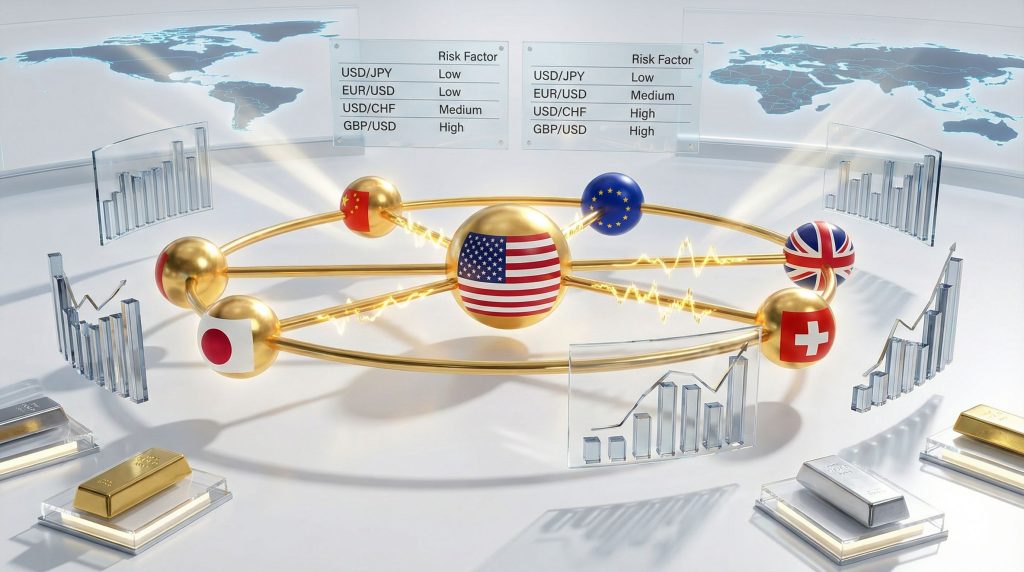
Currency markets exhibit heightened sensitivity to trade policy announcements, with the US dollar experiencing significant weakness following the Supreme Court ruling. The dollar declined 0.4% against the Japanese yen and 0.5% versus the Swiss franc, while the euro and sterling gained 0.3-0.4% as investors reassessed implications of limits on US tariff authority.
Currency Movement Analysis (February 2026):
| Currency Pair | Movement Direction | Magnitude | Market Driver |
|---|---|---|---|
| USD/JPY | USD weakness | -0.4% | Tariff authority limits |
| USD/CHF | USD weakness | -0.5% | Safe haven rebalancing |
| EUR/USD | Euro strength | +0.3% | Relative policy stability |
| GBP/USD | Sterling strength | +0.4% | Brexit trade flexibility |
The February 2026 currency movements demonstrate critical market reassessment where the Supreme Court's tariff ruling prompted investors to recalibrate expectations regarding US economic competitiveness. The dollar's equal weakness across multiple pairs suggests tariff uncertainty reduced perceived US growth prospects rather than creating flight-to-safety dynamics.
USD/JPY Technical Analysis:
- Recent high: ¥155.64
- Current level: ¥154.00
- Support levels: ¥153.62 (mid-November low), ¥152.27-¥152.10 (late January-February lows)
- Resistance target: ¥156.12 (January 5 low)
Tariff Policy Transmission to Currency Markets
Currency markets price forward-looking expectations, explaining why USD weakness preceded actual economic data deterioration. Four theoretical channels explain this transmission:
1. Trade Balance Channel
- Tariffs improve relative import-export pricing
- Uncertainty prevents full pass-through effects
- Creates currency volatility without directional bias
2. Interest Rate Expectations Channel
- Tariff-induced inflation raises Federal Reserve rate expectations
- Supreme Court constraints suggest lower tariff outcomes
- Reduced rate expectations weaken USD valuation
3. Capital Flow Channel
- Tariff uncertainty increases portfolio volatility
- Triggers rebalancing from USD assets into diversified currency baskets
- Foreign investment flows become more selective
4. Relative Growth Expectations
- Tariffs reduce near-term US GDP growth expectations
- Investment deferral and inventory adjustment create headwinds
- Weakens relative currency valuation compared to trading partners
Furthermore, understanding tariff impact on markets helps explain these currency transmission mechanisms.
Emerging Market Currency Exposure
Developing economies demonstrate complex responses to US tariff uncertainty, with Asian markets showing resilience based on tariff relief expectations. The MSCI Asia-Pacific ex-Japan index rose 0.9% in light trading, with South Korea gaining 0.5% and Taiwan reaching record highs with 1.2% increases.
Asian Market Performance Analysis:
| Market | Performance | Strategic Positioning |
|---|---|---|
| South Korea | +0.5% | Export diversification benefits |
| Taiwan | +1.2% (records) | Technology sector resilience |
| MSCI Asia-Pacific ex-Japan | +0.9% | Tariff relief expectations |
Market analysts suggest effective US tariff rates could ease in the near term, supporting export-oriented Asian equities, as reported by Reuters. This reflects a critical insight: emerging market exposure to US tariff uncertainty creates both vulnerability and opportunity, depending on bilateral trade relationships and economic diversification strategies.
Countries with significant dollar-denominated debt obligations face disproportionate impacts, while those with diversified export markets and flexible currency regimes demonstrate greater resilience during uncertainty periods. Moreover, US‑China trade war effects illustrate these complex dynamics across global markets.
What Investment Strategies Emerge During Tariff Uncertainty Periods?
Precious Metals as Inflation Hedges
Gold and silver markets demonstrate increased activity during trade policy uncertainty, reflecting investor concerns about currency debasement and inflationary pressures from higher import costs. Gold climbed 1.1% to $5,159 an ounce while silver rose 3.2% as markets priced approximately 52% chance of a June Federal Reserve rate cut following mixed US growth and inflation data.
Precious Metals Performance Indicators:
| Metal | Price Movement | Key Level | Market Driver |
|---|---|---|---|
| Gold | +1.1% to $5,159/oz | Rate cut expectations | Inflation hedge demand |
| Silver | +3.2% to $87.83/oz | Two-week high | Industrial/safe haven demand |
Silver Technical Analysis:
- Current high: $87.83 (two-week peak)
- Resistance targets: $90.34-$92.20 (January-February range)
- Support levels: $84.03-$82.77 (late December-January highs)
- Medium-term outlook: Neutral with bullish bias above $91.98
The silver price rally reflects both safe haven demand and industrial usage considerations, as trade policy uncertainty affects manufacturing supply chains and input cost calculations. Heightened Iran-US tensions temporarily propelled silver to two-week highs, demonstrating how geopolitical factors amplify precious metals volatility during tariff uncertainty periods. In addition, gold as an inflation hedge provides essential portfolio protection during these volatile periods.
Equity Sector Rotation Patterns
Stock markets exhibit distinct sector rotation behaviours during tariff uncertainty phases, with investors favouring domestic-focused companies over internationally exposed businesses. The retreat from record highs demonstrates how policy uncertainty triggers risk-off sentiment across equity markets.
Sector Performance Analysis:
| Sector Category | Uncertainty Performance | Strategic Rationale |
|---|---|---|
| Domestic Services | Outperformance expected | Reduced import dependency |
| Export Manufacturing | Underperformance likely | Direct tariff exposure |
| Technology | Mixed performance | Complex supply chain effects |
| Commodities | Increased volatility | Input cost fluctuations |
FTSE 100 Technical Framework:
- Record high: 10,745 (recently achieved)
- Current support: 10,639 (Friday's low)
- Trend line support: 10,583 (February uptrend)
- Upside target: 11,000 region
- Bullish threshold: Above 10,442 (February 17 low)
Investment strategies during US tariff uncertainty periods require enhanced portfolio diversification accounting for trade policy risks across multiple dimensions, including geographic revenue exposure, currency hedging optimisation, and alternative asset allocation increases.
How Do Supply Chain Disruptions Amplify Economic Uncertainty?
Manufacturing Sector Adaptations
Global manufacturing networks face fundamental restructuring pressures during extended periods of tariff uncertainty. Companies must balance cost optimisation with supply chain resilience, creating new investment patterns and geographic preferences that extend beyond immediate tariff impacts.
Supply Chain Transformation Metrics:
- Nearshoring investment acceleration
- Inventory level strategic adjustments
- Supplier diversification initiatives
- Regional trade agreement utilisation increases
Manufacturing sector adaptations demonstrate how tariff uncertainty creates permanent structural changes rather than temporary adjustments. Companies implement just-in-case inventory strategies instead of just-in-time models, increasing working capital requirements and affecting cash flow patterns across industries.
Service Sector Indirect Effects
While services typically face less direct tariff exposure, uncertainty creates significant indirect effects through reduced business investment, altered consumer spending patterns, and financial market volatility impacts. Service sector companies experience disruption through:
- Business-to-business demand reduction as manufacturing clients defer expansion
- Consumer discretionary spending shifts affecting retail and hospitality
- Financial services complexity from increased hedging and risk management requirements
- Technology services demand for supply chain optimisation and trade compliance
The interconnected nature of modern service economies means US tariff uncertainty cascades through multiple economic sectors simultaneously, creating amplified effects beyond direct trade-exposed industries.
What Are the Long-Term Structural Economic Implications?
Trade Relationship Realignment
Persistent tariff uncertainty accelerates structural changes in global trade relationships, potentially creating permanent shifts in economic partnerships and supply chain configurations. Oil markets reflect these broader concerns, with Brent crude falling 1.3% to $70.84 and WTI dropping to $65.61 as traders assess implications of US-Iran nuclear negotiations in Geneva.
Structural Change Indicators:
- Bilateral trade volume trend modifications
- Foreign direct investment flow redirections
- Regional economic integration acceleration
- Technology transfer pattern changes
The energy sector demonstrates how geopolitical uncertainties interact with trade policy volatility, creating compound effects on global economic relationships. US-Iran nuclear negotiations represent broader patterns where trade policy uncertainty intersects with diplomatic and security considerations.
Monetary Policy Coordination Challenges
Central banks face increased complexity in policy coordination when tariff uncertainty creates divergent inflationary pressures across economies. The 52% probability of June Fed rate cuts reflects this coordination challenge, as monetary authorities must balance domestic inflation concerns with international competitive considerations.
Central Bank Coordination Framework:
- Divergent inflation transmission across economies
- Currency intervention coordination requirements
- Interest rate policy synchronisation challenges
- Financial stability monitoring enhancement
This coordination complexity amplifies macroeconomic effects of trade policy volatility, as central banks must navigate between domestic policy objectives and international financial stability considerations. However, reports from The Wall Street Journal indicate that these challenges continue affecting global markets significantly.
The next major ASX story will hit our subscribers first
How Should Investors Position for Continued Uncertainty?
Portfolio Diversification Strategies
Investment portfolios require enhanced diversification strategies that account for trade policy risks across multiple dimensions. Risk management frameworks must incorporate geographic exposure analysis, currency hedging optimisation, and sector correlation monitoring to navigate US tariff uncertainty effectively.
Enhanced Diversification Components:
- Geographic revenue exposure analysis: Assess company-level international sales dependencies
- Currency hedging optimisation: Dynamic hedging ratios based on tariff policy developments
- Sector correlation monitoring: Track changing relationships between domestic and international sectors
- Alternative asset allocation: Increase precious metals, commodities, and real assets exposure
Scenario Planning Methodologies
Successful navigation of tariff uncertainty requires robust scenario planning incorporating multiple policy outcomes and cascading economic effects. Investment scenarios must account for:
Policy Escalation Pathways:
- Constitutional challenges to tariff authority
- Congressional intervention possibilities
- International retaliatory measures
- Bilateral negotiation outcomes
Economic Impact Modelling:
- GDP growth effect calculations
- Inflation transmission analysis
- Currency valuation projections
- Sector performance forecasting
Market Reaction Forecasting:
- Equity market volatility expectations
- Bond yield curve adjustments
- Commodity price correlations
- Foreign exchange rate ranges
Scenario development must incorporate both immediate market impacts and longer-term structural changes reshaping international economic relationships, requiring continuous strategy refinement as new information becomes available.
Navigating the New Trade Policy Reality
US tariff uncertainty represents a fundamental shift in global economic risk management, requiring sophisticated analytical frameworks and adaptive investment strategies. The February 2026 market movements demonstrate how constitutional constraints, policy flexibility, and market dynamics create environments where traditional economic models require continuous refinement.
The intersection of legal limitations, tactical policy implementation, and market reactions creates unprecedented complexity for investors and businesses. Success in this environment demands understanding both immediate market impacts and longer-term structural changes reshaping international economic relationships.
Key insights for navigating this environment include:
- Constitutional constraints on executive tariff authority create new policy implementation pathways
- Currency markets demonstrate heightened sensitivity to trade policy developments with USD experiencing broad-based weakness
- Precious metals serve as effective hedges against policy-induced inflation and currency debasement
- Asian markets show resilience based on expectations of reduced tariff pressure following legal constraints
- Supply chain restructuring creates permanent economic changes beyond temporary policy adjustments
Investment success requires enhanced capabilities for rapid strategy adjustment while maintaining focus on long-term value creation objectives. Portfolio diversification, scenario planning, and risk management become essential tools for navigating sustained periods of trade policy volatility.
The evolving landscape demands continuous monitoring of legal developments, policy implementation patterns, and market responses to maintain effective positioning across asset classes. Investors must develop frameworks accommodating both immediate volatility and structural economic transformation occurring through persistent US tariff uncertainty.
Disclaimer: This analysis involves forecasts and speculative elements regarding future trade policy developments and market reactions. Past performance does not guarantee future results. Investors should conduct independent research and consider professional advice before making investment decisions based on trade policy uncertainty scenarios.
Ready to capitalise on market volatility from trade uncertainty?
Discovery Alert's proprietary Discovery IQ model delivers instant notifications when significant ASX mineral discoveries are announced, helping you identify opportunities whilst global markets navigate policy-driven turbulence. Begin your 14-day free trial today to position yourself ahead of market uncertainty and secure actionable insights that traditional analysis might miss.