
June 21, 2026
The Hidden Architecture Behind North American Metal Trade
Trade policy rarely operates the way its architects intend. Tariffs designed to protect domestic industries routinely generate unintended consequences upstream, downstream, and across borders in ways that reshape entire industrial ecosystems. The Section 232 framework governing US tariffs on Mexican steel and aluminum is a textbook illustration of this phenomenon: a national security instrument that has quietly become the structural backbone of North American metal trade relations, influencing everything from automotive pricing in Detroit to public works procurement in Mexico City.
Understanding this framework requires moving beyond headline tariff rates and into the mechanics of how bilateral agreements, surge protection clauses, and performance-based duty adjustment pathways interact with geopolitical forces and domestic industrial policy. The full picture is considerably more nuanced than the 50% tariff figure that dominates media coverage. For a broader view of how these measures ripple outwards, the steel and aluminum tariff impact extends well beyond North America.
When big ASX news breaks, our subscribers know first
Why the Section 232 National Security Argument Matters More Than It Appears
Section 232 of the Trade Expansion Act of 1962 grants the US president broad authority to impose import restrictions when the Department of Commerce determines that foreign products threaten national security. When the framework was activated for steel and aluminum in 2018, critics argued the national security justification stretched credibility when applied to close allies like Canada and Mexico.
What those critics missed, however, was the strategic intent embedded in the framework's design. By invoking national security rather than standard trade remedy mechanisms — anti-dumping, countervailing duties, or safeguard provisions under WTO rules — the US government gained considerably more flexibility to negotiate bilateral carve-outs, attach conditions to exemptions, and adjust the framework without triggering standard WTO dispute resolution timelines.
The result is a hybrid instrument: nominally a universal tariff, but operationally a system of differentiated bilateral relationships wrapped in a national security rationale.
Current US Tariff Rates on Steel and Aluminum: A Tiered Structure Most Analysts Overlook
The public narrative fixates on the 50% base rate, but the actual tariff architecture as of April 2026 is considerably more granular. Different product categories face materially different duty levels depending on their composition, end-use application, and origin of input materials.
| Product Category | Tariff Rate | Effective From |
|---|---|---|
| Primary steel/aluminum articles (coils, sheets) | 50% | June 2025 |
| Derivative products substantially made of covered metals | 25% | April 2026 |
| Metal-intensive equipment | 15% (through 2027) | April 2026 |
| Products made entirely with US-origin metals processed abroad | 10% | April 2026 |
| Products containing 15% or less covered metals | Exempt | April 2026 |
| Copper (primary articles) | 50% | July 2025 |
Several policy design choices embedded in this structure deserve closer analysis:
- The de minimis 15% threshold for covered metal content reflects a deliberate administrative calculation, balancing enforcement costs against protectionist objectives.
- The temporary 15% rate on metal-intensive equipment, set to expire in 2027, suggests a transitional protection period rather than a permanent trade barrier, potentially inviting renegotiation pressure as that deadline approaches.
- The 10% rate for products using US-origin metals processed abroad creates an incentive for manufacturers to source American primary metal even when finishing operations occur offshore, effectively extending the reach of US industrial policy beyond domestic borders.
- Copper's inclusion from July 2025 represents a significant expansion of the framework's scope, reflecting growing strategic concern about copper supply security in the context of electrification and defence manufacturing demands.
Furthermore, understanding the global commodity tariff effects of these tiered rates helps illustrate just how far-reaching the framework's influence has become.
The layered tariff structure functions less like a simple trade barrier and more like a behavioural incentive system, rewarding supply chain configurations that align with US industrial policy objectives regardless of where final processing occurs.
Mexico's Bilateral Agreement: Preferential Access with Conditional Strings
The 2018 US-Mexico bilateral agreement created a parallel trade lane that effectively exempts qualifying Mexican steel and aluminum from the standard Section 232 duties. Understanding this agreement requires examining not just what it grants, but what it withholds.
The agreement's core provisions include:
- Full elimination of Section 232 steel and aluminum duties between the two countries
- Simultaneous removal of Mexico's retaliatory tariffs within a compressed two-day window
- Ongoing monitoring provisions targeting dumping, subsidy channelling, and transshipment risks
- Separate treatment for North American-melted and poured steel, creating a distinct regulatory category for regionally integrated supply chains
How Surge Protection Works in Practice
The agreement's conditional architecture centres on surge protection mechanisms. If Mexican steel or aluminum imports exceed established historic trade volume thresholds or defined market share benchmarks, the US retains authority to impose temporary safeguard duties: 25% on steel and 10% on aluminum by product category. Critically, Mexico's retaliatory rights under such scenarios are explicitly constrained by the agreement's terms, creating an asymmetric enforcement structure.
This asymmetry reflects the underlying power differential in the relationship. Mexico gains the commercial benefit of tariff-free access; the US retains the operational levers to restrict that access if trade patterns deviate from established norms. The surge protection mechanism functions as a behavioural guardrail rather than a punitive measure, but its activation would have significant consequences for Mexican producers operating on thin margins.
The 225,000 metric ton billet provision represents a specific quantitative threshold within this framework, establishing a ceiling for certain steel semifinished products. This level of granularity in a bilateral agreement is unusual and reflects the sophisticated trade monitoring infrastructure both governments agreed to maintain.
The Commerce Department's New Tariff Reduction Pathway: Performance-Based Duty Relief
As of April 2026, the US Department of Commerce opened a tariff-adjustment process that introduces an entirely new dimension to the US tariffs on Mexican steel and aluminum landscape. Rather than blanket rate reductions or renegotiated exemptions, this pathway creates a performance-based mechanism: producers can access reduced Section 232 duties, but only by demonstrating a verifiable commitment to expanding US primary steel or aluminium production capacity.
The eligibility requirements reveal the policy's strategic intent:
- Qualifying supply chains must be specifically tied to automotive, medium-duty, and heavy-duty vehicle manufacturing
- Producers must demonstrate concrete plans to expand US primary metal production capacity, not simply increase processing or finishing operations
- The process applies symmetrically to both Mexican and Canadian producers under parallel conditions, suggesting a coordinated North American industrial policy approach rather than a bilateral-only framework
Why Automotive Manufacturing Is the Qualifying Threshold
Restricting tariff relief to automotive supply chains is not arbitrary. The automotive sector represents one of the highest-value, highest-employment manufacturing clusters in North America, and its supply chains exhibit precisely the complexity that policymakers want to anchor domestically.
By making automotive supply chain participation the gateway to duty relief, the Commerce Department effectively recruits the automotive industry as an enforcement partner: producers seeking tariff advantages must align their investment decisions with US capacity-building objectives.
This mechanism also reflects a sophisticated understanding of the steel and aluminium supply chain. Primary metal producers seeking tariff relief must invest upstream in US capacity; downstream automotive manufacturers benefit from more cost-competitive Mexican and Canadian metal inputs. The policy simultaneously incentivises upstream investment and downstream competitiveness.
Historical Impact: What the 2018 Tariff Shock Revealed About Economic Vulnerabilities
When Section 232 tariffs first took effect in 2018, the economic consequences spread rapidly across multiple sectors. Metal prices across North American markets rose by an estimated 5 to 10% in the months following implementation. Mexico's automotive sector, which contributes approximately 4% of GDP, faced immediate upstream cost pressure as steel and aluminium input prices reflected the tariff shock.
US consumers and manufacturers absorbed the downstream consequences. Independent analyses suggested that additional manufacturing costs attributable to metal tariff pass-through added an estimated $2,000 or more per vehicle to production expenses — costs that ultimately flowed through to retail pricing and compressed automotive sector margins.
One of the more counterintuitive findings from the 2018 experience was that tariffs nominally designed to counter Chinese subsidies and overcapacity often raised costs most significantly for US manufacturers, not Chinese producers. Chinese steel entered the US market through complex routing patterns that the tariff architecture struggled to intercept, while allied nations with transparent supply chains faced the full duty burden. This dynamic directly motivated the bilateral exemption negotiations with Mexico and Canada.
The USMCA negotiation process, which ran parallel to the initial tariff period, illustrated how effectively tariff pressure can be used as a negotiating lever. Tariff exemptions were deployed as rewards for trade agreement concessions, blurring the line between trade remedy and trade negotiation tactics. Consequently, the iron ore markets under tariffs experienced similarly complex knock-on effects during this period.
The next major ASX story will hit our subscribers first
Mexico's Domestic Response: The National Steel Sourcing Strategy
Mexico's response to external tariff uncertainty has taken a distinctly inward-looking form. The Agreement for the Promotion of the Mexican Steel Industry, signed by the federal government alongside representatives from the steel, housing, and construction sectors, establishes a formal commitment to prioritising domestic steel procurement in public infrastructure projects. According to Reuters, this policy shift represents one of the most direct industrial responses to US tariff pressure seen in the region.
The agreement's three core objectives work in concert:
- Prioritise domestic steel in public works procurement, directing government contract spending toward national producers rather than imported alternatives
- Facilitate import substitution across strategic construction and infrastructure categories
- Protect national employment within the steel production and processing workforce
Why Public Works Procurement Functions as a Strategic Industrial Lever
Government infrastructure spending represents one of the most powerful and direct mechanisms available to an industrial policy toolkit. Unlike tax incentives or regulatory relief, procurement commitments translate immediately into guaranteed revenue streams for domestic producers, reducing commercial risk and enabling capacity investment that would otherwise require uncertain market signals.
For Mexican steelmakers, preferential access to public works contracts provides a demand floor that partially offsets the revenue volatility created by US tariff uncertainty. If external conditions deteriorate and tariff-free access to the US market becomes restricted, domestic demand anchored in infrastructure spending provides a structural buffer.
This import substitution approach also reduces Mexico's exposure to global commodity price swings for finished steel products, since domestically sourced materials bypass the currency and logistics cost structures associated with imports.
Mexico's Mining Sector at Scale: Revenue Concentration and Structural Significance
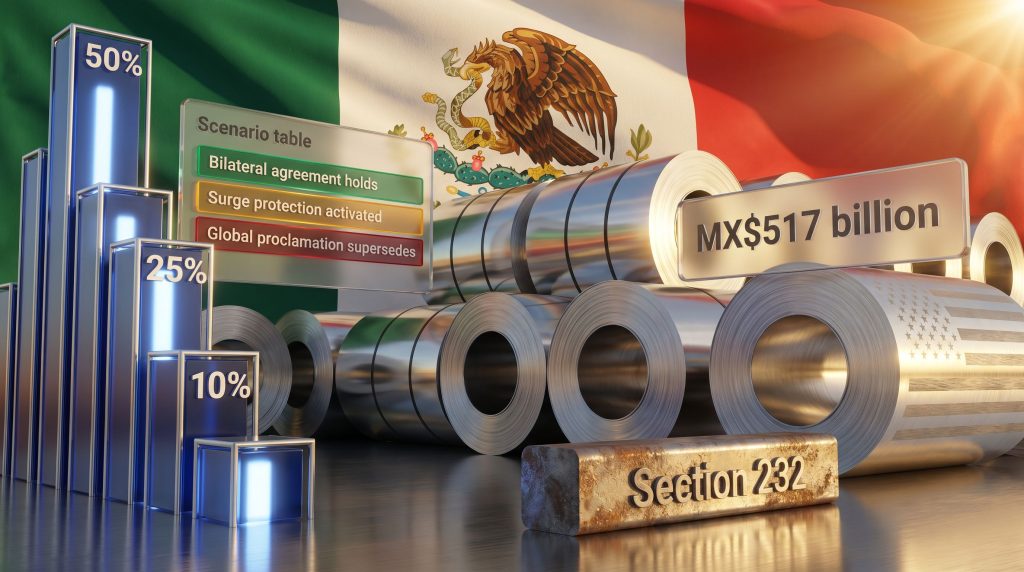
The broader context for understanding US tariffs on Mexican steel and aluminum requires appreciating the scale of Mexico's mining and metals sector. According to Expansión's ranking of Mexico's 500 most important companies, the country's ten largest mining enterprises collectively generate combined annual revenues exceeding MX$517 billion — a figure that underscores the sector's outsized economic significance.
Revenue concentration at this scale has important implications for tariff impact assessment. When a small number of large producers dominate national mining output, tariff disruptions that affect even one or two major operators can generate systemic economic effects disproportionate to the companies' individual size. Conversely, large producers possess greater financial resources to absorb short-term tariff cost increases while investing in the qualifying capacity commitments required to access duty reduction pathways.
The relationship between mining output and steel feedstock supply also connects directly to tariff exposure. Mexico's iron ore and metallurgical coal production feeds directly into domestic steel production capacity, meaning that tariffs affecting finished steel exports can create cascading effects upstream into mining operations, employment, and regional economies dependent on extraction industries. The US iron ore tariff impact illustrates precisely how these upstream pressures compound over time.
Geopolitical Forces and the Friendshoring Premium
The Institute of the Americas has articulated a framework that cuts to the heart of why North American metal trade faces structural reconfiguration beyond tariff mechanics. As geopolitical tensions and energy transition demands intensify, proximity and political alignment are becoming premium attributes for mineral and metal supply chains — attributes that pure cost competitiveness cannot replicate.
The IOA's analysis identifies a critical transition that mineral-rich nations must navigate: moving from functioning as raw resource exporters to establishing themselves as second-anchor nodes in global supply chains requires deliberate alignment of regulatory regimes and incentive structures. Geological wealth is a necessary but insufficient condition for achieving this elevated supply chain status.
This framework positions the US-Mexico bilateral tariff relationship within a larger strategic logic. Mexico's proximity, political relationship, and existing manufacturing infrastructure make it a natural candidate for friendshoring elevation, but only if regulatory alignment and investment incentives reinforce that geographic and political advantage. The evolving metals and mining geopolitics of the region add further complexity to this already layered picture.
Regulatory Divergence as the Primary Long-Term Risk
Joel González, Senior Partner at ALN Abogados, has identified five critical pillars that mining operations must align with to navigate Mexico's current regulatory environment: water management, forestry compliance, education commitments, financing structures, and responsible operational protocols. His perspective — that a multidisciplinary approach emphasising social resilience and rigorous documentation is essential for navigating permitting processes — reflects a regulatory environment that has tightened considerably around non-compliant concessions.
This regulatory complexity creates a dual risk for North American metal trade integration. Producers who cannot navigate Mexico's evolving permitting and compliance landscape may be structurally unable to access the tariff reduction pathway that requires demonstrable US capacity investment, since they cannot reliably operate and invest simultaneously across two regulatory jurisdictions.
Scenario Analysis: Three Possible Trajectories for US-Mexico Metal Trade
| Scenario | Trigger Condition | Likely Outcome |
|---|---|---|
| Bilateral agreement holds | No surge events; producers meet US capacity commitments | Continued tariff-free access for qualifying Mexican steel |
| Surge protection activated | Import volumes exceed historic thresholds | Temporary 25% steel / 10% aluminum safeguard duties applied |
| Global proclamation supersedes bilateral deal | Political renegotiation or legal challenge | Mexican producers exposed to full 50% base rate |
The third scenario carries the most severe commercial consequences but also the most complex political prerequisites. Superseding the 2018 bilateral agreement through a new global proclamation would require either a deliberate executive policy reversal or a successful legal challenge to the agreement's continued legal force.
Peru's political situation provides a sobering parallel. The South American nation's leftist presidential frontrunner, campaigning on plans to overhaul mining taxation, phase out open-pit operations, and redraft the constitution, has already rattled investors in the world's third-largest copper producer. The lesson for Mexico is clear: regulatory and political stability are not passive background conditions for mining investment — they are active determinants of whether geological and geographic advantages translate into durable commercial relationships. White & Case's analysis of Section 232 modifications further underscores how rapidly the regulatory ground can shift beneath even established bilateral frameworks.
FAQ: US Tariffs on Mexican Steel and Aluminum
What is the current US tariff rate on Mexican steel imports?
Under the 2018 bilateral agreement, qualifying Mexican steel imports are exempt from standard Section 232 duties. Most trading partners face a 50% base rate on primary steel and aluminium articles. Mexico's exemption is conditional on trade volume monitoring and compliance with surge protection provisions.
What triggers surge protection under the US-Mexico agreement?
If Mexican steel or aluminium imports exceed established historic volume thresholds or defined market share benchmarks, temporary safeguard duties of 25% on steel or 10% on aluminum can be applied per product category. Mexico's retaliatory rights in these scenarios are explicitly limited by the agreement's terms.
Can Mexican steel producers access tariff reductions under the new Commerce Department process?
Yes, provided they demonstrate a commitment to expanding US primary steel or aluminium production capacity tied specifically to automotive, medium-duty, and heavy-duty vehicle supply chains. The same pathway applies to Canadian producers under parallel conditions.
When were copper imports added to the Section 232 framework?
Copper primary articles were incorporated into the Section 232 tariff framework in July 2025, with a 50% duty rate matching the rate applied to primary steel and aluminium.
How do US steel tariffs affect Mexican automotive manufacturing?
Mexico's automotive sector, representing approximately 4% of GDP, faces significant upstream cost exposure when steel and aluminium tariffs affect input costs. The sector's dual dependence on both imported and domestically sourced metals makes it the highest-exposure industry in the bilateral tariff relationship, which is also why automotive supply chains serve as the qualifying threshold for the new Commerce Department duty reduction pathway.
This article reflects publicly available information as of May 2026. Tariff rates, policy frameworks, and trade agreement terms are subject to change through executive action, legislative development, or bilateral negotiation. Nothing in this article constitutes investment, legal, or trade compliance advice. Readers with specific commercial exposure to Section 232 tariffs should consult qualified trade counsel.
Want to Know Which ASX Mining Companies Stand to Benefit From Shifting Metal Trade Dynamics?
Discovery Alert's proprietary Discovery IQ model delivers real-time alerts on significant ASX mineral discoveries, instantly translating complex commodity and supply chain shifts into actionable investment opportunities — whether you're a short-term trader or a long-term investor seeking the next major find. Explore historic discoveries and their extraordinary returns, then begin your 14-day free trial to position yourself ahead of the market.