August 24, 2026
US tensions and possible regime shift in Venezuela present a complex intersection of energy security, sanctions policy, and geopolitical strategy that extends far beyond bilateral relations to influence global commodity markets and regional power structures. The intersection of energy security, sanctions policy, and regime stability creates strategic implications that ripple through international markets, particularly given Venezuela's position as holder of the world's largest proven oil reserves and its historical role in global energy supply chains.
Furthermore, understanding these dynamics requires examining not just the immediate tactical moves between Washington and Caracas, but the broader strategic implications for Western Hemisphere energy architecture and global supply chain resilience. The OPEC market influence becomes particularly relevant when considering how regime change might reshape cartel dynamics.
Venezuelan Energy Infrastructure Under Strategic Pressure
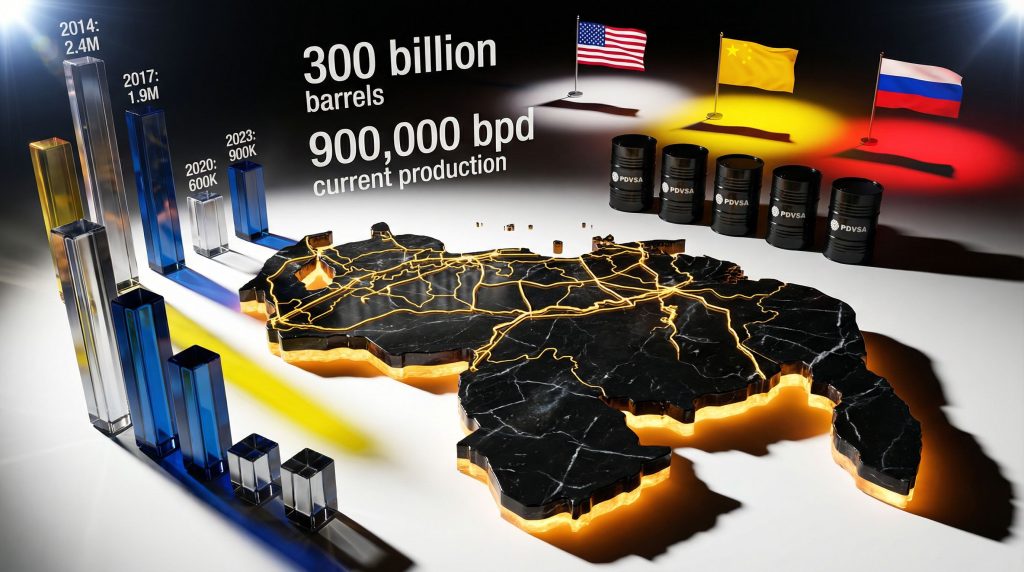
Venezuela's position as holder of the world's largest proven crude oil reserves, estimated at approximately 303.8 billion barrels according to the U.S. Energy Information Administration, creates unique strategic considerations for both regional stability and global energy markets. Yet current production languishes at roughly 900,000 barrels per day, representing a dramatic decline from the 3.2 million barrels per day achieved during the late 1990s peak production period.
This production collapse stems primarily from operational deterioration rather than resource depletion, a distinction that carries significant implications for potential recovery scenarios. Wood Mackenzie analysis suggests that many Venezuelan wells simply require workover operations, meaning production increases could be achieved through operational expenditures without substantial new capital investment.
The Orinoco Belt's heavy crude deposits present particular strategic value for U.S. Gulf Coast refineries specifically designed to process heavy grades. These facilities, representing billions of dollars in specialised infrastructure investment, have historically relied on Venezuelan crude imports to optimise their operational efficiency and economic returns.
Current Production Constraints and Technical Challenges
PDVSA's operational limitations under current sanctions create cascading effects throughout Venezuela's energy infrastructure. Moreover, these constraints demonstrate how modern sanctions regimes can effectively target specific sectors whilst maintaining some operational flexibility.
• Asset freezes preventing access to U.S. financial systems and technology transfers
• Restricted ability to conduct routine maintenance and capital investment programmes
• Limited access to specialised oilfield equipment and technical expertise
• Constraints on international joint venture partnerships and operations
Chevron's exceptional operating status as the sole Western company maintaining Venezuelan operations under special U.S. Treasury licenses demonstrates both the complexity of sanctions implementation and the strategic importance of maintaining some operational continuity. This arrangement allows limited crude production and export whilst preserving technical knowledge and infrastructure integrity.
The technical specifications of Venezuelan crude present both opportunities and challenges. The Orinoco Belt bitumen requires specialised extraction and upgrading technology, with API gravity around 8-10 degrees and high sulfur content demanding sophisticated refining capabilities. This heavy crude profile makes Venezuelan oil particularly valuable to refineries configured for such grades, but also limits the global market for direct substitutes.
When big ASX news breaks, our subscribers know first
Escalating Tensions and Strategic Calculations
The Trump administration's 2025 national security strategy explicitly prioritises strengthening U.S. influence across Latin America, positioning Venezuela as a critical test case for regional leadership. This strategic focus reflects broader concerns about Chinese and Russian influence expansion in America's traditional sphere of influence, whilst the U.S.-China trade war impact continues to shape regional dynamics.
Recent escalation patterns demonstrate coordinated policy implementation rather than isolated tactical moves. The December 2025 seizure of a Venezuelan oil tanker coincided precisely with the release of the new national security strategy, indicating deliberate escalation timing designed to maximise policy impact and regional signalling effects.
Sanctions Architecture Evolution and Enforcement Mechanisms
Current U.S. sanctions employ multiple enforcement layers designed to maximise economic pressure whilst preserving policy flexibility. Additionally, the framework incorporates lessons learned from previous sanctions regimes applied to Iran and Russia.
Primary Sanctions on PDVSA:
• Complete asset freezes blocking U.S. financial system access
• Prohibition on crude oil sales denominated in U.S. dollars
• Restrictions on dividend payments and profit repatriation
• Limitations on technology transfers and technical assistance
Secondary Sanctions Framework:
• Threats against non-U.S. companies conducting business with PDVSA
• Potential exclusion from U.S. markets for sanctions violations
• Maritime interdiction operations targeting Venezuelan crude shipments
• Financial sector restrictions affecting international banking relationships
The December 2025 sanctions expansion specifically targeted Maduro family members and business associates, representing a shift toward personal sanctions designed to directly impact regime survival finances. This approach differs from purely institutional sanctions by creating individual accountability mechanisms and potential negotiation leverage.
Venezuelan production declined approximately 65-70% since 2015 under cumulative sanctions pressure, though precise attribution between sanctions effects and operational mismanagement remains analytically challenging. The estimated $100+ billion in lost oil revenues since 2019 reflects both actual export losses and opportunity costs from foregone production capacity.
Consequently, the Trump tariffs and oil prices relationship becomes increasingly complex as Venezuelan supply constraints interact with broader trade policy measures.
Strategic Scenario Framework: Multiple Pathways Forward
Managed Political Transition Scenario
This pathway involves Venezuelan power structures negotiating a managed transition under sustained international pressure, similar to transitions observed in other Latin American contexts. The probability assessment suggests moderate likelihood (35-40%) based on historical precedents and current political dynamics.
Key triggering mechanisms include:
• Military leadership calculating long-term regime survival costs
• Economic elite seeking sanctions relief and international market access
• Regional mediation efforts through Brazil, Colombia, or Mexico
• Gradual defection of key government and security figures
Under this scenario, energy market implications could be substantial:
| Timeline | Production Increase | Investment Required | Key Factors |
|---|---|---|---|
| 6-12 months | 200,000-400,000 bpd | Minimal operational expenditure | Well workover programmes |
| 1-2 years | 500,000-1,000,000 bpd | $5-10 billion | International expertise return |
| 3-5 years | 1,500,000+ bpd | $20+ billion | Full infrastructure rehabilitation |
The managed transition scenario assumes cooperative international support and gradual sanctions relief, allowing for systematic reconstruction of Venezuela's energy sector capabilities. However, the trade war oil market impact must be considered when evaluating potential recovery timelines.
Authoritarian Consolidation Under Pressure
This pathway, assessed as having the highest probability (45-50%), involves the Maduro government successfully weathering external pressure through enhanced repression and alternative economic partnerships, particularly with China and Russia. In this scenario, US tensions and possible regime shift in Venezuela would reach a stalemate with significant long-term implications.
Stabilisation mechanisms include:
• Increased security apparatus control over domestic opposition
• Economic diversification away from traditional Western markets
• Enhanced cooperation with other sanctioned nations (Iran, Russia)
• Regional alliance building with sympathetic governments
Market consequences under this scenario:
• Continued Venezuelan production stagnation around current 900,000 bpd levels
• Strengthened China-Venezuela oil-for-loans arrangements exceeding current $60+ billion commitments
• Potential retaliatory measures affecting regional energy flows
• Sustained pressure on global heavy crude availability and pricing
Chinese strategic calculations become particularly important under this scenario, as Beijing's substantial infrastructure investments create incentives for continued support despite international pressure. The Belt and Road Initiative framework provides alternative financing mechanisms that could sustain Venezuelan operations independently of Western financial systems.
Prolonged Instability and Fragmentation
While assessed as lower probability (15-20%), this scenario presents significant risks for regional stability and global energy markets. Political deadlock could lead to territorial fragmentation, humanitarian crisis escalation, and cross-border security spillover effects.
Destabilising factors include:
• Military fractures along regional or institutional lines
• Economic collapse triggering mass migration exceeding current levels
• Cross-border incidents involving neighbouring countries
• International intervention complications and proxy conflicts
Energy sector risks under fragmentation:
• Accelerated infrastructure degradation and production decline
• Force majeure declarations affecting existing international contracts
• Regional energy security disruptions affecting Colombia and Brazil
• Humanitarian crisis overwhelming neighbouring countries' resources
Global Oil Market Transformation Potential
Production Recovery Trajectories and Technical Feasibility
Wood Mackenzie analysis indicates that operational improvements could restore Venezuelan production to 2 million barrels per day within 1-2 years through focused workover programmes and enhanced operational management. This assessment assumes sanctions relief and renewed international technical cooperation.
Short-term recovery potential (1-2 years):
• Well workover programmes addressing deferred maintenance backlogs
• Operational management improvements with international expertise
• Limited capital investment in existing mature field operations
• Enhanced recovery techniques application in established areas
Medium-term expansion potential (3-5 years):
• Comprehensive Orinoco Belt joint venture restoration
• Estimated $20 billion investment requirement for infrastructure rehabilitation
• Technology transfer from international oil company partners
• New field development and production capacity expansion
The technical feasibility of rapid production recovery distinguishes Venezuela from other oil-producing nations facing similar challenges. Unlike geological depletion or reservoir damage, Venezuela's production decline stems primarily from operational and financial constraints that can be addressed through appropriate investment and expertise application.
OPEC Dynamics and Cartel Restructuring
A U.S.-aligned Venezuelan government would fundamentally alter OPEC's internal power dynamics and decision-making processes. Venezuela's status as one of OPEC's five founding members in 1960 alongside Saudi Arabia, Iraq, Iran, and Kuwait complicates any scenarios involving membership withdrawal or expulsion.
Strategic advantages for Washington include:
• Enhanced coordination with Saudi Arabia and UAE on production policy
• Venezuelan support for moderate pricing policies aligned with U.S. interests
• Reduced Iranian and Russian influence within cartel decision-making
• Potential cooperation frameworks with non-OPEC producers
According to recent analysis from Venezuela's Oil Future, Bob McNally of Rapidan Energy Group notes that President Trump's emphasis on strong relationships with Riyadh and Abu Dhabi creates complex dynamics, as these OPEC founders prioritise maintaining cartel cohesion over U.S. preferences for Venezuelan exclusion.
OPEC adaptation strategies would likely include:
• Production quota reallocation accommodating Venezuelan recovery
• Pricing policy adjustments reflecting new geopolitical realities
• Internal governance modifications addressing U.S. strategic concerns
• Enhanced cooperation mechanisms with North American producers
Venezuela currently operates under OPEC+ production cut exemptions due to sanctions-constrained output, but restored production capacity would require integration into cartel quota systems and production management frameworks.
Investment Architecture and Capital Requirements
International Oil Company Strategic Positioning
Major international oil companies are positioning for potential Venezuelan market re-entry, with several firms maintaining contingency planning despite current operational restrictions. Furthermore, the tariffs impacting investments create additional considerations for capital allocation decisions.
Chevron's competitive advantages:
• Existing operational presence under special U.S. licenses
• Maintained technical knowledge and local relationships
• Infrastructure familiarity and geological expertise
• Established crude export and marketing capabilities
ExxonMobil's historical claims:
• Substantial pre-sanctions investments and infrastructure
• Arbitration proceedings against Venezuelan government
• Technical expertise in heavy crude development
• Gulf Coast refining integration capabilities
European majors (Total, Shell, BP) maintain interest in Venezuelan opportunities despite European Union sanctions coordination with U.S. policy. These companies possess specialised heavy crude development experience and global marketing networks essential for Venezuelan crude commercialisation.
Infrastructure Investment Framework and Financial Requirements
| Sector | Investment Range | Timeline | Expected Returns |
|---|---|---|---|
| Upstream Operations | $15-20 billion | 3-5 years | 500,000+ bpd capacity addition |
| Refining Infrastructure | $8-12 billion | 4-6 years | Regional supply security enhancement |
| Pipeline Systems | $5-8 billion | 2-4 years | Export capacity restoration |
| Port and Terminal Facilities | $3-5 billion | 2-3 years | International market access |
| Power and Utilities | $4-7 billion | 3-5 years | Operational infrastructure support |
Risk assessment considerations include:
• Transition government stability and international recognition
• Property rights restoration and legal framework establishment
• Debt restructuring negotiations involving $150+ billion external obligations
• Regulatory modernisation and investment protection mechanisms
Chinese debt obligations present particular complexity, with China holding approximately $60+ billion in Venezuelan infrastructure loans that would require resolution under any new government framework. These obligations could either facilitate smooth transition through Chinese cooperation or create complications if Beijing opposes regime change.
Regional Security Architecture and Migration Dynamics
Migration Management and Regional Integration
Venezuela's migration crisis involves over 7 million Venezuelans living abroad, primarily in Colombia, Peru, and Ecuador. This displacement creates both humanitarian challenges and potential opportunities for reverse migration under improved political and economic conditions.
Current migration patterns include:
• Approximately 2.8 million Venezuelans in Colombia
• 1.5 million in Peru
• 500,000+ in Ecuador
• Significant populations throughout Central America and the Caribbean
Successful political transition could trigger reverse migration flows as economic opportunities improve and security conditions stabilise. However, this process would require careful management to prevent infrastructure overload and social tensions.
Regional integration frameworks would need enhancement to manage migration flows effectively:
• Standardised documentation and legal status recognition
• Economic integration programmes supporting Venezuelan reintegration
• Infrastructure development supporting population movements
• Social services coordination across national boundaries
Security Cooperation and Counter-Narcotics Operations
Enhanced U.S.-regional cooperation under a new Venezuelan government could address multiple security challenges. Additionally, improved coordination mechanisms would strengthen regional stability frameworks.
Drug trafficking network disruption:
• Coordination with Colombian anti-narcotics operations
• Border security standardisation and intelligence sharing
• Maritime interdiction capability enhancement
• Alternative development programmes in affected regions
Regional security architecture improvements:
• Intelligence sharing mechanisms and operational coordination
• Counter-terrorism cooperation frameworks
• Border monitoring and control system modernisation
• Military cooperation and training programme development
Venezuelan territory currently serves as a transit corridor for South American cocaine trafficking, with weak state control enabling criminal organisation operations. Restored governmental authority could significantly disrupt these networks whilst improving regional security cooperation.
The next major ASX story will hit our subscribers first
Global Power Competition and Strategic Responses
Chinese Economic Calculations and Belt and Road Implications
China's $60+ billion infrastructure investment in Venezuela through loans, construction projects, and energy sector cooperation creates complex strategic considerations under regime change scenarios. These investments span multiple sectors beyond energy, including telecommunications, transportation, and manufacturing.
Chinese strategic interests include:
• Debt recovery mechanisms under new governmental structures
• Belt and Road Initiative project continuity and expansion
• Alternative Latin American partnership development
• Energy security diversification through South American suppliers
Beijing's approach to Venezuelan regime change would likely emphasise pragmatic accommodation rather than ideological opposition, assuming debt obligations receive appropriate treatment and Chinese commercial interests maintain protection under new arrangements.
Chinese oil-for-loans arrangements currently provide Venezuela with crucial financing whilst securing long-term crude supply contracts for Chinese refineries. These mechanisms could either facilitate transition through continued economic support or create complications if new governments seek contract renegotiation.
Russian Geopolitical Positioning and Military Cooperation
Moscow's Venezuelan engagement serves broader strategic objectives beyond immediate economic returns. Russian military advisors, defence cooperation frameworks, and energy sector partnerships represent investments in regional influence projection rather than purely commercial ventures.
Russian strategic objectives include:
• Regional influence projection capabilities in U.S. sphere of influence
• Alternative energy partnership models challenging U.S. dominance
• Defence cooperation frameworks and military presence maintenance
• Precedent establishment for supporting anti-U.S. governments globally
Russian response to Venezuelan regime change would likely involve strategic retrenchment whilst maintaining capabilities for future engagement. According to recent analysis on Venezuela and US conflict, Moscow's limited financial resources constrain its ability to compete with U.S. and Chinese economic incentives, but military and security cooperation could continue through alternative mechanisms.
Economic Impact Analysis and Market Projections
Oil Price Implications Under Different Scenarios
Managed Transition Scenario (35-40% probability):
• Short-term: $3-5 per barrel price decline as markets price in supply recovery expectations
• Medium-term: Price stabilisation around $65-75 per barrel with increased supply cushion
• Long-term: Enhanced market stability through diversified supply sources and reduced geopolitical risk premiums
Continued Instability Scenario (45-50% probability):
• Sustained price volatility within $70-85 per barrel range
• Risk premiums reflecting ongoing geopolitical uncertainty
• Potential supply disruption concerns affecting regional energy markets
• Limited impact on global supply-demand fundamentals
Fragmentation Scenario (15-20% probability):
• Initial price spikes potentially reaching $85-95 per barrel
• Regional supply disruption effects spreading to neighbouring countries
• Increased market volatility and risk premium expansion
• Potential for humanitarian crisis costs affecting global economic growth
U.S. Economic Benefits and Strategic Advantages
Energy security enhancement mechanisms:
• Heavy crude supply diversification reducing Middle Eastern dependency
• Strategic petroleum reserve management optimisation
• Refinery utilisation improvement for Gulf Coast facilities
• Regional energy partnership strengthening throughout Latin America
Trade balance improvements include:
• Reduced energy import costs through closer supplier proximity
• Enhanced export opportunities for U.S. energy technology and services
• Regional economic integration benefits supporting broader trade relationships
• Investment flow facilitation between U.S. and Venezuelan energy sectors
Strategic petroleum reserve implications become significant given Venezuelan heavy crude compatibility with U.S. storage and refining infrastructure. Restored Venezuelan production could provide cost-effective strategic reserve additions whilst reducing reliance on Middle Eastern crude purchases.
Strategic Implications for Global Energy Security
The Venezuelan situation represents a critical inflection point where geopolitical strategy, energy security, and economic development converge to influence regional power balances and global commodity markets. Success in managing political transition, whether through diplomatic engagement, economic incentives, or strategic patience, will significantly affect U.S. regional leadership credibility and global energy market stability.
Key stakeholder considerations include:
For policymakers: Venezuelan outcomes will establish precedents for sanctions effectiveness, regime change strategies, and regional influence projection that extend far beyond Latin America to influence approaches toward Iran, Russia, and other strategic competitors.
For energy markets: Restored Venezuelan production capacity could fundamentally alter global heavy crude availability, OPEC internal dynamics, and pricing mechanisms whilst providing supply diversification benefits for consuming nations.
For regional stability: Migration management, security cooperation, and economic integration frameworks developed for Venezuelan transition will influence broader Latin American development trajectories and U.S.-regional relationship foundations.
The intersection of US tensions and possible regime shift in Venezuela creates scenarios where successful navigation could yield substantial strategic dividends, whilst mismanagement risks regional instability and global energy market disruption. Understanding these dynamics requires recognising that Venezuelan energy sector outcomes will reverberate through migration patterns, security architectures, and power balances for decades, making current policy decisions particularly consequential for Western Hemisphere stability and global energy security frameworks.
Furthermore, the complexity of managing regime transition whilst maintaining regional stability demonstrates the interconnected nature of modern geopolitical challenges, where energy security, migration management, and economic development create cascading effects that extend far beyond bilateral relationships.
Investment decisions regarding Venezuelan energy exposure should consider the substantial uncertainties inherent in regime change scenarios, sanctions policy evolution, and regional security developments. This analysis presents strategic scenarios for educational purposes and does not constitute investment advice or political recommendations.
Ready to Capitalise on Emerging Market Opportunities?
Discovery Alert's proprietary Discovery IQ model delivers real-time notifications on significant ASX mineral discoveries, empowering subscribers to identify actionable investment opportunities ahead of broader market movements. Explore how major mineral discoveries can generate substantial returns and begin your 30-day free trial today to secure your competitive advantage.