June 22, 2026
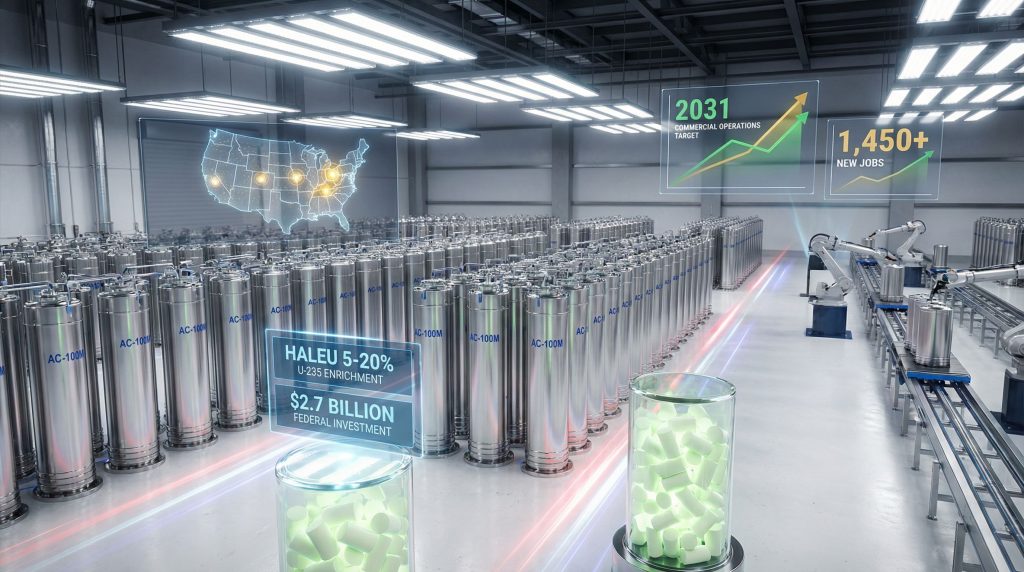
US uranium enrichment funding represents a watershed moment in American energy policy, with the Department of Energy's unprecedented $2.7 billion investment marking the largest commitment to domestic nuclear fuel infrastructure in over a decade. This strategic initiative addresses critical supply chain vulnerabilities while positioning America to lead the global transition toward advanced nuclear technologies. Furthermore, the funding distribution across three primary recipients signals a comprehensive approach to rebuilding domestic enrichment capabilities that extend far beyond traditional market mechanisms.
Within this evolving paradigm, uranium enrichment capabilities have emerged as a cornerstone of national energy independence strategy. The technical sophistication required for uranium enrichment positions it as both a critical infrastructure asset and a strategic competitive advantage in the global clean energy transition.
What Does America's $2.7 Billion Uranium Investment Signal for Global Energy Security?
The recent allocation of $2.7 billion in federal task orders represents the most significant commitment to domestic uranium enrichment infrastructure in over a decade. This investment framework distributes funding across three primary recipients, with $900 million allocated to each of General Matter, American Centrifuge Operating, and Orano Federal Services. Additionally, Global Laser Enrichment received $28.5 million for advanced technology development, signaling federal recognition of alternative enrichment methodologies.
The strategic imperative driving this investment stems from America's gradual abandonment of domestic enrichment capacity following economic pressures and international competition. Moreover, the Russian uranium import ban has exposed critical vulnerabilities in nuclear fuel supply chains, creating an urgent need for domestic production capabilities. The closure of the Paducah enrichment facility in 2013 marked the end of large-scale American uranium enrichment operations, creating a supply chain vulnerability that recent geopolitical developments have brought into sharp focus.
The Strategic Imperative Behind Domestic Enrichment Revival
Current uranium enrichment dependencies expose critical infrastructure to foreign supply disruptions. The existing reactor fleet of approximately 94 operating units relies heavily on imported enriched uranium, creating strategic vulnerabilities that extend beyond simple market considerations to encompass national security implications.
The emergence of artificial intelligence data centers as major power consumers adds urgency to nuclear capacity expansion. These facilities require consistent, reliable baseload power that renewable sources cannot currently provide at scale. Nuclear energy offers the carbon-free, high-capacity solution that AI infrastructure demands, but only with secure fuel supply chains.
Advanced reactor technologies compound this urgency through their specific fuel requirements. Next-generation reactor designs from companies like TerraPower and X-energy require High-Assay Low-Enriched Uranium (HALEU), a specialised fuel form currently unavailable from domestic sources at commercial scale. Additionally, the ongoing uranium market volatility has demonstrated the importance of establishing stable, domestic supply chains.
Mapping the Three-Pronged Federal Strategy
| Company | Federal Award | Technology Focus | Primary Location | Job Creation |
|---|---|---|---|---|
| American Centrifuge Operating | $900M base + $170M options | HALEU production expansion | Piketon, Ohio | 1,000 construction, 300 permanent |
| Orano Federal Services | $900M | LEU commercial production | Oak Ridge, Tennessee | Hundreds of direct positions |
| General Matter | $900M | Next-generation enrichment | Multiple sites | To be determined |
| Global Laser Enrichment | $28.5M | Laser enrichment technology | Paducah, Kentucky | Research and development focus |
The geographic distribution across Ohio, Tennessee, and Kentucky creates regional economic clusters while leveraging existing nuclear infrastructure and workforce expertise. Ohio benefits from the established Piketon facility, Tennessee gains from Oak Ridge's research capabilities, and Kentucky's Paducah site offers depleted uranium stockpiles for innovative reprocessing approaches.
Economic multiplier effects extend well beyond direct employment. The 1,450 combined positions across primary facilities generate substantial indirect employment in manufacturing, transportation, and professional services. Regional supply chains for centrifuge components, specialised materials, and technical services create additional economic value throughout the industrial ecosystem.
When big ASX news breaks, our subscribers know first
How Will HALEU Production Transform America's Nuclear Future?
High-Assay Low-Enriched Uranium represents a fundamental shift in nuclear fuel technology, requiring enrichment levels between 5-20% U-235 compared to conventional reactor fuel at 3-5% U-235. This higher enrichment enables advanced reactor designs with improved efficiency, enhanced safety features, and reduced waste production.
Decoding High-Assay Low-Enriched Uranium (HALEU) Economics
HALEU's technical specifications enable reactor designs impossible with conventional fuel. The higher uranium-235 concentration allows for:
- Longer fuel cycles reducing refuelling frequency and operational costs
- Smaller reactor cores enabling modular designs and factory construction
- Enhanced safety margins through improved neutron physics
- Reduced waste generation per unit of energy produced
Current global HALEU availability remains severely constrained, with Russian sources representing the primary commercial supply. This creates both a market opportunity and a strategic vulnerability that domestic production capacity directly addresses.
The development of secure HALEU supply chains represents a critical enabler for advanced reactor deployment, potentially accelerating clean energy transition timelines while maintaining energy security priorities.
American Centrifuge Operating's Piketon Expansion Strategy
Centrus Energy's approach leverages proven AC-100M centrifuge technology that became operational in 2023 under a demonstration contract with the Department of Energy. The expansion strategy encompasses multiple production capabilities:
HALEU Production Scaling:
- Additional centrifuge cascades for expanded capacity
- Integration with existing demonstration operations
- Flexible production scheduling for varying demand profiles
LEU Feed Material Production:
- Uranium hexafluoride processing capabilities
- Quality control systems for HALEU feedstock preparation
- Integration with commercial LEU production lines
Workforce Development:
- 1,000 construction positions during facility expansion
- 300 permanent operating positions upon full capacity
- 150 retained existing jobs maintaining operational continuity
- Technical training programmes developing specialised enrichment expertise
The Piketon facility's strategic advantage lies in its existing infrastructure and regulatory framework. Operating experience from the demonstration cascade provides valuable performance data for commercial-scale expansion, reducing technical risks associated with new facility development. However, the facility must navigate ongoing challenges related to tariff impact on uranium markets and trade policies.
General Matter's Competitive Positioning
As a newer market entrant, General Matter's $900 million federal award positions the company to develop alternative enrichment approaches. While specific technical details remain proprietary, their strategy likely focuses on:
- Technology differentiation through innovative enrichment methodologies
- Cost optimisation via advanced manufacturing techniques
- Scalability advantages enabling rapid capacity expansion
- Partnership development with advanced reactor companies
The timeline for achieving commercial HALEU production varies by technology approach, but federal funding acceleration suggests operational capacity within the current decade. General Matter's success could introduce competitive pressures that benefit the overall market through improved pricing and service levels.
What Makes Orano's Project IKE a Game-Changer for LEU Supply?
Project IKE represents the largest single uranium enrichment facility investment announced in the United States since the industry's restructuring in the 1990s. Located in Oak Ridge, Tennessee, this multi-billion-dollar facility targets 2031 commercial operations with regulatory submission planned for early 2026.
The Oak Ridge Renaissance: Project IKE's Multi-Billion Dollar Vision
Project IKE Facility Specifications:
| Parameter | Details |
|---|---|
| Location | Oak Ridge, Tennessee |
| Site Selection Announced | September 2024 |
| Licence Submission | Early 2026 to NRC |
| Commercial Production Start | 2031 |
| Investment Scale | Multi-billion dollar facility |
| Technology Base | Georges Besse II experience |
The Oak Ridge location offers strategic advantages including proximity to existing nuclear research facilities, established regulatory relationships, and access to specialised workforce pools. Tennessee's business environment and state-level support enhance project viability through favourable permitting processes and economic incentives.
Project IKE's naming connects modern energy security objectives with historical nuclear leadership, drawing parallels to President Eisenhower's "Atoms for Peace" initiative that established America's civilian nuclear programme. This symbolic connection reinforces the facility's role in advancing peaceful nuclear technology development.
European Expertise Meets American Manufacturing
Orano's competitive advantage stems from proven operational experience at the Georges Besse II facility in France, completed in 2011. This commercial centrifuge plant provides technical expertise directly applicable to American operations, including:
Proven Technology Transfer Elements:
- Reliable centrifuge designs with established performance metrics
- Existing transport container systems for uranium hexafluoride
- Enrichment processes refined through decades of commercial operations
- Quality assurance protocols meeting international standards
The U.S. Department of Energy's enrichment funding initiative represents a significant commitment to domestic nuclear fuel security. Jean-Luc Palayer, CEO of Orano USA, emphasised the company's operational expertise, stating that successful enriched uranium production requires reliable centrifuges, existing transport containers, and enrichment processes refined through decades of successful commercial operations.
Domestic Supply Chain Integration:
- Component sourcing from American manufacturers where feasible
- Technology transfer agreements facilitating knowledge development
- Workforce training programmes leveraging international expertise
- Quality standards alignment with NRC requirements
The integration of European technology with American manufacturing capabilities creates opportunities for hybrid approaches that combine proven designs with domestic innovation. This strategy reduces technical risks while supporting American industrial development.
LEU vs. HALEU Production Strategies Comparison
| Aspect | LEU (Orano) | HALEU (Centrus/General Matter) |
|---|---|---|
| Enrichment Level | 3-5% U-235 | 5-20% U-235 |
| Primary Market | Existing 94 U.S. reactors | Advanced/SMR reactors |
| Production Start | 2031 (Project IKE) | Phased 2026-2030 |
| Investment Scale | Multi-billion (Project IKE) | $900M federal + private |
| Technology Maturity | Proven commercial operation | Demonstration to commercial scale |
| Market Size | Established reactor fleet demand | Emerging advanced reactor market |
Can Laser Enrichment Technology Disrupt Traditional Centrifuge Dominance?
Global Laser Enrichment's $28.5 million federal award represents recognition of alternative enrichment methodologies that could fundamentally alter industry cost structures and technical approaches. Laser enrichment technology offers theoretical advantages over traditional centrifuge methods, including potentially lower energy consumption and reduced facility complexity.
Global Laser Enrichment's Innovation Pathway
The Paducah Laser Enrichment Facility (PLEF) concept centres on reprocessing depleted uranium stockpiles accumulated from decades of American enrichment operations. This approach addresses two strategic objectives simultaneously: waste reduction and fuel production.
PLEF Capacity Projections:
- Annual output: Up to 2,000 tonnes of uranium hexafluoride
- Uranium content: Up to 5 million pounds annually
- Operational duration: More than three decades
- Domestic supply impact: Nearly 10% of current U.S. reactor demand
These projections represent a nearly tenfold increase in domestic natural uranium output, significantly enhancing national energy security and fuel independence. The extended operational timeline reflects the substantial depleted uranium stockpiles available for reprocessing.
Scenario Analysis: Technology Disruption Probabilities
Commercial Viability Factors:
-
Technical Performance
- Energy efficiency compared to centrifuge operations
- Throughput rates and scalability potential
- Maintenance requirements and operational complexity
-
Economic Competitiveness
- Capital investment requirements per unit of capacity
- Operating costs including energy, labour, and materials
- Cost-per-kilogram projections for enriched uranium
-
Regulatory Pathway
- NRC approval timeline for novel enrichment technology
- Safety assessment requirements and precedent establishment
- Environmental impact evaluation for large-scale operations
Integration Potential with Existing Infrastructure:
Laser enrichment technology could complement rather than replace centrifuge operations, particularly for specialised applications or feedstock reprocessing. The Paducah site's existing infrastructure and depleted uranium stockpiles provide ideal conditions for technology demonstration and commercial scaling.
The success of laser enrichment technology could introduce disruptive pricing pressures while expanding total enrichment capacity, potentially accelerating advanced reactor deployment timelines through improved fuel availability.
How Will This Investment Reshape Global Uranium Markets?
The $2.7 billion federal investment represents a fundamental shift in global uranium enrichment dynamics, potentially reducing American dependence on foreign suppliers while creating competitive pressures throughout international markets. Furthermore, this initiative aligns with broader trends in the US uranium production outlook that emphasise domestic capacity building.
Supply Chain Diversification Impact Assessment
Current American uranium enrichment dependencies create strategic vulnerabilities that extend beyond simple market considerations. The existing reliance on facilities operated by foreign entities, including Urenco's New Mexico operations, exposes critical infrastructure to potential supply disruptions.
Market Rebalancing Effects:
- Reduced import requirements as domestic capacity scales
- Competitive pricing pressure on international suppliers
- Enhanced negotiating position for long-term supply contracts
- Strategic reserve capabilities for national security applications
European and Canadian enrichment partnerships will likely evolve from dependency relationships toward collaborative arrangements. American domestic capacity reduces urgency in international negotiations while maintaining beneficial technology sharing and market access agreements.
Economic Multiplier Effects Across Three States
The geographic distribution of enrichment investments creates regional economic clusters with substantial multiplier effects extending throughout local economies.
Direct Employment Impact:
- Piketon, Ohio: 1,000 construction + 300 permanent operations + 150 retained positions
- Oak Ridge, Tennessee: Hundreds of direct jobs in centrifuge manufacturing and facility operations
- Paducah, Kentucky: Research and development positions in laser enrichment technology
Indirect Economic Benefits:
- Centrifuge manufacturing and component supply chains
- Specialised transportation services for nuclear materials
- Professional services including engineering, legal, and financial support
- Regional workforce development and technical training programmes
The concentration of nuclear expertise in these regions creates innovation ecosystems that attract additional investment in related technologies. Universities, research institutions, and private companies benefit from proximity to major nuclear facilities through collaborative opportunities and workforce development.
Key Investment Questions and Answers
Why did the U.S. lose enrichment capacity initially?
Economic factors dominated the decision to close domestic enrichment facilities, particularly the Paducah plant's shutdown in 2013. International competition, particularly from lower-cost foreign suppliers, made American operations economically unviable without strategic government support. The current US uranium enrichment funding recognises enrichment capabilities as critical infrastructure requiring policy intervention beyond pure market mechanisms.
How does this compare to China's nuclear fuel investments?
China has pursued aggressive domestic nuclear fuel cycle development, including substantial enrichment capacity investments over the past decade. The American $2.7 billion commitment represents catch-up investment rather than leadership positioning, but establishes a foundation for competitive capabilities in advanced fuel technologies like HALEU where China has less established advantages.
What happens if these projects face delays?
Existing uranium stockpiles and allied supplier relationships provide interim supply security while domestic capacity develops. The federal funding structure includes milestone-based payments that incentivise timely project completion, while multiple parallel investments reduce risks associated with individual project delays. International partnerships remain viable as backup supply sources during the transition period.
What Are the Long-Term Strategic Implications?
The uranium enrichment investment extends far beyond immediate fuel supply considerations to encompass broader strategic positioning in clean energy technology development and international nuclear cooperation. Moreover, this initiative must be viewed alongside the global uranium reserves outlook and long-term supply availability projections.
Nuclear Renaissance Catalyst Effects
Secure HALEU supply chains directly enable advanced reactor deployment, potentially accelerating clean energy transition timelines while maintaining grid reliability during renewable energy scaling. The integration with broader clean energy policies creates synergistic effects that enhance both nuclear and renewable energy development.
Advanced Reactor Deployment Acceleration:
- Reduced fuel supply uncertainties enabling private investment decisions
- Predictable pricing frameworks supporting project financing
- Domestic supply preferences strengthening American reactor vendor competitiveness
- Technology export opportunities for complete nuclear systems including fuel services
AI and Data Centre Power Demands:
- Consistent baseload power requirements aligned with nuclear capabilities
- Carbon-free energy mandates driving nuclear adoption in technology sectors
- Grid stability benefits supporting renewable energy integration
- Strategic importance of reliable power for national competitiveness in AI development
The latest nuclear energy policy developments suggest continued federal support for domestic nuclear infrastructure development, further reinforcing the strategic importance of enrichment capabilities.
Geopolitical Positioning and Energy Independence
Nuclear fuel independence represents a critical component of broader energy security strategies that extend beyond traditional fossil fuel considerations. The technical sophistication and strategic importance of enrichment capabilities position America as a more reliable partner for international nuclear cooperation.
Strategic Alliance Strengthening:
- Enhanced credibility in nuclear technology partnerships
- Reduced vulnerability to foreign supply manipulation
- Export potential for enriched uranium to allied nations
- Technology leadership in advanced nuclear fuel cycles
Critical Mineral Strategy Integration:
- Uranium supply chain security aligned with broader critical mineral policies
- Domestic processing capabilities reducing foreign dependency risks
- Strategic reserve management and inventory optimisation
- Supply chain resilience lessons applicable to other critical materials
The investment creates long-term competitive advantages that extend beyond immediate energy security to encompass technological leadership, economic development, and international influence in nuclear technology markets.
The next major ASX story will hit our subscribers first
From Dependency to Leadership: America's Nuclear Fuel Renaissance
The transformation from uranium enrichment dependency toward domestic leadership represents more than infrastructure development; it signifies strategic recognition of nuclear technology's critical role in national competitiveness and energy security.
Timeline for Energy Security Achievement
2026-2028: Foundation and Construction Phase
- Regulatory approvals and construction commencement
- Workforce development and training programme implementation
- Supply chain establishment and vendor qualification
- Technology transfer and knowledge development
2029-2031: Initial Production and Market Integration
- First commercial HALEU production from expanded Piketon operations
- Project IKE construction completion and regulatory commissioning
- Market price stabilisation as domestic supply increases
- Advanced reactor fuel supply agreement negotiation and execution
2032+: Full-Scale Independence and Export Potential
- Complete domestic supply chain capability for strategic requirements
- Competitive pricing enabling export market development
- Technology leadership in advanced nuclear fuel cycles
- Strategic reserve management and supply security optimisation
Investment Community and Market Development
The federal investment catalyses private capital mobilisation beyond the initial $2.7 billion commitment. Centrus President and CEO Amir Vexler characterised the federal award as historic commitment to revitalising America's nuclear fuel supply chain and reclaiming American nuclear leadership on the global stage, emphasising that the award will catalyse additional private investment and supports the prospect of further expansion as the market continues to grow.
Private Investment Opportunities:
- Uranium mining and conversion facility development to supply enrichment operations
- Advanced centrifuge manufacturing and component supply chains
- Transportation and logistics services for nuclear materials
- Technology development for next-generation enrichment methods
Market Development Implications:
- Reduced price volatility through domestic supply diversity
- Enhanced project financing availability for nuclear projects with secure fuel supplies
- Export market development potential as domestic capacity exceeds strategic requirements
- Integration opportunities with international nuclear technology partnerships
The uranium enrichment renaissance positions America not merely as a consumer of nuclear technology, but as an innovator and leader in advanced nuclear fuel cycles that will define clean energy infrastructure for decades to come. US uranium enrichment funding represents the cornerstone of this transformation, establishing the foundation for energy independence and technological leadership in the nuclear sector.
This analysis incorporates publicly available information from federal agencies and company announcements. Investment decisions should consider multiple factors including regulatory approvals, market conditions, and technological development risks. Projected timelines and capacity estimates remain subject to regulatory approval and market conditions.
Looking to capitalise on uranium enrichment opportunities?
Discovery Alert's proprietary Discovery IQ model delivers real-time alerts on significant uranium and critical mineral discoveries across the ASX, instantly empowering subscribers to identify actionable opportunities ahead of the broader market. Understand why historic discoveries can generate substantial returns by visiting Discovery Alert's dedicated discoveries page and begin your 30-day free trial today to position yourself ahead of the market as America's nuclear renaissance unfolds.