
May 17, 2026
Understanding the Strategic Investment Framework for US Uranium Equities
The uranium market has evolved beyond simple commodity exposure into a complex ecosystem where supply chain security dictates investment returns. With global uranium demand projected to rise approximately 30% by 2030 and more than double by 2040, according to the World Nuclear Association's data, institutional investors increasingly evaluate equity exposure in US uranium market through multiple analytical frameworks that extend far beyond traditional commodity metrics.
This transformation reflects structural shifts in how capital markets assess nuclear fuel supply chains. Furthermore, federal energy security policies, domestic procurement mandates, and supply chain resilience requirements have created differentiated valuation frameworks that prioritise strategic positioning over pure production metrics.
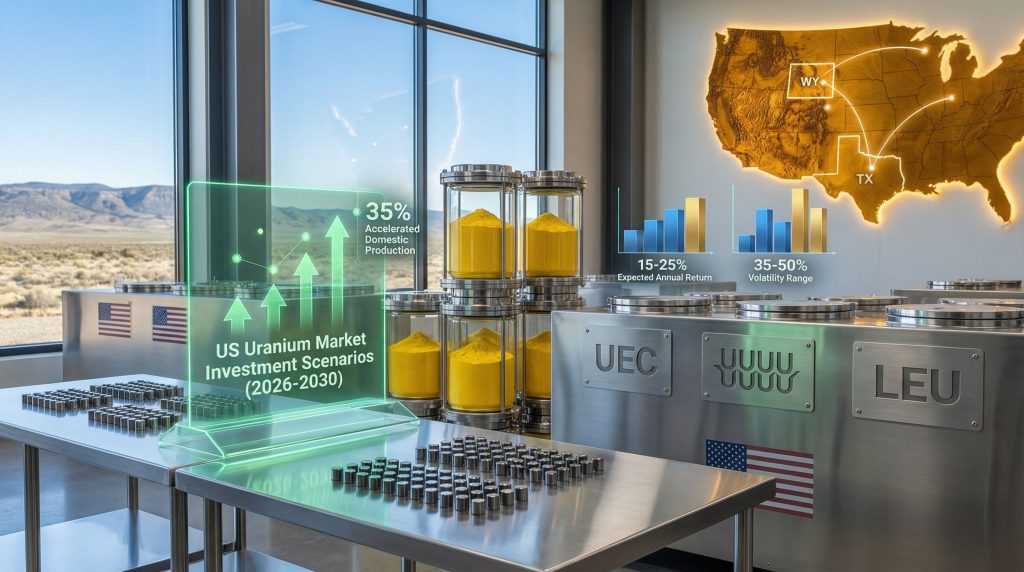
Table: US Uranium Market Investment Scenarios (2025-2030)
| Scenario | Market Probability | Primary Drivers | Optimal Strategy |
|---|---|---|---|
| Accelerated Domestic Production | 35% | Federal procurement programs | Direct producer exposure |
| Gradual Supply Normalisation | 40% | Extended import dependencies | Diversified uranium ETFs |
| Supply Chain Crisis | 20% | Geopolitical disruptions | Leveraged nuclear positions |
| Policy Reversal | 5% | Regulatory changes | Physical uranium holdings |
Secondary supply sources, including utility inventories, enrichment facility underfeeding, and reprocessed materials, have undergone systematic depletion over multiple decades. Consequently, this drawdown has coincided with years of underinvestment in primary production capacity, creating structural deficits that cannot be addressed through short-term market adjustments.
The US Senate uranium ban has further intensified these supply constraints, creating additional upward pressure on domestic uranium equity valuations.
Strategic Insight: The uranium investment landscape now rewards assets with regulatory certainty, processing infrastructure access, and federal policy alignment rather than resource scale alone.
When big ASX news breaks, our subscribers know first
Strategic Premium Factors Driving US Uranium Asset Valuations
US uranium assets command distinct premiums based on strategic factors that international competitors cannot replicate. These advantages stem from proximity to domestic nuclear infrastructure, established regulatory frameworks, and preferential treatment under federal energy security initiatives.
Regulatory certainty represents perhaps the most significant competitive advantage for US operations. Established federal support mechanisms, including strategic uranium reserves and domestic procurement programs, provide price floors and contract visibility that international operations lack.
This regulatory backstop reduces downside risk while maintaining upside exposure to global uranium price movements. Additionally, supply chain integration creates operational efficiencies that become more valuable during supply constraints.
US uranium production tech operations benefit from proximity to the White Mesa mill in Utah, currently the only conventional uranium processing facility operating in the United States. This infrastructure advantage reduces transportation costs, regulatory complexity, and processing delays.
Policy alignment with federal energy independence initiatives provides sustained demand visibility for domestic producers. For instance, recent federal programs prioritising domestic uranium procurement create competitive advantages that extend beyond simple cost considerations.
Primary US Uranium Producer Investment Vehicles
Large-Scale Production Platforms
Uranium Energy Corp (UEC) operates the most extensive in-situ recovery platform in the United States, with projects spanning Wyoming and Texas. The company's hub-and-spoke operational model enables rapid production scaling in response to market conditions, providing operational flexibility that conventional mining operations cannot match.
This distributed approach reduces concentration risk while allowing capacity modulation based on uranium price cycles. However, the company's established infrastructure and regulatory permits position it to respond quickly to federal procurement programs.
Energy Fuels Inc (UUUU) controls critical downstream infrastructure through its ownership of the White Mesa conventional uranium mill in Utah. This facility represents the only operating conventional uranium processing infrastructure in the United States, creating competitive advantages during supply constraints.
The mill's strategic importance extends beyond Energy Fuels' own operations, as it provides processing services for other domestic producers. Consequently, this infrastructure control creates integrated value chain advantages and reduces processing bottlenecks.
Centrus Energy Corp (LEU) focuses on uranium enrichment services rather than primary production, positioning the company as a critical component of domestic nuclear fuel security. The company's enrichment capabilities in Ohio represent essential infrastructure for converting domestic uranium into reactor-ready nuclear fuel.
Development-Stage Opportunities
enCore Energy Corp (EU) develops in-situ recovery projects across South Texas and Wyoming, with regulatory approvals already secured for near-term production capability. The company's projects benefit from established infrastructure and streamlined permitting processes that reduce time-to-production.
Ur-Energy Inc (URG) operates the Lost Creek in-situ recovery facility in Wyoming, demonstrating proven production capability with expansion potential. Furthermore, the facility's operational track record provides validation for the company's technical capabilities and regulatory compliance.
The Patterson Corridor uranium project represents another significant development opportunity, showcasing how strategic positioning in proven uranium districts can enhance equity exposure prospects.
Uranium-Focused ETF Strategies for Diversified Market Access
Broad-Based Uranium Exposure
Sprott Uranium Miners ETF (URNM) provides comprehensive exposure to global uranium mining companies while maintaining significant allocation to US-listed equities. The fund's methodology requires minimum 50% uranium-related revenue exposure from portfolio companies, ensuring focused sector allocation.
Current fund composition includes:
- 82% uranium and related equities
- 18% physical uranium holdings
- Geographic diversification across major uranium jurisdictions
- Regular rebalancing based on uranium revenue exposure requirements
This structure allows investors to participate in global uranium market dynamics while maintaining substantial exposure to US-listed companies benefiting from domestic policy support and infrastructure advantages.
Leveraged US Uranium Exposure
URAA ETF delivers 200% daily exposure to the Solactive United States Uranium and Nuclear Energy ETF Select Index, specifically targeting US uranium and nuclear energy equities. This leveraged approach amplifies both gains and losses, requiring active risk management.
Leveraged products introduce volatility decay considerations that make them unsuitable for long-term buy-and-hold strategies. However, they provide tactical exposure opportunities for investors seeking amplified participation in US uranium market movements during specific market conditions.
Strategic Equity Stakes as Capital-Efficient Growth Mechanisms
Strategic equity positions have emerged as preferred mechanisms for gaining targeted uranium exposure without assuming full operational risk or capital deployment requirements. This approach allows investors to participate in uranium market upside while maintaining capital flexibility.
Corporate Strategic Positioning Models
Recent transactions demonstrate how strategic equity stakes create leveraged exposure to domestic uranium market dynamics. These positions provide multiple advantages over direct operational investment:
- Capital efficiency through participation without full development costs
- Operational optionality with influence but not management responsibility
- Market timing flexibility to scale exposure based on market conditions
- Risk distribution across multiple development stages and jurisdictions
Companies utilising strategic equity approaches can adjust their uranium exposure incrementally as market conditions evolve. Consequently, this maintains strategic influence while preserving balance sheet flexibility for other opportunities.
Examples of Strategic Portfolio Construction
Companies with diversified uranium platforms often maintain equity positions across development-stage companies, providing exposure to multiple projects and development timelines. This approach creates portfolio-level leverage to uranium price movements while reducing concentration risk.
Strategic equity holdings typically focus on companies with established regulatory approvals, proven management teams, and near-term production potential. For instance, this screening reduces development risk while maintaining upside exposure to uranium price appreciation.
Federal Policy Impact on US Uranium Equity Valuations
Strategic Uranium Reserve Programs
Federal strategic uranium reserve initiatives create sustained demand for domestic production, establishing price floors and contract certainty for US-based operations. These programs prioritise domestic suppliers, creating competitive advantages that international operations cannot access.
Reserve accumulation programs operate on multi-year timelines, providing demand visibility that extends beyond typical utility contracting cycles. Furthermore, this federal demand creates a backstop for domestic producers while supporting price stability during market volatility periods.
Nuclear Fuel Security Initiatives
Recent federal legislation targeting nuclear fuel supply chain security has elevated the strategic value of US uranium assets beyond their fundamental production economics. However, market disruption from tariffs remains a consideration for equity exposure strategies.
Key policy drivers include:
- Domestic uranium procurement preferences in federal contracting
- Strategic reserve accumulation programs with domestic sourcing requirements
- Nuclear fuel cycle investment incentives for US-based operations
- Import dependency reduction mandates affecting utility procurement strategies
These policies create structural demand for domestic uranium that operates independently of global market dynamics. Consequently, this provides premium valuations for US assets with appropriate permits and infrastructure access.
The next major ASX story will hit our subscribers first
Risk-Adjusted Return Analysis for US Uranium Equities
Operational Risk Considerations
US uranium equities exhibit distinct risk profiles compared to international uranium investments, with several factors reducing operational uncertainty while potentially increasing market sensitivity. Regulatory advantages through established permitting frameworks and federal support reduce regulatory risk.
However, this regulatory certainty may reduce volatility that creates trading opportunities in other uranium markets. Additionally, infrastructure benefits from access to existing nuclear fuel processing and transportation systems reduce operational complexity.
Market access through direct relationships with US utilities and federal procurement programs provides sustained demand visibility. Furthermore, this may limit exposure to international price premiums during global supply shortages.
Volatility and Correlation Patterns
US uranium equities typically exhibit higher beta coefficients relative to broader market indices during uranium price cycles, reflecting their leveraged exposure to underlying commodity movements. However, federal policy support and strategic reserve programs may reduce downside volatility compared to purely commodity-exposed uranium investments.
Table: US Uranium Equity Risk-Return Profiles (2025-2030 Projections)
| Investment Category | Expected Annual Return | Volatility Range | Uranium Price Correlation |
|---|---|---|---|
| Large US Producers | 15-25% | 35-50% | 0.75-0.85 |
| Development Companies | 25-40% | 50-80% | 0.80-0.90 |
| Uranium ETFs | 12-20% | 30-45% | 0.70-0.80 |
| Leveraged Products | 25-50% | 60-100% | 0.85-0.95 |
Portfolio Construction Strategies for US Uranium Equity Investment
Core-Satellite Allocation Framework
Core holdings (60-70% allocation) should focus on established US uranium producers with proven operations, existing contract coverage, and confirmed participation in federal procurement programs. These positions provide stable exposure to uranium market fundamentals while reducing single-company execution risk.
Satellite positions (30-40% allocation) can include development-stage companies, strategic equity stakes, and leveraged products for enhanced upside participation. These positions provide amplified exposure to uranium price appreciation while maintaining overall portfolio diversification.
Geographic and Operational Diversification
While focusing on US uranium market exposure, investors should consider diversification across multiple dimensions to reduce concentration risk. This includes:
- Production methods: In-situ recovery operations vs. conventional mining approaches
- Development stages: Operating mines vs. development projects vs. exploration assets
- Value chain positions: Primary production vs. processing and enrichment services
- Contract exposure: Spot market pricing vs. long-term contracted sales arrangements
This diversification approach maintains focus on US uranium market dynamics while reducing operational and timing risks from individual company execution. Furthermore, it allows for balanced exposure to uranium markets across different operational profiles.
Market Timing Considerations for Strategic Entry
Uranium Price Cycle Positioning
US uranium equities typically lead uranium price movements during bull markets due to operational leverage and fixed cost structures. However, they may lag during price corrections as operational commitments limit downside flexibility.
Strategic entry points often occur during uranium price consolidation phases when equity valuations compress relative to underlying asset values. Additionally, investors should monitor the relationship between spot uranium prices and long-term contract prices.
Widening spreads often indicate supply tightness that benefits US producers with contract exposure and federal procurement access. The impact of uranium supply cycles on equity valuations requires careful consideration for optimal positioning.
Policy Catalyst Monitoring
Federal policy announcements, strategic reserve procurement cycles, and nuclear capacity expansion decisions create discrete catalysts for US uranium equity performance. Monitoring policy development timelines provides tactical positioning opportunities for investors seeking to capitalise on regulatory-driven demand increases.
Recent policy initiatives suggest sustained federal support for domestic uranium development, with budget allocations and procurement timelines extending through 2030. Consequently, this policy visibility creates investment confidence while supporting premium valuations for qualified US assets.
Future Market Structure Evolution
Structural Demand Growth Drivers
Several long-term trends support sustained demand growth for US uranium production beyond current market cycles:
- Nuclear capacity expansion programs at state and federal levels
- Small modular reactor deployment initiatives requiring domestic fuel sources
- Data centre nuclear power adoption for carbon-neutral computing infrastructure
- Federal decarbonisation mandates prioritising nuclear energy in clean power portfolios
Supply Side Constraints
Structural limitations on uranium supply growth create favourable conditions for existing US producers:
- Limited new uranium mine development due to capital requirements and permitting complexity
- Existing mine depletion schedules requiring replacement production capacity
- Extended permitting timeline for new US uranium projects
- Capital allocation discipline among producers following previous market cycles
Strategic Assessment: The combination of sustained demand growth and supply constraints creates compelling risk-adjusted return potential for strategically positioned US uranium equity investments.
Investment Thesis Summary for US Uranium Equity Exposure
The structural transformation of uranium markets from commodity speculation to strategic resource positioning creates differentiated opportunities for investors focused on equity exposure in US uranium market. Federal policy support, supply chain advantages, and sustained demand growth combine to support premium valuations.
Key investment considerations include:
- Supply security fundamentals driving long-term uranium price support above incentive levels
- Federal policy alignment creating competitive advantages for domestic producers
- Capital allocation discipline being rewarded through reduced dilution and enhanced optionality
- Diversified exposure strategies providing multiple pathways to uranium market participation
- Consolidation potential as scarcity value increases for permitted US uranium assets
The evolution toward strategic equity positions, policy-supported demand, and supply chain integration suggests that equity exposure in US uranium market represents more than cyclical commodity investment. For investors seeking exposure to domestic energy security themes while participating in global uranium market dynamics, the combination of regulatory support creates compelling opportunities.
Furthermore, infrastructure advantages and structural supply constraints provide differentiated access to domestic energy security investment themes across multiple risk and return profiles.
Investment Outlook: As supply constraints deepen and federal support mechanisms mature, equity exposure in US uranium market provides differentiated access to domestic energy security investment themes. Strategic positioning across core producers, development assets, and specialised ETF vehicles offers portfolio-level optimisation for uranium market participation within diversified energy security allocations.
Ready to Discover Your Next Strategic Investment Opportunity?
Discovery Alert's proprietary Discovery IQ model provides instant notifications on significant ASX mineral discoveries, including uranium and critical commodities, empowering investors to identify actionable opportunities ahead of the broader market. Explore Discovery Alert's discoveries page to understand how historic mineral discoveries have generated substantial returns, then begin your 30-day free trial today at Discovery Alert to position yourself ahead of the market.