May 19, 2026
US intervention in Venezuela oil market represents a strategic pivot from sanctions-based containment toward direct market control mechanisms. The Western Hemisphere's energy landscape faces potential transformation as geopolitical forces reshape traditional supply relationships that have persisted for decades. Understanding these evolving patterns requires examining multiple interconnected systems spanning production capacity, infrastructure requirements, regulatory frameworks, and investment flows across regional markets.
The current situation represents more than a simple policy adjustment. Energy security considerations, combined with long-term strategic positioning, create complex scenarios where traditional market relationships must adapt to new realities. However, trade war oil movements from other regions suggest that such transitions typically unfold across multiple phases, each presenting distinct opportunities and challenges for market participants.
What Does Washington's Venezuelan Oil Strategy Signal for Global Market Dynamics?
The Geopolitical Chess Move Behind Energy Control
The US intervention in Venezuela oil market differs fundamentally from previous policy frameworks that relied primarily on economic isolation. Instead of maintaining Venezuelan oil supplies outside global markets, Washington appears positioned to integrate these resources under Western oversight structures. Furthermore, this approach creates potential alignment with broader OPEC production impact considerations affecting global supply balances.
Venezuelan crude oil production collapsed from historical peaks of 3.2-3.5 million barrels per day in the early 2000s to approximately 400,000-500,000 bpd by late 2024. This dramatic decline resulted from infrastructure deterioration, international sanctions, and capital flight beginning around 2013, according to analysis from The Conversation on Venezuelan oil market dynamics.
The strategic implications extend beyond immediate supply considerations. Energy policy analysts characterise Venezuelan potential reintegration as strategically significant for Western Hemisphere energy independence objectives, though production recovery timelines remain uncertain pending comprehensive infrastructure assessment. Congressional Research Service analyses highlight these complexities across multiple policy option evaluations.
Market Response Indicators and Price Volatility Patterns
Global crude markets demonstrate heightened sensitivity to supply disruption scenarios involving major producing regions. Venezuelan heavy crude, typically ranging from 8-12 API gravity, occupies a specialised niche within refinery configurations, particularly in U.S. Gulf Coast facilities designed for heavy crude processing. This specialisation differs significantly from medium and light crude grades dominating other regional markets.
Market structure considerations reveal that Venezuelan crude integration affects specific refinery segments rather than broad commodity pricing. According to EIA refinery capacity data, the U.S. Gulf Coast contains refineries specifically configured for heavy crude processing capacity of approximately 2.5-3.0 million bpd total. Venezuelan crude historically represented 40-60% of feedstock for certain facilities before sanctions implementation.
Currency implications extend throughout regional economies. Venezuelan bolívar volatility correlates directly with oil price movements, whilst neighbouring economies face trade relationship restructuring. Regional banking systems must adapt to modified payment mechanisms and compliance requirements under evolving sanctions frameworks.
When big ASX news breaks, our subscribers know first
Which Energy Companies Stand to Benefit from Venezuelan Market Access?
US Corporate Winners in the New Landscape
Chevron Corporation maintains the most established position for Venezuelan market re-entry, having operated through joint ventures including Orinoco Belt operations prior to sanctions escalation. However, as of Q4 2023, Chevron reported zero production from Venezuela following compliance with U.S. sanctions orders, according to company Form 10-K filings.
The regulatory environment creates opportunities primarily for companies with existing U.S. Treasury Department relationships and proven sanctions compliance frameworks. Under Office of Foreign Assets Control regulations, companies must conduct comprehensive due diligence on Venezuelan energy sector involvement, as outlined in 2023-2024 compliance guidance documentation.
Service sector opportunities represent the most immediate market entry pathway. Oil field services companies specialising in well-logging, completion equipment, and pipeline inspection services require less capital commitment than upstream development projects. Energy Intelligence Group analysis identifies these sectors as primary near-term opportunities within the evolving regulatory landscape.
Key corporate positioning advantages include:
- Existing OFAC licensing relationships and compliance infrastructure
- Heavy crude processing capabilities in Gulf Coast refinery systems
- Technical expertise in enhanced oil recovery for mature field operations
- Financial capacity for long-term infrastructure rehabilitation projects
- Established supply chain networks for equipment and materials delivery
International Players Facing Market Exclusion
International energy companies face significant barriers under current regulatory frameworks. Russian energy entities, particularly Rosneft, encounter asset freeze provisions and operational restrictions that effectively eliminate market participation opportunities. Chinese companies, including CNPC, must navigate partnership termination requirements and potential investment loss scenarios.
European energy companies operate within complex compliance requirements balancing EU regulations with U.S. sanctions enforcement mechanisms. These companies must assess political risk factors, regulatory coordination challenges, and potential secondary sanctions exposure when evaluating Venezuelan market opportunities.
Infrastructure rehabilitation contracts favour companies with established Western technology transfer agreements and proven track records in challenging operational environments. Equipment suppliers with historical PDVSA relationships may maintain advantages, though compliance verification requirements create additional operational complexity.
How Will Venezuelan Production Recovery Impact Global Supply Chains?
Short-Term Production Scenarios (2026-2028)
Production recovery trajectories depend heavily on infrastructure rehabilitation timelines and political stability maintenance. Historical precedents from other recovering oil sectors provide useful benchmarks for scenario development, though each situation presents unique technical and political constraints. Additionally, oil price rally analysis suggests that market timing considerations remain crucial.
| Timeline | Production Capacity | Key Constraints | Market Impact |
|---|---|---|---|
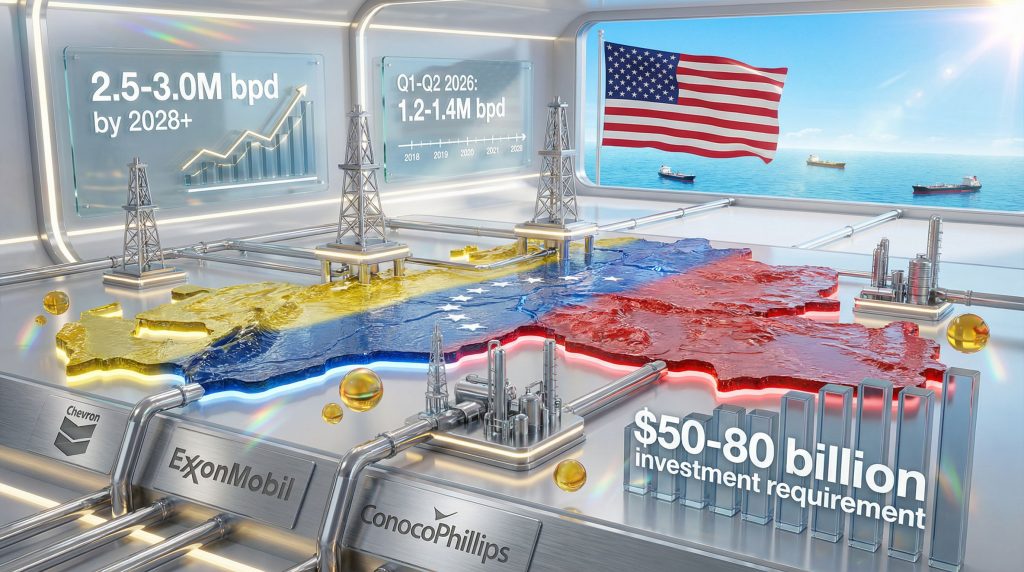
| Q1-Q2 2026 | 1.2-1.4M bpd | Infrastructure repairs, political stability | Limited price relief |
| 2027 | 1.8-2.2M bpd | Investment inflows, technical expertise | Moderate supply increase |
| 2028+ | 2.5-3.0M bpd | Full rehabilitation, new drilling | Significant market rebalancing |
Venezuelan crude represents approximately 2.4-3.0% of global production at historical peak levels, within a global crude oil production context of approximately 101-102 million bpd as of 2024. OPEC crude production totals approximately 27-28 million bpd, according to December 2024 Monthly Oil Market Report data.
Kuwait's recovery from 1.3 million bpd in 2010 to 2.8 million bpd by 2013 demonstrates accelerated infrastructure recovery potential through concentrated investment. Production growth averaged 37% annually during the recovery phase, though political stability and continued investment proved essential for sustainability.
Long-Term Infrastructure Investment Requirements
Comprehensive sector rehabilitation demands substantial capital commitments across multiple infrastructure categories. Venezuelan energy infrastructure spans facilities operational since the 1960s-1980s, requiring modernisation alongside basic operational restoration. Consequently, Australia's energy export challenges provide comparative context for understanding infrastructure rehabilitation complexity.
Infrastructure priorities require sequential development:
Upstream Systems:
- Deepwater drilling equipment compatible with Lake Maracaibo specifications (100-300 metres depth)
- Enhanced oil recovery technology for mature field production maintenance
- Well re-entry drilling and pump replacement systems
- Gathering pipeline inspection and segment replacement
Midstream Networks:
- Export terminal capacity restoration and equipment overhaul
- Pipeline network rehabilitation and corrosion management
- Transportation infrastructure linking production areas to export facilities
- Storage facility maintenance and expansion
Downstream Capabilities:
- Refinery catalyst replacement and equipment retrofitting
- Processing unit modernisation for efficiency improvements
- Environmental compliance systems installation
- Product distribution network rehabilitation
Investment requirements range from $50-80 billion for comprehensive sector rehabilitation, according to industry engineering assessments. Technology transfer agreements and modernisation timelines extend across 5-10 year implementation periods for full operational restoration.
What Are the Regional Trade Flow Implications?
Caribbean and Latin American Market Disruptions
Regional energy relationships face fundamental restructuring as Venezuelan oil exports normalise under new frameworks. Caribbean refining capacity totaling approximately 1.2-1.3 million bpd across facilities in Curaçao, Aruba, and Trinidad historically processed 40-60% Venezuelan crude feedstock before sanctions implementation.
China previously received approximately 600,000-800,000 bpd of Venezuelan crude through debt-for-oil agreements during 2015-2020, with volumes declining significantly after 2020. Russian petroleum product imports to Venezuela averaged 50,000-100,000 bpd during peak partnership periods from 2010-2019, according to Russian Federal Customs Service trade documentation and Venezuela trade analysis.
Energy policy analysts characterise Venezuelan reintegration as fundamentally restructuring hemispheric energy partnerships. Termination of Chinese crude import arrangements and Russian petroleum product supply relationships represents strategic reorientation toward Western Hemisphere-integrated trade patterns, according to Morgan Stanley's analysis of market implications.
Global Heavy Crude Market Rebalancing
Venezuelan heavy crude grades occupy distinct market positions compared to alternative sources. For instance, these grades require specialised refining configurations that differ significantly from conventional processing systems.
Crude Quality Specifications:
- Venezuelan Merey crude: ~16 API gravity
- Venezuelan Boscan crude: ~10 API gravity
- Saudi Arabian Heavy: ~27-30 API
- Mexican Maya: ~22 API
- Canadian bitumen/synthetic: ~20-30 API range
Caribbean refining specialists note that regional facilities, particularly Curaçao's Isla refinery and Aruba operations, remain specifically configured for Venezuelan heavy crude processing. These refineries benefit from normalised supply flows, according to downstream industry analysis from Wood Mackenzie's Caribbean refining outlook assessments.
Heavy crude refining configurations typically feature:
- Conversion capacity (coking, visbreaking) at 30-50% of total throughput
- Hydrocracking units for molecular weight reduction
- Hydrogen production capacity for desulfurisation requirements
These configurations command premium processing margins, typically $8-15 per barrel above light crude processing, remaining economical when heavy crude pricing reflects sufficient discount to offset conversion costs.
How Do Sanctions Relief Mechanisms Create Investment Opportunities?
Conditional Partnership Framework Analysis
Investment opportunities emerge through carefully structured compliance mechanisms that balance market access with regulatory oversight. Companies seeking Venezuelan market participation must navigate evolving requirements for severing relationships with sanctioned entities whilst maintaining operational viability.
The framework establishes precedent for conditional market integration that extends beyond traditional sanctions relief models. Requirements typically include comprehensive due diligence, ongoing compliance monitoring, and regular reporting to regulatory authorities. Risk assessment procedures must account for political instability, infrastructure constraints, and regulatory evolution scenarios.
Compliance monitoring mechanisms involve:
- Real-time transaction reporting to Treasury Department oversight systems
- Quarterly operational audits by approved third-party verification entities
- Investment milestone documentation linking market access to performance metrics
- Political risk insurance coordination with government-backed programmes
- Escrow account management for revenue protection and oversight
Revenue Protection and Financial Structures
Financial engineering mechanisms must address political risk, regulatory compliance, and operational uncertainty simultaneously. US-controlled escrow accounts for oil proceeds provide revenue protection whilst ensuring sanctions compliance and supporting rehabilitation investment requirements.
Investment guarantee structures coordinate multiple stakeholders:
Government-Backed Insurance:
- Multilateral Investment Guarantee Agency (MIGA) political risk coverage
- Export-Import Bank financing for equipment and technology transfer
- Development Finance Corporation investment partnerships
- Bilateral development bank coordination mechanisms
Private Sector Risk Management:
- Commercial political risk insurance through specialised providers
- Currency hedging instruments for bolivar exposure management
- Force majeure insurance covering operational disruption scenarios
- Revenue guarantee structures linking payments to production milestones
Banking sector participation requires coordination between international financial institutions and Venezuelan monetary authorities. Investment financing structures must accommodate both regulatory compliance requirements and commercial viability considerations across extended development timelines.
What Market Scenarios Could Emerge from Political Instability?
Best-Case Production Recovery Timeline
Optimal recovery scenarios assume political stability maintenance, rapid international investment deployment, and infrastructure rehabilitation proceeding without significant delays. Under these conditions, Venezuelan production could potentially reach 3.5 million bpd by 2030, representing restoration to near-historical peak levels.
Global oil price impacts from additional 2+ million bpd supply depend on concurrent production trends in other regions and global demand growth patterns. Energy market analysts note that significant supply increases occur against evolving global energy demand influenced by energy transition policies, making price impact magnitude difficult to predict precisely.
Market rebalancing effects include:
- Reduced price volatility through increased supply diversity
- Enhanced energy security for Western Hemisphere consumers
- Competitive pressure on other heavy crude producers
- Refinery margin optimisation through feedstock diversification
Worst-Case Disruption Scenarios
Political instability scenarios could result in production declining below 1 million bpd thresholds, potentially reaching levels comparable to current output. Infrastructure sabotage, labour disputes, and regional conflict spillover represent primary risk factors for continued operational disruption. Furthermore, oil price crash insights demonstrate how rapidly market conditions can deteriorate under adverse scenarios.
Iraq's experience following 2003 intervention demonstrates both recovery potential and volatility risks. Iraqi production increased from 1.4 million bpd in 2003 to 4.4 million bpd by 2018, though this represented a 13-15 year recovery trajectory with significant periodic disruptions.
Disruption scenarios affect multiple stakeholders:
Regional Impact Assessment:
- Caribbean refinery feedstock shortages and margin compression
- Latin American energy security concerns and alternative supplier development
- US Gulf Coast refinery configuration underutilisation
- Global heavy crude pricing premiums and supply constraint effects
Investment Risk Implications:
- Political risk insurance claim activation and coverage limitations
- Infrastructure asset protection and security cost escalation
- Technology transfer programme suspension and equipment recovery challenges
- Long-term partnership viability and exit strategy implementation
The next major ASX story will hit our subscribers first
How Will This Reshape OPEC+ Strategic Calculations?
Saudi Arabia's Response to Increased Western Hemisphere Supply
OPEC+ strategic decision-making incorporates Venezuelan production potential into global supply balance calculations. Saudi Arabia's role as swing producer requires adjustment considerations for maintaining price stability objectives whilst managing market share implications.
Production quota frameworks must accommodate potential Venezuelan supply additions of 1.5-2.5 million bpd over medium-term timeframes. Historical OPEC responses to non-member production increases typically involve coordinated production adjustments to maintain target price ranges, though member coordination complexity increases with geopolitical considerations.
Strategic petroleum reserve policies reflect long-term market share considerations versus short-term price support objectives. Saudi Arabian reserve management balances immediate market intervention capacity with sustained production capability across multiple demand scenarios.
Russia's Diminished Influence in Latin American Energy
Venezuelan partnership termination eliminates a significant component of Russian energy sector international expansion strategy. Loss of Venezuelan cooperation reduces Moscow's leverage in Latin American energy markets whilst constraining alternative revenue stream development.
Russian energy companies must develop alternative market opportunities in Asia and Africa to offset Venezuelan partnership losses. This geographic diversification strategy encounters increased competition from established players and requires substantial capital redeployment across different regulatory environments.
Global energy alliance structures face realignment as traditional East-West energy partnerships undergo modification. Russian influence in Latin American energy sectors diminishes whilst Western partnerships strengthen through direct market control mechanisms.
What Investment Strategies Should Energy Stakeholders Consider?
Direct Investment Opportunities and Risk Profiles
Venezuelan energy sector investment opportunities span multiple segments with varying risk-return profiles. Upstream exploration and production partnerships offer highest potential returns alongside elevated political and operational risks. Midstream infrastructure development provides more stable return profiles with substantial capital requirements.
Upstream Investment Categories:
- Mature field rehabilitation: Lower geological risk, established reserves, requires EOR technology
- Exploration drilling: Higher geological uncertainty, potential for significant discoveries
- Deepwater development: Advanced technology requirements, substantial capital commitments
- Heavy oil processing: Specialised extraction techniques, transportation infrastructure needs
Midstream Development Opportunities:
- Pipeline network expansion: Connecting production areas to export terminals
- Storage facility construction: Crude oil and refined product inventory management
- Terminal capacity expansion: Export infrastructure for international market access
- Transportation system integration: Linking Venezuelan production to regional markets
Downstream Integration Projects:
- Refinery modernisation: Processing capability enhancement and environmental compliance
- Petrochemical complex development: Value-added processing and product diversification
- Distribution network rehabilitation: Domestic and regional market supply infrastructure
- Technology transfer partnerships: Operational expertise and equipment supplier agreements
Portfolio Hedging Against Venezuelan Supply Volatility
Energy commodity futures positioning requires careful consideration of Venezuelan production timeline uncertainty and geopolitical risk factors. Volatility hedging strategies must account for both upside supply potential and downside disruption scenarios across multiple timeframes.
Futures Market Positioning:
- WTI and Brent crude contracts for broad market exposure management
- Heavy crude differentials for specific grade exposure hedging
- Refined product spreads capturing refinery margin implications
- Natural gas correlations reflecting associated gas production potential
Geographic diversification considerations balance Venezuelan exposure against established producing regions. Energy investment portfolios benefit from maintaining exposure across multiple basins to reduce concentration risk whilst capturing recovery upside potential.
Currency Hedging Strategies:
- Venezuelan bolivar exposure management through structured products
- Regional currency correlations affecting neighbouring economy stability
- US dollar revenue protection for international partnership arrangements
- Commodity-linked currency instruments reflecting oil price relationships
Navigating the New Venezuelan Oil Market Reality
Key Takeaways for Energy Market Participants
Venezuelan oil market reintegration represents a multifaceted opportunity requiring careful risk assessment and strategic positioning. Timeline expectations for meaningful production increases extend across 3-7 year periods, with significant uncertainty regarding pace and sustainability of recovery trajectories.
Regulatory compliance requirements demand substantial legal and operational infrastructure for market entry. Companies must maintain comprehensive sanctions compliance frameworks whilst positioning for evolving regulatory environments. Political risk assessment capabilities prove essential for successful participation in volatile transition periods.
Critical Success Factors:
- Regulatory expertise and compliance infrastructure maintenance
- Technical capabilities matching heavy crude production requirements
- Financial capacity for extended development timelines and uncertainty management
- Political risk tolerance appropriate to transition economy characteristics
- Strategic patience for long-term value realisation across volatile periods
Investment opportunities favour participants with established relationships, proven operational capabilities, and comprehensive risk management frameworks. Market entry timing requires balancing early-mover advantages against regulatory clarity and operational stability.
Long-Term Implications for Global Energy Security
Western Hemisphere energy independence potential increases substantially through Venezuelan production restoration. Reduced reliance on Middle Eastern and Russian oil supplies enhances energy security for regional consumers whilst providing strategic flexibility for foreign policy coordination.
Climate policy interactions with increased fossil fuel production create complex policy balancing requirements. Venezuelan heavy crude development occurs alongside global energy transition initiatives, requiring careful consideration of environmental impact and regulatory evolution trajectories.
Strategic Implications Assessment:
- Supply diversity enhancement reducing geopolitical concentration risk
- Regional energy integration strengthening hemispheric partnerships
- Technology transfer acceleration improving operational efficiency across sectors
- Investment flow redirection from sanctioned regions toward Western partnerships
- Market structure evolution through direct control mechanism implementation
Market participants must navigate evolving regulatory landscapes whilst maintaining operational flexibility for changing political and economic conditions. Venezuelan energy sector reintegration represents a significant strategic opportunity requiring comprehensive planning and risk management across multiple timeframes.
"The Venezuelan oil sector transformation reflects broader geopolitical realignment affecting global energy relationships," according to energy security analysts. This development creates both opportunities and challenges requiring sophisticated strategic responses from industry participants.
Disclaimer: This analysis involves forecasts and speculation regarding future political and economic developments in Venezuela. Actual outcomes may differ significantly from projections presented. Investors should conduct independent due diligence and risk assessment before making investment decisions related to Venezuelan energy sector opportunities.
Are You Ready to Capitalise on the Next Energy Market Discovery?
Discovery Alert's proprietary Discovery IQ model instantly identifies significant ASX mineral discoveries, including those in the energy and resources sectors that could benefit from shifting global supply dynamics like Venezuelan market developments. Begin your 30-day free trial with Discovery Alert today and position yourself ahead of market-moving announcements in Australia's dynamic resources sector.