August 14, 2026
What Does US-Venezuela Oil Production Expansion Actually Mean for Global Energy Markets?
Strategic energy partnerships rarely emerge from military interventions, yet the recent US action in Venezuela presents unprecedented opportunities to reshape global hydrocarbon flows. Beyond the geopolitical headlines lies a complex resource equation that could fundamentally alter North American energy security architecture and challenge established Asian supply chains that have dominated Venezuelan commodity exports for over a decade.
The scale of potential transformation extends far beyond conventional crude oil extraction, encompassing critical minerals energy security essential for both traditional energy infrastructure and renewable technology supply chains. This convergence of hydrocarbon abundance and battery metals reserves positions Venezuela as a unique strategic asset capable of supporting both current energy demands and future transition requirements.
When big ASX news breaks, our subscribers know first
Defining the Strategic Partnership Framework
Venezuelan energy cooperation with the United States operates within a fundamentally different framework compared to traditional resource extraction partnerships. The integration involves state-owned Petroleos de Venezuela (PDVSA) working alongside US technical capabilities, particularly in heavy crude processing where American Gulf Coast refineries maintain specialized infrastructure developed over decades of prior Venezuelan crude imports.
Current production baselines demonstrate both the challenge and opportunity ahead. Venezuela achieved 952,000 barrels per day in 2024, representing a 21.6% increase from the previous year's 783,000 barrels per day. These figures, while showing recovery momentum, remain significantly below historical export levels when Venezuela supplied 1.5 to 2 million barrels daily to US markets during the late 1990s and early 2000s.
The partnership framework must address infrastructure limitations that have accumulated through years of underinvestment. PDVSA facilities require substantial modernization to support expanded production targets, while transportation networks need upgrading to handle increased throughput efficiently.
Current Production Baselines and Recovery Trajectories
Venezuelan oil production recovery follows a measured trajectory constrained by both technical and logistical factors. The country's 2024 oil sales abroad totaled $17.52 billion, providing a revenue foundation for potential expansion but highlighting the significant gap between current performance and resource potential.
Production capacity assessment reveals multiple bottlenecks requiring coordinated solutions. Processing facilities designed for conventional crude must accommodate the unique characteristics of Orinoco Belt extra-heavy oil, which demands specialized refining techniques available primarily in US Texas and Louisiana installations.
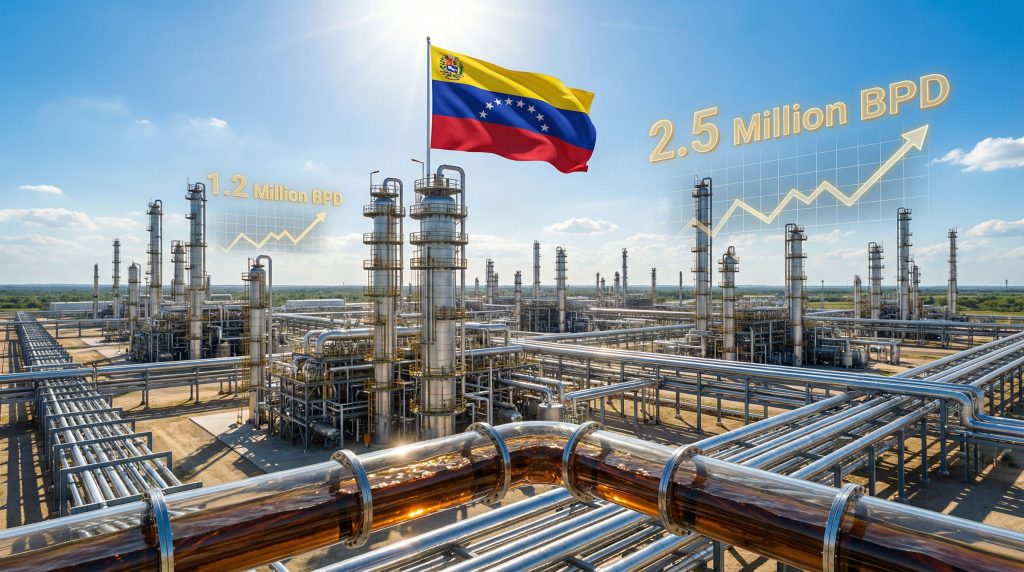
Recovery scenarios depend heavily on technology transfer agreements and service company integration. Historical production levels suggest Venezuela could realistically target 1.2 to 2.5 million barrels per day within a five-year expansion timeline, contingent on sustained investment in critical infrastructure components.
Sanctions Relief Timeline and Market Access Windows
Market access mechanisms operate through structured licensing frameworks designed to ensure compliance with democratic governance benchmarks. These authorization processes create predictable market entry windows while maintaining oversight capabilities essential for sustainable partnership development.
Revenue sharing arrangements incorporate transparency requirements that align with international best practices for resource extraction partnerships. Companies seeking market access must demonstrate adherence to environmental standards and community engagement protocols that support long-term operational stability.
The reversibility factor remains a critical consideration for investment planning. Furthermore, the tariff impact on investments requires careful evaluation, as political stability requirements extend beyond Venezuelan domestic policies to include US domestic political considerations that could influence sanctions relief continuation across different electoral cycles.
How Will Venezuela's Resource Portfolio Transform Under US Investment?
The Orinoco Belt Heavy Crude Processing Challenge
Venezuela's Orinoco Belt spans approximately 55,000 square kilometers across eastern regions, containing extra-heavy crude oil that presents both significant opportunities and technical challenges. This viscous, dense crude requires specialized extraction and processing methods that distinguish it from conventional oil operations worldwide.
| Crude Type | API Gravity | Extraction Cost ($/barrel) | Processing Requirements |
|---|---|---|---|
| Orinoco Heavy | 6-10° | $35-45 | Advanced thermal recovery |
| US Light Sweet | 35-45° | $20-30 | Conventional processing |
| Saudi Light | 32-34° | $15-25 | Standard refining |
| Canadian Oil Sands | 8-12° | $40-55 | Specialized upgrading |
Processing economics for Orinoco crude depend critically on specialized refinery capabilities. US Gulf Coast installations possess the thermal cracking and coking infrastructure necessary to handle heavy crude efficiently, creating natural synergies between Venezuelan production and American processing capacity.
Why US Gulf Coast refineries are uniquely positioned for Venezuelan crude: These facilities were specifically designed to process heavy crude imports and maintain spare capacity that could accommodate significant Venezuelan volume increases without major infrastructure modifications.
Heavy crude pricing typically trades at $10-15 per barrel discount to lighter grades, but this differential narrows when processing costs are optimized through appropriate refinery matching. Venezuelan crude's sulfur content and metal contamination require specialized desulfurization units common in Texas and Louisiana installations.
Natural Gas Integration Opportunities
Venezuela holds approximately 5.5 trillion cubic meters of natural gas reserves, ranking ninth globally and representing 73% of South American regional reserves. These deposits offer substantial monetization potential through both domestic utilization and export development programs.
Associated gas production represents 80% of Venezuelan natural gas output, creating direct linkages between oil production expansion and gas availability. This relationship connects to broader US natural gas forecast trends, enabling integrated development strategies that maximize resource extraction efficiency while supporting both hydrocarbon and petrochemical sector growth.
Gas-to-liquids technology applications could transform associated gas streams into higher-value products suitable for international export markets. Venezuela's coastal positioning provides advantageous access to both Atlantic and Caribbean shipping routes, supporting diverse market development opportunities.
Natural gas infrastructure development requires coordination between production facilities and processing plants. Current Venezuelan gas processing capacity operates below optimal levels, creating opportunities for technology partnerships focused on efficiency improvements and capacity expansion.
Critical Minerals Beyond Oil: The Untapped $5.5 Billion Mining Potential
Venezuela's mineral wealth extends far beyond hydrocarbons, encompassing critical materials essential for both traditional industrial applications and emerging clean energy technologies. The country possesses 161.2 metric tonnes of official gold reserves, worth over $23 billion at current market values, representing Latin America's largest certified holdings.
| Mineral | Proven Reserves | Estimated Resources | Global Ranking |
|---|---|---|---|
| Gold | 161.2 tonnes | 644+ tonnes | Top 15 globally |
| Iron Ore | 3.6 billion tonnes | 14.68 billion tonnes | Top 10 globally |
| Nickel | 407,885 tonnes | Under assessment | Top 20 globally |
| Bauxite | 99.4 million tonnes | Expanding surveys | Top 15 globally |
| Coal | 3 billion tonnes | Certified reserves | Regional leader |
The Orinoco Mining Arc initiative, spanning 12% of Venezuelan territory, targets diverse mineral extraction across multiple states. Diamond reserves total 1,020 million carats within this region, with 275 million carats concentrated in the Guanaimo area alone, highlighting the geological diversity available for development.
Mining sector revival requires substantial equipment and technology investments. The 2018 Gold Plan, which included $5.5 billion in announced mining deals, demonstrates the sector's potential scale but also highlights implementation challenges that must be addressed through improved governance and security frameworks.
Critical minerals for energy transition include nickel for battery production and bauxite for aluminum manufacturing. These materials support both traditional industrial demand and emerging clean energy supply chains, creating multiple market opportunities for Venezuelan mineral production.
What Are the Production Scale Scenarios for 2026-2030?
Conservative Growth Model: 1.2 Million BPD Ceiling
Conservative production modeling assumes gradual infrastructure rehabilitation and measured investment deployment. This scenario targets 1.2 million barrels per day by 2028, representing a 26% increase from current production levels while maintaining operational sustainability.
Infrastructure constraints limit rapid expansion capabilities, particularly in transportation networks and processing facilities. PDVSA facilities require systematic upgrading to handle increased throughput while maintaining safety and environmental standards essential for international partnership sustainability.
Investment requirements for conservative growth total approximately $8-12 billion over five years, covering:
• Well rehabilitation and drilling equipment upgrades
• Pipeline capacity expansion and maintenance systems
• Processing facility modernization and safety improvements
• Transportation infrastructure development and port upgrades
• Environmental monitoring and compliance systems
This production ceiling accounts for realistic timelines required for equipment procurement, installation, and commissioning. Conservative estimates incorporate potential delays from regulatory approvals, environmental assessments, and workforce training requirements.
Accelerated Investment Scenario: Path to 2.5 Million BPD
Accelerated growth scenarios target 2.5 million barrels per day production by 2030, approaching pre-sanctions output levels through intensive investment and technology transfer programs. This ambitious timeline requires coordinated deployment of advanced extraction technologies and substantial infrastructure development.
Timeline for reaching pre-sanctions production levels:
- 2026: 1.1 million BPD (infrastructure assessment and planning)
- 2027: 1.5 million BPD (major equipment installation phase)
- 2028: 2.0 million BPD (capacity testing and optimization)
- 2029: 2.3 million BPD (full system integration)
- 2030: 2.5 million BPD (sustained production targets)
Technology transfer requirements include advanced drilling techniques, enhanced oil recovery systems, and digital monitoring capabilities. US service company integration provides essential expertise for complex heavy crude extraction while ensuring operational efficiency standards.
Investment scaling for accelerated scenarios approaches $20-25 billion over five years, requiring coordinated financing from multiple sources including private investment, development banks, and government-backed programs.
Geopolitical Risk Factors That Could Derail Expansion
Political stability requirements extend beyond domestic Venezuelan considerations to encompass regional dynamics and international relationship management. Consequently, OPEC global influence becomes increasingly important as Venezuelan production approaches levels that could impact global market balance.
Venezuela's founding membership in OPEC, established in Baghdad in September 1960, creates both opportunities and constraints for production expansion. Quota negotiations must balance Venezuelan recovery goals with broader OPEC+ market management objectives.
Domestic security challenges, particularly in mining regions where non-state armed groups maintain control, require comprehensive solutions before major investment deployment. These security considerations directly impact investor confidence and operational continuity planning.
International sanctions frameworks remain subject to policy changes that could affect market access and investment protection. Risk mitigation strategies must account for potential reversals in sanctions relief depending on political developments in multiple countries.
How Does This Reshape Global Oil Trade Flows?
China's Dominant Market Position Under Pressure
China currently holds an 81.7% market share of Venezuelan oil exports, importing 778,000 barrels per day out of Venezuela's total 952,000 barrels daily production as of November 2025. This dominant position represents over a decade of strategic relationship building during periods when Western companies faced sanctions restrictions.
| Destination | November 2025 (BPD) | Market Share | Projected 2027 (BPD) | Projected Share |
|---|---|---|---|---|
| China | 778,000 | 81.7% | 800,000 | 50-55% |
| United States | 150,400 | 15.8% | 600,000 | 35-40% |
| Cuba | 23,800 | 2.5% | 50,000 | 3-4% |
| Other | Minimal | <1% | 150,000 | 8-10% |
Chinese refineries have adapted specifically to Venezuelan heavy crude processing, creating technical dependencies that complicate rapid supply chain realignment. However, US Gulf Coast refineries maintain superior processing capabilities for Orinoco Belt crude, potentially offering better pricing for Venezuelan exports.
Market share redistribution will likely occur gradually rather than through immediate shifts. Chinese contracts often include long-term commitments and financing arrangements that create contractual obstacles to rapid supply chain changes.
US Gulf Coast Refinery Renaissance Potential
Historical context demonstrates proven capacity for substantial Venezuelan crude imports. During the late 1990s and early 2000s, US refineries processed 1.5-2 million barrels per day of Venezuelan crude, establishing operational expertise that remains relevant for expanded cooperation.
Heavy crude processing capacity utilization in Texas and Louisiana facilities currently operates below maximum potential, creating opportunities to accommodate significant Venezuelan volume increases without major infrastructure modifications. These refineries possess specialized coking units and thermal cracking capabilities essential for heavy crude optimization.
Refinery economics favour Venezuelan heavy crude when transportation costs and processing capabilities align effectively. US installations can achieve higher yields and better product quality from Orinoco Belt crude compared to alternative processing locations, creating competitive advantages for both Venezuelan exporters and American refiners.
Atlantic Basin Supply Chain Reconfiguration
Transportation cost advantages emerge from Venezuela's Atlantic positioning relative to US Gulf Coast markets. Shipping distances from Venezuelan ports to Texas and Louisiana installations are substantially shorter than routes to Chinese refineries, creating natural economic incentives for trade flow realignment.
Strategic petroleum reserve implications include potential for Venezuelan crude to contribute to US emergency preparedness programs. Heavy crude storage capabilities in salt caverns provide options for incorporating Venezuelan supplies into strategic reserve management strategies.
Port facility modernisation requirements encompass both Venezuelan export terminals and US receiving facilities. Coordination between port authorities can optimise vessel sizing, loading procedures, and scheduling efficiency to minimise transportation costs and delivery times.
What Investment Opportunities Emerge from US-Venezuela Energy Cooperation?
Upstream Development Joint Ventures
Service company market entry strategies focus on specialised capabilities required for Orinoco Belt development. Companies with enhanced oil recovery expertise, horizontal drilling capabilities, and heavy crude extraction experience possess competitive advantages in Venezuelan market development.
Technology licensing opportunities encompass digital oilfield management, production optimisation software, and environmental monitoring systems. Venezuelan operations require advanced technology integration to achieve competitive production costs while maintaining environmental compliance standards.
Equipment supply chains must accommodate unique requirements for heavy crude extraction, including specialised pumping systems, thermal recovery equipment, and processing infrastructure designed for high-viscosity crude handling.
Joint venture structures balance Venezuelan state participation with international technical expertise and financing capabilities. These partnerships require careful structuring to align interests while providing appropriate risk allocation and return mechanisms.
Midstream Infrastructure Investment Requirements
Pipeline capacity expansion needs encompass both gathering systems for production areas and transmission lines connecting processing facilities to export terminals. Current infrastructure operates near capacity limits, creating bottlenecks that constrain production growth.
Port facility modernisation projects require coordination between crude oil terminals and refined product export capabilities. Venezuelan ports need upgrading to handle larger vessels and increased throughput volumes efficiently while meeting international safety and environmental standards.
Storage infrastructure development includes both crude oil storage at production facilities and product storage at refineries and terminals. Adequate storage capacity provides operational flexibility and market timing optimisation opportunities.
Downstream Integration Possibilities
Refinery upgrade economics for heavy crude processing: Specialised heavy crude refineries typically achieve 15-20% higher margins on Venezuelan crude compared to conventional processing, justifying significant infrastructure investments when supply agreements provide long-term volume certainty.
Petrochemical sector development potential builds on natural gas availability and refinery integration opportunities. Venezuelan feedstock supplies could support expanded petrochemical production serving both domestic and export markets.
Product distribution networks require development to support domestic market growth and export capability enhancement. Refined product storage and transportation systems need coordination with crude oil processing expansion to optimise overall system efficiency.
The next major ASX story will hit our subscribers first
Which Market Sectors Benefit Most from Venezuelan Resource Expansion?
Energy Security and Price Stabilisation Effects
Impact on global oil price volatility: Venezuelan production increases of 1-1.5 million barrels per day could reduce global oil price volatility by 5-8%, providing strategic buffer capacity during market disruptions and contributing to more stable energy pricing for consumers worldwide.
Strategic buffer capabilities against Middle East supply disruptions become increasingly important as geopolitical tensions affect traditional supply sources. Venezuelan production provides geographic diversification that enhances overall supply chain resilience for both US and global markets.
However, market dynamics also connect to broader oil price crash analysis scenarios, where price stabilisation effects extend beyond crude oil to include refined products and petrochemical feedstocks. Increased Venezuelan production capacity creates competitive pressure that moderates price spikes during supply disruption periods.
Mining Equipment and Technology Providers
Gold mining sector revival opportunities encompass both large-scale industrial operations and artisanal mining improvements. Equipment suppliers with experience in tropical mining conditions and heavy mineral processing possess advantages in Venezuelan market development.
Critical minerals extraction technology needs include nickel processing systems, bauxite refining capabilities, and rare earth element separation technologies. These requirements create opportunities for specialised equipment manufacturers and engineering services companies.
| Mining Equipment Category | Market Size (2026-2030) | Primary Applications | Technology Requirements |
|---|---|---|---|
| Heavy Earth Moving | $800M – $1.2B | Gold, Iron Ore | Tropical durability |
| Processing Equipment | $1.5B – $2.2B | Ore concentration | High-efficiency systems |
| Environmental Systems | $400M – $600M | Waste management | Regulatory compliance |
| Digital Mining Tech | $200M – $350M | Optimisation | Remote monitoring |
Environmental remediation technology markets emerge from requirements to address previous mining impacts while establishing sustainable practices for future operations. These opportunities span water treatment, soil rehabilitation, and ecosystem restoration services.
Transportation and Logistics Expansion
Tanker fleet requirements increase significantly with expanded Venezuelan oil exports, creating opportunities for shipping companies and vessel operators specialised in heavy crude transportation. Vessel modifications may be required to optimise heavy crude handling capabilities.
| Shipping Route | Distance (nautical miles) | Transit Cost ($/barrel) | Voyage Duration (days) |
|---|---|---|---|
| Venezuela-US Gulf | 1,200-1,500 | $2.50-$3.50 | 4-6 |
| Venezuela-China | 8,500-9,200 | $8.00-$12.00 | 18-25 |
| Venezuela-Europe | 4,200-4,800 | $5.50-$7.50 | 10-14 |
Port services expansion includes vessel loading and discharge capabilities, storage facility management, and cargo handling optimisation. Venezuelan port authorities require partnerships with experienced international operators to achieve efficiency improvements.
Logistics coordination services encompass supply chain management, inventory optimisation, and transportation scheduling. These services become increasingly complex as production volumes grow and market destinations diversify.
What Are the Long-Term Strategic Implications for Energy Transition?
Heavy Oil's Role in Declining Fossil Fuel Demand
Economic viability analysis under carbon pricing scenarios reveals complex dynamics for heavy crude investments. While carbon costs increase production expenses, heavy crude's processing flexibility allows for higher-value product optimisation that can maintain competitiveness.
Investment payback periods for heavy crude projects typically span 15-20 years, requiring careful assessment of long-term energy demand trajectories and policy environments. Venezuelan projects must demonstrate economic viability across multiple demand scenarios to justify substantial capital commitments.
Processing technology advances enable heavy crude conversion into specialised products with reduced carbon intensity compared to conventional processing methods. These technological improvements help maintain heavy crude relevance during energy transition periods.
Critical Minerals for Renewable Energy Infrastructure
Venezuela's battery metals potential positions the country strategically within clean energy supply chains. Nickel reserves of 407,885 metric tonnes support battery production requirements, while bauxite holdings of 99.4 million metric tonnes serve aluminium needs for renewable energy infrastructure.
Supply chain diversification strategies seek alternatives to Chinese-dominated critical mineral supply chains. Venezuelan mineral production could provide Western markets with alternative sourcing options that reduce dependence on potentially unstable supply relationships.
Mining sector development timelines for critical minerals typically require 7-10 years from exploration to production, creating urgency for investment decisions that support energy transition supply chain security objectives.
Hydrogen and Carbon Capture Integration Possibilities
Natural gas-to-hydrogen conversion potential utilises Venezuela's 5.5 trillion cubic meters of gas reserves for clean hydrogen production. Associated gas streams from oil production provide feedstock for hydrogen generation that could serve both domestic and export markets.
Carbon capture and storage (CCS) technology deployment opportunities exist within heavy oil operations where CO2 injection can enhance oil recovery while providing carbon sequestration benefits. This dual-purpose approach improves project economics while addressing environmental concerns.
Integrated energy systems combining hydrocarbon production with renewable energy and hydrogen generation create comprehensive energy solutions that bridge current fossil fuel demands with future clean energy requirements.
How Do Sanctions Relief Mechanisms Actually Work in Practice?
License-Based Market Access Framework
Company-specific authorisation processes operate through detailed applications submitted to US Treasury Department's Office of Foreign Assets Control (OFAC). These applications require comprehensive business plans, compliance frameworks, and monitoring procedures that demonstrate adherence to sanctions relief conditions.
Authorisation criteria encompass financial transparency requirements, operational oversight capabilities, and commitment to democratic governance benchmarks. Companies must establish robust compliance systems that ensure ongoing adherence to authorisation conditions throughout project lifecycles.
Market access windows depend on Venezuelan government compliance with specified governance improvements and democratic institutions strengthening. These requirements create performance-based relief mechanisms that maintain pressure for continued political development.
Compliance Monitoring and Enforcement Mechanisms
Key performance indicators for sanctions relief: Democratic governance benchmarks include electoral transparency, press freedom improvements, political prisoner releases, and civil society participation expansion, with specific metrics required for continued market access authorisation.
Monitoring systems track both company compliance with authorisation conditions and Venezuelan government adherence to governance benchmarks. These dual-layer oversight mechanisms ensure sanctions relief contributes to broader policy objectives beyond commercial considerations.
Enforcement mechanisms include authorisation suspension capabilities that allow rapid response to compliance failures or governance regression. These reversibility provisions protect sanctions relief effectiveness while providing flexibility for policy adjustment.
Reversibility Factors and Political Risk Assessment
US domestic political considerations influence sanctions relief sustainability across electoral cycles. Investment decisions must account for potential policy reversals that could affect market access and operational continuity regardless of Venezuelan compliance performance.
Venezuelan policy stability requirements extend beyond current government commitments to encompass institutional development that supports long-term partnership sustainability. Political risk assessment must evaluate both current leadership capacity and institutional resilience factors.
Risk mitigation strategies include investment structuring that accommodates potential sanctions reimposition while maintaining operational capabilities during policy uncertainty periods.
FAQ: Critical Questions About US-Venezuela Oil Production Expansion
When Will Venezuelan Oil Production Reach Pre-Sanctions Levels?
Venezuelan oil production reaching pre-sanctions levels of 1.5-2 million barrels per day requires 5-7 years under optimal investment scenarios. Current production of 952,000 barrels per day provides a foundation for expansion, but infrastructure rehabilitation and technology transfer require substantial time investments.
Realistic timelines account for equipment procurement delays, regulatory approval processes, and workforce training requirements. Accelerated scenarios could achieve 2 million barrels per day by 2030 with sustained investment commitments and favourable political conditions.
How Does This Affect OPEC+ Production Agreements?
Venezuela's OPEC founding membership creates obligations to coordinate production increases with broader OPEC+ market management strategies. Current agreements may require modification to accommodate Venezuelan recovery without destabilising global oil markets.
Quota negotiations must balance Venezuelan economic recovery needs with other OPEC+ members' market share concerns. Venezuela's unique circumstances as a recovering producer may warrant special consideration within OPEC+ frameworks.
What Role Will Environmental Standards Play in Development?
Environmental compliance requirements encompass both US regulatory standards for companies operating under sanctions relief and Venezuelan domestic environmental protection obligations. These standards affect project design, operational procedures, and monitoring requirements.
Technology deployment must demonstrate environmental performance improvements compared to historical operations. Advanced monitoring systems and pollution control technologies become essential components of expanded production systems.
Can Venezuela's Mining Sector Compete with Established Producers?
Venezuelan mining competitiveness depends on infrastructure development, governance improvements, and technology modernisation. Gold reserves exceeding 644 metric tonnes provide substantial competitive advantages, but operational efficiency must match international standards.
Cost competitiveness requires addressing security challenges, transportation infrastructure limitations, and regulatory framework improvements. These foundational elements determine whether Venezuelan mining operations can achieve sustainable market positions.
Strategic Outlook: Venezuela's Position in 2030 Global Energy Architecture
Production Capacity Projections and Market Share Analysis
By 2030, Venezuelan oil production capacity could realistically achieve 2-2.5 million barrels per day under favourable investment and political conditions. This production level would restore Venezuela's position among top global oil exporters while maintaining compatibility with climate transition timelines.
Market share projections suggest Venezuela could supply 8-12% of US crude oil imports by 2030, compared to current levels below 5%. This increased market presence would enhance North American energy security while providing Venezuela with diversified export markets.
Natural gas production expansion could reach 45-60 billion cubic metres annually by 2030, supporting both domestic petrochemical development and potential LNG export capabilities. Associated gas monetisation becomes increasingly important as oil production scales upward.
Integration with North American Energy Security Framework
Venezuelan energy integration enhances North American energy independence through diversified supply sources and reduced dependence on potentially unstable international suppliers. Heavy crude processing capabilities in US Gulf Coast refineries create natural partnerships that optimise resource utilisation.
Strategic petroleum reserve contributions could include Venezuelan crude storage options that provide emergency response capabilities while supporting market stabilisation objectives. These arrangements require coordination between national security considerations and commercial operations.
Cross-border infrastructure development opportunities encompass pipeline connections, refined product distribution systems, and integrated petrochemical supply chains that optimise resource flows throughout North American markets.
Competitive Positioning Against Other Heavy Oil Producers
Venezuelan heavy oil competitiveness benefits from proximity advantages to US processing facilities compared to Canadian oil sands operations. Transportation cost differentials and processing optimisation capabilities create competitive advantages that support market share growth.
Technology transfer partnerships enable operational efficiency improvements that enhance Venezuelan competitiveness against established heavy oil producers worldwide. Advanced extraction techniques and processing optimisation reduce production costs while improving product quality.
Long-term competitive sustainability requires continued investment in technology development, infrastructure modernisation, and workforce capabilities that maintain Venezuelan advantages in global heavy oil markets.
This analysis represents current assessments based on available information and market projections. Actual outcomes depend on numerous variables including political stability, investment commitments, and global energy market developments that may differ from current expectations.
For the latest analysis on Trump's policy impacts on Venezuela, see this Guardian report and fact-checking coverage regarding claims about US control over Venezuelan oil sales.
Ready to Capitalise on the Next Energy Market Shift?
Discovery Alert's proprietary Discovery IQ model delivers real-time notifications on significant ASX mineral discoveries, including critical materials that support both traditional energy infrastructure and renewable technology supply chains. As global energy partnerships reshape commodity markets, subscribers gain immediate access to actionable insights that position them ahead of market movements. Begin your 30-day free trial today to secure your competitive advantage in evolving energy and mining markets.