August 6, 2026
Strategic supply chain vulnerabilities in critical materials often emerge not from resource scarcity, but from temporal misalignments between industrial capabilities. In the rare earth minerals sector, America faces a particularly complex challenge where domestic magnet manufacturing infrastructure is advancing faster than the supporting extraction and processing foundation. This timing disconnect creates windows of dependency that undermine strategic autonomy objectives, forcing manufacturers to rely on foreign-processed materials during critical transition periods.
The current landscape reveals a fundamental restructuring of global supply chains, where geopolitical tensions accelerate domestic capacity building while established international networks maintain operational advantages. Understanding these dynamics requires examining not just what America produces today, but when different supply chain segments will achieve commercial viability and how market forces shape investment decisions during this transformation period.
Understanding America's Critical Mineral Processing Timeline
The USA Rare Earth mine-to-magnet gap represents more than a simple supply chain challenge. It reflects a systematic timing mismatch where downstream manufacturing capabilities are being developed ahead of upstream processing infrastructure. This sequence creates vulnerabilities during the transition period, as domestic manufacturers must source processed materials from foreign suppliers while waiting for domestic processing capacity to mature.
Furthermore, the critical minerals energy transition amplifies these challenges as clean energy infrastructure demands substantial rare earth inputs. The temporal disconnect becomes evident when examining specific company timelines.
Current Supply Chain Development Status:
| Supply Chain Stage | Development Timeline | Capacity Status | Key Constraints |
|---|---|---|---|
| Raw Material Extraction | 2025-2027 | Limited domestic sources | Permitting, environmental compliance |
| Separation Processing | 2027-2030 | Pilot to commercial scale | Technology validation, capital intensity |
| Magnet Manufacturing | 2025-2026 | Emerging production | Feedstock availability |
| End-Use Integration | Current | Established capability | Supply security |
While facilities for permanent magnet production are targeting operational status by 2026, the corresponding rare earth oxide separation capabilities remain years behind. This forces manufacturers to rely on imported processed materials, potentially undermining the strategic benefits of domestic manufacturing.
Processing Infrastructure Development:
- Energy Fuels (NYSE: UUUU): Operating pilot-scale heavy rare earth processing at White Mesa mill in Utah
- MP Materials (NYSE: MP): Commercial light rare earth processing at Mountain Pass, California
- USA Rare Earth (NASDAQ: USAR): Planned integrated processing tied to Round Top project development
- American Resources Corp: Technology development for separation capabilities
The challenge extends beyond simple capacity building. Heavy rare earth processing requires significantly more complex separation technologies compared to light rare earth elements, yet these materials are critical for high-performance permanent magnets used in defense and advanced technology applications.
When big ASX news breaks, our subscribers know first
China's Processing Dominance and Market Structure
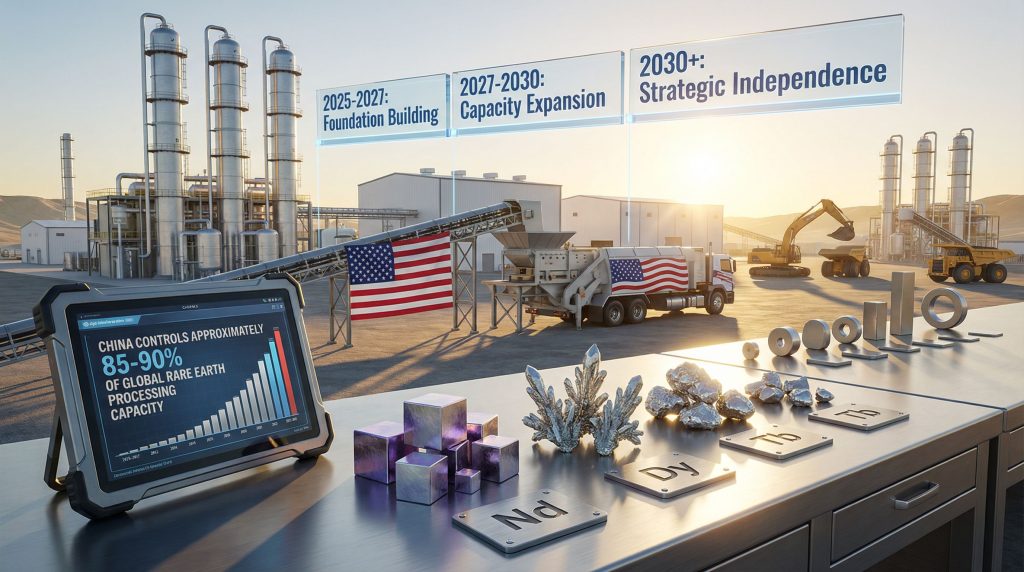
China's control over rare earth processing stems from decades of integrated infrastructure development and cost advantages that extend beyond labor considerations. The country processes approximately 85-90% of global rare earth materials, maintaining vertical integration from mining through magnet manufacturing.
In addition, recent US-China trade tensions have highlighted the strategic risks of such concentrated supply chains. This concentration creates both supply vulnerabilities and competitive challenges for emerging domestic producers.
Chinese Processing Advantages:
- Scale economies: Massive processing volumes reduce per-unit costs
- Integrated supply chains: Coordinated development from mining to end products
- Technology maturation: Decades of process optimization and efficiency improvements
- Capital infrastructure: Established separation facilities and environmental management systems
Processing economics reveal the challenge facing American developers. Current analysis suggests cost differentials between Chinese-processed rare earth oxides and potential domestic alternatives range from 30-60%, primarily reflecting scale advantages and infrastructure maturity rather than labor cost differences alone.
Domestic Processing Reality:
The United States currently operates minimal commercial-scale rare earth processing capacity. Mountain Pass, operated by MP Materials, represents the primary domestic light rare earth processing facility. However, heavy rare earth processing remains largely absent, despite these materials being critical for advanced magnet applications.
Energy Fuels has initiated pilot-scale heavy rare earth processing operations, representing an important step toward domestic capability. However, scaling from pilot operations to commercial production requires substantial capital investment and technology validation.
The fundamental bottleneck in American rare earth supply chain development is not mining capacity but rather the processing infrastructure required to convert raw materials into magnet-grade oxides and metals.
Financial Implications of Supply Chain Dependencies
The capital requirements for achieving rare earth processing independence present significant financial challenges for both companies and government policy makers. Industry estimates suggest $15-25 billion in total investment across the entire domestic supply chain, with return timelines extending 8-12 years for integrated operations.
Investment Profile Analysis:
USA Rare Earth Financial Position (December 2025):
- Net loss TTM: $285 million
- Cash reserves: Approximately $258 million
- EBITDA: -$39 million
- Share price: $13.84 (52-week range: $5.56 – $43.98)
- Short interest: ~13% of float
The financial metrics for USA Rare Earth illustrate typical patterns among rare earth developers: significant cash burn, pre-revenue status, and substantial funding requirements for project development. The company's cash position provides operational runway, but achieving commercial production requires additional capital deployment.
Valuation Challenges in Pre-Revenue Development:
Discounted cash flow models for rare earth developers face inherent challenges given execution uncertainties and timeline risks. Simply Wall Street's DCF valuation places USA Rare Earth at $31.93 versus current market pricing around $13.84, reflecting the gap between theoretical project value and market-assessed execution probability.
Capital Structure Considerations:
- Positive indicators: Minimal debt burden, substantial cash reserves relative to current burn rate
- Risk factors: Negative book value, ongoing losses, dependence on future funding rounds
- Timeline pressure: Production delays directly impact funding requirements and dilution scenarios
The acquisition of Less Common Metals by USA Rare Earth represents strategic positioning for processing capabilities, but integration costs and operational scaling remain unproven. Successful processing pathway development requires both technical validation and economic competitiveness against established Chinese capacity.
Companies Addressing the Supply Chain Gap
Multiple companies across different supply chain segments are working to establish domestic rare earth capabilities. Their approaches vary significantly, from focused mining operations to integrated mine-to-magnet strategies, each facing distinct technical and financial challenges.
Mining and Primary Processing:
MP Materials (NYSE: MP) operates the Mountain Pass facility in California, representing America's primary commercial rare earth mining and light element processing operation. The facility produces rare earth concentrates and has developed domestic processing capabilities for light rare earth elements including neodymium and praseodymium, which are essential for permanent magnet production.
USA Rare Earth (NASDAQ: USAR) is developing the Round Top project in Texas, targeting 2028 commercial production. The project aims for integrated operations spanning mining, processing, and magnet manufacturing. The company's acquisition of Less Common Metals provides access to separation technologies, though integration and scale-up remain critical execution factors.
Energy Fuels (NYSE: UUUU) processes monazite sands at its White Mesa mill in Utah, targeting heavy rare earth recovery alongside uranium operations. The facility represents one of the few domestic sources for heavy rare earth processing, though current operations remain at pilot scale.
Processing and Separation Technology:
Processing represents the most critical bottleneck in domestic supply chain development. Chinese facilities achieve separation purities exceeding 99.9% at commercial scale, establishing the technical benchmark for domestic alternatives.
American Resources Corp is developing proprietary separation technologies, though commercial validation remains pending. The company focuses on efficient separation methods that could reduce capital intensity compared to traditional processing approaches.
Lynas Rare Earths, an Australian company, plans US processing facility development to serve domestic markets. This approach leverages established mining operations in Australia with US-based processing to reduce supply chain dependencies.
Magnet Manufacturing Development:
Permanent magnet manufacturing represents the downstream application for rare earth materials, where several international companies maintain US operations:
- VAC (Vacuumschmelze): German technology company with US manufacturing capabilities
- Shin-Etsu Chemical: Japanese manufacturer with US presence for domestic supply
- USA Rare Earth: Planned Oklahoma magnet facility as part of integrated strategy
Geopolitical Factors Driving Supply Chain Strategy
National security considerations significantly influence rare earth supply chain development, with defense applications requiring reliable access to specific heavy rare earth elements. Recent developments, including the Trump critical minerals order, demonstrate how policy responses span multiple federal agencies and legislative initiatives.
Critical Vulnerability Assessment:
Defense applications require consistent access to dysprosium, terbium, and other heavy rare earth elements for advanced guidance systems, communications equipment, and precision weaponry. Current supply dependencies create potential disruption scenarios that extend beyond commercial market considerations.
Clean energy infrastructure development compounds these vulnerabilities, with wind turbines, electric vehicle motors, and energy storage systems requiring substantial rare earth permanent magnets. Supply disruptions could impact both defense readiness and climate policy implementation.
Policy Response Mechanisms:
The Defense Production Act has been invoked to prioritise critical mineral processing development, providing emergency authority to accelerate domestic production capabilities. This legislation enables government contracts and loan guarantees for strategic projects that might not achieve commercial viability under normal market conditions.
Federal Funding Initiatives:
- CHIPS and Science Act: Allocates funding for semiconductor and technology supply chain development
- Inflation Reduction Act: Provides tax incentives for clean energy manufacturing requiring rare earth inputs
- Department of Energy: Direct grants exceeding $140 million for rare earth processing projects
- Department of Defense: Strategic materials stockpile investments and research funding
State-level support supplements federal initiatives, with Texas supporting Round Top development, Utah backing Energy Fuels facility expansion, and California optimising Mountain Pass operations through regulatory and infrastructure assistance.
Technical Challenges in Rare Earth Processing
Rare earth processing involves complex chemical separation processes that distinguish between elements with similar chemical properties. The technical difficulty increases significantly for heavy rare earth elements, where separation efficiency and purity requirements exceed those for light rare earth processing.
Processing Complexity Matrix:
| Element Category | Separation Difficulty | US Capability | Strategic Importance | Purity Requirements |
|---|---|---|---|---|
| Light REEs (La, Ce, Pr, Nd) | Moderate complexity | Developing capacity | High for permanent magnets | 99.9%+ for magnet applications |
| Heavy REEs (Dy, Tb, Ho, Er) | Extreme complexity | Minimal capacity | Critical for defense applications | 99.99%+ for specialised uses |
| Mixed concentrates | Variable complexity | Limited capability | Feedstock for processing | Depends on end application |
Environmental and Regulatory Considerations:
Rare earth processing generates radioactive byproducts, including thorium and uranium contamination that requires specialised waste management protocols. Environmental compliance adds significant costs and timeline complications to facility development, with permitting processes extending 5-7 years for new operations.
Water treatment represents another technical challenge, as processing operations require substantial water volumes and generate contaminated streams requiring extensive remediation. Advanced treatment technologies add capital costs but are essential for regulatory compliance and community acceptance.
Separation Technology Approaches:
Traditional solvent extraction methods dominate current commercial operations, requiring multiple separation stages and significant chemical inputs. Alternative approaches being developed include:
- Advanced solvent systems: Improved selectivity and reduced chemical consumption
- Membrane separation: Potentially reduced environmental impact and energy requirements
- Electrolytic processing: Direct metal production from oxides with reduced chemical processing
- Biomining techniques: Experimental approaches using biological agents for selective extraction
The next major ASX story will hit our subscribers first
Timeline Projections for Supply Chain Independence
Achieving comprehensive rare earth supply chain independence requires coordinated development across multiple segments with different technical and financial requirements. Realistic timelines reflect both technical constraints and capital deployment realities.
What Are the Key Development Phases?
Phase 1 (2025-2027): Foundation Building
This initial phase focuses on pilot-scale validation and early commercial production from existing facilities. MP Materials continues optimising Mountain Pass operations, while Energy Fuels scales heavy rare earth processing at White Mesa.
Key milestones include achieving consistent separation purities, validating environmental management systems, and securing initial customer relationships for domestically processed materials. Capital requirements remain moderate, focusing on optimisation rather than major expansion.
Phase 2 (2027-2030): Commercial Scale Development
Commercial-scale processing facilities enter operation during this phase, with USA Rare Earth targeting Round Top production by 2028. Integrated mine-to-processing operations demonstrate economic viability, while magnet manufacturing facilities achieve commercial production using domestic feedstock.
This phase requires the largest capital deployment, with multiple facilities requiring simultaneous construction and commissioning. Success depends on coordinating mining, processing, and manufacturing timelines to minimise dependency gaps.
Phase 3 (2030+): Strategic Independence and Export Capability
Full supply chain sovereignty emerges during this phase, with domestic production meeting strategic requirements and generating export opportunities. Technology leadership development enables competitive positioning in global markets, while strategic stockpiles provide security against potential disruptions.
Risk Factors Affecting Timelines:
- Permitting delays: Environmental and regulatory approvals often exceed projected timelines
- Technology validation: Scaling from pilot to commercial operations frequently encounters unexpected challenges
- Capital market conditions: Funding availability affects development pace and execution capability
- Market competition: Chinese pricing and supply strategies influence project economics
Investment Evaluation Framework for Rare Earth Opportunities
Evaluating rare earth investment opportunities requires understanding both technical feasibility and market positioning factors that distinguish successful projects from development challenges. Given the sector's complexity and long development timelines, due diligence must address multiple risk categories.
Technical Assessment Criteria:
Resource Quality and Composition:
- Rare earth oxide grades: Higher concentrations reduce processing costs and improve economics
- Heavy versus light rare earth ratios: Heavy rare earth content significantly increases project value
- Radioactive contamination levels: Thorium and uranium content affects processing complexity and costs
- Mineralogy and processing pathway: Different ore types require distinct separation approaches
Processing Technology Validation:
- Separation efficiency rates: Recovery percentages for individual rare earth elements
- Purity achievements: Demonstrated ability to achieve magnet-grade specifications
- Environmental management: Proven approaches for radioactive waste and water treatment
- Energy consumption profiles: Processing energy requirements affect operating costs
How Should Investors Assess Market Positioning?
Offtake Agreement Assessment:
- Binding versus non-binding commitments: Legal enforceability of customer agreements
- Pricing mechanisms: Fixed-price, market-indexed, or negotiated pricing structures
- Volume commitments: Percentage of planned production covered by agreements
- Customer credit quality: Financial strength of purchasing counterparties
Competitive Positioning Factors:
- Cost structure analysis: All-in production costs compared to Chinese alternatives
- Quality differentiation: Specifications and consistency compared to established suppliers
- Supply security value: Premium pricing potential for domestic sourcing
- Regulatory advantages: Benefits from domestic content requirements or trade policies
Financial Risk Assessment:
Development Stage Risk Matrix:
| Development Stage | Primary Risks | Key Indicators | Risk Mitigation |
|---|---|---|---|
| Pre-resource definition | Geological uncertainty | Drilling results, resource estimates | Diversified exploration programs |
| Resource to development | Technical feasibility | Pilot testing, environmental approvals | Technology partnerships |
| Construction phase | Execution and funding | Construction progress, cost overruns | Fixed-price contracts, funding secured |
| Commercial production | Market and operational | Production rates, cost performance | Offtake agreements, operational experience |
Capital Structure Evaluation:
Successful rare earth development requires substantial capital over extended periods. Evaluation should consider:
- Total funding requirements: Capital needed through commercial production
- Funding timeline: When additional capital is required relative to milestones
- Dilution scenarios: Share issuance implications at different development stages
- Debt capacity: Project economics supporting debt financing for construction
Consequently, incorporating investment strategy 2025 principles becomes essential when evaluating these complex, capital-intensive projects.
Government Policy Impact on Supply Chain Development
Federal policy initiatives significantly influence rare earth supply chain development through direct funding, regulatory frameworks, and market incentives. Understanding policy mechanisms helps evaluate both opportunities and constraints affecting industry development.
Direct Funding and Support Programs:
Department of Energy Critical Materials Programs:
The DOE has allocated over $140 million specifically for rare earth processing and technology development. These grants target separation technology advancement, processing facility development, and research into alternative processing methods. Funding priorities emphasise heavy rare earth processing and technologies that reduce environmental impact.
Defense Production Act Applications:
Presidential invocation of the Defense Production Act for critical minerals enables priority contracting and loan guarantees for strategic projects. This authority allows government agencies to provide financial support for projects that serve national security interests but may not achieve commercial viability under normal market conditions.
State-Level Development Support:
Regional Specialisation Strategies:
- Texas: Infrastructure development and regulatory support for Round Top project
- Utah: Environmental permitting assistance for Energy Fuels expansion
- California: Operational optimisation support for Mountain Pass facility
- Wyoming: Research funding for alternative processing technologies
State-level support often includes tax incentives, infrastructure development, and regulatory streamlining that reduces development costs and timelines for qualified projects.
What Regulatory Frameworks Are Emerging?
Environmental Compliance Standards:
New regulations address radioactive waste management, water treatment requirements, and air quality standards specific to rare earth processing. While these regulations increase compliance costs, they also provide certainty for project planning and environmental management system design.
Critical Mineral Designation Benefits:
Materials classified as critical minerals receive priority treatment in permitting processes, streamlined environmental reviews, and access to strategic stockpile programs. This designation significantly affects project development timelines and government support availability.
International Partnerships and Supply Chain Diversification
Strategic partnerships with allied nations provide pathways for reducing Chinese supply dependencies while building integrated supply chains spanning multiple countries. These collaborations leverage comparative advantages across different supply chain segments.
Allied Nation Strategic Cooperation:
Australia Partnership Framework:
Australia operates significant rare earth mining operations through companies like Lynas Rare Earths, which processes materials in Malaysia and plans US processing facility development. This partnership model provides access to established mining operations while building domestic processing capability.
The Australia-US critical minerals partnership includes technology sharing agreements, joint research programs, and coordinated supply chain development. Investment facilitation and regulatory cooperation reduce barriers to integrated operations spanning both countries.
However, Australia green metals leadership demonstrates how regional partnerships can complement domestic capabilities rather than compete with them.
Canadian Critical Minerals Cooperation:
Canada maintains substantial rare earth deposits and developing processing capabilities that complement US strategic requirements. Joint development programs focus on heavy rare earth resources and advanced separation technologies that benefit both countries' supply security objectives.
Technology Transfer and Development Partnerships:
Japanese Manufacturing Integration:
Japanese companies like Shin-Etsu Chemical bring advanced magnet manufacturing technologies to US operations, providing access to proven production methods and quality control systems. These partnerships accelerate domestic manufacturing capability development while maintaining technology leadership.
South Korean Research Collaboration:
South Korean research institutions and companies contribute advanced materials science and processing technology development through joint research programs. Battery technology and permanent magnet applications receive particular emphasis in these collaborations.
Market Psychology and Investment Dynamics
Rare earth investment markets exhibit distinct psychological patterns driven by geopolitical concerns, supply security fears, and long development timelines. Understanding these dynamics helps explain valuation discrepancies and market behavior patterns affecting sector investment.
Speculation Versus Fundamentals:
Market pricing for rare earth developers often reflects geopolitical premium rather than fundamental project economics. USA Rare Earth's 52-week trading range from $5.56 to $43.98 illustrates the volatility driven by sentiment rather than operational developments.
Short interest at 13% of float indicates persistent scepticism about execution timelines and project economics. This volatility affects capital availability and investor confidence in sector development.
Valuation Model Limitations:
Traditional DCF models struggle with rare earth projects due to execution uncertainties, regulatory risks, and market pricing volatility. The gap between Simply Wall Street's $31.93 theoretical valuation and current market pricing around $13.84 reflects market-assessed execution probability rather than model deficiency.
Investment Timeline Misalignment:
Public market investment horizons often conflict with rare earth development timelines, creating funding challenges for projects requiring 5-10 years to reach commercial production. This mismatch favours companies with existing operations or near-term production capability over earlier-stage developers.
Strategic Supply Chain Vulnerabilities and Solutions
The development of rare earth processing capabilities requires understanding both immediate vulnerabilities and long-term solutions. Current supply dependencies create strategic risks that extend beyond commercial considerations.
Critical Vulnerability Points:
The USA Rare Earth mine-to-magnet gap manifests most critically in heavy rare earth processing, where domestic capabilities remain minimal despite strategic importance. Defense applications requiring dysprosium and terbium face particular supply vulnerabilities.
Manufacturing timeline misalignment creates additional vulnerabilities, as magnet production facilities achieve operational status before corresponding feedstock processing capabilities. This forces reliance on imported processed materials during critical transition periods.
How Can Strategic Vulnerabilities Be Mitigated?
Integrated Development Approaches:
Successful mitigation requires coordinated development across mining, processing, and manufacturing segments. Companies pursuing integrated strategies potentially reduce timeline mismatches and supply dependencies.
Technology Partnerships:
Advanced processing technology development through international partnerships provides pathways for accelerating domestic capabilities while maintaining competitive positioning.
Collaboration with allied nations leverages existing capabilities while building redundant supply pathways. This approach reduces single-point-of-failure risks while sharing development costs across multiple stakeholders.
Strategic Stockpiling:
Government stockpiling programs provide buffer capacity during transition periods, reducing immediate supply vulnerabilities while domestic capabilities mature. These programs require coordination between defense requirements and commercial market dynamics.
The path toward American rare earth supply chain independence requires navigating complex technical, financial, and geopolitical challenges while building capabilities across multiple industry segments. Success depends on coordinated development spanning mining, processing, and manufacturing, with realistic timelines reflecting both technical constraints and market realities.
Current market dynamics favour companies with demonstrated operational capabilities over purely developmental projects, though strategic government support provides pathways for advancing critical projects that serve national security objectives. Investment evaluation must balance long-term strategic importance against near-term execution risks and capital requirements.
The USA Rare Earth mine-to-magnet gap represents both vulnerability and opportunity, requiring sustained commitment from government and industry participants to achieve meaningful supply chain independence. While challenges are significant, ongoing development across multiple companies and projects indicates progress toward reducing foreign dependencies in this critical sector.
Disclaimer: This analysis contains forward-looking statements regarding rare earth supply chain development, company operational timelines, and market projections that involve substantial uncertainties. Investment decisions should be based on comprehensive due diligence and professional financial advice. Past performance and development projections do not guarantee future results.
Looking to Capitalise on Critical Minerals Development?
Discovery Alert's proprietary Discovery IQ model delivers real-time notifications on significant ASX mineral discoveries, including critical materials essential to supply chain independence. With comprehensive coverage across rare earth elements and strategic commodities, explore Discovery Alert's historic examples of exceptional returns from major mineral discoveries and begin your 30-day free trial today to secure your market-leading advantage.