August 6, 2026
Why the USGS Appalachia lithium potential matters in a supply chain risk framework
Lithium markets are shaped as much by bottlenecks as by geology. A country can identify a large mineral endowment and still remain dependent on imports if it lacks drilling success, permitting progress, concentrator capacity, chemical conversion infrastructure, trained labour, and stable project financing. That is the right lens for understanding the USGS Appalachia lithium potential.
In plain English, the assessment indicates that the Appalachian belt may contain a substantial amount of undiscovered, economically recoverable lithium oxide hosted in pegmatites. It does not mean those tonnes are already defined by drilling, booked as reserves, or ready for commercial extraction.
That distinction matters for investors, policymakers, and local communities because a regional mineral assessment is best viewed as a strategic signal. It suggests the eastern United States could play a larger future role in domestic lithium supply, but it does not guarantee near-term mine output or self-sufficiency.
Important caution: a national or regional resource estimate is not the same thing as a shovel-ready supply pipeline. Converting geologic potential into battery-grade material can take many years and may never occur at commercial scale in every prospective district.
A further point of confusion is reporting units. Lithium oxide, or Li2O, is a standard geological reporting unit used in hard-rock lithium assessments. It helps geologists compare pegmatite occurrences consistently before moving to downstream product measures such as lithium carbonate equivalent or lithium hydroxide output.
When big ASX news breaks, our subscribers know first
How large is the USGS Appalachia lithium estimate?
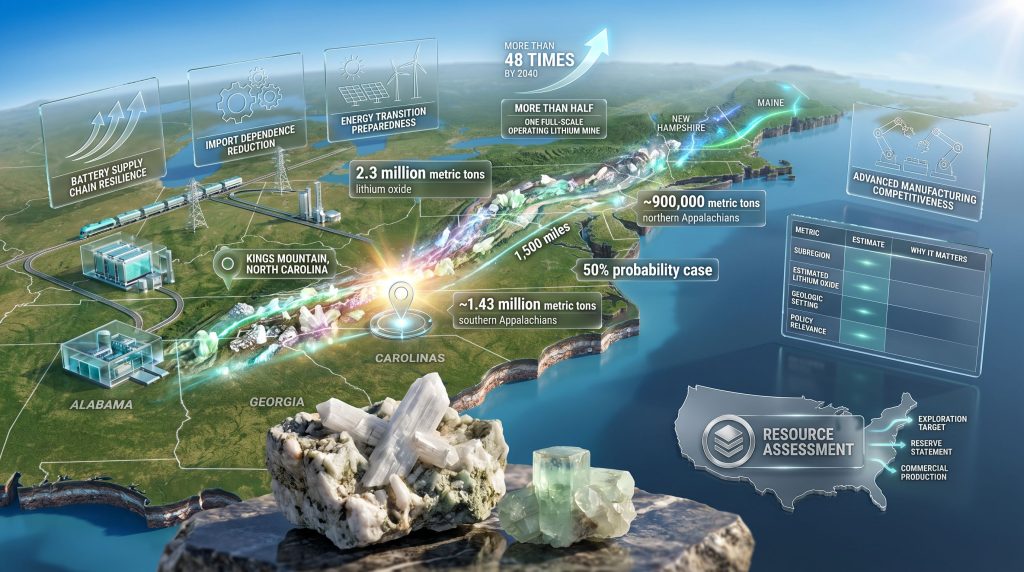
The headline figure attached to the USGS Appalachia lithium potential is 2.3 million metric tonnes of lithium oxide at a 50 percent probability case, according to the underlying USGS assessment referenced in 2026 coverage and associated scientific publication. Within that total, roughly 1.43 million metric tonnes were attributed to the southern Appalachians, while about 900,000 metric tonnes were linked to the northern Appalachians.
The mineralised belt spans about 1,500 miles, running from Alabama to Maine. In addition, a USGS news release framed the eastern resource as potentially large enough to materially reshape import dependence assumptions.
Key figures at a glance
| Metric | Estimate | Why it matters |
|---|---|---|
| Total lithium oxide | 2.3 million metric tonnes | Indicates large regional hard-rock lithium potential |
| Southern Appalachians | ~1.43 million metric tonnes | Shows the larger share sits in the historically known southern belt |
| Northern Appalachians | ~900,000 metric tonnes | Expands attention to northeastern pegmatite systems |
| Belt length | ~1,500 miles | Suggests a broad exploration corridor rather than a single camp |
| Probability case | 50% likelihood | Confirms the figure is probabilistic, not certain |
Those numbers are often translated into consumer-device equivalents to explain scale. Using the framing associated with the assessment, the tonnage is broadly comparable to lithium needs for around 130 million average-sized EVs, 180 billion laptops, or 500 billion smartphones.
These comparisons are useful for context; however, they should be treated carefully.
- They are illustrative scale comparisons, not development forecasts.
- They do not account for mining dilution, metallurgical recovery, product specification losses, or project-by-project economics.
- They do not mean Appalachia can realistically supply those end uses on any fixed timeline.
In industry terms, this is a classic case of a large top-down number that may attract public attention faster than it attracts qualified drilling rigs, processing plants, and environmental review teams.
Where lithium potential is concentrated across Appalachia
The geographic spread of the USGS Appalachia lithium potential is important because it broadens the domestic lithium map beyond the western United States. It also introduces very different state-level policy settings, land-use debates, and infrastructure questions.
Southern Appalachians and the Carolinas
The southern segment, with about 1.43 million metric tonnes of lithium oxide, draws attention because the Carolinas have long been associated with lithium-bearing pegmatites. Kings Mountain, North Carolina remains one of the most historically important hard-rock lithium districts in the country and is frequently used as a reference point when discussing U.S. pegmatite geology.
Why the southern belt stands out:
- It has stronger historical association with U.S. lithium mining and spodumene extraction.
- Regional geology is comparatively better known than many frontier districts.
- Existing industrial corridors in the Southeast may improve long-run mine-to-manufacturing logistics.
Northern Appalachians, especially Maine and New Hampshire
The northern estimate of about 900,000 metric tonnes of lithium oxide matters because it widens the strategic conversation. Maine and New Hampshire are now part of the domestic sourcing map in a more serious way, even though exploration maturity, social acceptance, and state-specific regulatory pathways remain critical variables.
For policymakers, the northern belt raises a different set of questions:
- How will permitting frameworks interact with conservation priorities and land-use restrictions?
- Can northeastern deposits support downstream processing economics, or will concentrate need to move long distances?
- Will local communities accept mine development even if regional geology proves favourable?
| Subregion | Estimated lithium oxide | Geologic setting | Policy relevance |
|---|---|---|---|
| Southern Appalachians | ~1.43 Mt | Lithium-bearing pegmatites, including historically important Carolina districts | Closest link to past U.S. hard-rock lithium production |
| Northern Appalachians | ~0.9 Mt | Pegmatite systems in the northeastern orogen | Expands domestic sourcing options and state-level policy debate |
One underappreciated point for investors is that geographic diversification can lower strategic concentration risk at the national level, while increasing complexity at the project level. More states involved means more optionality, but also more permitting pathways, more local politics, and more uneven infrastructure quality.
How USGS estimated the Appalachia lithium potential
The assessment was built as a quantitative mineral resource assessment, not as a mine feasibility study. USGS geologists combined multiple datasets to estimate the likely number and size distribution of undiscovered lithium-bearing pegmatite deposits across the Appalachian belt.
A quantitative resource assessment provides the methodological backbone, which is important because media summaries often compress the caveats that matter most.
Core inputs used in the assessment
- Geologic maps to identify favourable host rocks and structural settings
- Geochemical datasets to track lithium-related signatures
- Geophysical surveys to help map buried or poorly exposed geological features
- Known mineral occurrence records to anchor the model in observed mineralisation
- Global analog data from other lithium-bearing pegmatite systems to inform size and frequency assumptions
Why the 50 percent probability case matters
A 50 percent probability estimate is effectively a midpoint scenario. It means the modelled endowment has an equal chance of being higher or lower than the stated figure under the assumptions used. This is normal in regional mineral science.
Step by step, the process works like this:
- Identify the deposit type by focusing on lithium-bearing pegmatites.
- Map favourable geology across the full Appalachian corridor.
- Compare local geology with global analogues that host similar mineralisation styles.
- Estimate the likely number and size of undiscovered deposits.
- Model a probability distribution rather than rely on one deterministic figure.
This methodology is scientifically useful. However, investors should not confuse it with a JORC or NI 43-101 style estimate for a specific company asset. A regional assessment can highlight opportunity without telling you which deposit, if any, will become an economic mine.
Best practice is to cite the underlying USGS paper when discussing methodology, probability ranges, and deposit-modelling assumptions, because media summaries often compress important technical caveats.
Why pegmatites are central to the story
A lithium-bearing pegmatite is a coarse-grained igneous rock that can host concentrated lithium minerals, often including spodumene. In hard-rock lithium systems, pegmatites matter because they can deliver high-grade mineralisation in discrete bodies that are generally more direct to map and drill than some diffuse sedimentary targets.
Pegmatites versus brines and clays
| Deposit type | Typical geology | Processing pathway | Key advantage | Main challenge |
|---|---|---|---|---|
| Pegmatites | Hard-rock intrusive bodies | Mining, crushing, concentration, chemical conversion | Well-known mining model | Midstream conversion still required |
| Brines | Lithium-rich saline waters | Pumping, evaporation or direct lithium extraction, refining | Lower mining intensity in some settings | Long development and water-management complexity |
| Sedimentary/clay hosted | Fine-grained basin deposits | Mining and specialised extraction flowsheets | Large tonnage in some districts | Metallurgy can be difficult and unproven at scale |
For Appalachia, pegmatites matter not just geologically but strategically. They place part of the U.S. lithium discussion in the East, closer to population centres, electric grids, transport links, and some manufacturing corridors.
That does not automatically make projects cheaper. However, it does change freight, workforce, and industrial planning logic. Furthermore, the contrast with lithium brines highlights how different extraction routes create very different risk profiles.
A lesser-known technical point is that grade alone is not enough in hard-rock lithium. The market ultimately cares about:
- mineralogy, especially the proportion of spodumene versus less favourable lithium minerals
- liberation characteristics during crushing and grinding
- impurity profile, including iron and mica-related penalties
- conversion response in downstream chemical plants
That is why metallurgical test work often becomes a more meaningful milestone than early excitement over district-scale tonnage.
Can Appalachian lithium replace U.S. imports?
The idea that Appalachian resources could replace U.S. imports for more than three centuries should be interpreted as a scale comparison, not as a realistic production forecast. It is based on current or historical import relationships and does not account for changing demand, recycling growth, battery chemistry shifts, or future trade patterns.
That said, import dependence is a genuine policy issue. The research context cited that the United States relies on imports for more than half of its lithium supply and has had only one full-scale operating lithium mine, the Silver Peak brine operation in Nevada, as the long-standing domestic producer.
Why geology does not solve the full supply chain problem
| Category | Current U.S. position | Potential role of Appalachian resources | Main bottleneck |
|---|---|---|---|
| Mining | Limited domestic output base | Could expand hard-rock feedstock options | Permitting and project execution |
| Refining and conversion | Constrained relative to future demand | Could support domestic feed for new plants | Midstream buildout |
| Cathode materials | Mixed and globally connected supply chains | Indirect upstream support | Chemical processing depth |
| Battery manufacturing | Growing domestic footprint | Better feedstock security over time | Materials qualification |
| Recycling | Emerging but still scaling | Complements primary supply, not full substitute yet | Collection and economics |
The market psychology here is important. Investors often overvalue discovery headlines in commodity upcycles and then underestimate the time and capital required to commercialise them. In lithium, the biggest strategic gap is frequently conversion capacity, not raw ore.
A mine can produce concentrate long before a region can produce battery-grade chemicals at stable cost and quality. Consequently, any domestic resource story must be viewed through the lens of critical minerals demand as well as processing readiness.
So, could Appalachia help reduce import reliance? Yes, potentially. Could it by itself make the United States self-sufficient? That remains uncertain and depends on exploration success, metallurgy, permitting, infrastructure, financing, and downstream execution.
The next major ASX story will hit our subscribers first
The biggest policy hurdles between resource potential and real supply
The path from regional estimate to commercial output is full of friction points. Critical mineral status in policy discussions does not erase normal environmental review, local opposition risk, or market volatility.
1. Permitting and environmental review
Mine development in Appalachia would have to navigate overlapping federal, state, and local rules. Common review areas include:
- water use and water quality protection
- biodiversity and habitat impacts
- waste rock and tailings management
- traffic, noise, land disturbance, and community effects
2. Processing and conversion capacity
Hard-rock lithium follows several stages:
- Ore is mined from the deposit.
- Concentrate is produced through crushing, grinding, and beneficiation.
- Chemical conversion products such as lithium carbonate or lithium hydroxide are made in specialised downstream plants.
This midstream step is often the hardest to scale. It requires technology, reagent management, product consistency, energy access, and commercial qualification with battery supply chains. In addition, broader critical minerals policy can influence momentum, even if it does not remove project-level hurdles.
3. Social licence and workforce
Even attractive geology can stall if local trust is weak. Skilled trades, geologists, metallurgists, process engineers, and environmental specialists are all needed. Community acceptance can strongly influence permitting timelines and financing confidence.
4. Infrastructure and financing
Roads, rail access, power availability, water supply, and plant siting all shape economics. Lithium markets are also cyclical. Weak prices can delay projects that looked robust during tighter market conditions.
Forward-looking note: any project-level economic expectation should be treated as speculative until supported by drilling, metallurgy, permitting data, capital estimates, and independent technical studies.
How rising lithium demand changes the significance of the estimate
The strategic backdrop is demand growth. The source context cited a forecast for lithium demand to rise by more than 48 times by 2040, tied to EV production and energy storage. Forecasts vary by methodology and technology assumptions, so readers should treat any single long-term demand figure as scenario-based rather than fixed.
Scenario planning for Appalachian lithium
- Bull case: stronger exploration success, smoother permitting, new conversion plants, and integrated mine-to-chemical strategies bring parts of the belt into the domestic supply chain faster.
- Base case: geology continues to attract interest, but only a limited number of projects advance due to permitting, metallurgical, and financing constraints.
- Bear case: lower lithium prices, weak local support, or midstream underinvestment prevent meaningful commercial development despite encouraging geology.
One nuanced investing insight is that lithium projects are often re-rated on de-risking milestones, not just resource size. The milestones that matter most usually include:
- validated drilling continuity
- recoveries established through metallurgy
- realistic infrastructure solutions
- community engagement evidence
- credible capital intensity assumptions
What to watch next in the Appalachia lithium story
The most useful signals will be practical, not rhetorical.
Early indicators of real progress
- more detailed exploration campaigns
- drilling that converts regional potential into deposit-scale definition
- metallurgical test programmes
- pilot-scale processing studies
- transparent environmental baseline work
Credibility markers
- peer-reviewed geology
- independently validated metallurgical results
- disclosure frameworks consistent with recognised reporting standards where applicable
- realistic development timelines rather than hype-driven deadlines
- clear explanation of permitting pathway and infrastructure needs
For policy observers, expanded public geoscience data, workforce training programmes, and domestic processing incentives may help the sector. But none of these should be described as project-specific support unless explicitly confirmed in an official filing or government notice.
FAQ: USGS Appalachia lithium potential
How much lithium did USGS estimate in Appalachia?
The assessment pointed to 2.3 million metric tonnes of lithium oxide on a probabilistic basis at the 50 percent likelihood case.
Is the USGS figure a reserve?
No. It is a regional resource assessment of undiscovered, economically recoverable material, not a proved or probable reserve statement for an operating mine.
Which states matter most?
The belt stretches from Alabama to Maine, with major attention on the Carolinas in the south and Maine and New Hampshire in the north.
Could Appalachia make the U.S. self-sufficient in lithium?
It could help, but self-sufficiency would depend on exploration success, mine development, chemical conversion, permitting outcomes, and commercial economics.
Why is Kings Mountain frequently mentioned?
Because it is one of the most historically significant U.S. hard-rock lithium districts and remains central to any discussion of Appalachian pegmatites and prior domestic production history.
Final takeaway: breakthrough or starting point?
The USGS Appalachia lithium potential looks more like a starting point with national strategic significance than a finished breakthrough. The geologic signal is meaningful: a long Appalachian pegmatite belt may host material enough to reshape how the United States thinks about eastern domestic lithium supply.
But geology is only the first step.
The real test is whether that potential can be converted into:
- drilled and delineated deposits
- permitted projects
- bankable processing plans
- competitive chemical conversion capacity
- durable integration with domestic battery materials manufacturing
For readers, investors, and policymakers, the strongest conclusion is also the most grounded one: Appalachia may become an important part of U.S. critical minerals planning, but only if scientific promise survives the far harder phases of project development.
Could the Next Major Lithium Discovery Move Markets?
Discovery Alert’s proprietary Discovery IQ model delivers real-time alerts on significant ASX mineral discoveries, helping investors spot actionable opportunities before the broader market reacts. See how major discoveries have historically driven exceptional returns on Discovery Alert’s discoveries page and start a 14-day free trial to stay ahead of the market.