July 10, 2026
What Makes Utah's Silicon Ridge Discovery Unique in North America?
The emergence of ion-adsorption clay deposits across North America represents a fundamental shift in how critical minerals energy security can reshape domestic supply chains. These geological formations enable simultaneous recovery of multiple strategic elements through processes that require significantly less infrastructure than conventional hard-rock mining operations.
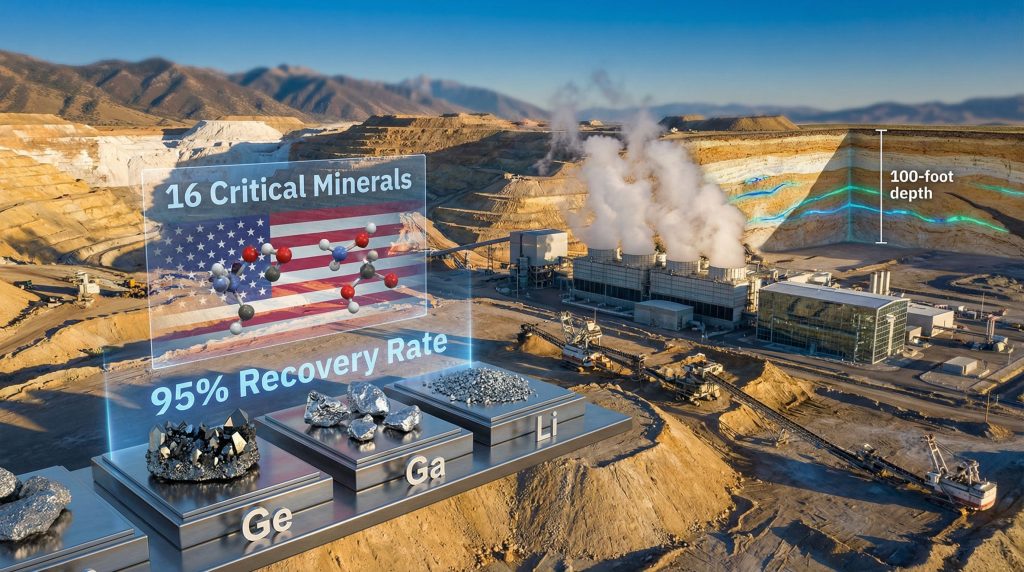
The large critical minerals deposit discovered in Utah demonstrates exceptional technical characteristics through its halloysite-hosted system, which concentrates 16 critical minerals including germanium, gallium, lithium, and rare earth elements within shallow depths not exceeding 100 feet. This geological configuration enables advanced extraction methods that achieve recovery rates approaching 95% while maintaining minimal environmental disruption.
Technical Advantages of Ion-Adsorption Clay Systems
Ion-adsorption clay formations provide distinct operational benefits over traditional mining approaches:
• Simplified Processing Architecture: Clay disaggregation requires minimal mechanical crushing compared to hard-rock extraction methods
• Enhanced Recovery Efficiency: Multi-element extraction achieves 95% recovery rates versus 60-80% typical in conventional operations
• Reduced Chemical Intensity: Ion exchange processes utilise environmentally compatible lixiviants rather than harsh chemical treatments
• Integrated Co-Product Generation: Single operations produce high-purity alumina and nano-silicon as valuable secondary products
The proximity to Utah's technology corridor, located less than 20 miles from Silicon Slopes, creates immediate supply chain integration opportunities with existing semiconductor and advanced manufacturing facilities.
Geological Formation Characteristics
The Lake Mountains formation demonstrates unique mineralisation patterns with consistent grade distribution across explored areas. Initial assessment covering 11% of the total resource area confirms approximately 2,700 parts per million combined critical minerals concentration, suggesting substantial expansion potential as exploration programmes advance.
The shallow depth characteristics and uniform distribution patterns indicate this deposit could support large-scale extraction operations without the deep mining infrastructure required for traditional rare earth projects.
When big ASX news breaks, our subscribers know first
Why Are Critical Minerals Essential for America's Technology Infrastructure?
Modern technology systems depend entirely on specific mineral compositions that enable advanced manufacturing across defence, semiconductor, renewable energy, and telecommunications sectors. The concentration of these materials in foreign supply chains creates strategic vulnerabilities that domestic production can directly address through mining innovation trends.
Current import dependencies highlight the scope of supply chain exposure across critical technology sectors:
| Mineral | Primary Applications | Current Import Dependency |
|---|---|---|
| Germanium | Fibre optics, infrared systems, solar panels | 100% imported |
| Gallium | Semiconductors, LEDs, defence electronics | 100% imported |
| Lithium | Battery technology, ceramics, grid storage | 75% imported |
| Scandium | Aerospace alloys, fuel cells, advanced materials | 100% imported |
| Rare Earth Elements | Permanent magnets, electronics, wind turbines | 95% imported |
Strategic Applications Across Defence Systems
Defence applications require specific mineral compositions that cannot be substituted without performance degradation:
• Germanium: Essential for night vision equipment and missile guidance systems
• Gallium: Critical for radar systems and electronic warfare capabilities
• Rare Earth Elements: Required for precision-guided munitions and communications equipment
• Scandium: Enables lightweight armour and aerospace component manufacturing
Semiconductor Manufacturing Dependencies
The semiconductor industry relies on ultra-pure mineral inputs where even minor supply disruptions can halt production lines worth billions in economic activity. Furthermore, germanium substrates enable high-frequency applications in telecommunications infrastructure, while gallium compounds form the foundation of LED manufacturing and power electronics systems.
Battery Technology Evolution
Lithium demand extends beyond electric vehicles to encompass grid-scale energy storage systems that support renewable energy integration. Current projections indicate domestic lithium requirements will increase 400% by 2030 as utilities deploy massive battery installations to balance renewable energy intermittency.
How Does Utah's Geological Formation Compare to Global Standards?
International benchmarking reveals that Utah's Silicon Ridge deposit demonstrates superior grade characteristics when compared to established ion-adsorption clay operations worldwide. The 2,700 parts per million combined critical minerals concentration exceeds the upper performance range of Chinese deposits that typically produce between 500-2,000 parts per million.
Comparative Grade Analysis
Global ion-adsorption clay deposit performance metrics establish the following grade ranges:
• Utah Silicon Ridge: ~2,700 ppm combined critical minerals
• Chinese IAC Operations: 500-2,000 ppm typical concentration
• Southeast Asian Deposits: 800-1,500 ppm average grade
• Global IAC Average: 1,200 ppm baseline performance
The halloysite-hosted mineralisation system provides structural advantages through consistent grade distribution and shallow depth accessibility that reduces capital expenditure requirements compared to deep mining operations.
Chinese Operations Context
China's ion-adsorption clay mines in Jiangxi and Guangdong provinces supply over 70% of global heavy rare earth elements through operations that demonstrate the commercial viability of this extraction methodology. These facilities process approximately 200,000 tons annually of clay material to produce concentrated rare earth oxides for global markets.
Metallurgical Testwork Implications
Laboratory analysis confirms that Utah's deposit exhibits superior leaching characteristics with faster extraction kinetics compared to international benchmarks. Column leaching tests demonstrate 95% recovery rates for target minerals whilst maintaining selectivity that minimises impurity incorporation during processing.
The combination of high-grade mineralisation and favourable metallurgical characteristics positions this deposit among the most economically attractive critical minerals projects globally.
What Processing Technologies Enable Rapid Development?
Advanced ion exchange methodologies specifically designed for halloysite-hosted deposits enable accelerated development timelines through established processing frameworks. The 74,000-square-foot facility in Provo provides immediate processing capability that eliminates construction delays typical in greenfield mining projects.
Multi-Stage Extraction Framework
The processing sequence optimises mineral recovery through specialised unit operations:
-
Clay Disaggregation: Mechanical separation techniques prepare mineral-bearing clays for chemical treatment
-
Selective Ion Exchange: Environmentally compatible solutions extract target minerals whilst preserving clay matrix integrity
-
Precipitation and Purification: Individual mineral recovery through pH adjustment and selective precipitation chemistry
-
Co-Product Recovery: High-purity alumina and nano-silicon generation from processing residues
Infrastructure Readiness Assessment
Existing facility capabilities accelerate project development through pre-installed processing equipment:
• Processing Capacity: Current facility designed for pilot-scale operations with expansion capability
• Permit Status: Mining authorisations secured, eliminating regulatory approval delays
• Transportation Access: Direct highway connectivity to major distribution networks
• Utility Infrastructure: Established electrical grid and water supply connections
Process Innovation Highlights
The extraction methodology produces valuable aluminium and silicon compounds as co-products, transforming traditional waste streams into revenue-generating materials. This integrated approach reduces per-unit production costs whilst creating diversified revenue streams that enhance project economics during commodity price volatility.
How Does Government Policy Support Critical Minerals Development?
Federal investment programmes demonstrate unprecedented commitment to domestic critical minerals production through direct equity participation and strategic financing initiatives. However, policy support shifts signal a fundamental transition from traditional loan guarantees toward active ownership in strategic resource projects.
Strategic Investment Program Overview
Major government investments across the critical minerals sector include:
| Company | Government Investment | Project Focus | Strategic Value |
|---|---|---|---|
| MP Materials | $400M preferred stock | Heavy rare earth magnet production | Defence manufacturing supply chains |
| Trilogy Metals | $35.6M equity stake | Alaska copper and critical minerals | Arctic resource development |
| Lithium Americas | $435M loan (first tranche) | Nevada lithium production | Battery manufacturing supply chain |
| Vulcan Elements | $620M DOD loan | Rare earth magnet manufacturing | Pentagon strategic procurement |
Policy Framework Evolution
The transition toward direct government equity participation represents significant changes in U.S. industrial policy approaches. Traditional loan guarantee programmes have expanded to include ownership stakes that provide government agencies direct influence over production allocation and pricing strategies.
Pentagon Strategic Capital Initiative
The Department of Defence Office of Strategic Capital prioritises investments that address specific capability gaps in defence supply chains. This programme targets companies developing domestic production capacity for materials deemed essential to national security objectives.
Recent Chinese export restrictions on gallium and germanium create immediate market opportunities for domestic producers capable of rapid production scaling. Consequently, these policy actions have generated supply gaps exceeding $18.5 billion annually across affected industrial sectors.
What Economic Models Apply to Multi-Mineral Extraction Operations?
Multi-mineral extraction operations demonstrate distinct economic characteristics compared to single-commodity mining projects through revenue diversification that reduces commodity price exposure. The Silicon Ridge project's ability to produce 16 different critical minerals enables cost distribution across multiple revenue streams within a comprehensive critical minerals strategy.
Revenue Stream Analysis
Economic modelling for multi-mineral operations incorporates diversified revenue sources:
• Primary Revenue: High-value critical minerals (germanium, gallium, scandium) commanding premium pricing
• Secondary Revenue: Battery materials (lithium, rare earth elements) with established market demand
• Co-Product Revenue: Industrial materials (high-purity alumina, nano-silicon) providing baseline cash flow
Cost Structure Optimisation
Single-operation extraction enables cost efficiencies unavailable to mono-commodity projects:
• Shared Infrastructure: Processing equipment serves multiple product streams simultaneously
• Operational Synergies: Integrated extraction sequences reduce per-unit processing costs
• Market Timing Flexibility: Production scheduling responds to individual commodity market conditions
Economic Risk Mitigation
Multi-mineral operations provide natural hedging against individual commodity price volatility. When rare earth prices decline, increased focus on lithium or scandium production maintains overall project economics. This flexibility proves particularly valuable during commodity cycle transitions.
Single operations capturing value from multiple commodity cycles provide revenue stability unavailable to traditional mining projects focused on individual materials.
The next major ASX story will hit our subscribers first
How Do Geopolitical Factors Influence Critical Minerals Strategy?
China's strategic export restrictions create immediate supply disruptions that accelerate domestic production development timelines. Recent policy actions demonstrate how mineral export controls can reshape global supply chains within months rather than years.
Recent Chinese Export Policy Actions
Critical timeline developments affecting global markets:
• December 2024: Complete export ban implemented on gallium and germanium compounds
• April 2025: Enhanced export licensing requirements for rare earth elements
• Ongoing Policy: Strategic stockpiling programmes prioritising domestic industrial consumption
Market Response Mechanisms
Supply disruptions exceeding $18.5 billion annually across affected industries have triggered emergency procurement programmes and accelerated domestic production initiatives. Government agencies now prioritise domestic sourcing arrangements that provide supply security over traditional cost optimisation strategies.
Pentagon Stockpiling Response
Defence Department procurement programmes now emphasise long-term supply agreements with domestic producers over spot market purchases. These arrangements provide price stability and production volume guarantees that justify capital investment in domestic processing facilities.
International alliance frameworks increasingly incorporate critical minerals cooperation agreements that reduce dependence on single-source suppliers. For instance, the AUKUS partnership includes specific provisions for sharing critical minerals production capacity among member nations.
What Timeline Factors Determine Project Development Speed?
The Silicon Ridge project benefits from pre-existing regulatory approvals and processing infrastructure that eliminate typical development delays. Most mining projects require 5-10 years for permitting and facility construction, whilst this project can advance directly to production scaling.
Development Milestone Framework
Accelerated development timeline includes:
• Q1 2025: Preliminary Economic Assessment initiation with expanded resource evaluation
• H1 2026: PEA completion targeting commercial production parameters
• 2026-2027: Processing facility expansion to commercial-scale operations
• 2027+: Full-scale production targeting multiple mineral product streams
Critical Path Acceleration Factors
Several elements enable compressed development schedules:
• Regulatory Readiness: Existing mining permits eliminate 2-3 years of approval processes
• Infrastructure Availability: Current processing facility reduces capital expenditure timeline
• Market Demand Certainty: Government offtake agreements provide production volume security
• Technical Validation: Proven extraction methodologies reduce process development risks
Funding Environment Advantages
Current government investment programmes provide accessible capital for domestic critical minerals projects. Unlike traditional mining finance that requires extensive due diligence periods, strategic government funding prioritises rapid deployment over detailed technical evaluation.
How Does This Discovery Impact North American Resource Security?
Domestic critical minerals production addresses multiple strategic vulnerabilities simultaneously through supply chain diversification and processing capability development. The Silicon Ridge project represents more than mineral extraction; it establishes indigenous expertise in advanced materials processing technologies.
Supply Chain Resilience Enhancement
Multi-faceted security benefits include:
• Import Elimination: Domestic sourcing for 16 critical materials reduces foreign dependency
• Geographic Risk Reduction: North American production alternatives to concentrated Asian suppliers
• Processing Capability: Domestic refining capacity prevents raw material export dependency
• Technology Development: Indigenous extraction expertise supports future resource development
Regional Economic Integration
Utah's technology corridor location provides unique integration opportunities with existing advanced manufacturing capabilities. Moreover, semiconductor facilities, defence contractors, and renewable energy manufacturers within the region create immediate demand for domestically-produced critical minerals.
Strategic Reserve Implications
Reliable domestic production enables strategic stockpile policies that provide emergency supply capacity during international disruptions. Government agencies can maintain reserve inventories without ongoing import requirements that expose strategic planning to foreign policy considerations.
The project's multi-mineral production capability supports diverse industrial sectors simultaneously, creating economic resilience that extends beyond individual supply chain security concerns.
What Technical Innovations Enable Sustainable Extraction?
Ion-adsorption clay processing represents significant environmental advancement over conventional mining methodologies through reduced chemical consumption and minimal waste generation. Furthermore, the extraction process produces near-zero tailings whilst maintaining high recovery efficiency.
Environmental Performance Metrics
Comparative environmental advantages include:
• Water Usage Reduction: 60% lower water consumption versus conventional mining operations
• Chemical Minimisation: Environmentally compatible lixiviants replace harsh acid processing
• Waste Elimination: Near-zero tailings production through complete material utilisation
• Surface Footprint: Reduced land disturbance through shallow extraction depths
Process Innovation Elements
Technical advances enable sustainable operations:
• Selective Extraction: Ion exchange chemistry targets specific minerals whilst preserving matrix materials
• Reagent Recycling: Closed-loop processing systems minimise chemical consumption
• Co-Product Utilisation: Complete material usage eliminates traditional waste streams
• Energy Efficiency: Low-temperature processing reduces energy requirements compared to pyrometallurgical methods
Regulatory Compliance Framework
Environmental management systems incorporate best practices from established international operations whilst exceeding current U.S. environmental standards. The processing methodology qualifies for streamlined environmental permitting due to minimal chemical usage and waste generation characteristics.
These technical innovations demonstrate how advanced extraction methodologies can achieve commercial viability whilst maintaining environmental responsibility standards essential for long-term operational sustainability. The large critical minerals deposit discovered in Utah exemplifies how modern extraction technologies can transform domestic resource security.
This analysis is based on publicly available information and industry reports. Readers should conduct independent research and consult with qualified professionals before making investment or business decisions related to critical minerals projects.
Could Your Portfolio Benefit from Critical Minerals Intelligence?
Discovery Alert's proprietary Discovery IQ model instantly alerts investors to significant ASX mineral discoveries, including critical minerals projects that could reshape supply chains and generate substantial returns. Understand why major mineral discoveries can lead to exceptional market returns by exploring Discovery Alert's dedicated discoveries page, then begin your 30-day free trial to position yourself ahead of the market.