May 17, 2026
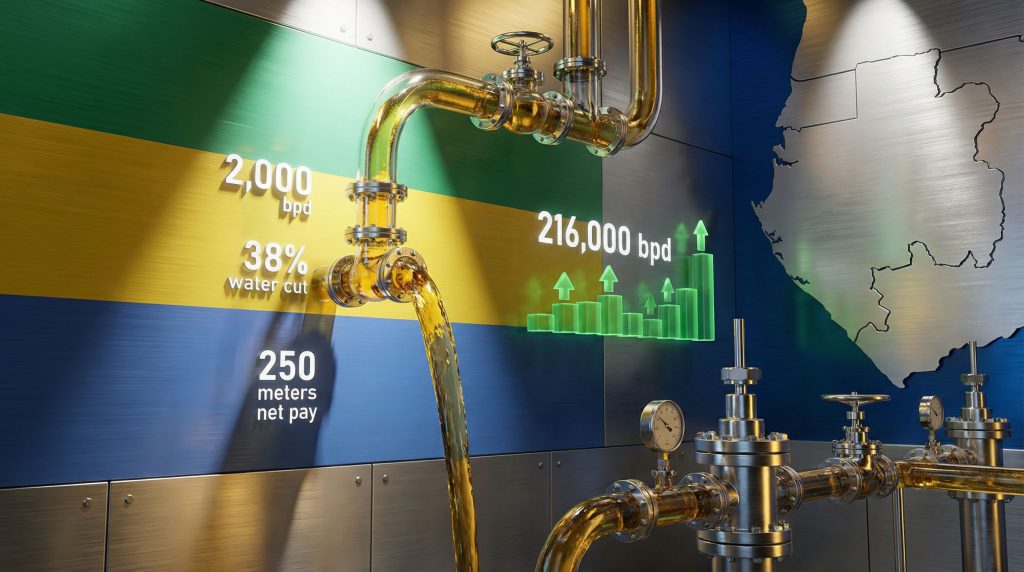
Vaalco Energy's recent achievements at offshore wells in Gabon demonstrate how systematic reservoir management addresses production decline in aging offshore assets. The newly operational Etame 15H-ST well produces 2,000 barrels per day with a 38% water cut, reflecting typical characteristics of mature reservoir compartments where decades of production have altered original pressure and fluid distribution patterns. Furthermore, the 250-meter net pay intersection indicates substantial remaining hydrocarbon columns in previously untapped reservoir sections.
Reservoir Engineering Fundamentals in Mature Offshore Systems
The Vaalco Energy offshore well Gabon operations showcase advanced reservoir engineering techniques essential for maximising recovery from mature fields. This measurement represents the total thickness of oil-bearing rock encountered by the wellbore, suggesting that compartmentalisation within the Gamba sand formations has preserved discrete pressure zones despite extensive field development since the early 2000s.
Horizontal drilling configurations like the 15H-ST designation provide enhanced reservoir contact compared to vertical completions, typically achieving 2-5× productivity multipliers depending on formation anisotropy. The horizontal wellbore design enables operators to intersect multiple productive layers within a single completion. Consequently, this approach maximises drainage efficiency while utilising existing platform infrastructure.
Critical Performance Metrics:
• Production Rate: 2,000 bpd initial capacity
• Water Cut: 38% at startup
• Net Pay Contact: 250 metres of productive reservoir
• Well Configuration: Horizontal development completion
• Infrastructure: Platform-based production system
Water Cut Dynamics and Production Forecasting
The 38% initial water cut at Etame 15H-ST reflects moderate water production typical of mature fields where aquifer influx and gravity segregation influence fluid production ratios. Water production in offshore systems results from multiple mechanisms including bottom-water drive and aquifer support from underlying formations. Moreover, selective water coning toward perforated intervals contributes to overall water cut percentages.
Industry data from comparable West African mature fields indicates water cuts typically range 25-50% at infill well startup in fields with established aquifer support. This range suggests the Etame development remains within normal operating parameters for continued economic production. However, water separation and disposal costs will increase operational expenses.
Water Cut Management Strategies:
• Selective Perforation: Targeting oil-rich formation zones
• Artificial Lift Systems: Maintaining production rates as pressure declines
• Water Treatment Infrastructure: Managing increasing fluid volumes
• Production Optimisation: Real-time monitoring and adjustment protocols
When big ASX news breaks, our subscribers know first
Production Decline Patterns in West African Mature Fields
Gabon's national oil production trajectory illustrates classic decline patterns affecting mature petroleum provinces across West Africa. Historical peak production exceeded 350,000 barrels per day in the mid-1990s, compared to current output of approximately 216,000 bpd according to OPEC statistical data. This represents a 38% decline over three decades.
The Etame Marin permit experienced significant production variations, with 2024 average output of 19,000 bpd declining to 14,300 barrels of oil equivalent per day in 2025. This 24.7% year-over-year decrease reflects natural reservoir pressure depletion and infrastructure aging challenges. In addition, such patterns are common in fields approaching economic limits.
Gabon Production Evolution:
| Time Period | Production Level | Annual Decline |
|---|---|---|
| Mid-1990s Peak | 350,000+ bpd | Baseline |
| 2024 | 216,000 bpd | ~1.4% average |
| Etame 2024 | 19,000 bpd | Field-specific |
| Etame 2025 | 14,300 boepd | 24.7% decline |
Comparative Analysis with Regional Mature Provinces
Similar decline trajectories appear across mature offshore regions globally. The US oil production decline patterns in the Gulf of Mexico experienced peak production of approximately 1.5 million bpd in 2002. Currently, this has declined to levels around 700,000 bpd, representing a 53% decline over 23 years.
North Sea combined UK-Norway production peaked at 6.2 million bpd in 1999, falling to approximately 1.8 million bpd currently. This represents a 71% decline over 25 years. These comparative metrics validate Gabon's production trajectory as consistent with natural reservoir depletion cycles affecting offshore petroleum provinces. Furthermore, fields developed during the 1970s-1990s exploration phase show similar patterns.
Infrastructure Optimisation and Development Strategy
Vaalco's 63.6% operating interest in the Etame Marin permit provides complete operational control for implementing systematic reservoir management strategies. This majority position eliminates consensus requirements with non-operating partners. Consequently, it enables rapid execution of drilling programmes and production optimisation initiatives.
The Phase Three Drilling Program represents disciplined capital deployment through sequential well placement targeting identified pressure compartments. Platform-based development eliminates greenfield infrastructure requirements by utilising existing production manifolds. Moreover, it leverages established flowlines and export systems, significantly reducing per-barrel development costs compared to new field developments.
Strategic Development Advantages:
• Existing Infrastructure: Eliminates platform installation costs
• Proven Reservoir: Reduces geological risk compared to exploration drilling
• Operational Control: Accelerates decision-making and execution timelines
• Shared Facilities: Leverages established power, water treatment, and accommodation systems
Production Growth Targets and Feasibility Analysis
Vaalco's aggressive target of 30,000 bpd by end-2026 represents a 109% increase from current Gabon portfolio output of 14,300 boepd. Achieving this target requires successful execution of multiple development phases including the completed Etame 15H-ST startup. In addition, ongoing West Etame exploration drilling and potential production contributions from Côte d'Ivoire expansion projects are essential.
The 15,700 bpd additional production required to meet targets depends on exploration success, infill drilling productivity, and maintenance of base production from existing wells. This growth trajectory assumes continued investment in enhanced recovery techniques. Furthermore, it requires successful reservoir pressure management strategies.
Exploration Risk Assessment and Geological Success Factors
The West Etame (ET-14P) exploration prospect carries a 57% geological success probability, reflecting moderate confidence in extending productive zones beyond currently defined field boundaries. This probability assessment incorporates multiple risk factors including structural integrity and seal effectiveness. Moreover, it considers hydrocarbon charge systems and preservation mechanisms.
Risk Factor Analysis:
• Structural Risk: Likelihood of trap geometry capable of hydrocarbon retention
• Seal Risk: Effectiveness of overlying formations in preventing migration
• Charge Risk: Source kitchen connectivity and hydrocarbon generation capacity
• Preservation Risk: Post-accumulation leakage and alteration potential
The 43% dry hole probability indicates substantial exploration risk remains despite proximity to proven productive zones. Industry risk classification systems typically categorise 50-70% success probabilities as moderate confidence. This is higher than frontier basin exploration (30-40%) but lower than development drilling within proven reservoirs (80-95%).
Seismic Interpretation and Geological Modelling
Step-out drilling success depends on accurate seismic interpretation using amplitude variations with offset (AVO) analysis. Furthermore, frequency content evaluation and structural coherency mapping are crucial. These techniques identify potential hydrocarbon indicators and define trap geometries extending beyond current field boundaries.
Advanced Seismic Techniques:
• AVO Analysis: Identifies fluid content variations in prospective zones
• Coherency Mapping: Defines fault patterns and structural compartments
• Frequency Analysis: Detects thin-bed reservoir intervals
• Attribute Integration: Combines multiple data types for risk assessment
Economic Modelling and Field Life Extension
Global Data analysis indicates approximately 90% of Etame's total reserves have been recovered, with production projected to continue until the field reaches its economic limit in 2029. This timeline provides a 3-4 year production sustainability window for implementing enhanced recovery programmes. Moreover, it allows time for exploring adjacent prospects.
Economic limit calculations incorporate declining production rates, increasing operating costs, and infrastructure maintenance requirements. Water cut increases, artificial lift costs, and regulatory compliance expenses collectively determine when continued production becomes uneconomical. However, this occurs despite remaining reserves in place.
Economic Limit Factors:
• Production Decline Rates: Natural reservoir pressure depletion
• Operating Cost Inflation: Increased maintenance and water handling expenses
• Infrastructure Ageing: Platform and subsea system reliability challenges
• Regulatory Compliance: Environmental and safety requirement costs
Enhanced Recovery Technologies for Mature Fields
Extending economic field life requires implementing advanced recovery techniques including water injection, gas injection, and chemical enhanced oil recovery (EOR) methods. These technologies can increase ultimate recovery factors from typical 35-45% to 50-60% in favourable reservoir conditions.
Horizontal drilling combined with hydraulic fracturing or selective zone management enables operators to access previously uneconomic reservoir sections. The Vaalco Energy offshore well Gabon configuration demonstrates these principles by maximising reservoir contact within identified productive intervals. Furthermore, data-driven optimization techniques enhance operational efficiency across all development phases.
Operational Challenges in Mature Offshore Development
Ageing offshore infrastructure presents unique operational challenges including corrosion management, equipment reliability, and safety system maintenance. Water cut management becomes increasingly critical as production facilities must handle larger fluid volumes with higher treatment and disposal costs.
The 38% water cut at Etame 15H-ST requires separation equipment capable of processing mixed fluid streams whilst maintaining oil quality specifications. Water disposal options include reinjection into suitable formations. Alternatively, treatment for overboard discharge within regulatory limits is possible.
Operational Management Priorities:
• Corrosion Control: Managing increased water production effects on equipment
• Facility Capacity: Upgrading separation and treatment systems
• Safety Systems: Maintaining reliability in ageing offshore platforms
• Environmental Compliance: Meeting discharge and emission regulations
Technology Integration for Production Optimisation
Real-time monitoring systems enable operators to optimise production rates, manage reservoir pressure, and predict equipment maintenance requirements. These technologies become essential for maintaining economic production as fields approach their natural decline phases. Moreover, they provide critical data for reservoir management decisions.
Artificial lift systems including electric submersible pumps (ESP), progressive cavity pumps (PCP), and gas lift installations help maintain flow rates as reservoir pressure declines. Technology selection depends on fluid properties, production rates, and infrastructure constraints. Furthermore, economic considerations influence equipment choices.
The next major ASX story will hit our subscribers first
Regional Market Dynamics and Investment Climate
West African offshore development decisions reflect complex interactions between commodity price cycles, regulatory frameworks, and infrastructure constraints. Mature field economics depend heavily on sustained oil price levels above $40-50 per barrel to justify continued development investments.
Gabon's petroleum fiscal regime influences development timing and investment allocation through production sharing agreements, tax structures, and local content requirements. Stable regulatory frameworks encourage continued investment in mature assets. However, uncertain policies can accelerate field abandonment decisions. Additionally, WTI Brent oil futures volatility impacts long-term planning decisions.
Market Influence Factors:
• Commodity Prices: Break-even economics for infill drilling projects
• Fiscal Terms: Government revenue sharing and tax obligations
• Local Content: Requirements for domestic goods and services utilisation
• Infrastructure Access: Pipeline, processing, and export facility availability
Geographic Diversification Strategies
Vaalco's expansion into Côte d'Ivoire projects represents geographic risk mitigation and growth optionality beyond mature Gabonese assets. Multi-jurisdiction portfolios provide operational flexibility and reduce dependence on single-country regulatory or economic changes. In addition, this approach enables companies to navigate various energy transition challenges across different markets.
Regional development strategies enable operators to leverage technical expertise across multiple assets whilst maintaining economies of scale in drilling, completion, and production operations. Cross-border asset management requires understanding diverse regulatory requirements and operational environments. Furthermore, it demands flexibility in adapting to local market conditions.
How Do Global Trade Dynamics Affect West African Oil Projects?
Current geopolitical tensions significantly impact investment decisions in West African offshore developments. US-China trade tensions create uncertainties in global energy markets, affecting commodity pricing and investment flows. Moreover, these dynamics influence project financing and equipment procurement strategies.
Geopolitical Impact Areas:
• Investment Flows: Capital allocation decisions by international energy companies
• Technology Access: Equipment and service availability from global suppliers
• Market Access: Export destination diversity and pricing mechanisms
• Financing Terms: Risk premiums and lending conditions for African projects
Future Outlook for West African Offshore Development
The successful startup of Etame 15H-ST demonstrates systematic infill drilling programme viability in mature West African offshore fields. However, long-term sector sustainability depends on discovering new reserves and implementing advanced recovery technologies to offset natural production decline.
Industry trend analysis suggests a continued shift toward:
• Enhanced Recovery: Advanced completion techniques and artificial lift systems
• Infrastructure Sharing: Multi-field development through shared facilities
• Technology Integration: Real-time monitoring and predictive maintenance
• Geographic Expansion: Risk diversification across multiple jurisdictions
Vaalco's aggressive 30,000 bpd production target by 2026 will test the company's technical execution capabilities amid declining base production from ageing assets. Success depends on exploration drilling results, infill well productivity, and effective reservoir management in mature field environments. Furthermore, the Vaalco Energy offshore well Gabon operations will serve as a benchmark for similar developments across the region.
The broader implications for Gabon's energy sector highlight the critical importance of maintaining operational excellence in mature fields whilst developing new exploration opportunities to replace depleting reserves. This balance between production optimisation and reserve replacement will determine the country's long-term petroleum sector viability. Moreover, successful implementation of enhanced recovery techniques will establish precedents for similar fields across West Africa.
Investment in offshore oil and gas projects involves substantial risks including commodity price volatility, regulatory changes, and technical execution challenges. This analysis is for informational purposes only and should not be considered investment advice. Readers should conduct independent research and consult qualified professionals before making investment decisions.
Ready to Capitalise on the Next Major Energy Discovery?
Discovery Alert's proprietary Discovery IQ model delivers instant notifications on significant ASX mineral and energy discoveries, empowering subscribers to identify actionable trading opportunities ahead of the broader market. While mature offshore fields like Gabon's Etame project demonstrate systematic reservoir management, early discovery alerts can provide the market edge needed to capitalise on emerging opportunities—begin your 14-day free trial today to position yourself ahead of major announcements.