July 28, 2026
When Boardroom Confidentiality Breaks Down: The Systemic Risk Hiding in Mining's Corner Offices
Corporate governance in the global mining sector rarely generates headlines during periods of operational calm. The real stress tests arrive when factional interests collide at the board level, when information meant to stay within the walls of a boardroom finds its way out, and when the procedures designed to manage these situations prove slower than the crisis itself. Vale board member Gasparino steps down amid governance tensions is a reminder that for an industry routinely handling billions in capital allocation decisions, a breach of board confidentiality is not merely an administrative embarrassment — it is a material risk event.
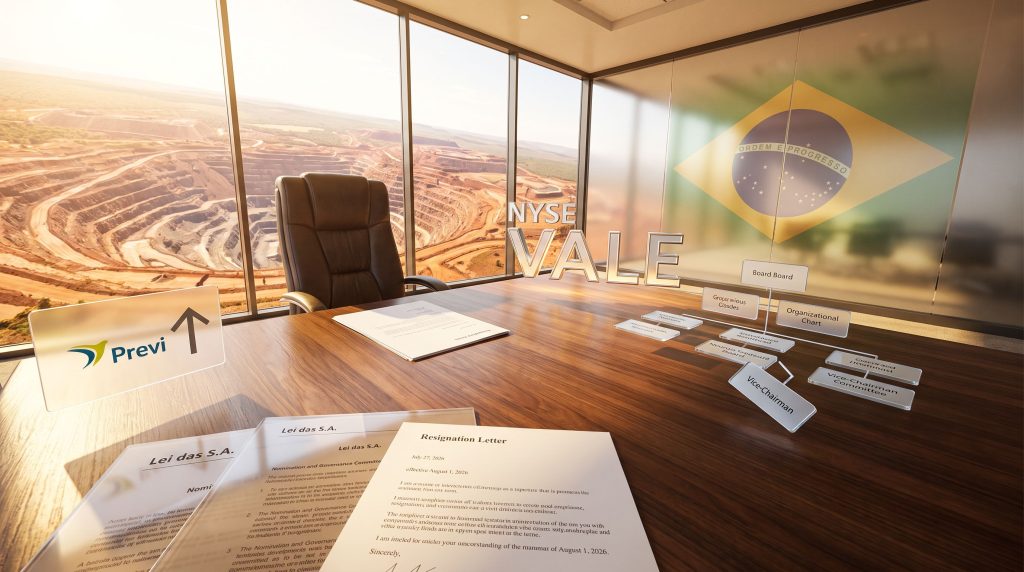
The situation unfolding at Vale, one of the world's largest diversified miners, offers a rare window into how governance fractures develop, compound, and ultimately reshape leadership structures at companies of global systemic significance. The resignation of board member and vice-chairman Marcelo Gasparino da Silva, confirmed via securities filing on July 27, 2026, with an effective date of August 1, 2026, is the most visible outcome of a much deeper institutional rupture.
When big ASX news breaks, our subscribers know first
Vale's Place in the Global Mining Hierarchy
Understanding why this governance episode carries weight beyond Brazil requires appreciating Vale's scale. The company is one of the world's three largest mining enterprises, alongside BHP and Rio Tinto, and it is the dominant global producer of iron ore pellets and a significant producer of nickel and copper. Its operations span Brazil, Canada, Indonesia, and several other jurisdictions, feeding the steel mills and battery supply chains that underpin global industrial output.
Vale carries a dual listing structure, trading on the Brazilian stock exchange (B3) and on the New York Stock Exchange under the ticker VALE. This cross-listing creates a layered governance obligation. As a foreign private issuer on the NYSE, Vale must meet U.S. securities disclosure standards alongside its obligations under Brazilian corporate law, specifically the Lei das S.A. (Law No. 6,404/1976). When governance events of material significance occur, both regulatory regimes impose disclosure requirements that operate simultaneously, leaving little room for delay or ambiguity.
The company's shareholder base further complicates its governance dynamics. Brazilian institutional investors, particularly state-linked pension funds, hold substantial stakes and exercise influence that extends well beyond passive ownership. These entities do not merely vote at annual meetings — they actively shape board composition, executive appointments, and strategic priorities in ways that can create factional tensions when their interests diverge. Furthermore, geopolitical risks in mining add another layer of complexity to these already intricate ownership dynamics.
The Anatomy of Vale's Governance Crisis
The June 19 Board Meeting and Its Aftermath
The sequence of events that led to Gasparino's departure began with a Vale board meeting held on June 19, 2026. Following that meeting, allegations emerged that confidential information discussed in the session had been leaked externally. Vale's board commissioned an external investigation to examine the alleged breach. That investigation reportedly confirmed that a leak had occurred and attributed it to Gasparino.
The board subsequently voted to seek his removal. However, under Brazilian corporate law, the removal of a board member requires formal shareholder approval, typically through an extraordinary general meeting. This procedural requirement introduced a lag between the board's decision and any enforceable outcome, creating the conditions under which Gasparino's voluntary resignation became the more immediate resolution.
Step-by-Step: How the Crisis Escalated
- June 19, 2026 — A confidential Vale board meeting takes place; alleged information leak attributed to Gasparino occurs.
- External investigation commissioned — Vale's board initiates an independent review of the alleged breach.
- Investigation findings — External investigators reportedly confirm the leak and its source.
- Board resolution to remove — Vale's board votes to pursue Gasparino's removal, contingent on shareholder approval.
- Chairman election contested — Shareholders elect Manuel Lino Silva de Sousa Oliveira as the new board chairman, displacing the prior leadership faction and marking the departure of former chairman Daniel Stieler.
- July 27, 2026 — Gasparino submits his formal resignation letter; Vale confirms the development via a securities filing.
- August 1, 2026 — The resignation takes effect; Vale's Nomination and Governance Committee begins reviewing board reconstitution.
The Procedural Significance of Resignation vs. Formal Removal
The distinction between voluntary resignation and formal shareholder-approved removal matters in ways that are not always immediately visible to outside observers.
| Factor | Resignation Pathway | Formal Removal Pathway |
|---|---|---|
| Requires shareholder vote | No | Yes, under Lei das S.A. |
| Effective timeline | Immediate upon acceptance | Subject to EGM scheduling |
| Reputational framing | Self-directed exit | Externally imposed sanction |
| Legal liability exposure | Potentially lower | Potentially higher |
| Market disclosure trigger | Immediate filing required | Multiple filings over time |
By resigning voluntarily, Gasparino effectively bypassed the need for an extraordinary general meeting. From a procedural standpoint, this compressed the resolution timeline significantly. From a reputational standpoint, it allowed the narrative to be framed as a self-directed departure rather than a formal sanction — even though the underlying findings of the external investigation remained on the record.
The Role of Previ and Institutional Shareholder Power
Previ, the pension fund for employees of Banco do Brasil and Brazil's single largest pension fund by assets, played a significant role in shaping the leadership transition that accompanied this governance dispute. Previ's backing was instrumental in the election of Manuel Lino Silva de Sousa Oliveira as Vale's new chairman, filling the vacancy created by the departure of Daniel Stieler.
This dynamic reflects a broader structural feature of Vale's ownership architecture. Unlike fully privatised miners where market-based institutional investors dominate, Vale's shareholder register includes large blocks held by entities with explicit strategic and political mandates. When these investors align behind a particular leadership outcome, they can exercise decisive influence over board composition in ways that smaller public shareholders cannot match.
The influence of state-linked pension funds over privatised resource companies creates a distinctive governance risk: decisions that appear commercially driven may reflect institutional agendas that do not always align with broader market shareholder interests.
This concentration of influential shareholders is not inherently problematic, but it does create structural conditions where boardroom disputes can escalate rapidly if key blocs shift their support. The Vale episode illustrates how quickly a contested chairmanship election and an alleged confidentiality breach can combine to destabilise even a board of a company with Vale's operational scale and market standing. Indeed, management red flags of this nature can significantly affect long-term investor confidence.
How Brazilian Corporate Law Governs Board Confidentiality
Under Brazil's Lei das S.A., directors owe fiduciary duties of loyalty and confidentiality to the company. These obligations are not merely procedural — they are legally enforceable, and breaches can give rise to civil liability under Brazilian corporate law as well as potential regulatory scrutiny from the CVM (Comissão de Valores Mobiliários), Brazil's securities regulator.
The critical legal distinction lies in the nature of the information disclosed. Brazilian securities regulation, like its U.S. counterpart, distinguishes between material non-public information (MNPI) and general board deliberations. If the information allegedly leaked from the June 19 meeting constituted MNPI, the potential regulatory consequences extend beyond internal governance proceedings into the domain of market manipulation or selective disclosure violations.
For a company like Vale, which operates as a foreign private issuer in the United States, this creates the possibility of parallel regulatory scrutiny. The U.S. Securities and Exchange Commission has jurisdiction over disclosure conduct affecting NYSE-listed securities, meaning that a confidentiality breach originating in a Brazilian board meeting could theoretically trigger regulatory interest on both sides of the Atlantic simultaneously.
Investor Implications: The Governance Discount in Large-Cap Mining
How Governance Controversy Affects Valuation
Market participants with experience in large-cap mining equities will recognise a well-documented pattern: sustained boardroom instability tends to introduce a valuation discount that persists even when underlying operational metrics remain strong. Credit rating agencies factor governance quality into their assessments of investment-grade mining companies, and institutional fund managers operating under ESG mandates are increasingly sensitive to board-level conduct risks.
The mechanism through which governance controversy suppresses valuation multiples is not always immediate. Initial market reactions to boardroom disputes at companies of Vale's scale are often muted, as investors reasonably focus on production volumes, iron ore price realisation, and capital expenditure discipline. However, where governance fractures remain unresolved, they compound over time, eroding the institutional confidence premium that large-cap miners depend on to access low-cost capital. In addition, commodity prices and miner performance are already under pressure, making governance stability all the more critical.
Key Risks for Shareholders to Monitor
- Information governance risk: Whether additional undisclosed confidentiality breaches may surface during the ongoing board review process.
- Leadership continuity risk: The stability of the newly elected chairman's mandate and whether factional tensions within the board have been genuinely resolved or merely suppressed.
- Regulatory risk: Potential scrutiny from Brazil's CVM or the U.S. SEC regarding disclosure adequacy around both the alleged leak and the sequence of board proceedings.
- Operational distraction risk: Whether sustained boardroom instability has diverted senior executive attention from Vale's core iron ore, copper, and nickel production priorities.
- Succession clarity risk: How quickly Vale's Nomination and Governance Committee can identify and seat a credible replacement for Gasparino's vacant position.
The next major ASX story will hit our subscribers first
Broader Governance Standards in Latin American Mining
A Regional Governance Gap
Vale's governance episode does not exist in isolation. Across Latin America's major mining jurisdictions — including Brazil, Chile, Peru, and Mexico — the concentration of ownership among state-aligned institutional investors creates structural governance vulnerabilities that are distinctly different from those found in Anglo-Australian or North American mining companies.
International frameworks such as the ICMM Principles and GRI Standards are increasingly pressing mining boards toward stronger confidentiality protocols, conflict-of-interest management, and independent director oversight. These frameworks do not carry the force of law, but they shape the expectations of the institutional investors and development finance institutions whose capital flows into the sector.
For emerging market mining companies seeking to attract diversified international capital, the reputational cost of visible governance failures is amplified by the already-elevated risk premium that many investors attach to the region. Mining industry consolidation trends further complicate matters, as governance disputes can undermine a company's position during joint venture negotiations or asset sale processes.
Lessons the Industry Cannot Afford to Ignore
Governance risk is not a compliance checkbox. It is a material financial risk that, when activated, can take years to fully resolve and carries costs that dwarf the short-term inconvenience of building stronger board protocols in the first place.
The structural lessons emerging from this episode point toward several practices that mining boards globally are increasingly adopting. Consequently, Vale board member Gasparino steps down amid governance tensions may accelerate wider industry adoption of the following standards:
- Mandatory board information governance protocols, including tiered access to sensitive materials.
- Independent annual board evaluations conducted by third-party governance specialists.
- Formal conflict-of-interest disclosure frameworks applied consistently across all director categories.
- Proactive succession planning to ensure that contested leadership transitions do not create governance vacuums.
- Documented procedures for escalating alleged confidentiality breaches to independent legal counsel without requiring full board consensus.
Furthermore, global tax and royalty pressures on major miners mean that any governance distraction carries heightened financial consequences at precisely the moment when strategic clarity is most needed.
Frequently Asked Questions: Vale's Governance Dispute
Why did Marcelo Gasparino resign from Vale's board?
Gasparino resigned following an external investigation that reportedly confirmed he had leaked confidential information originating from a Vale board meeting held on June 19, 2026. Vale's board had already voted to pursue his formal removal, but that process required shareholder approval under Brazilian corporate law. His resignation, effective August 1, 2026, pre-empted that shareholder vote.
Who is Vale's new chairman following this governance transition?
Manuel Lino Silva de Sousa Oliveira was elected as Vale's new board chairman as part of the broader leadership reshuffle. He replaced former chairman Daniel Stieler, whose departure preceded the formal governance crisis.
What role did Previ play in this situation?
Previ, Brazil's largest pension fund and a significant Vale shareholder, was reportedly influential in backing the leadership transition that resulted in Oliveira's election to the chairmanship. Large institutional shareholders with concentrated stakes routinely exercise significant influence over board composition at major Brazilian corporates.
What are the next steps for Vale's board?
Vale confirmed that its Nomination and Governance Committee is reviewing next steps for board reconstitution following Gasparino's departure. The company has committed to keeping the market informed of material developments through the appropriate regulatory filing channels.
Could this governance dispute affect Vale's operational performance?
While the immediate dispute is a governance and regulatory matter rather than an operational one, sustained boardroom instability at major miners has historically introduced measurable valuation discounts and can divert executive focus from production priorities. The speed with which Vale reconstitutes its board and demonstrates governance stability will be a key variable for investor confidence in the near term.
Key Takeaways
- Resignation confirmed: Vale board member Gasparino steps down amid governance tensions, with his resignation letter received on July 27, 2026 and the departure effective August 1, 2026.
- Trigger event: An alleged leak of confidential information from the June 19, 2026 board meeting, reportedly confirmed by an external investigation commissioned by Vale's board.
- Procedural bypass: Voluntary resignation pre-empted a shareholder removal vote that would otherwise have been required under Brazil's Lei das S.A.
- Leadership transition: The broader governance reshuffle resulted in the election of Manuel Lino Silva de Sousa Oliveira as chairman, following the prior departure of Daniel Stieler.
- Shareholder dynamics: Previ, Brazil's largest pension fund, played a material role in shaping the outcome of the contested chairmanship election.
- Regulatory exposure: Dual listing on the NYSE and B3 creates simultaneous disclosure obligations under both U.S. and Brazilian securities law, raising the stakes of any governance misstep.
- Next steps: Vale's Nomination and Governance Committee is actively reviewing board reconstitution, with ongoing disclosure commitments to the market.
Disclaimer: This article is intended for informational purposes only and does not constitute financial or investment advice. Governance situations at publicly listed companies are subject to ongoing developments, and investors should consult regulatory filings and independent financial advisers before making investment decisions.
Want to Stay Ahead of Major ASX Mineral Discoveries Before the Broader Market Reacts?
While governance risks at global mining giants like Vale serve as a reminder of how quickly boardroom instability can reshape investment outcomes, Discovery Alert's proprietary Discovery IQ model keeps subscribers informed of significant ASX mineral discoveries the moment they are announced — explore the historic returns major discoveries have generated or visit the Discovery Alert home page to begin your 14-day free trial and secure a market-leading edge.