May 9, 2026
The global mining industry stands at a technological inflection point where traditional extraction methods intersect with advanced processing systems. Modern copper operations require sophisticated integration of geological assessment, infrastructure optimization, and market timing strategies. Within this evolving landscape, the Vale Carajas copper investment represents a strategic capital allocation decision that increasingly determines competitive positioning across international commodity markets.
Brazil's mining sector represents a particularly complex case study in operational synergies, where established infrastructure networks can potentially support multi-metal extraction programs. The Carajás region exemplifies this dynamic, combining existing logistics frameworks with emerging geological opportunities for base metal development. Furthermore, understanding current copper price trends becomes essential for evaluating the strategic timing of such investments.
Understanding the Technical Architecture of Modern Copper Mining Operations
The Carajás Mineral Province encompasses approximately 120,000 square kilometres of the Amazon Basin, containing some of South America's most significant polymetallic deposits. Geological surveys indicate copper mineralisation occurs alongside existing iron ore formations, creating potential for integrated extraction methodologies.
The Carajás Region's Geological Advantages for Copper Development
Key geological factors supporting copper development include:
- Primary sulphide ore bodies with copper grades ranging from 0.8% to 1.2%
- Proximity to established iron ore processing facilities
- Proven geological stability for large-scale mining operations
- Existing environmental baseline studies and regulatory frameworks
The region's ore characteristics suggest compatibility with standard flotation and concentration processes, potentially reducing capital requirements for specialised processing equipment. In addition, metallurgical testing indicates copper recovery rates between 85-90% using conventional methods.
Infrastructure Synergies Between Iron Ore and Copper Operations
Existing Carajás infrastructure provides substantial advantages for copper project development. The integrated transportation network includes the Carajás Railway, extending 892 kilometres to the Port of Itaqui, with current capacity exceeding 230 million tons annually.
Power generation capabilities through the Tucuruí Hydroelectric Complex supply over 8,000 megawatts, sufficient to support expanded mining operations. Water management systems, originally designed for iron ore processing, can be adapted for copper flotation circuits with minimal additional investment.
Infrastructure utilisation benefits:
- Shared transportation costs reducing per-ton logistics expenses
- Existing workforce with specialised mining expertise
- Established supply chain relationships and maintenance facilities
- Regulatory compliance frameworks already in place
When big ASX news breaks, our subscribers know first
What Makes the Vale Carajas Copper Investment Strategically Critical?
Global copper demand projections indicate sustained growth through 2030, driven primarily by renewable energy infrastructure and electric vehicle adoption. Industry analysis suggests annual demand increases of 3-4% over the next decade, with supply constraints emerging in traditional producing regions.
The strategic timing of copper expansion aligns with global decarbonisation initiatives requiring substantial copper-intensive infrastructure. Electric vehicles contain approximately 83 kilograms of copper per unit, compared to 23 kilograms in traditional internal combustion vehicles. However, the broader copper investment outlook suggests significant opportunities across multiple markets.
Energy Transition Metal Demand Projections Through 2030
Renewable energy systems demonstrate significantly higher copper intensity compared to conventional power generation. Wind turbines require 3-5 tons of copper per megawatt of installed capacity, while solar installations utilise approximately 4 tons per megawatt.
Copper demand drivers through 2030:
- Electric vehicle production scaling to 30+ million units annually
- Grid modernisation programmes across developing economies
- Renewable energy capacity additions exceeding 200 GW annually
- Industrial electrification initiatives in manufacturing sectors
Market analysis indicates potential supply deficits approaching 4-6 million tons annually by 2030, assuming current production capacity expansion rates. This supply-demand imbalance creates strategic opportunities for new production capacity development, as evidenced by copper production insights from other regions.
Brazil's Position in Global Copper Supply Chain Dynamics
Brazil currently produces approximately 280,000 tons of copper annually, representing roughly 1.3% of global production. The country's strategic location provides advantageous shipping routes to both Asian and European markets, with transit times typically 15-20% shorter than competing South American producers.
| Market Factor | Current Position | Projected Position |
|---|---|---|
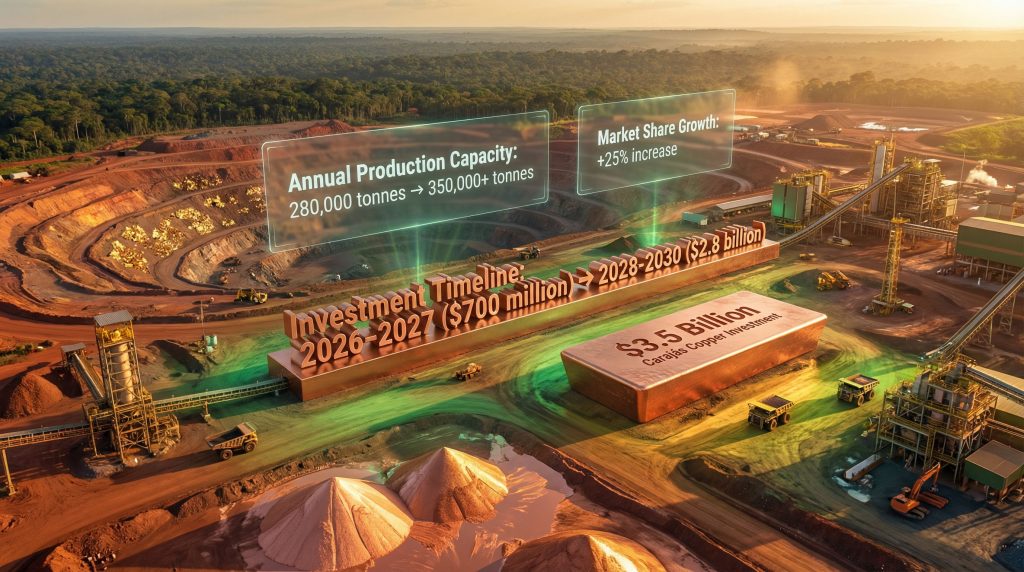
| Annual Production | 280,000 tons | 350,000+ tons |
| Global Market Share | 1.3% | 1.6%+ |
| Regional Ranking | 4th in South America | 3rd in South America |
| Export Revenue | $2.8 billion | $4.2+ billion |
The Vale Carajas copper investment positions Brazil to capture increased market share during a period of constrained global supply growth. Competing projects in Chile and Peru face regulatory delays and community opposition, creating market entry opportunities for Brazilian production.
How Will Vale's Phased Investment Timeline Impact Market Dynamics?
The structured investment approach spans five years, with total capital deployment of $3.5 billion allocated across escalating annual phases. This timeline reflects typical mining project development cycles, where initial phases focus on infrastructure and regulatory compliance before accelerating to major construction activities.
Investment escalation follows established mining project patterns, with peak capital deployment occurring during final construction and equipment commissioning phases. Vale's major investment announcement indicates this timeline provides optimal balance between capital efficiency and production ramp-up speed.
Investment Escalation Strategy Analysis (2026-2030)
Phase 1 Development (2026-2027): $700 million total
- 2026 allocation: $300 million focused on regulatory approvals and site preparation
- 2027 allocation: $400 million for infrastructure development and initial construction
- Key milestones include environmental licensing and community agreement finalisation
- Engineering studies completion and equipment procurement initiation
Phase 2 Acceleration (2028-2030): $2.8 billion total
- 2028 allocation: $800 million for major construction and processing facility development
- 2029 allocation: $900 million for equipment installation and pre-production testing
- 2030 allocation: $1.1 billion for production optimisation and capacity expansion
- Commercial production targeting mid-2029 with full capacity by 2031
Production Ramp-Up Scenarios and Market Response
Typical copper mining projects achieve 60-70% of design capacity within 12 months of initial production, reaching full operational capacity within 24 months. Market absorption of additional Brazilian copper production appears favourable given projected supply deficits.
"The investment timeline coincides with expected tightening in global copper markets, potentially allowing new production to achieve premium pricing during initial ramp-up phases."
Commodity market analysis suggests Brazilian copper will primarily serve Asian markets, where demand growth remains strongest. Transportation advantages through existing port infrastructure provide competitive delivery costs compared to alternative suppliers.
Which Specific Projects Drive Vale's Copper Expansion Strategy?
The copper development programme encompasses three integrated components designed to maximise operational synergies with existing Carajás operations. Each project leverages different aspects of the established infrastructure whilst contributing to overall production capacity expansion. Consequently, the integration of mining technology integration becomes crucial for operational success.
Project integration follows proven satellite mining methodologies, where smaller deposits connect to central processing facilities through shared transportation and power systems. This approach minimises environmental footprint whilst optimising capital efficiency.
Bacaba Satellite Mine Development Framework
The Bacaba project represents the primary expansion component, targeting annual production of approximately 50,000 metric tons of copper concentrate. The satellite operation connects to existing infrastructure through a 15-kilometre access road and dedicated slurry pipeline system.
Bacaba technical specifications:
- Proven reserves: 180 million tons at 1.1% copper grade
- Mine life: 20+ years at planned production rates
- Processing method: Conventional flotation with 88% recovery rates
- Annual processing capacity: 12 million tons of ore
Mining operations utilise open-pit methods compatible with existing equipment fleets. The integration strategy minimises duplicate infrastructure investment whilst maintaining operational flexibility for future expansion phases.
Sossego Complex Integration and Operational Synergies
Sossego operations provide the foundational processing capabilities for expanded copper production, with current annual processing capacity of 36 million tons. Facility upgrades focus on flotation circuit optimisation and concentrate handling improvements.
Integration benefits include shared maintenance facilities, administrative systems, and workforce development programmes. The expansion utilises existing tailings storage facilities with additional containment capacity designed for increased throughput volumes.
Operational enhancement areas:
- Flotation circuit efficiency improvements targeting 2% recovery increase
- Concentrate dewatering and storage capacity expansion
- Power supply optimisation and backup generation systems
- Environmental monitoring and water treatment facility upgrades
Novo Carajás Program's Broader Economic Impact
The Novo Carajás Programme represents Vale's comprehensive regional development strategy, extending beyond immediate mining operations to encompass community development and environmental conservation initiatives. Moreover, Vale's broader investment programme demonstrates commitment to sustainable development.
Programme components include workforce training facilities, local supplier development programmes, and biodiversity conservation projects spanning 12,000 hectares of protected forest areas. These initiatives support long-term operational sustainability and community partnership development.
Economic impact extends through regional supply chain development, with local procurement targeting 60% of operational supplies and services. The multiplier effect creates employment opportunities across transportation, maintenance, and support sectors.
What Are the Economic and Environmental Implications?
Regional economic analysis indicates substantial positive impacts for Pará state, with projected annual GDP contributions reaching R$80-100 billion through direct and indirect economic activity. The mining operations generate export revenue of approximately R$15 billion annually, supporting Brazil's trade balance improvement.
Employment generation encompasses both direct mining positions and induced employment across support sectors. Historical mining project analysis suggests employment multiplier effects of 3-4 indirect positions for each direct mining job, creating opportunities across transportation, maintenance, and commercial sectors.
Regional GDP Impact Projections for Pará State
Economic modelling indicates copper operations contribute 8-12% of Pará state's total GDP through combined direct operations, supplier relationships, and worker spending patterns. The concentrated economic activity supports regional development infrastructure including healthcare, education, and transportation improvements.
Economic impact distribution:
- Direct operations: R$35-40 billion annual contribution
- Supply chain spending: R$25-30 billion in regional procurement
- Worker income and spending: R$20-30 billion in local economies
- Tax revenue generation: R$8-12 billion in state and federal contributions
Regional development benefits extend beyond immediate mining areas through improved transportation infrastructure and telecommunications systems required for operational support.
Sustainable Mining Practices in Amazon Conservation Context
Environmental compliance frameworks integrate Amazon conservation requirements with operational necessities, establishing buffer zones and biodiversity monitoring systems across operational areas.
The project commits to zero net deforestation through forest restoration programmes exceeding operational footprint requirements. Water management systems incorporate closed-loop processing to minimise freshwater consumption and eliminate discharge to natural waterways.
Environmental protection measures:
- Biodiversity monitoring across 50,000 hectares of operational and buffer zones
- Forest restoration programmes targeting 150% of operational area disturbance
- Carbon footprint reduction through renewable energy integration
- Tailings storage facilities designed for 200-year stability requirements
Export Revenue Enhancement for Brazil's Trade Balance
Copper export revenues support Brazil's balance of payments improvement, with annual export values projected at $4.2+ billion based on current commodity pricing. The revenue diversification reduces dependence on iron ore exports whilst maintaining Vale's position as a leading mining company.
Currency impact analysis suggests copper exports contribute approximately 0.3% to Brazil's total export revenue, supporting Real exchange rate stability through increased foreign currency inflows.
How Does This Investment Position Vale Against Global Copper Competitors?
Global copper production remains concentrated among established producers including Codelco, Freeport-McMoRan, and BHP, with Vale's expanded capacity positioning the company among the top 10 global producers. The strategic expansion occurs during a period of limited new capacity additions from competing producers.
Competitive advantages emerge through integrated operational costs and established infrastructure utilisation, potentially achieving C1 cash costs in the lower quartile of global production. Transportation and power cost advantages provide sustainable competitive positioning.
Comparative Analysis with Major Copper Producers
Vale's copper expansion strategy differs from competitors through infrastructure leverage and operational integration benefits. Whilst competitors focus on standalone project development, the Carajás approach maximises existing asset utilisation. Furthermore, the broader context of industry innovation trends supports this integrated approach.
Competitive positioning factors:
- Production costs: Projected C1 cash costs of $2.20-2.40 per pound
- Infrastructure advantages: Established transportation and power systems
- Market access: Optimised shipping routes to key demand centres
- Operational scale: Integration benefits with existing mining operations
The investment timing provides first-mover advantages in responding to projected copper supply deficits, whilst competing projects face extended development timelines and regulatory challenges.
Base Metals Free Cash Flow Projections
Financial modelling suggests robust cash flow generation potential with copper prices above $3.50 per pound, providing strong returns on invested capital. The project economics remain positive across various commodity price scenarios, supporting long-term investment viability.
Base metals operations contribute to Vale's portfolio diversification strategy, reducing dependence on iron ore price volatility whilst maintaining focus on bulk commodity expertise and operational capabilities.
Strategic Advantages in South American Market
Regional market leadership opportunities emerge through Brazil's strategic location and established trade relationships with Asian copper consumers. The country's political stability and regulatory framework provide advantages over competing South American producers facing governance challenges.
Vale's integrated approach creates barriers to entry for potential competitors whilst establishing sustainable cost advantages through operational synergies and infrastructure optimisation.
The next major ASX story will hit our subscribers first
What Risks and Opportunities Should Investors Consider?
Investment risk assessment encompasses commodity price volatility, regulatory compliance requirements, and operational execution challenges typical of large-scale mining developments. The Amazon location creates additional environmental scrutiny and community engagement complexities.
Commodity price exposure remains the primary risk factor, with copper price volatility potentially affecting project economics and cash flow generation. However, long-term demand fundamentals support favourable pricing environments through the operational timeline.
Regulatory Environment and Environmental Compliance Challenges
Brazilian mining regulations continue evolving following recent tailings dam incidents, potentially affecting operational requirements and compliance costs. Environmental licensing processes require extensive stakeholder consultation and impact assessment documentation.
Regulatory risk factors:
- Amazon protection legislation potentially restricting operational expansion
- Indigenous land rights considerations requiring community agreements
- Water usage permits subject to environmental authority approval
- Tailings storage regulations requiring enhanced safety standards
Compliance costs are incorporated into project economics, but regulatory changes could affect operational timelines and capital requirements.
Copper Price Volatility Impact on Investment Returns
Sensitivity analysis indicates project economics remain viable across copper price ranges from $3.00-6.00 per pound, with optimal returns achieved above $4.00 per pound. Current forward curves suggest favourable pricing through the investment timeline.
Currency risk mitigation occurs through natural hedging, with operational costs in Brazilian Reais partially offsetting revenue exposure to US dollar copper prices. This structure provides some protection against exchange rate volatility.
Technology Integration and Operational Efficiency Gains
Operational technology integration opportunities include automated mining equipment, advanced process control systems, and predictive maintenance programmes. These innovations support productivity improvements and cost reduction initiatives.
Digital mining technologies enable real-time optimisation of processing circuits, potentially increasing copper recovery rates by 2-3% through advanced flotation control systems and ore sorting technologies.
Future Outlook: Vale's Copper Strategy Beyond 2030
Long-term strategic positioning indicates potential for additional copper capacity expansion as global demand growth continues accelerating through renewable energy adoption and electric vehicle proliferation. The established infrastructure provides platforms for future development phases.
Regional exploration programmes continue identifying additional copper deposits within the Carajás Mineral Province, suggesting potential for sustained production growth beyond initial project phases. Geological assessments indicate multiple satellite deposit opportunities for future development.
Long-term Production Capacity Expansion Potential
Expansion scenarios suggest potential doubling of copper production capacity through additional satellite deposits and processing facility upgrades. The infrastructure investment creates scalable platforms for incremental capacity additions as market conditions warrant.
Future development phases could target annual production capacity of 700,000+ tons, positioning Vale among the top 5 global copper producers whilst maintaining competitive cost positions through operational integration benefits.
Integration with Global Energy Transition Trends
The Vale Carajas copper investment strategy aligns with accelerating global decarbonisation initiatives, positioning Vale as a strategic supplier to renewable energy and electric mobility sectors. Long-term demand visibility supports sustained investment in capacity expansion.
Market positioning enables direct supply relationships with major industrial consumers, potentially securing premium pricing through long-term contract arrangements and supply chain integration initiatives.
Competitive Positioning in Evolving Copper Market
Strategic competitive advantages through infrastructure integration and operational scale create sustainable differentiation in evolving global copper markets. The Brazilian operational base provides geographic diversification benefits for international customers.
Vale's integrated mining approach establishes competitive moats through cost advantages and operational flexibility, supporting market leadership positioning as copper demand continues expanding through energy transition requirements.
Disclaimer: This analysis contains forward-looking projections and investment considerations that involve inherent uncertainties. Commodity price volatility, regulatory changes, and operational execution risks may materially affect actual outcomes. Readers should conduct independent due diligence and consider consulting qualified financial advisors before making investment decisions related to mining sector investments or commodity exposure.
Looking to Capitalise on Base Metals Investment Opportunities?
Discovery Alert's proprietary Discovery IQ model delivers instant notifications on significant ASX mineral discoveries, empowering subscribers to identify actionable copper and base metals opportunities ahead of the broader market. Explore how major mineral discoveries can generate substantial returns by visiting Discovery Alert's discoveries page and begin your 14-day free trial today to secure your market-leading advantage.