
July 19, 2026
Indonesia's mining sector operates under a complex regulatory architecture designed to balance resource extraction with domestic processing objectives. The cornerstone of this system is the RKAB framework, which translates to Rencana Kerja dan Anggaran Biaya or Work Plan and Budget Plan. This mechanism grants the Ministry of Energy and Mineral Resources substantial oversight authority over annual production allocations across the archipelago's mineral-rich territories. Understanding these mining permitting basics proves essential for companies navigating Indonesia's evolving regulatory landscape.
The Vale Indonesia 2026 mining quota situation exemplifies the challenges facing international mining operations in Indonesia's increasingly restricted regulatory environment. Furthermore, the transition from multi-year quota systems to annual allocations represents a fundamental shift in Indonesia's resource governance strategy. Mining companies now face heightened regulatory uncertainty as they must annually justify their production requirements against evolving government priorities.
Strategic Objectives Behind Tighter Quota Controls
The Indonesian government's increasingly restrictive quota management serves multiple strategic objectives beyond simple production control. Price stabilisation efforts aim to prevent the boom-bust cycles that have historically characterised commodity markets, particularly for critical minerals like nickel. By constraining raw ore exports and mandating downstream processing, Indonesia seeks to capture greater value-added revenue streams while developing domestic industrial capacity.
Environmental sustainability considerations have become increasingly prominent in quota determinations. The government faces mounting pressure to balance economic development with ecological preservation, particularly in regions where mining operations intersect with sensitive ecosystems. Consequently, the annual quota system provides a mechanism for incorporating environmental impact assessments into production planning.
In addition, these controls align with broader industry evolution trends that emphasise sustainable resource development. The government recognises that modern mining operations must integrate environmental stewardship with economic objectives.
When big ASX news breaks, our subscribers know first
Evaluating Vale's Production Deficit Challenge
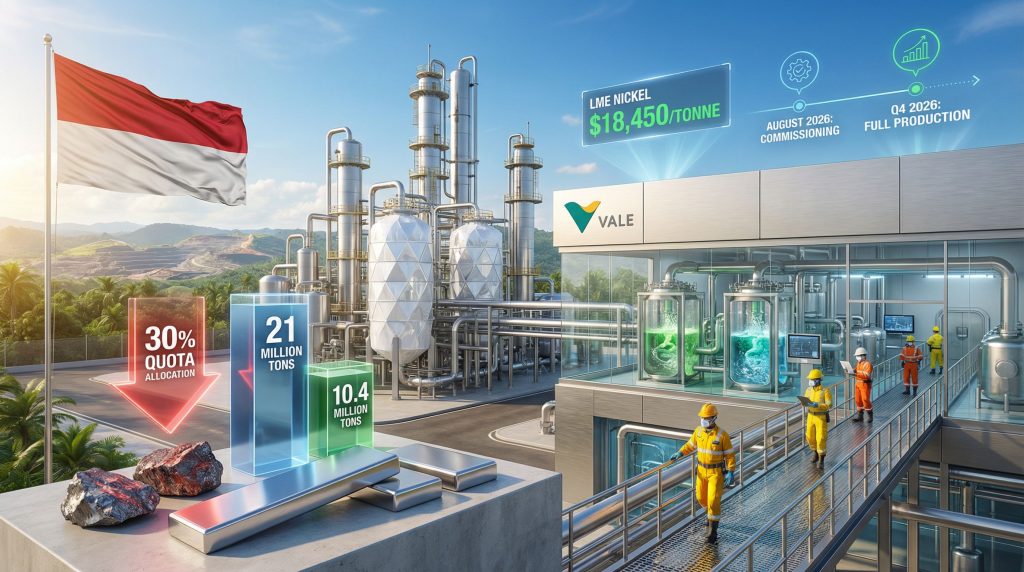
The magnitude of Vale Indonesia's quota shortfall presents unprecedented operational challenges for one of the country's most established mining operations. Company executives disclosed that government approval covered approximately 30% of their requested production volumes for 2026, creating a substantial gap between planned operations and regulatory authorization.
The Vale Indonesia 2026 mining quota restriction directly impacts their ability to feed upcoming High-Pressure Acid Leaching facilities. The Pomalaa plant requires 21 million tons of limonite ore annually to produce 120,000 metric tons of Mixed Hydroxide Precipitate, while the Bahodopi facility needs 10.4 million tons for its 66,000-ton annual output capacity.
Production Timeline and Capacity Constraints
| Facility | MHP Output | Ore Requirement | Startup Timeline |
|---|---|---|---|
| Pomalaa HPAL | 120,000 tons/year | 21 million tons/year | August 2026 |
| Bahodopi HPAL | 66,000 tons/year | 10.4 million tons/year | Q4 2026 |
| Combined Capacity | 186,000 tons/year | 31.4 million tons/year | 2026 Operations |
The timing of quota approval creates particular concern for Vale's operational readiness. Chief Executive Bernardus Irmanto's parliamentary testimony revealed deep apprehension about plant commissioning without adequate ore reserves. "We face significant challenges in facility completion without corresponding feedstock availability," he stated during recent hearings.
However, this timing mismatch between capital deployment and resource access represents a critical risk factor that extends beyond Vale's operations to the broader Indonesian mining investment landscape.
Capital Investment Risk Assessment
Vale's Indonesian operations face substantial financial exposure due to quota restrictions impacting their most significant capital commitments. The company has deployed $6.5 billion across two major HPAL projects, with $4.5 billion invested in the Pomalaa facility and $2 billion committed to Bahodopi development.
The potential for stranded assets emerges when analysing capacity utilisation scenarios under current quota constraints. If the 30% quota allocation remains binding, Vale's MHP production would operate at significantly reduced efficiency levels. For instance, Pomalaa's designed 120,000-ton annual capacity could be limited to approximately 36,000 tons.
Financial Impact Analysis
The economics of High-Pressure Acid Leaching technology involve substantial upfront capital deployment with relatively low marginal operating costs. This cost structure means that quota-constrained production creates disproportionate financial impact compared to traditional mining operations.
Capital Efficiency Implications:
- Fixed infrastructure costs remain constant regardless of production volumes
- Variable costs scale with ore input availability
- Reduced utilisation increases per-unit production costs substantially
- Return on invested capital calculations face material revision
Market dynamics add complexity to financial risk assessment, particularly when considering investment risk strategies for resource sector investments. Current LME nickel prices around $18,450 per tonne provide strong revenue potential for MHP output, but quota restrictions prevent Vale from capitalising on favourable market conditions.
Indonesia's Electric Vehicle Battery Strategy Integration
Vale's HPAL plants represent critical infrastructure for Indonesia's ambitions to become a dominant force in the global electric vehicle battery supply chain. High-Pressure Acid Leaching technology enables processing of laterite nickel ore into Mixed Hydroxide Precipitate, an intermediate product essential for battery cathode manufacturing.
The strategic positioning of these facilities within the broader EV supply chain demonstrates Indonesia's value-added processing objectives. Rather than exporting raw ore, the country aims to capture higher-value processing stages before materials reach international battery manufacturers. Furthermore, this approach requires substantial coordination between mining operations, processing facilities, and downstream manufacturing capacity.
Technology and Processing Specifications
HPAL technology represents a sophisticated approach to laterite ore processing, utilising high-pressure and high-temperature conditions to extract nickel from ore matrices that prove challenging for conventional smelting methods. The process produces Mixed Hydroxide Precipitate containing nickel, cobalt, and other battery-relevant metals in intermediate form suitable for further refining.
Processing Requirements:
- Specialised metallurgical equipment for high-pressure operations
- Precise process control systems for temperature and pressure management
- Substantial energy input requirements for processing operations
- Environmental management systems for acid handling and waste processing
Vale's Indonesian HPAL operations specifically target limonite ore types, which contain nickel in oxide form rather than sulfide minerals. Consequently, this ore type requires different processing approaches compared to traditional nickel sulfide deposits, making HPAL technology particularly suitable for Indonesian laterite resources.
National Supply Chain Implications
Indonesia's aggregate nickel production quota for 2026 reflects broader policy shifts affecting the entire mining sector. Total national quota allocations have declined substantially compared to 2025 levels, creating potential supply constraints across multiple producers beyond Vale's specific situation.
The reduction in aggregate quotas signals government prioritisation of controlled resource development over maximum production volumes. This approach aligns with Indonesia's downstream processing mandates, which require mining companies to demonstrate domestic value-added activities before receiving production authorisation.
Competitive Dynamics Among Indonesian Producers
Vale's quota shortfall occurs within a broader competitive landscape where multiple Indonesian nickel producers face similar regulatory constraints. Companies including PT Antam, PT Harita Nickel, and various Chinese-backed operations compete for limited quota allocations based on their downstream processing commitments and investment readiness.
However, the Vale Indonesia 2026 mining quota situation illustrates how even established operators with substantial investments face allocation challenges under Indonesia's evolving regulatory framework.
"The allocation of limited production quotas among competing producers creates strategic advantages for companies with established processing infrastructure and strong regulatory relationships, while constraining expansion opportunities for operations dependent solely on ore export revenues," according to industry analysts.
Regulatory Navigation Strategies
Vale's approach to addressing quota constraints involves multiple strategic channels, beginning with direct parliamentary engagement. Company executives have explicitly requested legislative support for additional quota allocations, leveraging their substantial capital investments and job creation commitments as justification for increased production authorisation.
The parliamentary hearing approach represents a sophisticated understanding of Indonesia's political economy, where legislative support can influence executive branch regulatory decisions. In addition, Vale's strategy emphasises their contribution to national economic development objectives, particularly regarding technology transfer and domestic processing capacity development.
Operational Optimisation Approaches
Beyond regulatory advocacy, Vale faces operational challenges requiring technical solutions to maximise efficiency within quota constraints. For instance, potential optimisation strategies include selective mining techniques and advanced ore sorting technologies.
Ore Grade Enhancement:
- Selective mining techniques to concentrate higher-grade deposits
- Advanced ore sorting technologies to improve feed quality
- Geological analysis to identify premium ore zones within existing concessions
Process Efficiency Maximisation:
- HPAL plant optimisation to extract maximum nickel recovery rates
- Energy efficiency improvements to reduce operating costs per ton
- Maintenance scheduling to maximise production availability windows
Furthermore, the company may explore alternative sourcing arrangements through joint venture partnerships with other Indonesian mining operations or ore purchase agreements with third-party producers holding quota allocations.
The next major ASX story will hit our subscribers first
Broader Mining Policy Implications
Indonesia's quota restriction approach reflects tensions between resource sovereignty objectives and foreign investment attraction. The government seeks to maximise domestic value capture from natural resources while maintaining sufficient investment incentives for continued capital deployment in processing infrastructure.
This balance proves particularly challenging in capital-intensive sectors like nickel processing, where multi-billion dollar investments require predictable regulatory frameworks for feasibility assessment. Consequently, the Vale Indonesia 2026 mining quota situation illustrates potential consequences when regulatory assumptions underlying investment decisions prove incorrect.
Regional Competition and Strategic Positioning
Indonesia's restrictive quota policies occur within a competitive regional context where Philippines, New Caledonia, and other nickel-producing jurisdictions may capture market opportunities constrained by Indonesian policy. This dynamic creates pressure for regulatory flexibility to maintain Indonesia's market position while advancing domestic processing objectives.
However, mining decarbonisation benefits remain a key consideration in policy formulation. China's role as a major downstream processor adds complexity to Indonesia's strategic calculations, as Chinese companies have invested heavily in Indonesian processing facilities.
Global Supply Chain Diversification Trends:
- EV manufacturers seeking supply chain resilience beyond single-country dependence
- Battery material processors evaluating alternative feedstock sources
- Mining companies reassessing concentration risk in Indonesia-focused strategies
- Governments promoting domestic critical mineral processing capabilities
Investment Risk Framework and Market Outlook
The Vale Indonesia quota situation provides insight into systematic risks affecting mining investments in Indonesia's evolving regulatory environment. Investors must evaluate projects against scenarios involving production constraints, policy volatility, and changing government priorities regarding resource development.
Trade policy developments continue to influence investment decisions, particularly regarding tariffs and market impact considerations.
Critical Risk Factors:
- Annual quota approval processes creating recurring regulatory uncertainty
- Government policy evolution affecting long-term investment predictability
- Domestic processing requirements potentially constraining raw material exports
- Environmental compliance standards influencing production authorisation
Strategic Recommendations for Market Participants
Portfolio diversification emerges as a critical strategy for managing Indonesia-specific regulatory risks. Companies heavily concentrated in Indonesian operations face substantial exposure to policy changes, while diversified producers can better navigate individual jurisdiction constraints.
Alternative investment opportunities in nickel processing include operations in jurisdictions with more predictable regulatory frameworks, though often with higher political risk or resource quality challenges. For instance, the Philippines offers laterite resources similar to Indonesia but with different regulatory approaches.
Market Outlook Considerations:
- Supply constraint duration likely extends beyond 2026 given policy trajectory
- Indonesian processing capacity development may eventually resolve quota constraints
- Global nickel demand growth supports price levels despite supply disruptions
- Technology development in battery chemistry may alter nickel demand patterns
- Geopolitical factors affecting critical mineral supply chains remain elevated
The long-term trajectory of Indonesia's mining policy will significantly influence global nickel markets, EV battery supply chains, and mining investment patterns. Furthermore, the Vale Indonesia 2026 mining quota challenge represents an early indication of how resource nationalism and value-added processing mandates may reshape international commodity trade relationships in the critical minerals sector.
Looking for Opportunities in Resource Sector Investments?
Discovery Alert's proprietary Discovery IQ model delivers real-time alerts on significant ASX mineral discoveries, instantly empowering subscribers to identify actionable opportunities ahead of the broader market. Explore why major mineral discoveries can lead to substantial market returns and begin your 30-day free trial today to secure your market-leading advantage.