June 6, 2026
When Geography Becomes a Catalyst for Engineering Innovation
In bulk commodity shipping, geography is rarely neutral. The physical distance between a mine and its primary customer market shapes freight economics, competitive positioning, and ultimately, the viability of entire supply chains. For producers separated from their largest buyers by tens of thousands of kilometres of open ocean, the cost of moving product is not a background expense but a frontline strategic variable. It is within this context that Vale sail-equipped iron ore carriers have evolved from a maritime novelty into a commercially serious freight efficiency tool, and nowhere is this transition more consequential than in the global iron ore trade.
When big ASX news breaks, our subscribers know first
The Freight Cost Problem That Defines Iron Ore Competition
Iron ore is among the most price-sensitive of major bulk commodities. Unlike copper or gold, where grade quality and processing complexity create natural pricing buffers, iron ore competes primarily on cost-per-tonne delivered. Freight efficiency is therefore not peripheral to the business model but central to it.
The Brazil-to-China shipping corridor is one of the longest regularly operated major commodity trade routes on earth, spanning roughly 19,000 kilometres across the South Atlantic and Indian Oceans. This distance creates a structural freight cost disadvantage for Brazilian producers relative to their Australian counterparts. The iron ore demand outlook reinforces just how critical proximity to Chinese steel mills remains, giving Australian producers a geographic advantage that no amount of mining efficiency can fully neutralise through conventional means alone.
Compounding this challenge is the volatility of bunker fuel prices. Marine heavy fuel oil remains the dominant energy source for commercial shipping, and its price moves with global oil markets, which have experienced significant disruption tied to Middle East geopolitical tensions. According to reporting from MINING.COM, freight costs are significant for the mining sector and have climbed during the Iran war, making fuel expenditure a direct and immediate threat to iron ore margins on long-haul routes.
This is the commercial environment in which Vale's decision to more than double its fleet of Vale sail-equipped iron ore carriers must be understood.
How Rotor Sail Technology Works at Sea
The spinning cylindrical structures now visible on Vale's vessels are not decorative. They are precision-engineered propulsion devices rooted in a well-established aerodynamic principle: the Magnus effect. When a cylinder rotates in a crosswind, the interaction between the rotating surface and the moving air generates a perpendicular force. On a ship, this translates into forward thrust that supplements the main engine, reducing the load required from conventional fuel-burning propulsion.
What makes rotor sails particularly suited to transoceanic bulk carriers is their compatibility with long open-ocean passages where consistent trade winds provide sustained propulsion opportunity. The South Atlantic and Indian Ocean legs of the Brazil-China route are well-positioned for this kind of wind harvesting. Furthermore, Norsepower's rotor sail installation on a capesize bulk carrier demonstrated early that the technology could be meaningfully integrated with large-scale ore carriers. The sails operate at variable rotational speeds calibrated to wind conditions and vessel heading, and critically, they can be folded flat against the deck during port operations, eliminating any obstruction during loading and discharge.
Rafael Fischer, Vale's general manager for shipping, confirmed to Reuters that these rotating cylindrical sails, standing approximately as high as a ten-storey building, deliver fuel savings of up to 10% depending on the specific vessel and voyage conditions. He made these comments aboard one of the sail-equipped vessels docked at Tubarão port in Espírito Santo state, Brazil.
The Mechanics of Operational Efficiency
Several characteristics make rotor sails commercially practical on ultra-large ore carriers:
- The systems are mechanically robust and require minimal crew intervention during transit
- Rotational speed adjusts automatically to optimise propulsion contribution based on real-time wind data
- Folding mechanisms allow unobstructed terminal operations at major ports including Tubarão in Brazil and Teluk Rubiah in Malaysia
- The technology functions as a supplementary propulsion layer rather than a primary drive system, meaning vessels retain full engine capability under all conditions
- Long ocean passages with predictable trade wind patterns provide the ideal operating environment for consistent fuel displacement
Vale's Decade of Maritime Decarbonisation: The Ecoshipping Program
The current fleet expansion does not represent a sudden strategic pivot. It is the latest phase of a commitment that Vale formalised in 2016 through its Ecoshipping programme, a long-term initiative focused on reducing both emissions and fuel costs across its carrier fleet. The programme has coordinated rotor sail retrofits, new vessel specifications, and fuel technology trials across multiple shipowner partnerships and shipyard relationships over nearly a decade.
What distinguishes the Ecoshipping programme from typical corporate sustainability initiatives is its explicit commercial rationale. The programme was designed from the outset to address a freight cost challenge, not merely a public relations objective. Wind-assisted propulsion is positioned within Vale's operational philosophy as a complementary efficiency layer, not a replacement for engine power.
Fischer articulated this dual motivation clearly, stating to Reuters that energy efficiency means the company relies less and less on fuel, which directly reduces the impact of any variation in bunker fuel prices. This framing positions the technology as financial risk management as much as environmental stewardship.
Key Milestones in the Ecoshipping Timeline
- 2016: Ecoshipping programme established with long-term maritime efficiency targets set
- Capesize retrofit phase: 200,000-tonne bulk carriers fitted with large cylindrical rotor sails under partnerships with major shipowners
- Guaibamax deployment: 325,000-tonne very large ore carriers fitted with multiple rotor sail installations at Chinese shipyards
- Berge Neblina: A 388,000 DWT Valemax retrofitted with rotor sails, documenting measurable annual fuel savings exceeding 1,000 tonnes
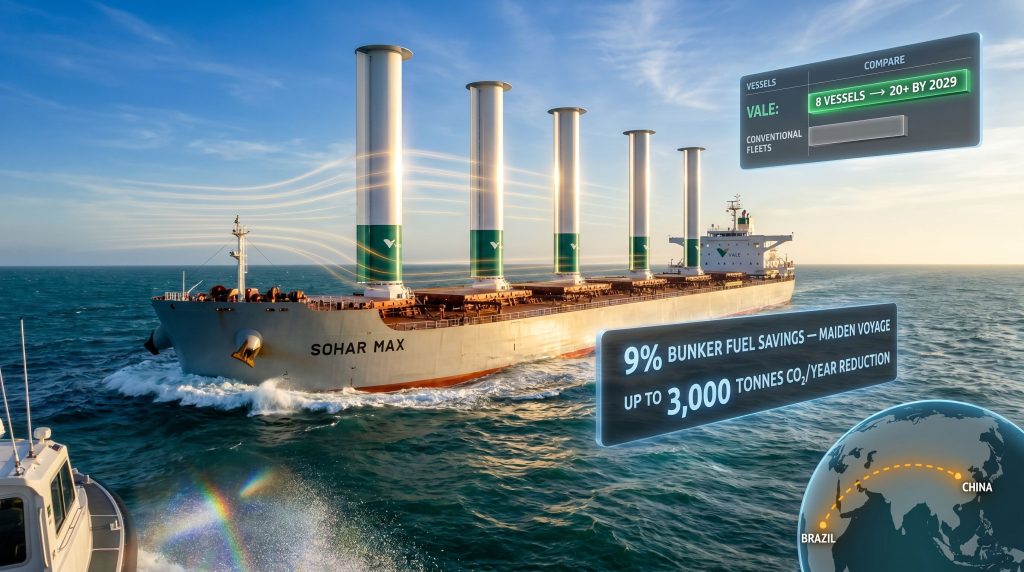
- Sohar Max: A 400,000-tonne Valemax fitted with five rotating sails at an adaptation cost of approximately $13 million, recording approximately 9% bunker fuel savings on its maiden voyage
- April 2026: A 25-year charter agreement with Shandong Shipping Corporation announced for ethanol-fuelled vessels; fleet expansion to at least 20 sail-equipped vessels confirmed
Doubling the Fleet: From 8 to 20+ Vessels by 2029
Vale currently operates eight sail-equipped iron ore carriers, a number that will expand to a minimum of 20 within three years according to confirmed company plans reported by Reuters on April 30, 2026. This more-than-doubling of wind-assisted capacity represents a transition from proof-of-concept deployment to fleet-level operational standard.
The commercial significance of reaching the 20-vessel threshold extends beyond the headline number. At that scale, wind-assisted technology becomes embedded in Vale's standard operating model rather than a specialised subset of its fleet. This creates leverage in charter rate negotiations, as demonstrated fuel efficiency credentials increasingly influence vessel economics in a market where emissions performance is attracting regulatory and commercial scrutiny.
The expansion involves partnerships with major international shipowners and construction relationships with Chinese shipyards, reflecting the global nature of both the bulk shipping industry and the supply chain for large vessel construction. Partners including Pan Ocean, MOL (Mitsui O.S.K. Lines), and Asyad Group, along with shipyards New Times Shipbuilding and PaxOcean, are involved across different phases of the programme.
Fleet Expansion at a Glance
| Metric | Current Status | Target (by ~2029) |
|---|---|---|
| Sail-equipped vessels | 8 | 20+ |
| Maximum vessel size | Up to 400,000 DWT | Up to 400,000 DWT |
| Fuel savings range | Up to 10% per vessel | Consistent across fleet |
| Fleet penetration | Minority share | Up to ~40% of total fleet |
| Fuel strategy | Wind assist + conventional | Wind assist + multi-fuel |
The Geographic Disadvantage That Drives Constant Innovation
Australian iron ore producers ship to China across a distance of roughly 7,000 to 8,000 kilometres. Brazilian producers face a journey more than twice as long. This distance asymmetry is not something Vale can engineer away through mining productivity or processing improvements. The kilometres exist regardless of operational excellence onshore.
Fischer was direct about this structural reality when speaking to Reuters, describing the geographic disadvantage relative to competitors as a challenge that the company addresses by using innovation as a lever to mitigate its effect. This framing is strategically significant: it positions technological investment not as a luxury or a corporate responsibility exercise but as a competitive necessity. Indeed, Australia's iron ore advantage remains a formidable structural factor that Brazilian producers must continuously work to offset.
Wind-assisted propulsion, combined with the ultra-large vessel economics of the Valemax class at up to 400,000 DWT, allows Vale to pursue a two-pronged freight cost compression strategy. Larger vessels spread fixed voyage costs across greater cargo volumes. Fuel-saving technology simultaneously reduces variable expenditure. Together, they narrow the per-tonne freight cost gap between Brazilian and Australian supply, without requiring either geographic proximity or lower commodity prices.
Comparative Competitive Dynamics
| Factor | Vale (Brazil) | Australian Producers |
|---|---|---|
| Distance to China | ~18,000–19,000 km | ~7,000–8,000 km |
| Vessel size strategy | Valemax (up to 400,000 DWT) | Capesize standard |
| Wind-assisted fleet | 8 vessels, expanding to 20+ | Limited adoption |
| Freight offset mechanism | Innovation-led efficiency | Route proximity |
| Fuel strategy | Multi-fuel + rotor sail hybrid | Primarily conventional |
The next major ASX story will hit our subscribers first
Beyond Wind: The Multi-Fuel Architecture of Next-Generation Carriers
Rotor sails address one dimension of freight cost vulnerability: fuel consumption volume. Vale's next strategic layer targets fuel price volatility itself through multi-fuel vessel architecture.
In April 2026, Vale announced a 25-year charter agreement with China's Shandong Shipping Corporation for the construction of two vessels described as among the world's first ethanol-fuelled transoceanic bulk carriers. Critically, these ships will not be single-fuel vessels. They will combine rotor sail wind propulsion with the ability to operate on ethanol as the primary fuel, with additional capability for methanol and conventional bunker fuel. Furthermore, the China steel and iron ore market continues to drive demand for cleaner, more cost-efficient supply chains, making fuel flexibility increasingly valuable for producers. Future conversion pathways are designed for liquefied natural gas and ammonia.
This creates what Fischer described to Reuters as a future with the option of at least five fuels, providing the flexibility to adapt to different situations and market conditions. This architecture is not simply an environmental positioning statement. It is a risk management framework for a 25-year charter horizon that will span multiple commodity price cycles, geopolitical shifts, and regulatory transitions.
The Five-Fuel Flexibility Framework
- Ethanol as the primary low-carbon operational fuel
- Methanol as an alternative low-carbon option with overlapping infrastructure
- Conventional bunker fuel retained for legacy compatibility and backup capability
- Liquefied natural gas (LNG) as a future conversion option as infrastructure matures
- Ammonia as the long-term zero-carbon pathway aligned with IMO 2050 targets
Plus rotor sail wind assist operating across all fuel modes simultaneously
The logic behind five-fuel flexibility is not technological indecisiveness but strategic optionality. Over a 25-year vessel life, the energy economics of shipping will shift in ways that no forecast can reliably predict. Vessels locked into a single fuel type face stranded asset risk if that fuel becomes uncompetitive or subject to punitive regulation. Vale's multi-fuel architecture is effectively an insurance policy written in steel and engineering specifications.
Port Integration and Operational Realities for Ultra-Large Sail-Equipped Vessels
A legitimate operational question surrounds the compatibility of tall rotor sail structures with the loading infrastructure of major iron ore terminals. Overhead clearances, conveyor systems, and loading cranes at facilities like Tubarão in Brazil and Teluk Rubiah in Malaysia are engineered for specific vessel profiles. Adding structures equivalent in height to a ten-storey building introduces real logistical considerations.
The engineering solution adopted across Vale's fleet is a folding mechanism that allows rotor sails to lie flat against the deck during port calls. This eliminates overhead obstruction during loading and discharge operations without requiring terminal infrastructure modification. At sea, the sails return to vertical operating position and begin rotating once vessel speed and wind conditions are sufficient for meaningful propulsion contribution.
This operational flexibility is a key reason why rotor sail technology has proven viable on ultra-large bulk carriers where port turnaround efficiency is as commercially important as voyage fuel consumption. A technology that created port delays or terminal incompatibility would undermine any fuel savings achieved at sea. In addition, Anemoi's deployment of rotor sails on very large ore carriers has further validated the folding design across different vessel configurations.
What the Industry Signal Means for Maritime Decarbonisation
Vale's fleet expansion has implications that extend well beyond its own logistics operations. For a decade, wind-assisted propulsion on commercial bulk carriers was viewed as an interesting experiment at the margins of maritime innovation. The Ecoshipping programme has progressively shifted that perception. Consequently, the broader trajectory of green iron production is increasingly intertwined with shipping decarbonisation as producers seek end-to-end sustainability credentials.
At fleet scale, rotor sail technology demonstrates several commercially relevant properties:
- It generates measurable, verifiable fuel savings across multiple vessel classes and route profiles
- It is compatible with port operations without requiring terminal infrastructure investment
- Its per-vessel adaptation cost, estimated at approximately $13 million for a 400,000-tonne Valemax installation, produces a return profile that strengthens as bunker fuel prices remain elevated
- It is technically scalable to vessels across the size spectrum from capesize to Valemax class
- It functions as an additive efficiency layer compatible with any primary fuel type, including future zero-carbon alternatives
For the broader dry bulk sector, where Australian, Brazilian, and Asian operators collectively move billions of tonnes of commodities annually, Vale's demonstrated programme provides a commercial template that other operators can evaluate against their own route profiles and fuel cost structures.
The alignment of Vale's fleet strategy with IMO 2030 interim efficiency targets and the 2050 net-zero ambition for international shipping is not coincidental. Operators who develop wind-assisted and multi-fuel capabilities now position themselves ahead of regulatory requirements that will increasingly penalise fuel-inefficient vessels through carbon pricing mechanisms and port access conditions. The China iron ore outlook suggests that demand volumes will remain substantial, reinforcing why freight efficiency improvements at scale carry such significant long-term commercial value.
Frequently Asked Questions: Vale's Wind-Assisted Fleet
How much fuel do rotor sails save on Vale's ore carriers?
Fuel savings reach up to 10% per vessel, depending on vessel size, route, and wind conditions during the voyage. The actual benefit varies by passage, with long open-ocean legs through consistent trade wind zones delivering the strongest performance.
How tall are the rotor sails used on Vale's ships?
The spinning cylindrical structures installed across Vale's fleet stand approximately as high as a ten-storey building. Specific heights vary by vessel class, with some configurations reaching 35 metres in height.
What did the rotor sail installation on the Sohar Max cost?
The adaptation of the Sohar Max, a 400,000-tonne Valemax, involving the installation of five rotating sails, was completed at an estimated cost of approximately $13 million. Against documented fuel savings of approximately 9% and annual CO₂e reductions of around 3,000 tonnes, the payback period is heavily influenced by prevailing bunker fuel prices.
Will Vale's future vessels also run on alternative fuels?
Yes. The two ethanol-fuelled carriers being constructed under the Shandong Shipping charter combine rotor sail wind assist with multi-fuel engine capability. These vessels are designed to operate on ethanol, methanol, and conventional bunker fuel, with future conversion pathways for LNG and ammonia, providing five distinct fuel options across their operational life.
How does wind-assisted shipping help Vale compete with Australian iron ore producers?
Australian producers hold a structural freight advantage due to their proximity to Chinese steel mills. Vale's wind-assisted fleet reduces per-voyage fuel expenditure, compressing the freight cost gap created by the longer Brazil-China route distance. Combined with ultra-large Valemax vessel economics, rotor sail technology forms a core component of Vale's strategy to maintain cost-competitive positioning on the world's longest major iron ore trade corridor.
Key Takeaways
| Metric | Detail |
|---|---|
| Current sail-equipped fleet | 8 vessels |
| Target fleet size | 20+ vessels within 3 years |
| Fuel savings per vessel | Up to 10% depending on conditions |
| Rotor sail height | Approximately 10-storey building equivalent |
| Largest vessel class | Valemax up to 400,000 DWT |
| Best recorded efficiency | ~9% bunker fuel saving (Sohar Max maiden voyage) |
| Annual CO₂e reduction per vessel | Up to ~3,400 tonnes |
| Rotor sail adaptation cost | ~$13 million per Valemax installation |
| New vessel fuel options | Ethanol, methanol, bunker fuel, LNG, ammonia |
| Charter partner for ethanol vessels | Shandong Shipping Corporation (25-year agreement) |
| Programme origin | Ecoshipping initiative, established 2016 |
| Primary competitive rationale | Offsetting Brazil-China distance disadvantage vs. Australian producers |
Disclaimer: This article contains forward-looking statements, fleet expansion targets, and fuel savings estimates that are subject to change based on market conditions, regulatory developments, and operational outcomes. Past fuel savings performance on individual voyages does not guarantee equivalent results across all vessels or routes. Readers should conduct independent research before making investment decisions related to companies or technologies mentioned in this article.
Want to Know Which ASX Mining Innovators Are Worth Watching?
Discovery Alert's proprietary Discovery IQ model delivers real-time alerts on significant ASX mineral discoveries — instantly cutting through complex data to surface actionable opportunities in the companies driving the next wave of resource sector innovation. Explore historic discoveries and their exceptional market returns, then begin your 14-day free trial at Discovery Alert to position yourself ahead of the broader market.