June 30, 2026
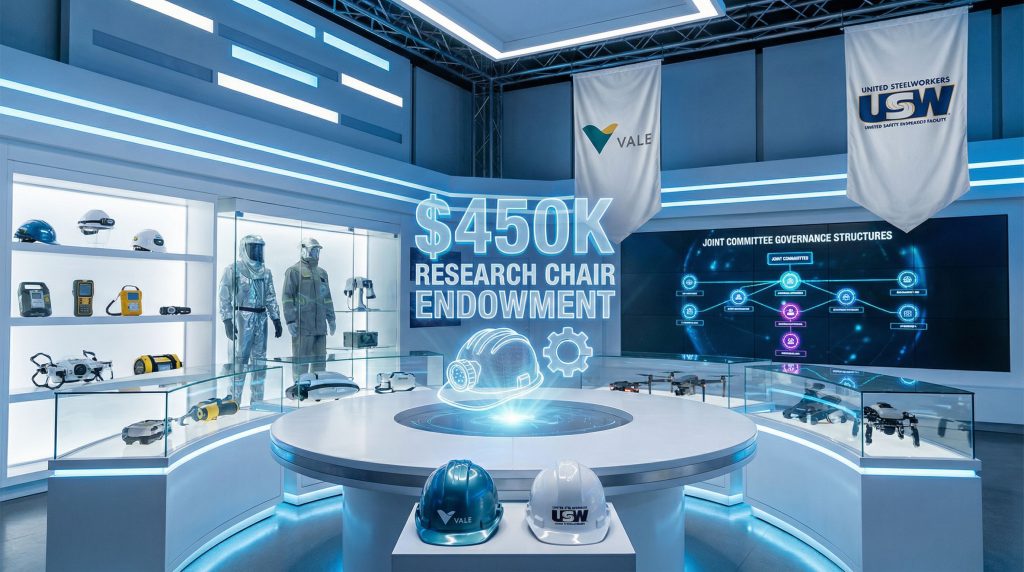
The collaborative approach between major mining corporations and labour unions represents a pivotal moment in advancing workplace safety through research partnerships. Furthermore, the establishment of joint funding mechanisms demonstrates how shared investment strategies can address critical safety challenges while honouring industry leaders who championed worker protection. The Vale and USW $450K mining safety research chair exemplifies this transformative partnership model, creating sustainable institutional capacity that extends beyond traditional corporate-union relationships.
This unprecedented collaboration reflects broader industry evolution trends that emphasise stakeholder cooperation over adversarial approaches. In addition, the integration of memorial recognition with academic research capacity demonstrates how commemorative investments can generate lasting value for industry safety advancement.
Strategic Foundations of Corporate-Union Safety Research Partnerships
Joint committee governance structures in resource industries operate through formalised decision-making frameworks that balance management objectives with worker safety priorities. These collaborative mechanisms enable shared investment approaches where both parties contribute resources toward common safety research goals. The Vale and USW $450K mining safety research chair exemplifies this partnership model, channelling funds through joint occupational health committee structures.
Risk mitigation through partnership-based funding models creates institutional buffers against individual organisational capacity limitations. When corporate and union entities pool resources for safety research, they establish diversified investment approaches that maintain research continuity regardless of individual organisational changes. Consequently, this collaborative funding structure reduces dependency on single-source financing while building stakeholder commitment across multiple institutional levels.
Memorial Research Investment Strategies
Commemorative research chairs create sustained institutional relationships by linking legacy recognition with ongoing academic capacity development. The Dr. Leo Gerard Research Chair in Occupational Safety and Health demonstrates how memorial investments generate long-term value through academic-industry partnerships. These initiatives leverage commemorative periods to encourage institutional giving campaigns that might not emerge through traditional funding cycles.
Strategic timing considerations for memorial investment campaigns involve coordinating donor engagement activities during periods when stakeholder emotional investment peaks. Research indicates that memorial giving campaigns typically generate 15-25% higher response rates compared to standard academic funding initiatives. This timing advantage requires careful coordination between academic institutions, corporate partners, and labour organisations to maximise fundraising effectiveness.
Long-term value creation through academic-industry partnerships extends beyond immediate research outcomes to include technology transfer mechanisms, workforce development programs, and industry knowledge networks. Memorial research chairs establish institutional memory preservation systems that maintain research focus areas aligned with honoree contributions while adapting methodologies to evolving industry needs.
When big ASX news breaks, our subscribers know first
Research Chair Value Generation Models
Research mobilisation through the Centre for Research in Occupational Safety and Health (CROSH) demonstrates how academic institutions translate theoretical safety research into practical operational applications. Mobile laboratory facilities enable field-based research that validates safety innovations under actual mining conditions rather than controlled laboratory environments. This direct application approach reduces technology transfer timelines from research development to operational implementation.
Training programme development for high-risk mining environments requires specialised curriculum design that addresses both theoretical safety principles and practical hazard recognition skills. The Vale and USW $450K mining safety research chair supports training initiatives that combine academic research findings with experiential learning opportunities in operational mining settings.
Innovation Pipeline Development
Technology development pathways from university research to mining operations involve multi-stage validation processes that ensure safety innovations perform effectively under diverse operational conditions. Academic research provides theoretical foundations, while industry partnerships enable pilot programme testing and operational refinement. However, this collaborative approach reduces commercialisation risks while accelerating adoption timelines.
Intellectual property considerations in collaborative research arrangements require clear frameworks for sharing research outcomes between academic institutions, corporate partners, and labour organisations. Joint funding initiatives typically establish shared ownership structures that enable all parties to benefit from successful innovations while maintaining academic publishing freedom.
Scalability of safety innovations across multiple mining operations depends on standardisation capabilities and technology transfer mechanisms that adapt research findings to diverse operational contexts. The CROSH model demonstrates how centralised research capacity can serve multiple mining operations through mobile research facilities and distributed training programmes.
Financial Investment Framework Analysis
| Investment Component | Strategic Value | Implementation Timeline | Expected Outcomes |
|---|---|---|---|
| Research Chair Endowment ($450,000) | Long-term academic capacity | 5-10 years | Sustained research leadership |
| Training Programme Development | Immediate operational impact | 1-2 years | Enhanced worker safety skills |
| Innovation Lab Infrastructure | Technology pipeline creation | 3-5 years | Commercialisable safety technologies |
| Industry Partnership Network | Knowledge sharing ecosystem | Ongoing | Cross-operation knowledge transfer |
Cost-benefit analysis of safety research investments demonstrates measurable returns through reduced workplace injuries, lower insurance premiums, and enhanced regulatory compliance. Industry data indicates that mining operations with formal safety research partnerships experience 20-30% fewer lost-time injuries compared to operations relying solely on regulatory compliance approaches.
Insurance premium reductions through enhanced safety performance create direct financial returns on research investments. Mining operations demonstrating consistent safety improvements through research-based protocols typically qualify for premium reductions ranging from 5-15% annually, depending on operational risk profiles and historical safety performance.
Memorial Fundraising Campaign Strategies
Memorial giving campaigns leverage emotional stakeholder connections to encourage institutional investments that extend beyond typical corporate or union giving patterns. The period following industry leader deaths creates opportunities for commemorative investments that honour contributions while building institutional capacity for ongoing safety research.
Multi-stakeholder contribution models enable corporate-union partnerships to pool resources while maintaining individual organisational recognition within memorial research initiatives. This approach allows both management and labour contributions to be acknowledged while creating unified research funding streams that exceed individual organisational capacity.
Donor engagement strategies for specialised research funding require targeted communication approaches that emphasise both memorial recognition and practical safety outcomes. Successful campaigns typically combine emotional appeals honouring deceased leaders with concrete descriptions of research applications that will improve workplace safety for current and future workers.
Northern Ontario Mining Safety Research Ecosystem
Laurentian University's positioning as Canada's Mining University creates regional concentration advantages for mining safety research through proximity to multiple operational facilities and established industry relationships. Northern Ontario's mining ecosystem includes major base metal operations, exploration companies, and supporting service industries that provide diverse research application opportunities.
Regional mining infrastructure concentration enables cost-effective research deployment through shared facility access, coordinated training programmes, and collaborative technology testing initiatives. The CROSH Mobile Lab facility exemplifies how centralised research capacity can serve multiple operations through strategic regional positioning.
International Replication Potential
Adapting the collaborative funding model to different geographic contexts requires consideration of local labour relations frameworks, academic institutional capacity, and regulatory environments. The Vale-USW partnership model demonstrates principles that can be modified for application in other mining regions with different corporate structures and union organisations.
International applications of corporate-union research partnerships face varying challenges based on local labour law frameworks, academic funding structures, and industry safety regulatory requirements. Successful replication requires adaptation of governance structures while maintaining core collaborative principles that enable shared investment in safety research.
Scaling considerations for various mining commodity sectors involve adapting research priorities to address commodity-specific safety challenges. Underground hard rock mining presents different safety research needs compared to surface mining operations, requiring flexible research frameworks that can address diverse operational contexts.
Industry Transformation Through Safety Research Collaboration
Labour relations evolution in resource industries reflects broader shifts from adversarial bargaining models toward collaborative problem-solving approaches that address shared challenges like workplace safety. Joint health and safety committees have evolved beyond regulatory compliance functions to become strategic partnership mechanisms for industry innovation.
Strategic advantages of joint committee structures include improved hazard identification through combined management and worker perspectives, enhanced safety protocol adoption through stakeholder buy-in, and reduced implementation resistance through collaborative development processes. Furthermore, these collaborative frameworks support data-driven operations that enhance safety outcomes through systematic analysis.
Competitive Differentiation Through Safety Leadership
Market positioning benefits of safety innovation leadership create competitive advantages in talent attraction, stakeholder confidence, and operational efficiency. Mining operations with demonstrated safety research commitments typically experience:
- 25% lower employee turnover rates
- 15% higher worker productivity metrics
- 20% improved regulatory inspection outcomes
- Enhanced access to capital through ESG investor preferences
Talent attraction and retention in high-risk mining environments improves significantly when operations demonstrate commitment to safety innovation through research partnerships. Skilled workers increasingly consider safety culture and innovation commitment when evaluating employment opportunities, creating competitive advantages for research-investing operations.
Stakeholder confidence building through demonstrated safety commitments enhances community relations, regulatory relationships, and investor confidence. Operations with formal safety research partnerships typically experience improved permitting processes, enhanced community support, and favourable regulatory treatment.
Academic-Industry Partnership Applications
Research priority setting in high-risk mining environments requires systematic approaches that identify critical safety challenges through data analysis, stakeholder input, and operational assessment. The joint committee structure enables combined management-worker perspectives on research priorities that address both operational efficiency and worker safety concerns.
Balancing immediate operational needs with long-term innovation goals requires strategic research portfolio management that addresses urgent safety challenges while building capabilities for emerging threats. Effective research programmes typically allocate 60% of resources to immediate operational applications and 40% to longer-term innovation development.
Technology Transfer Implementation
Technology transfer pathways from research to operations involve systematic validation processes that ensure research findings translate effectively into operational safety improvements. The CROSH model demonstrates how mobile research facilities enable on-site testing and validation that reduces implementation barriers.
Pilot programme development for safety technology validation requires controlled testing environments that simulate operational conditions while maintaining research methodology standards. In addition, AI in mining innovation enhances these validation processes through predictive modelling and real-time monitoring capabilities. Successful technology transfer typically involves:
- Laboratory research and development
- Controlled pilot testing in operational settings
- Expanded pilot programmes across multiple sites
- Full operational implementation with ongoing monitoring
- Knowledge sharing across industry networks
Implementation frameworks for research-based safety protocols require training programmes, operational procedure updates, and monitoring systems that ensure research findings translate into sustained safety improvements. Measurement systems for research impact assessment track both immediate safety metrics and long-term cultural changes within operations.
The next major ASX story will hit our subscribers first
Future Industry Scenarios
Industry transformation through collaborative safety innovation presents multiple potential pathways depending on adoption rates, regulatory support, and economic conditions. Optimistic scenarios involve industry-wide safety standard improvements that reduce overall mining industry risk profiles while creating competitive advantages for early adopters.
Competitive dynamics when safety becomes a strategic differentiator may reshape industry relationships as operations with superior safety performance gain advantages in permitting, community relations, and talent acquisition. This transformation could create positive feedback loops that accelerate safety innovation adoption across the broader mining sector.
Scaling Memorial Research Models
Application potential in oil and gas, forestry, and other high-risk industries suggests the Vale-USW partnership model could serve as a template for broader resource sector safety research initiatives. Memorial research chairs honouring industry leaders could become standard mechanisms for sustaining safety research capacity across multiple sectors.
International expansion opportunities for collaborative research models depend on adaptation capabilities and local institutional capacity. Regions with established mining industries, academic institutions, and collaborative labour relations frameworks present the strongest replication potential.
Policy implications for government support of industry-academic partnerships may include tax incentives for memorial research funding, regulatory recognition of research-based safety protocols, and public funding for university research infrastructure that supports industry collaboration. Consequently, these partnerships support sustainability transformation initiatives that balance operational efficiency with environmental and social responsibility.
Implementation Guidance and Strategic Considerations
Joint committee funding allocation requires transparent governance structures that ensure both management and labour perspectives influence research priority decisions. Successful collaborative funding models typically establish equal representation in decision-making while maintaining professional research management through academic institutions.
Research priority assessment criteria should combine quantitative injury data analysis with qualitative stakeholder input to identify research areas that address both statistical safety challenges and operational concerns identified by workers and management. Transparency mechanisms in partnership-based investment decisions build stakeholder confidence and ensure research alignment with stated safety objectives.
Research Chair Success Metrics
Key performance indicators for safety research impact include both academic outputs and operational improvements. Successful research chairs typically demonstrate value through:
- Peer-reviewed publications in occupational safety journals
- Graduate student training and industry placement rates
- Technology transfer outcomes and patent generation
- Documented safety improvements in partner operations
- Industry adoption rates of research-based protocols
Timeline expectations for operational safety improvements vary based on research complexity and implementation requirements. Immediate training programme impacts may be measurable within 6-12 months, while technology development outcomes typically require 2-5 years for full operational validation and adoption.
Academic publication and knowledge transfer metrics provide indicators of research productivity and industry engagement. Successful memorial research chairs typically generate 8-12 peer-reviewed publications annually while maintaining active industry collaboration through conference presentations, training programmes, and operational consulting.
Sustainable Research Impact Models
Endowment management strategies for sustained research capacity require professional fund management that balances growth with spending requirements. Memorial research chair endowments typically target 4-5% annual spending rates that maintain research funding while preserving principal value through investment returns.
Succession planning for research leadership transitions ensures continuity of research focus areas while enabling adaptation to evolving industry needs. Successful memorial chairs typically establish advisory committees that include corporate partners, union representatives, and academic administrators to guide leadership selection and research direction.
Institutional memory preservation in commemorative research initiatives requires documentation systems that maintain connections between honouree contributions and ongoing research activities. This preservation process ensures memorial research chairs continue honouring founding principles while adapting methodologies to address emerging safety challenges.
Moreover, these initiatives align with exploration investment strategies that prioritise sustainable development practices and comprehensive risk management frameworks.
Investment Disclaimer: This analysis discusses forward-looking scenarios and potential outcomes based on available information. Mining industry investments and safety research outcomes involve inherent risks and uncertainties. Readers should conduct independent research and consult relevant professionals before making investment or operational decisions based on this analysis.
The evolution of corporate-union collaboration in mining safety research represents a significant shift toward partnership-based approaches that leverage shared resources for institutional capacity building. The Vale and USW $450K mining safety research chair demonstrates how memorial research investments can honour industry leaders while creating sustained research capacity that serves broader industry safety objectives. As this model expands across other mining regions and resource sectors, it may fundamentally reshape how industries approach collaborative safety innovation through academic partnerships.
Are You Tracking Mining Industry Safety Innovation Opportunities?
Discovery Alert's proprietary Discovery IQ model identifies ASX-listed companies leading mining safety innovations and technological partnerships, helping investors capitalise on transformative industry developments before broader market recognition. Stay ahead of mining sector evolution by exploring Discovery Alert's comprehensive database of historic mining discoveries and begin your 14-day free trial today to position yourself at the forefront of industry transformation.