
June 14, 2026
When Underground Mines Flood: Reading the Operational Recovery Cycle in PGM Mining
Few disruptions in hard-rock mining carry more operational complexity than underground flooding. Unlike surface-level weather events that can delay open-cut operations by days or weeks, underground inundation at a deep-level platinum mine triggers a cascading sequence of rehabilitation challenges that unfold across multiple reporting quarters. Stope access must be secured, water management infrastructure restored, ventilation networks rebalanced, and ground support systems inspected before normal ore extraction can resume. For investors tracking Valterra quarterly production after flooding, understanding this recovery mechanics is essential to interpreting what the numbers actually mean.
The Bushveld Complex, which hosts the world's largest known platinum group metal (PGM) reserves, presents particular hydrological challenges. Its geology combines fractured reef structures with seasonal rainfall patterns across the Limpopo and North West provinces of South Africa, creating conditions where water inflows can overwhelm underground pumping infrastructure during high-rainfall periods. When Amandelbult, Valterra Platinum's second-largest producing asset, experienced significant underground flooding in early 2025, the consequences were not limited to a single quarter of disrupted output. The ripple effects shaped production comparisons, sales strategy, and operational scheduling decisions well into 2026.
When big ASX news breaks, our subscribers know first
The Anatomy of an Underground Flood Event and Its Production Consequences
Why Underground Flooding Creates Multi-Quarter Recovery Arcs
Surface mining operations can often resume within days of a weather-related disruption once water recedes from pit floors. Underground platinum mining operates on an entirely different timeline. When water infiltrates a deep-level stope, the sequence of operational restoration follows a strict order that cannot be compressed without compromising safety.
The recovery process typically involves several distinct phases:
-
Emergency pumping and dewatering to reduce standing water levels to safe thresholds
-
Geotechnical assessment of hanging walls, footwalls, and support pillars that may have been destabilised by water exposure
-
Ground rehabilitation, including installation of new support systems and barring down of loose material
-
Ventilation circuit restoration, as flooding frequently disrupts air circulation pathways critical to both safety and ore extraction efficiency
-
Access development reinstatement, reopening haulage routes and conveyor systems to allow ore hoisting to resume
-
Processing feed normalisation, as the upstream mine progressively rebuilds its ore delivery rate to the concentrator
Each phase adds time. Industry experience across South African platinum operations suggests that comparable events at underground mines typically require two to four quarters before production returns to normalised run-rates. Furthermore, mine rehabilitation strategies employed during recovery can determine how efficiently an operation returns to full capacity. This extended timeline creates a structural distortion in year-on-year production comparisons that can persist long after the physical rehabilitation is complete.
"The base-effect phenomenon in mining is frequently misread by investors focused on headline percentage changes. A 40% year-on-year production increase at a mine recovering from flooding tells you more about how low the prior-year baseline was than about the operational trajectory of the current period."
The Downstream Refining Consequence: Feed Interruption and Toll Processing
An aspect of underground flooding that receives less attention than the mining disruption itself is its effect on downstream processing. Platinum group metal production follows an integrated sequence: ore is mined, hoisted to surface, crushed, milled, and then processed through flotation circuits to produce a platinum-rich concentrate. This concentrate feeds into smelting and base metal refining operations before final precious metal recovery occurs.
When underground ore access is curtailed, concentrator feed rates drop. Refineries operating below optimal throughput face elevated unit costs, and producers with surplus refining capacity may increase purchases of third-party concentrate to maintain processing utilisation. This dynamic helps explain why Valterra's external concentrate purchases grew in parallel with the Amandelbult recovery period, as the group actively managed its processing infrastructure during a period of constrained own-mined feed.
Decoding Valterra's Q1 2026 Production Numbers
Total Group Output: The 7% Increase in Proper Context
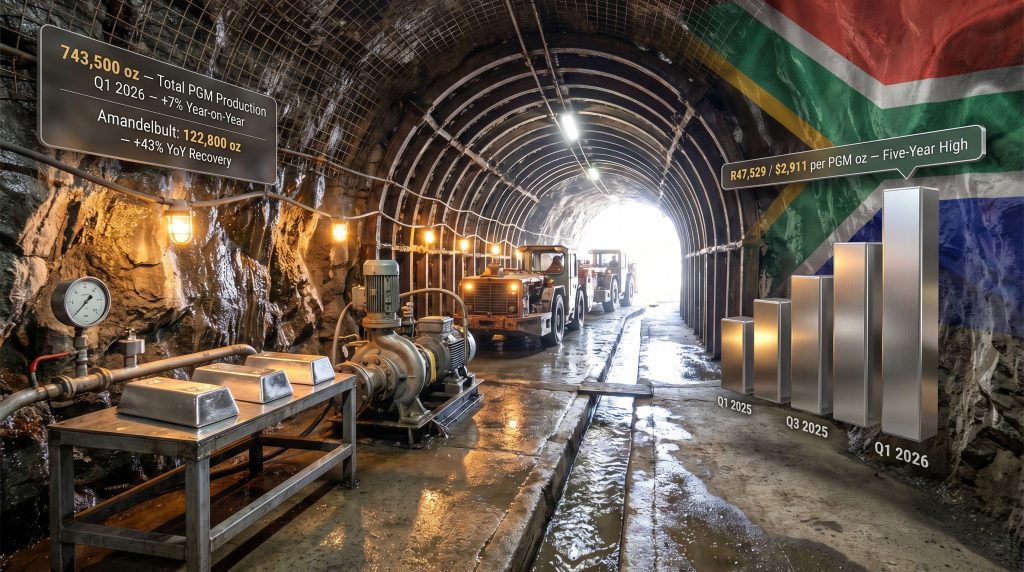
Valterra Platinum's Q1 2026 total PGM production reached 743,500 ounces, representing a 7% increase compared with the flood-affected Q1 2025 period. Breaking this figure into its constituent parts reveals a more nuanced operational picture than the headline suggests.
| Production Component | Q1 2026 Output | Year-on-Year Change |
|---|---|---|
| Total Group PGM Production | 743,500 oz | +7% |
| Own-Mined PGM Production | 486,200 oz | +5% |
| Third-Party Concentrate Purchases | 257,300 oz | +10% |
| Amandelbult Mine | 122,800 oz | +43% |
| Mogalakwena Mine | 212,300 oz | -6% |
Two forces are pulling in opposite directions within these numbers. The strong rebound at Amandelbult reflects the normalisation of production following the 2025 flooding, while Mogalakwena's output decline introduces a separate, unrelated operational variable that partially offsets the recovery effect.
Amandelbult's 43% Output Surge: Base Effect or Genuine Growth?
The 43% year-on-year production increase at Amandelbult is the most visually striking figure in the Q1 2026 report, but it demands careful interpretation. Valterra's own reporting confirms that Amandelbult returned to normal first-quarter output levels after recovering from the 2025 flooding event. This framing is significant: the 43% increase does not represent capacity expansion, operational transformation, or productivity improvement at the mine. It represents a return to the baseline that existed before the flooding disrupted operations.
This distinction matters for investors assessing the asset's forward contribution to group output. Once comparisons shift to quarters that were not affected by the flooding, Amandelbult's reported growth rates will revert to underlying operational levels. The statistical amplification created by an abnormally low comparison period is a one-time phenomenon.
Mogalakwena's 6% Decline: A Deliberate Variable, Not a Structural Problem
Valterra's flagship open-pit operation at Mogalakwena produced 212,300 ounces in Q1 2026, down 6% year-on-year. Two operational decisions drove this outcome, and both were deliberate rather than forced.
First, crusher maintenance was brought forward into Q1 rather than being deferred to a later period. Planned maintenance shutdowns reduce throughput during the period in which they occur, but protect equipment reliability and long-term production capacity. Second, Mogalakwena's management adopted a strategy of blending lower-grade ore from existing stockpiles into the processing feed mix. This reduces built-up head grades, which lowers PGM output per tonne processed but can serve useful purposes including stockpile management, ore body conservation, or waste movement optimisation.
Neither of these factors signals a structural production problem at Mogalakwena. They reflect active operational management decisions that created a short-term output reduction while preserving long-term asset integrity.
The Strategic Logic Behind Valterra's Q1 2026 Scheduling Decisions
Maintenance Deferral and the South African Electricity Cost Calendar
One of the less-discussed factors influencing Valterra quarterly production after flooding is the deliberate deferral of routine maintenance and stock count activities from Q1 to Q3 2026. The stated rationale is to minimise electricity consumption during South Africa's peak winter tariff period, which typically falls in the third quarter when heating demand drives up national electricity demand and Eskom's time-of-use tariffs escalate accordingly.
This scheduling decision has several implications for investors:
-
Q1 2026 output was elevated relative to a typical first quarter because normal maintenance downtime was absent
-
Q3 2026 production should be expected to carry a maintenance-related drag as the deferred work programmes are executed
-
Cost management sophistication is evident in the deliberate alignment of high-energy maintenance activities with lower-tariff periods, reducing the electricity cost per ounce produced
South Africa's electricity tariff structure under Eskom creates real operational cost variables for mining companies. Furthermore, the broader South Africa mining pressures around infrastructure reliability compound these challenges considerably. Winter tariff premiums for large industrial users can be substantial, and for operations running energy-intensive equipment like crushers, concentrators, and ventilation fans, timing discretionary shutdowns to avoid peak tariff windows represents genuine cost discipline rather than cosmetic scheduling.
The Inventory Draw-Down Strategy at a Five-Year Price High
Perhaps the most strategically interesting decision embedded in Q1 2026 results is Valterra's choice to sell 791,400 ounces of PGMs during the quarter, a figure that is 60% higher than the prior year's equivalent sales volume and which exceeded Q1 2026 production of 743,500 ounces. The gap was bridged through a marginal draw-down from refined inventory stockpiles.
The timing of this decision deserves attention. Valterra's average PGM basket price during Q1 2026 reached R47,529 per ounce (approximately $2,911), the highest level recorded since Q2 2021. Ruthenium, platinum, and rhodium recorded the most substantial price gains within the basket. Consequently, the PGM market challenges around supply and pricing that have characterised recent years created this particular pricing window. PGM prices reached multi-year highs in January 2026 before moderating through the quarter as a combination of market corrections and rising geopolitical tensions introduced volatility.
"Releasing refined inventory into a market at a five-year price peak while simultaneously recovering production volumes from a flooding event represents a compounding revenue alignment. The production normalisation and the pricing window arrived simultaneously, creating a revenue outcome that neither factor alone could have generated."
This strategy of selling above production through inventory releases is not unusual for platinum producers managing refined metal stockpiles, but the scale (60% above prior-year sales volumes) and the pricing context (five-year basket high) make Q1 2026 a particularly instructive example of operational and financial optimisation operating in concert.
Base Metals: The Underappreciated Revenue Dimension
Chrome, Nickel, and Copper Performance in Q1 2026
Alongside PGM recovery, Valterra's base metals production delivered results that deserve more analytical attention than they typically receive in PGM-focused reporting. Base metal output, while inherently variable and correlated with PGM mining intensity, recorded substantial year-on-year gains across all three primary streams.
| Base Metal | Q1 2026 Year-on-Year Change |
|---|---|
| Chrome | +56% |
| Nickel | +41% |
| Copper | +26% |
The 56% increase in chrome output is particularly noteworthy given South Africa's dominant position in global chrome ore supply. South Africa hosts the Bushveld Complex's Critical Zone, which contains the world's largest known chromite reserves, and chrome recovery from PGM mining operations has become an increasingly significant revenue stream as global ferrochrome demand, particularly from stainless steel producers in China, has remained robust.
Chrome is not merely a byproduct at many Bushveld operations. Its recovery is increasingly managed as a primary revenue objective in its own right, and improved recovery rates at Amandelbult following the flooding rehabilitation may partially explain the outsized chrome output growth. When stope access is restored and processing infrastructure is recommissioned after a flooding event, engineering teams often upgrade or optimise chrome recovery circuits during the rehabilitation process.
Base metals collectively serve as a revenue diversification buffer when PGM basket prices are volatile. In a geopolitical environment where palladium and rhodium prices can shift sharply on automotive sector news or supply disruption fears, having meaningful chrome, nickel, and copper revenue streams reduces the group's earnings sensitivity to any single metal.
Full-Year 2026 Guidance: Confidence Signals in an Uncertain Landscape
Production and Cost Targets Held Steady Despite Input Inflation
Valterra maintained its full-year 2026 production guidance unchanged following the Q1 2026 results, targeting 3.0 to 3.4 million PGM ounces from minerals in concentrate and refined production. The all-in sustaining cost guidance was also held at approximately $1,050 per 3E ounce, despite management acknowledging that input cost inflation driven by geopolitical factors is a real pressure across the commodities sector. Understanding commodity price impacts on producer margins remains essential context for evaluating whether this guidance is achievable.
| Full-Year 2026 Guidance Metric | Target Range |
|---|---|
| Total PGM Production (M&C + Refined) | 3.0 to 3.4 million ounces |
| All-In Sustaining Cost (AISC) | ~$1,050 per 3E oz |
The decision to hold guidance unchanged carries an implicit management signal. When producers narrow or lower guidance ranges, they are communicating operational uncertainty or deteriorating cost control. Holding guidance steady after a quarter that included meaningful base-effect tailwinds (Amandelbult recovery, maintenance deferral, inventory draw-down into peak pricing) suggests that management views these factors as normalising rather than structurally elevating the forward production profile.
What Could Threaten Full-Year Delivery?
Investors should be aware that several risk factors carry the potential to disrupt full-year guidance delivery:
-
A recurrence of weather-related underground flooding at Amandelbult or other shaft-mining operations within the portfolio
-
Electricity tariff escalation beyond current Eskom pricing trajectories, particularly if load-shedding returns and forces greater reliance on expensive diesel backup generation
-
Input cost inflation in explosives, steel, and reagents driven by sustained geopolitical supply chain disruptions
-
A sustained softening of the PGM basket price from current elevated levels, which would reduce the revenue benefit of the AISC cost structure
-
Unexpected labour disruptions or Section 54 safety stoppages under South African mine health and safety legislation, which grant inspectors authority to halt operations pending hazard rectification
Disclaimer: The above risk factors represent potential operational and market scenarios and should not be interpreted as forecasts or investment recommendations. Investors should conduct their own due diligence and consider seeking independent financial advice before making investment decisions.
The next major ASX story will hit our subscribers first
The Broader Context: Climate Risk and Underground PGM Operations
Why the Bushveld Complex Faces Growing Hydrological Vulnerability
The Amandelbult flooding event is unlikely to be viewed as an isolated incident as climate patterns across southern Africa evolve. The Bushveld Complex's underground platinum operations are predominantly accessed through shaft systems that descend hundreds of metres below surface, with water management infrastructure designed around historical inflow rates and seasonal rainfall norms.
Changing rainfall intensity and distribution patterns across the Limpopo River catchment have the potential to create inflow events that exceed the design parameters of existing pumping and water management systems. The capital investment required to upgrade underground water management infrastructure at established mines is substantial, and the urgency of such investments is increasingly appearing in PGM producer ESG disclosures and operational risk frameworks.
For investors applying environmental, social, and governance criteria to PGM sector analysis, the question of underground flood resilience is moving from a peripheral operational footnote to a material risk consideration. Amandelbult's 2025 experience provides a concrete case study of how a single flooding event can reduce output at a major producing asset by an estimated 40% or more for the affected period. In addition, mining reliability methods are increasingly being applied to assess how quickly operations can recover from such disruptions. These statistical distortions persist in reported results for three to four subsequent quarters.
"The financial cost of a major underground flooding event extends well beyond lost production in the affected quarter. Rehabilitation capital expenditure, heightened insurance premiums, extended production normalisation periods, and reputational effects with risk-focused institutional investors all contribute to the total economic impact."
Frequently Asked Questions: Valterra Quarterly Production After Flooding
What caused the production disruption at Amandelbult in 2025?
Amandelbult, Valterra Platinum's second-largest producing asset by volume, experienced significant underground flooding in early 2025. The event disrupted ore access, hoisting operations, and concentrate feed delivery to downstream processing facilities, substantially reducing output during the affected quarters. Recovery required a phased rehabilitation sequence spanning approximately three to four quarters before normal first-quarter output levels were restored.
How much did Valterra's total PGM production increase in Q1 2026?
Total group PGM production rose 7% year-on-year to 743,500 ounces in Q1 2026. This increase reflected normalised Amandelbult output following flooding recovery, a 10% increase in third-party concentrate purchases, and the deferral of routine maintenance activities from Q1 to Q3 2026.
Is Amandelbult's 43% production increase a sustainable growth rate?
No. The 43% year-on-year increase at Amandelbult primarily reflects a low base effect from the flood-impacted Q1 2025 period. Once year-on-year comparisons are made against unaffected quarters, Amandelbult's reported growth rate will normalise to underlying operational levels. Management confirmed that the mine returned to normal first-quarter output, which is a recovery statement rather than a capacity expansion announcement.
Why did Mogalakwena's production fall despite the group's overall recovery?
Mogalakwena's 6% year-on-year output decline to 212,300 ounces was the result of two deliberate operational decisions: the advancement of crusher maintenance into Q1, and a feed blending strategy incorporating lower-grade stockpile material that reduced built-up head grades. Neither factor represents a structural setback at Valterra's flagship open-pit operation.
What was Valterra's average PGM basket price in Q1 2026?
The group's average PGM basket price reached R47,529 (approximately $2,911) per PGM ounce in Q1 2026, the highest level since Q2 2021. Ruthenium, platinum, and rhodium recorded the most significant price gains within the basket during the period. According to Valterra's official press release, these pricing outcomes supported the group's strategic decision to draw down refined inventory during the quarter.
What is Valterra's full-year 2026 production and cost guidance?
Valterra has maintained its full-year 2026 guidance at 3.0 to 3.4 million PGM ounces from minerals in concentrate and refined production, with an all-in sustaining cost target of approximately $1,050 per 3E ounce, unchanged despite acknowledged sector-wide input cost inflation.
Key Takeaways for Investors Following Valterra Quarterly Production After Flooding
Understanding Valterra's Q1 2026 results requires separating the signal from the statistical noise created by the 2025 flooding event. Several conclusions stand out:
-
The 43% Amandelbult output increase is a normalisation, not a growth inflection, and investors should adjust forward expectations accordingly once comparisons are made against unaffected prior periods
-
Three concurrent factors amplified Q1 2026 headline numbers beyond pure recovery: Amandelbult normalisation, maintenance deferral to Q3, and inventory draw-down into a five-year price high
-
Mogalakwena's 6% decline is a planned operational variable, not a structural production concern, and should be interpreted within the context of deliberate maintenance scheduling and stockpile blending strategy
-
Base metals delivered exceptional results, with chrome up 56%, nickel up 41%, and copper up 26%, providing meaningful revenue diversification during the PGM recovery period
-
Full-year guidance stability at 3.0 to 3.4 million ounces and approximately $1,050 per 3E ounce AISC signals management confidence in sustained operational normalisation through the remainder of 2026
-
Climate-related operational risk at Bushveld Complex underground operations is an emerging material consideration for ESG-focused investors, with Amandelbult's 2025 experience providing a concrete and quantifiable case study
This article is intended for informational purposes only and does not constitute financial advice. Production figures and guidance ranges are sourced from company disclosures as reported by MiningMX. Past production performance does not guarantee future operational outcomes. Investors should seek independent professional advice before making investment decisions.
Want To Stay Ahead of Significant ASX Mineral Discoveries Before the Broader Market Reacts?
Discovery Alert's proprietary Discovery IQ model delivers real-time alerts on significant ASX mineral discoveries, transforming complex geological and market data into clear, actionable investment insights for both short-term traders and long-term investors. Explore how major mineral discoveries have historically generated substantial returns on Discovery Alert's dedicated discoveries page, and begin a 14-day free trial today to secure a market-leading advantage.