June 25, 2026
When Supply Chain Vulnerability Becomes a Strategic Imperative: The Vanadium Equation
For much of the past two decades, Western industrial policy treated vanadium as a background commodity, essential yet quietly sourced without strategic scrutiny. That posture has changed dramatically. As global energy systems pivot toward grid-scale storage and advanced manufacturing processes demand higher-specification alloys, the geographic concentration of vanadium supply has emerged as a material risk that Western supply chains can no longer afford to overlook. Against this backdrop, the South African vanadium project offtake term sheet secured by ASX-listed Vanadium Resources (VR8) deserves careful attention from investors, industry strategists, and energy market observers alike.
The Steelpoortdrift vanadium project, located within South Africa's Bushveld Complex, has reached a pivotal inflection point. Two simultaneous developments announced in late April 2026 collectively represent more than routine corporate progress. They signal the emergence of a fully articulated Western supply chain architecture, built on technical validation, commercial partnership, and dedicated financing infrastructure.
This article is intended for informational purposes only and does not constitute financial advice. Forward-looking statements, projections, and feasibility study economics involve inherent uncertainty and should not be relied upon as guarantees of future performance.
When big ASX news breaks, our subscribers know first
Understanding the Vanadium Supply Problem Before the Solution
Vanadium occupies an unusual position in the critical minerals hierarchy. Unlike lithium or cobalt, which have attracted intense investor attention, vanadium's strategic importance has developed more quietly. Critical minerals demand for vanadium spans two structurally distinct pools: it is a hardening agent used in high-strength steel, and it is the active electrochemical component in vanadium redox flow batteries (VRFBs), increasingly viewed as a preferred solution for long-duration grid energy storage.
What makes vanadium's supply profile geopolitically sensitive is its extreme geographic concentration. A significant portion of global vanadium production originates from China and Russia, with South Africa representing the other major producing jurisdiction. For Western nations seeking to reduce dependence on non-allied supply sources, the availability of high-quality vanadium assets in a stable, rule-of-law jurisdiction carries considerable strategic weight.
The Western Vanadium Supply Gap and Why It Matters
The absence of a large-scale, Western-aligned primary vanadium producer creates genuine energy security risks for downstream industries ranging from aerospace and defence manufacturing to energy storage infrastructure. Vanadium is used extensively in defence and aerospace applications, adding a national security dimension that is increasingly influencing how Western nations approach critical mineral supply chain design.
This structural gap is precisely the context within which the South African vanadium project offtake term sheet carries its broader significance. It is not simply a commercial agreement between a junior miner and a specialty chemical producer. It represents an early architectural element of a supply chain that does not yet fully exist, one that links primary ore extraction in South Africa with downstream vanadium refining capacity on US soil.
The Steelpoortdrift Deposit: Technical Credentials That Underpin the Commercial Case
Few undeveloped vanadium projects globally can match the technical scale and economic credentials of Steelpoortdrift. The numbers from the October 2022 definitive feasibility study establish a benchmark that is difficult to ignore.
| Parameter | Value |
|---|---|
| Ore Reserves | 77 Mt at 0.72% V₂O₅ |
| Total V₂O₅ Resource | 4.74 million tonnes |
| Projected Mine Life | ~180 years at 3.5 Mtpa ROM |
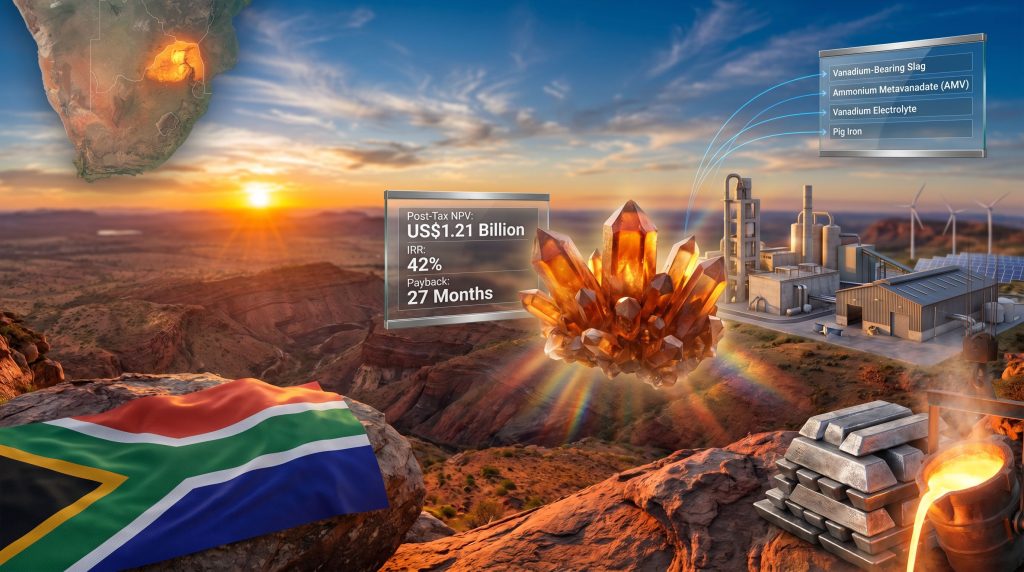
| Post-Tax NPV (DFS, October 2022) | US$1.21 billion |
| Internal Rate of Return | 42% |
| Capital Payback Period | 27 months |
An ore grade of 0.72% V₂O₅ is considered high-grade by global standards for primary vanadium production. Combined with a resource base of 4.74 million tonnes of contained V₂O₅, the deposit offers a scale of supply certainty that is almost without parallel among undeveloped vanadium assets in Western-aligned jurisdictions.
What the 180-Year Mine Life Actually Signals
The projection of approximately 180 years of mine life at proposed production rates is not merely a headline statistic. It carries direct commercial implications for offtake partners and financiers. Long-life deposits provide the security of supply continuity that downstream processors require to justify major capital investments in refining infrastructure.
When a vanadium processor commits to building or expanding refinery capacity, it needs confidence that raw material supply will be available across investment horizons that extend decades, not years. This longevity, furthermore, positions Steelpoortdrift as a potential anchor asset within a Western vanadium supply architecture, rather than a short-cycle production opportunity.
Bottom-Quartile Economics: The Cost Positioning Advantage
The Bushveld Complex ore body at Steelpoortdrift presents a globally competitive cost profile for several converging reasons. The ore grade is high, reducing the processing intensity required per unit of vanadium recovered. The established South African mining services sector provides access to skilled labour, equipment, and infrastructure at competitive rates.
Critically, the co-production model distributes capital and operating costs across multiple revenue streams rather than loading them entirely onto vanadium. A post-tax IRR of 42% and a payback period of just 27 months from DFS analysis place Steelpoortdrift among the most economically attractive undeveloped mining assets in the critical minerals sector globally. These metrics were established at October 2022 vanadium price assumptions, meaning shifts in commodity pricing since then create both upside and downside sensitivity that investors should evaluate carefully.
The Co-Production Model: Why Dual Revenue Streams Redefine Project Economics
The central innovation in VR8's approach to Steelpoortdrift is the decision to pursue a co-production model through the proposed V-Iron Plant, rather than a conventional single-product vanadium operation. This distinction is more significant than it might initially appear.
How the VTM Processing Pathway Works
Steelpoortdrift's ore is classified as vanadium-titanium-magnetite (VTM), a mineralogical type that naturally lends itself to pyrometallurgical processing. The proposed processing sequence involves two stages:
- Concentrator stage — Run-of-mine ore is processed through a concentrator to produce a VTM concentrate, increasing the vanadium grade and reducing the mass to be processed downstream.
- Pyrometallurgical beneficiation — The VTM concentrate is smelted at high temperatures to produce two co-products simultaneously: vanadium-bearing slag (the primary vanadium product) and pig iron (a direct input for steel manufacturing).
This processing route is not experimental. It has been demonstrated at industrial scale across multiple continents, including at Highveld Steel and Vanadium (South Africa), Chengde and Panzhihua (China), and Kachkanar (Russia). The existence of these operational precedents means the technology risk associated with the V-Iron Plant is low, because the processing route has already been industrially validated across multiple jurisdictions and ore types.
The Economic Logic of Revenue Distribution
Single-product vanadium operations are inherently exposed to the full amplitude of vanadium price cycles. When vanadium prices fall, as they periodically do with significant severity, single-product producers face margin compression with no offsetting revenue buffer. The co-production model structurally changes this equation by ensuring that pig iron revenues provide a partial economic floor regardless of vanadium price conditions.
VR8 executive chairperson Jurie Wessels has articulated that the shifting pricing landscape for vanadium reinforces the need to move away from models that feed into markets which can destabilise supply and pricing. By adopting a processing route already proven in South Africa, the full suite of metals within the orebody becomes accessible, strengthening project economics and diversifying the revenue base.
Historical analysis of vanadium price cycles shows extreme volatility, with prices capable of moving by several hundred percent within relatively short periods. The co-production model at Steelpoortdrift is consequently designed to avoid this structural vulnerability.
Downstream Product Pipeline
The V-Iron Plant's output feeds into a broader downstream product expansion vision. In addition to core vanadium slag production, the pipeline encompasses:
- Vanadium-bearing slag — the primary offtake product under the USV term sheet
- Ammonium metavanadate (AMV) — an intermediate chemical compound used in the production of high-purity vanadium pentoxide and other refined vanadium products
- Vanadium electrolyte — the direct active material used in VRFB energy storage systems, representing the highest-value downstream application
- Pig iron — a domestic market revenue stream, targeted at new South African steel producers
This staged downstream expansion pathway allows VR8 to begin generating revenue from slag sales while progressively capturing more value as refining capabilities are developed or partnered. Furthermore, green iron production trends globally are reshaping how co-production models like this one are evaluated by investors and financing institutions alike.
The Offtake Term Sheet With US Vanadium: What It Means and What It Doesn't
The South African vanadium project offtake term sheet between VR8 and US Vanadium Holding Company LLC (USV) is the most commercially significant announcement in Steelpoortdrift's development history. Understanding precisely what this agreement represents, and what remains to be established, is essential for accurate assessment.
Who Is US Vanadium Holding Company and What Is TechMet's Role?
USV is a producer of high-purity vanadium specialty chemicals, operating a production facility in Hot Springs, Arkansas. The company is a majority-owned portfolio company of TechMet, a London-based specialty metals investment firm whose mandate centres on securing Western supply chains for critical mineral applications in advanced technology and clean energy.
TechMet's involvement is strategically notable beyond its financial role. As a firm with an explicit critical minerals supply chain focus, TechMet's backing of USV signals that the USV-VR8 relationship is embedded within a broader strategic framework. However, it is important to note that TechMet's involvement does not constitute government funding, strategic project designation, or official support from any government body. TechMet is a private investment firm.
Full Coverage of Slag Production: The Commercial Significance
The term sheet covers 100% of vanadium-bearing slag production from the proposed V-Iron Plant. This is a critical commercial detail. Full offtake coverage eliminates the primary market risk for the vanadium product stream. VR8 will not need to develop independent sales and marketing capabilities for vanadium slag, nor will it need to compete for spot market buyers. The entire slag output has a committed home, subject to the term sheet progressing to a binding agreement.
Technical Validation at Hot Springs: An Underappreciated Detail
Perhaps the most technically significant element of the announcement is the metallurgical validation conducted at USV's Hot Springs production facility. Testing was performed using vanadium-bearing slag samples historically produced at Highveld Steel and Vanadium, serving as a proxy for the slag that Steelpoortdrift would generate, given the shared VTM ore origin and comparable pyrometallurgical processing route.
The conclusion of this testing was that high-grade vanadium slags derived from South African VTM ore are technically compatible with USV's downstream refinery operations. This is not a minor administrative step. It provides independent technical confirmation, at the refinery operator level, that the product VR8 intends to produce is exactly what USV's processing infrastructure requires, consequently removing a category of technical risk that would otherwise remain open until actual production commenced.
CEO Nick Diack has described the term sheet as representing a significant step forward in commercialisation of the deposit, reflecting the depth of technical and strategic work completed to date.
From Non-Binding to Binding: Understanding the Pathway
A non-binding term sheet establishes commercial intent, preferred terms, and technical specifications without creating a legally enforceable obligation. For investors assessing the significance of this agreement, several conditions typically govern progression to a binding offtake:
- Completion of a formal feasibility study for the V-Iron Plant confirming production parameters
- Final investment decision and commencement of project financing
- Regulatory approvals and permitting milestones
- Negotiation and execution of definitive binding agreement terms
Key permits are already reported to be in place for Steelpoortdrift, which reduces one category of transition risk between the current non-binding stage and a formal binding commercial commitment.
Rand Merchant Bank: The Capital Architecture Takes Shape
The simultaneous appointment of Rand Merchant Bank (RMB) as VR8's exclusive financial advisor and capital sourcing agent introduces a critical institutional pillar into the project development structure. For a junior mining company advancing a project of Steelpoortdrift's scale, mandating a tier-one South African investment bank signals that the capital raising process has moved from preliminary discussions to formal institutional engagement.
What RMB's Mandate Covers
RMB's remit involves securing funding for construction of two primary processing facilities:
- The concentrator, which handles initial ore beneficiation to produce VTM concentrate
- The pyrometallurgical beneficiation unit, which constitutes the V-Iron Plant and produces the co-product outputs of vanadium-bearing slag and pig iron
These are the two capital-intensive components that transform Steelpoortdrift from an ore deposit into an operating mine and processing complex. Securing construction financing for both facilities is therefore the gating milestone for the project's advancement to production.
The Financing Landscape for a Project of This Scale
| Funding Mechanism | Typical Application | Relevance to Steelpoortdrift |
|---|---|---|
| Project Finance Debt | Large-scale infrastructure with contracted revenues | High, given DFS-backed NPV of US$1.21 billion |
| Strategic Equity | Offtake-linked investment from downstream partners | High, aligned with USV and TechMet relationship |
| Development Finance Institution (DFI) Funding | Emerging market infrastructure development | Moderate, subject to policy alignment criteria |
| Royalty Streaming | Revenue-based financing against specific product streams | Possible, particularly for downstream vanadium products |
The DFS-validated economics create a compelling foundation for project finance debt, which typically requires demonstrated project NPV, contracted offtake, and a viable permitting position. The non-binding term sheet with USV, if progressed to a binding agreement, would substantially strengthen the debt financing case by providing revenue certainty to prospective lenders.
The next major ASX story will hit our subscribers first
Brownfield Site Acquisition: Capital Efficiency Through Infrastructure Reuse
One of the less widely discussed but potentially transformative elements of VR8's development strategy is its active pursuit of brownfield pyrometallurgical sites. The company is currently in discussions to acquire sites that host, or have previously hosted, large-scale pyrometallurgical operations with existing utility infrastructure and established environmental footprints.
Why Brownfield Development Changes the Economic Calculus
Building pyrometallurgical processing capacity from a greenfield position is enormously capital and time intensive. Permitting a new industrial processing facility requires environmental baseline studies, impact assessments, community consultation, and regulatory approvals that can extend project timelines by years. A brownfield acquisition, however, bypasses substantial portions of this process.
Key advantages of the brownfield approach include:
- Existing environmental footprint eliminates the need to establish new land disturbance approvals
- Pre-installed utility infrastructure (power, water, gas, road access) reduces both capital expenditure and development timeline
- Established regulatory history at the site simplifies permit transfer processes
- Proximity to existing vanadium industry assets within South Africa further reduces logistics complexity
The availability of nearby brownfield pyrometallurgical infrastructure, combined with emerging renewable energy capacity in the relevant regions of South Africa, makes the V-Iron Plant development both practically achievable and increasingly compelling from an ESG perspective.
Vanadium's Expanding Market: Beyond Steel Into Energy Storage
Understanding the full commercial opportunity at Steelpoortdrift requires appreciating the structural evolution of vanadium demand. While vanadium has historically derived the majority of its demand from the steel industry, two additional demand vectors are becoming increasingly important.
Defence, Aerospace, and Specialty Applications
Vanadium's use in defence and aerospace is acknowledged explicitly in VR8's project communications. High-strength vanadium steel alloys are critical inputs for armour plating, aerospace structural components, and naval vessel construction. As Western nations increase defence expenditure and seek to reduce dependence on non-allied critical mineral sources, vanadium supply security takes on dimensions that extend well beyond commodity market economics.
Vanadium Redox Flow Batteries: The Long-Duration Storage Opportunity
VRFBs represent the highest-value application for vanadium and the one with the most significant growth trajectory. Unlike lithium-ion batteries, which are well-suited for short-duration storage applications, VRFBs excel in long-duration scenarios, typically four hours or more, making them particularly relevant for grid-scale renewable energy integration.
The key characteristics of VRFBs that drive their appeal include:
- No capacity degradation over thousands of charge-discharge cycles, as the vanadium electrolyte does not degrade
- Independent scaling of power and energy, allowing system designers to optimise each parameter separately
- Long operational lifespan of 20–25 years with minimal maintenance requirements
- Recyclable electrolyte retains full value at end of battery life, representing a significant residual asset
As grid-scale energy storage deployment accelerates globally, vanadium electrolyte demand is projected to grow substantially. Steelpoortdrift's downstream product pathway positions VR8 to participate in this market if domestic refining capabilities are developed over time. For further context on the US offtake pathway details, additional reporting is available through specialist mining industry outlets covering the Southern African vanadium sector.
Frequently Asked Questions: South African Vanadium Project Offtake Term Sheet
What Is a Non-Binding Offtake Term Sheet?
A non-binding offtake term sheet is a commercial document that records the agreed intent between a producer and a buyer to enter into a formal purchase agreement for specified products. It typically outlines key commercial terms, including product specifications, volumes, and pricing mechanisms, but does not create a legally enforceable obligation on either party. It is a precursor to a binding offtake agreement, which is executed once project development milestones are achieved.
What Is Vanadium-Bearing Slag and Why Is It Commercially Valuable?
Vanadium-bearing slag is the vanadium-rich byproduct of smelting VTM ore. When VTM concentrate is processed through a pyrometallurgical furnace, vanadium preferentially concentrates into the slag phase, while iron separates as molten pig iron. The slag, which can contain vanadium pentoxide grades significantly higher than the original ore, is then sold to downstream processors who extract refined vanadium products including vanadium pentoxide, ammonium metavanadate, and vanadium electrolyte. Historically, vanadium-bearing slag from South African VTM operations has been the preferred feedstock for US-based vanadium refineries.
What Are the Next Key Milestones for Steelpoortdrift?
Based on current disclosed information, the primary near-term milestones include:
- Completion of a feasibility study for the V-Iron Plant, investigating the co-production processing pathway
- Progression of the RMB-led capital sourcing process toward a formal financing structure
- Advancement of brownfield pyrometallurgical site acquisition discussions
- Progression of the USV term sheet toward a binding offtake agreement
- Continued engagement toward a binding offtake for pig iron production with domestic South African steel producers
Who Owns the Steelpoortdrift Project?
The project is owned and operated by Vanadium Resources Limited (VR8), a company listed on the Australian Securities Exchange (ASX). The South African vanadium project offtake term sheet announced in April 2026 marks a significant milestone in the project's path toward production.
Key Takeaways: Steelpoortdrift's Position in the Global Vanadium Landscape
- Ore scale: 77 Mt at 0.72% V₂O₅ supports approximately 180 years of mine life at proposed production rates, providing unmatched supply certainty for long-term offtake commitments
- DFS economics: Post-tax NPV of US$1.21 billion, IRR of 42%, and a 27-month capital payback period place Steelpoortdrift among the most economically compelling undeveloped vanadium assets globally
- Offtake coverage: The non-binding term sheet with USV covers 100% of vanadium-bearing slag production from the V-Iron Plant, eliminating primary vanadium market risk subject to binding agreement execution
- Technical validation: Metallurgical testing at USV's Hot Springs facility confirmed that South African VTM-origin slag is fully compatible with USV's refinery operations
- Co-production model: The dual-revenue structure from vanadium-bearing slag and pig iron structurally reduces exposure to vanadium price volatility, an advantage supported by four historical operational precedents
- Financing mandate: Rand Merchant Bank has been appointed as exclusive financial advisor and capital sourcing agent, formalising the path toward construction financing
- Brownfield strategy: Active pursuit of brownfield pyrometallurgical sites targets material reductions in both capital requirements and project readiness timelines
- Downstream pathway: A clear route from vanadium slag through AMV to vanadium electrolyte positions Steelpoortdrift to serve the growing VRFB energy storage market over time
Readers seeking additional context on vanadium's role in critical mineral supply chains and energy storage applications may find value in exploring related industry coverage through Mining Weekly's vanadium sector portal at miningweekly.com, which tracks ongoing developments across the Southern African vanadium industry.
Want to Capitalise on the Next Major Critical Minerals Discovery Before the Market Does?
Discovery Alert's proprietary Discovery IQ model scans ASX announcements in real time, delivering instant alerts on significant mineral discoveries — including critical minerals like vanadium — so subscribers can identify actionable opportunities ahead of the broader market. Explore historic discoveries and the substantial returns they've generated, then begin your 14-day free trial at Discovery Alert to position yourself at the forefront of the next major find.