May 21, 2026
Understanding VBX's Wuudagu Bauxite Project: A Technical Deep Dive
High-solids ratio processing represents a fundamental shift in how mineral beneficiation operations approach throughput optimisation. When examining the intersection of metallurgical efficiency and operational economics, few developments demonstrate the potential for transformative impact like advanced scrubbing technologies that operate at dramatically reduced residence times while maintaining superior recovery rates.
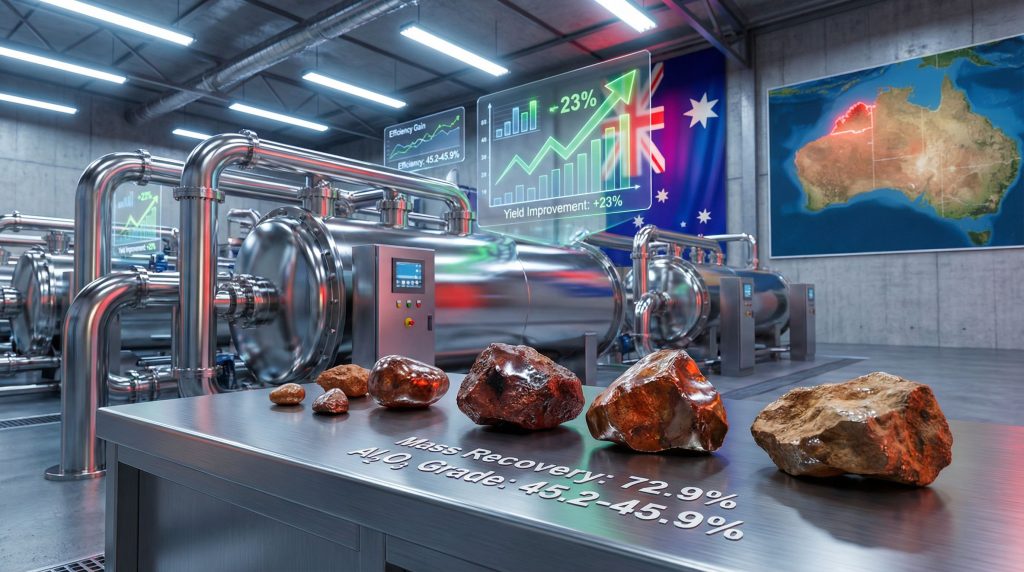
The VBX Wuudagu bauxite project exemplifies this evolution, where systematic optimisation of processing parameters has yielded results that challenge conventional assumptions about bauxite beneficiation. Through comprehensive Definitive Feasibility Study (DFS) work, the project has demonstrated the ability to achieve 72.9% mass recovery at a +3.35mm screen size, representing a substantial 23% improvement over Pre-Feasibility Study (PFS) assumptions.
When big ASX news breaks, our subscribers know first
Project Location and Geological Context
Located in the Kimberley region of northern Western Australia, the Wuudagu project benefits from unique geological characteristics that distinguish it from other Australian bauxite deposits. The region's bauxite formations developed through prolonged weathering processes under tropical conditions, creating deposits with distinct mineralogical properties.
According to the U.S. Geological Survey's 2024 Mineral Commodity Summary for Bauxite, Australia maintains its position as the world's leading bauxite producer, contributing approximately 100 million tonnes annually, representing roughly 30% of global production. Within this context, Western Australian deposits have historically shown varying degrees of beneficiation amenability.
Resource Base and Ore Reserve Classification
The current DFS optimisation work utilises a 1,500 kg composite sample derived from 23 bulk samples across 10 of 12 deposit areas, providing comprehensive representation of the vertical profile variation. The in-situ grade of this composite material averages 41% Al₂O₃ and 12% SiO₂ before beneficiation.
This compositional profile positions Wuudagu favourably compared to typical feed grades requiring beneficiation, where the substantial differential between alumina and silica content provides significant scope for selective upgrading through mechanical processing methods. Furthermore, these characteristics align with broader mining innovation trends emphasising efficiency and technological advancement.
Mining Method and Infrastructure Design
The project's technical approach centres on conventional open-pit mining methods, aligned with industry standards for weathered bauxite deposits. The beneficiation circuit employs wet scrubbing and screening, representing proven, lower-cost processing approaches compared to alternative technologies such as flotation or dense media separation.
Historical precedent for Kimberley bauxite processing dates back to metallurgical testing conducted by BHP in the 1960s, establishing early validation of the material's amenability to simple beneficiation methods. This decades-long understanding provides confidence in the technical approach and expected outcomes.
What Makes the Wuudagu Beneficiation Process Unique?
Metallurgical Characteristics of Kimberley Bauxite
Kimberley bauxite exhibits distinctive characteristics that facilitate efficient beneficiation through wet scrubbing processes. The weathered nature of the deposits results in silica-rich weathering products that can be effectively disaggregated and separated from bauxite particles through mechanical action.
The key differentiator lies in the ability to achieve superior product quality specifications while operating under optimised processing conditions. At a +3.35mm screen size, the beneficiated product achieves grades ranging from 45.2–45.9% Al₂O₃ with silica content reduced to 3.2–3.5% SiO₂.
Industry-Standard Wet Scrubbing and Screening Technology
According to technical literature on mineral processing, typical wet scrubbing residence times for bauxite beneficiation range from 8–15 minutes depending on ore characteristics and desired product specifications. The VBX Wuudagu bauxite project optimisation results demonstrate optimal performance at residence times of 1.5–2 minutes, representing an 85% reduction compared to PFS assumptions.
This breakthrough in processing efficiency translates directly to reduced equipment sizing requirements, lower water consumption, and decreased energy intensity per tonne processed. The ability to operate effectively at 55% solids ratios further enhances throughput capacity while reducing water management requirements.
Product Quality Specifications and Market Positioning
The low-silica advantage represents a significant competitive factor in global bauxite markets. The Bayer process for converting bauxite to alumina operates more efficiently with lower-silica feed material, as it reduces insoluble tailings and improves aluminium recovery rates.
Product quality results demonstrate consistency across different screen sizes:
- +3.35mm screen: 45.2–45.9% Al₂O₃, 3.2–3.5% SiO₂
- +1.0mm screen: 44.2–46.6% Al₂O₃, 2.6–4.4% SiO₂
This flexibility enables production tailoring to meet specific customer requirements while maintaining Wuudagu's low-silica competitive advantage.
How Do the Latest DFS Optimisation Results Compare to Previous Studies?
Pre-Feasibility Study Baseline Performance Metrics
The 2025 Pre-Feasibility Study established baseline assumptions for wet scrubbing and screening operations, targeting a beneficiated product grading 45.4% Al₂O₃ and 3.6% SiO₂ at a +3.35mm screen size. Mass recovery expectations were set at 59.5% from the Wuudagu C deposit, based on initial metallurgical testing protocols.
These conservative assumptions reflected standard industry approaches to feasibility study development, where preliminary estimates typically incorporate safety margins to account for operational variability and technical uncertainties. Moreover, such approaches align with ore and mining economics best practices for risk management.
Definitive Feasibility Study Enhancement Targets
The progression from PFS to DFS typically involves refined testing protocols, larger sample sizes, and systematic optimisation iterations. According to the Australian Institute of Geoscientists' guidelines for mineral resource estimation, typical improvements between PFS and DFS phases range from 5–15% as assumptions are validated and refined.
The VBX Wuudagu bauxite project results significantly exceed these benchmarks, with the 23% recovery improvement representing exceptional advancement in process understanding and optimisation.
Comparative Analysis of Recovery Improvements
| Parameter | PFS Results (2025) | DFS Optimisation (2026) | Improvement |
|---|---|---|---|
| Mass Recovery (+3.35mm) | 59.5% | 72.9% | +23% |
| Al₂O₃ Grade | 45.4% | 45.2–45.9% | Maintained |
| SiO₂ Content | 3.6% | 3.2–3.5% | Reduced |
| Solids Ratio | Standard | 55% | Optimised |
| Residence Time | 12 minutes | 1.5–2 minutes | 85% reduction |
The decade-long optimisation programme conducted by VBX has provided comprehensive understanding of material behaviour under various processing conditions. This accumulated knowledge base enables confidence in result repeatability and scalability to commercial operations.
The next major ASX story will hit our subscribers first
What Are the Key Technical Breakthroughs in Scrubbing Optimisation?
High Solids Ratio Processing Advantages
Operating at 55% solids ratios represents a significant advancement over conventional processing assumptions. Higher solids ratios provide multiple operational benefits:
- Increased throughput per unit of scrubbing equipment
- Reduced water consumption per tonne processed
- Lower energy requirements due to reduced slurry volumes
- Decreased pumping costs throughout the circuit
The ability to maintain superior recovery rates whilst operating at these elevated solids concentrations challenges traditional trade-offs between processing efficiency and product quality.
Short Residence Time Benefits for Operational Efficiency
The breakthrough achievement of optimal performance at 1.5–2 minute residence times provides transformative implications for equipment design and capital requirements. Compared to the 12-minute PFS assumption, this represents potential for:
- 6–8x higher capacity with equivalent equipment footprint
- Proportionally reduced scrubber sizing requirements
- Enhanced operational flexibility through faster response times
- Lower maintenance intensity due to reduced equipment scale
Furthermore, this technological advancement exemplifies the broader shift towards data-driven mining operations that prioritise efficiency and optimisation.
Reduced Capital and Operating Cost Implications
The optimisation results suggest substantial reductions in both capital and operating cost structures. Equipment sizing correlates directly with residence time requirements, indicating potential 20–30% capital cost reductions through smaller scrubber installations.
Operating cost benefits include:
- Reduced power consumption per tonne processed
- Lower water usage and associated treatment costs
- Decreased reagent requirements in downstream processes
- Enhanced production flexibility for market responsiveness
"The ability to achieve superior recovery rates at 55% solids ratios with residence times as short as 1.5 minutes represents a significant advancement in bauxite beneficiation efficiency, potentially reducing equipment sizing requirements and operational costs."
How Does the "Volume Strategy" Impact Production Economics?
+1.0mm Screen Size Recovery Performance
Implementation of a volume-focused strategy using a +1.0mm screen size yields 79.8% product mass recovery, representing a 34% increase compared to PFS recovery assumptions. This approach captures additional fines material that would otherwise be classified as tailings in conventional processing circuits.
The volume strategy addresses specific market segments where customers prioritise tonnage availability over premium grade specifications, providing operational flexibility to optimise revenue based on market conditions.
Trade-offs Between Recovery and Product Grade
Whilst the volume strategy enhances mass recovery, it involves typical trade-offs in product specifications:
- Slightly lower alumina grades due to inclusion of finer particles
- Marginally higher silica content from increased fine material recovery
- Broader size distribution in final product
Despite these considerations, product quality remains within acceptable ranges for many refinery applications, with grades ranging from 44.2–46.6% Al₂O₃ and 2.6–4.4% SiO₂.
Market Flexibility and Customer Segmentation Opportunities
The dual-strategy approach enables targeted marketing to different customer segments:
- Premium customers: +3.35mm product with superior grade specifications
- Volume customers: +1.0mm product emphasising tonnage availability
- Flexible supply agreements: Seasonal or market-responsive production switching
This segmentation strategy provides revenue optimisation opportunities and risk mitigation through diversified customer bases.
What Production Capacity Increases Are Now Possible?
20-30% Throughput Enhancement Potential
The metallurgical optimisation results directly translate to production capacity increases without requiring expanded mining rates. The 20–30% throughput enhancement stems from improved processing efficiency rather than increased resource extraction.
This capacity increase represents significant value creation through process optimisation, avoiding the capital requirements associated with expanded mining operations or additional resource development. In addition, the benefits extend to the broader economic impact, as evidenced by similar projects like the Western Yilgarn bauxite project.
Scalability Without Mining Rate Increases
The ability to increase production capacity whilst maintaining current mining plans provides exceptional operational leverage. Benefits include:
- Reduced unit mining costs through improved resource utilisation
- Enhanced project economics via increased revenue without proportional cost increases
- Extended mine life through more efficient resource extraction
- Improved return on investment from existing infrastructure
Resource Expansion Opportunities
Whilst current optimisation enables production increases without mining expansion, the results also support potential resource expansion scenarios. Enhanced processing efficiency reduces the minimum grade requirements for economic extraction, potentially enabling:
- Inclusion of lower-grade zones previously considered waste
- Expanded pit boundaries with acceptable economic returns
- Extended mine life through comprehensive resource utilisation
"The metallurgical optimisation results suggest VBX could increase Wuudagu's production capacity by 20-30% during the DFS phase without requiring increases to the mining rate, representing significant value creation through process efficiency gains."
How Do Product Quality Results Support Market Competitiveness?
Low-Silica Advantage in Australian Context
The achievement of 3.2–3.5% SiO₂ content at optimal processing conditions provides substantial competitive advantages in Australian and global markets. Existing Australian bauxite producers typically market products with significantly higher silica content, often ranging from 4–6% or higher.
This quality differential enables premium pricing strategies and preferred supplier status with refineries seeking high-efficiency feed materials. The VBX website confirms that lower-silica bauxite reduces processing costs and improves alumina recovery rates in Bayer process operations.
Flexible Product Specification Capabilities
The demonstrated ability to produce consistent quality across multiple screen sizes provides significant market flexibility:
| Screen Size | Al₂O₃ Grade Range | SiO₂ Content Range | Mass Recovery | Strategy Focus |
|---|---|---|---|---|
| +3.35mm | 45.2-45.9% | 3.2-3.5% | 72.9% | Premium quality |
| +1.0mm | 44.2-46.6% | 2.6-4.4% | 79.8% | Volume production |
This specification flexibility enables targeted marketing to different refinery requirements and seasonal demand variations.
Quality Consistency Across Different Screen Sizes
The consistency of product quality results across tested parameters demonstrates robust process control and predictable outcomes. This reliability supports long-term supply agreements and customer confidence in product consistency.
Quality assurance extends beyond grade specifications to include particle size distribution, moisture content, and chemical impurity levels, all critical factors in refinery feed evaluation.
What Does the Bulk Sample Testing Programme Reveal?
Wuudagu C Deposit Composite Sample Methodology
The 1,500 kg composite sample represents comprehensive coverage of the Wuudagu C deposit characteristics. Compiled from 23 bulk samples across 10 of 12 bulk sample sites, the composite provides statistically representative material for metallurgical testing.
This sampling methodology ensures results reflect the natural variability expected in commercial operations, reducing technical risk in project development and providing confidence in scalability to full production.
Representative Sampling Across Vertical Profiles
Vertical profile coverage ensures the composite sample represents variations in ore characteristics from surface weathering zones through deeper, less weathered horizons. This comprehensive approach addresses potential grade and metallurgical variations throughout the deposit.
The sampling methodology aligns with industry best practices for bulk metallurgical testing, providing confidence that results will translate effectively to commercial operations.
Statistical Validation of Metallurgical Performance
Ten years of accumulated metallurgical data provides robust statistical validation of processing performance expectations. This extensive database enables confidence intervals around performance projections and supports risk assessment for project financing and development decisions.
The consistency of results across multiple test programmes and sample composites demonstrates the reliability of the processing approach and expected outcomes.
Which Processing Parameters Deliver Optimal Results?
Solids Ratio Performance Analysis (45%-55%)
Testing across 45%, 50%, and 55% solids ratios demonstrates consistent performance improvements at higher concentrations. The optimal performance at 55% solids represents the upper limit of practical operations whilst maintaining superior recovery rates.
Higher solids ratios provide direct operational benefits through reduced water requirements, smaller equipment sizing, and enhanced throughput capacity per unit of installed processing capability.
Residence Time Optimisation Studies (1.5-12 minutes)
Systematic testing across residence times from 1.5 to 12 minutes identified optimal performance windows that challenge conventional processing assumptions. The ability to achieve superior results at 1.5–2 minutes represents breakthrough performance for bauxite scrubbing operations.
This optimisation provides transformative implications for equipment design, capital requirements, and operational flexibility in commercial operations.
Screen Size Selection for Different Market Strategies
| Parameter | +3.35mm (Premium) | +1.0mm (Volume) | Impact |
|---|---|---|---|
| Mass Recovery | 72.9% | 79.8% | +6.9pp volume advantage |
| Al₂O₃ Grade | 45.2-45.9% | 44.2-46.6% | Broader range for volume |
| SiO₂ Content | 3.2-3.5% | 2.6-4.4% | Variable silica management |
| Market Appeal | Premium refineries | Volume customers | Segmented approach |
The dual-screen strategy enables revenue optimisation through targeted marketing to different customer requirements and market conditions.
What Are the Next Steps in the DFS Metallurgical Programme?
Ongoing Bulk Sample Testing at Wuudagu B and C
Additional scrubbing and screening test work continues on bulk sample composites from both Wuudagu B and Wuudagu C deposits. This expanded testing programme ensures comprehensive understanding of metallurgical performance across different deposit areas.
The results from these ongoing programmes will validate the consistency of processing performance and support final flowsheet design for commercial operations. According to VBX's project information, this comprehensive approach ensures optimal outcomes.
Filtration Test Work for Fines Management
Concurrent filtration test work on fines material addresses downstream processing requirements for water management and tailings handling. Effective fines filtration enables water recycling and reduces environmental management requirements.
This technical work supports overall process optimisation and environmental compliance for commercial operations.
Simplified Tyre-Driven Scrubbing Solution Development
Based on optimisation results, VBX has elected to pursue a simplified tyre-driven scrubbing solution for commercial implementation. This approach capitalises on the short residence time requirements and high solids ratio capabilities identified in testing.
The simplified approach provides cost advantages and operational reliability compared to more complex processing alternatives.
How Does This Impact VBX's Commercial and Funding Strategy?
Enhanced Project Economics from Improved Recoveries
The 23% improvement in mass recovery directly translates to enhanced project economics through increased revenue generation from the same resource base. This improvement provides substantial value creation without corresponding increases in mining or processing costs.
Project economics benefit from multiple optimisation factors working synergistically to improve financial returns and reduce technical risk. Consequently, these improvements support various ASX capital raising strategies for project development.
Offtake Partner Interest and Marketing Opportunities
Strong interest from potential offtake partners reflects the competitive advantages provided by low-silica product specifications and reliable supply capabilities. The product quality and volume flexibility enable diverse marketing strategies and customer relationship development.
Commercial discussions with groups seeking to purchase or market VBX Wuudagu bauxite project products continue to advance based on demonstrated technical performance and production capabilities.
Funding Solution Advancement for Project Development
Enhanced project economics and demonstrated technical performance support funding solution advancement for project development. The combination of improved recoveries, optimised processing parameters, and market interest provides compelling value proposition for project financing.
Discussions with potential funding partners benefit from reduced technical risk and enhanced economic returns demonstrated through comprehensive metallurgical optimisation.
What Are the Broader Implications for Australian Bauxite Production?
Competitive Positioning Against Existing Producers
The low-silica competitive advantage positions Wuudagu favourably against existing Australian bauxite producers. Product specifications that consistently achieve 3.2–3.5% SiO₂ content provide pricing power and preferred supplier status with quality-conscious refineries.
This competitive positioning enables premium market access and long-term supply relationship development in both domestic and export markets.
Supply Chain Integration Opportunities
The technical performance and product quality specifications support potential supply chain integration opportunities with refinery operations. Long-term supply agreements and strategic partnerships become viable based on demonstrated consistency and quality advantages.
Integration opportunities extend beyond simple commodity supply to include technical collaboration and process optimisation partnerships with downstream operations.
Technology Transfer Potential to Other Projects
The optimisation techniques and processing parameters identified at Wuudagu provide technology transfer potential to other bauxite projects facing similar beneficiation challenges. The understanding of high-solids processing and short residence time capabilities represents intellectual property with broader industry applications.
What makes the Wuudagu bauxite project's metallurgical performance exceptional?
The project demonstrates superior mass recoveries at high solids ratios with dramatically reduced residence times, whilst maintaining high-quality, low-silica product specifications that provide competitive advantages in global markets.
How significant is the 23% improvement in mass recovery?
This improvement translates directly to increased production capacity and enhanced project economics, potentially allowing 20-30% higher throughput without requiring additional mining capacity or resource expansion.
What does the "volume strategy" mean for different customer segments?
By utilising a +1.0mm screen size, VBX can achieve 79.8% mass recovery, appealing to customers prioritising volume over premium grade specifications whilst maintaining acceptable quality parameters.
Disclaimer: This analysis contains forward-looking statements and projections based on company announcements and technical studies. Readers should conduct independent research and consider professional advice before making investment decisions. Mining projects involve inherent risks including technical, environmental, regulatory, and market factors that may affect outcomes.
Further exploration of bauxite beneficiation technologies and metallurgical optimisation can be found through industry resources and technical publications on mineral processing advancements in the Australian mining sector.
Looking to Capitalise on ASX Mineral Discovery Opportunities?
Discovery Alert's proprietary Discovery IQ model delivers instant notifications on significant ASX mineral discoveries, transforming complex metallurgical breakthroughs like VBX's Wuudagu bauxite project into actionable investment insights. Explore how major mineral discoveries generate substantial returns and begin your 30-day free trial today to position yourself ahead of the market with real-time alerts on the next transformative discovery.