July 31, 2026
When Commodity Producers Stop Competing on Volume Alone
The most durable competitive advantages in metals manufacturing rarely emerge from sheer production scale. They come from the ability to move up the value chain, converting raw output into engineered products that serve specific industrial needs at premium price points. For top aluminium producers navigating a global market shaped by energy transition demand, infrastructure investment cycles, and supply chain reshuffling, this distinction between volume and value has never mattered more.
Vedanta Aluminium expansion and higher-value products represents precisely this strategic logic. The company is not simply adding tonnes of primary metal to the market. It is repositioning itself as a premium supplier of processed aluminium products, simultaneously attacking its cost base through vertical integration. The combination of both levers being pulled at once is what has attracted multi-brokerage consensus and a notably strong financial performance in the first quarter of FY27.
When big ASX news breaks, our subscribers know first
The Demerger Catalyst and What It Unlocked
Vedanta Aluminium's listing as a standalone entity following its demerger from Vedanta created a structurally cleaner investment case. Previously embedded within a diversified natural resources conglomerate, the aluminium operations carried consolidated complexity that made granular financial analysis difficult for sector-focused investors.
As an independently listed entity, the business now presents its own balance sheet, capital allocation decisions, and earnings metrics with full transparency. This clarity has been a catalyst for institutional attention. The company's net worth expanded by 86% year-on-year to INR 304.41 billion (USD 3.19 billion), a figure that signals both retained earnings growth and underlying asset appreciation from its expanded production infrastructure.
What Vedanta Aluminium's Capacity Expansion Actually Involves
Phase-by-Phase Breakdown: BALCO, Jharsuguda, and Lanjigarh
The Vedanta Aluminium expansion and higher-value products strategy rests on a phased infrastructure programme across three major facilities, each serving a distinct role in the company's integrated production model.
| Facility | Expansion Detail | Capacity Target | Timeline |
|---|---|---|---|
| BALCO Smelter | +0.435 MTPA addition | 1.0 MTPA total | End Q2 FY26 |
| Jharsuguda | +250 KTPA addition | ~3.1 MTPA combined | FY28 |
| Lanjigarh Refinery | Debottlenecking underway | Up to 6 MTPA alumina | Medium-term |
| Long-term ambition | Multi-phase programme | 6 MTPA aluminium | 3 to 3.5 years |
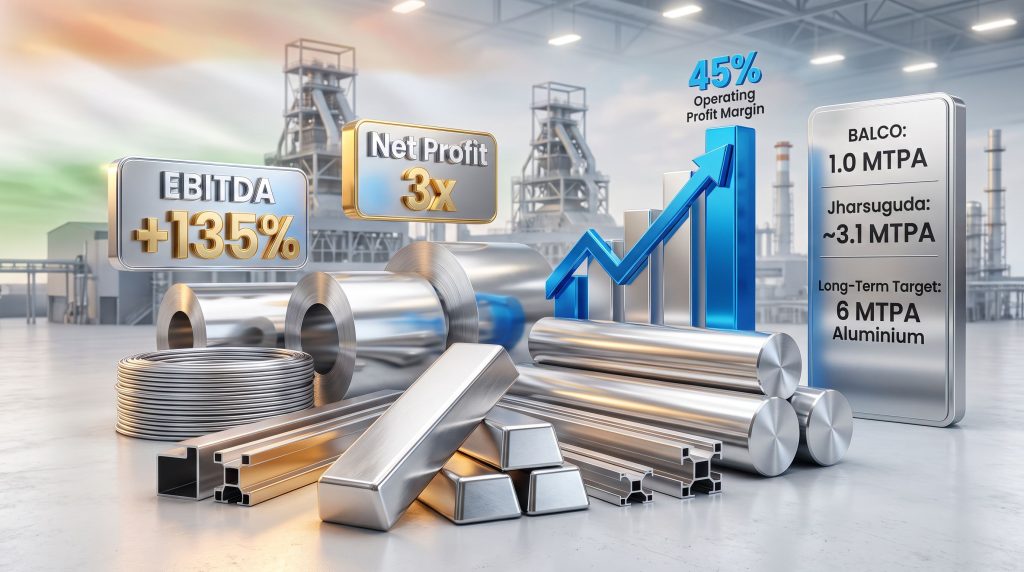
The BALCO smelter expansion is the nearest-term catalyst, adding 435,000 tonnes per annum of smelting capacity to bring the facility to a total of 1.0 MTPA. This positions BALCO as one of India's largest individual aluminium smelting complexes once fully operational.
The Jharsuguda facility expansion adds a further 250 KTPA, pushing the combined capacity across both smelters to approximately 3.1 MTPA by FY28. This underpins the analyst community's expectation of approximately 9% compound annual production growth through FY28.
The ₹13,226 Crore Investment Programme
The multi-facility expansion is backed by a committed capital programme of ₹13,226 crore, funding smelter capacity additions, refinery debottlenecking, and related infrastructure. This level of capital deployment places Vedanta Aluminium among the largest aluminium capital expenditure programmes currently underway in the Asia-Pacific region.
Critically, much of this capex cycle is now in its latter stages. As reported by the Economic Times, the company is transitioning from capital-intensive construction activity toward maximising returns from assets that are already largely in place. This shift from investment phase to harvest phase is a key thesis driver for current analyst bullishness.
Alumina Self-Sufficiency Through Lanjigarh
The Lanjigarh alumina refinery is the linchpin of Vedanta Aluminium's backward integration strategy. Expanding its capacity toward 6 MTPA of alumina output through debottlenecking reduces the company's exposure to third-party alumina procurement costs, which represent a significant input variable in primary aluminium production economics. Furthermore, understanding bauxite supply dynamics is essential context for appreciating why this self-sufficiency drive matters so greatly.
Aluminium producers with fully integrated supply chains, from bauxite mining through alumina refining to primary smelting, typically operate with structurally lower and more predictable cost bases than those reliant on third-party raw material procurement. Vedanta's Lanjigarh expansion is central to this cost insulation strategy.
The alumina-to-aluminium ratio in production requires approximately 2 tonnes of alumina per tonne of primary aluminium. At scale, owning this input domestically rather than sourcing it externally creates a meaningful and compounding cost advantage.
Understanding Value-Added Aluminium Products and the 90% VAP Target
What Qualifies as a Value-Added Product
Value-added aluminium products (VAP) are processed aluminium outputs such as billets, rolled sheets, wire rods, and alloy ingots that command premium pricing over standard primary aluminium ingots due to their higher downstream utility and reduced customer processing requirements. Rather than selling undifferentiated metal to traders or foundries, VAP sales position a producer as a direct supply chain partner to manufacturers across construction, automotive, electrical, and aerospace industries.
The financial logic is straightforward. Commodity-grade ingot pricing tracks the London Metal Exchange benchmark almost entirely. VAP pricing layers a fabrication and quality premium on top of that base, creating a margin buffer that partially insulates producers from pure commodity price volatility.
Vedanta's VAP Performance and the 90% Ambition
Vedanta Aluminium recorded VAP sales growth of 16% year-on-year, reaching a record output of 1,274 kilotonnes. The company's stated ambition is to push the VAP share of its total product mix toward 90%, a threshold that would fundamentally reframe its revenue quality relative to a pure primary aluminium producer.
| Product Category | Typical Pricing Premium | Margin Profile | End-Use Sectors |
|---|---|---|---|
| Standard Ingot | Base price | Commodity-linked | Foundries, trading |
| Billets | 5 to 12% premium | Moderate uplift | Construction, automotive |
| Wire Rods | 8 to 15% premium | Higher margin | Electrical, power |
| Rolled Products | 10 to 20% premium | Significant uplift | Packaging, aerospace |
| Alloy Products | Variable | Highest margin | EVs, aerospace, defence |
Reaching a 90% VAP mix would mean that less than 10% of Vedanta's aluminium output is sold as undifferentiated ingot. At current production volumes and trajectory, this represents a material shift in both revenue composition and earnings stability. In addition, Vedanta recently expanded its primary foundry alloy capacity by 120 KTPA at its Jharsuguda plant, further reinforcing this higher-value direction.
Which Sectors Are Pulling Demand for Higher-Value Aluminium
The demand profile for VAP aluminium in India is both broad and structurally supported by long-cycle investment trends. Unlike commodity demand, which fluctuates with short-term industrial output, several of the key end-use sectors for VAP are driven by decade-long capital expenditure programmes.
| End-Use Sector | Product Type | Growth Driver |
|---|---|---|
| Construction | Extrusions, sheets | Infrastructure spending |
| EVs | Alloy components | EV adoption acceleration |
| Renewable Energy | Structural aluminium | Solar and wind buildout |
| Railways | Rolled products, profiles | Rail network expansion |
| Electrical and Power | Wire rods | Grid modernisation |
| Packaging | Foil, rolled sheet | Consumer goods demand |
| Aerospace | High-grade alloys | Aviation recovery |
Construction and Infrastructure
India's construction sector remains the single largest domestic consumer of aluminium, absorbing significant volumes of extrusions, flat-rolled products, and structural profiles. National infrastructure investment cycles, urbanisation-driven building activity, and the expansion of commercial real estate all create consistent baseline demand for fabricated aluminium products. Consequently, industrial decarbonisation trends are also shaping how construction-grade materials are specified and procured.
Electric Vehicles and Energy Transition
The structural demand tailwind from electric vehicles is particularly relevant for high-specification alloy products. Aluminium's role in reducing vehicle weight to extend battery range makes it a preferred material for EV body panels, battery enclosures, and structural components. As India's EV adoption curve steepens, the domestic demand for automotive-grade aluminium alloys is expected to increase meaningfully over the coming decade.
Electrical Grid and Power Transmission
Wire rod demand is closely tied to grid modernisation and transmission infrastructure investment. As India expands its high-voltage power transmission network, aluminium wire rods, which are lighter and comparably conductive to copper for many transmission applications, represent a high-volume, consistent demand segment that aligns directly with Vedanta's expanded wire rod capacity. Furthermore, India's metals demand strategy more broadly reflects just how central industrial metals are to the country's long-term growth ambitions.
Q1 FY27 Financial Performance: What the Numbers Reveal
Vedanta Aluminium's first quarter results for FY27 delivered a financial performance that validated the strategic positioning across multiple dimensions simultaneously.
| Metric | Q1 FY27 Value | Year-on-Year Change |
|---|---|---|
| Revenue from Operations | INR 213.93B (USD 2.24B) | +46% |
| Total Income | INR 217.02B (USD 2.27B) | Strong growth |
| EBITDA | INR 102B (USD 1.07B) | +135% |
| Operating Profit Margin | 45% | Up from 26% |
| Net Profit | INR 56.29B (USD 589.69M) | More than threefold |
| Net Profit Margin | 31% | More than doubled |
| Net Worth | INR 304.41B (USD 3.19B) | +86% |
The 135% EBITDA surge was driven by three converging factors: higher realised aluminium prices during the period, increased production volumes from expanded capacity, and a more favourable product mix as VAP sales grew. The combination of volume, price, and mix improvements occurring simultaneously is unusual and reflects a business operating with strengthening underlying fundamentals rather than benefiting from a single external tailwind.
The operating profit margin expanding from 26% to 45% in a single year is a particularly notable data point. This level of margin expansion signals that fixed cost leverage from the expanded asset base is flowing through to profitability, as incremental production is being absorbed without a proportional increase in overhead.
First Interim Dividend: A Signal of Financial Confidence
The announcement of a first interim dividend of INR 8 per share for FY27, with a record date of August 5, 2026, is notable not only for its quantum but for its timing. Declaring an interim dividend so early in a new listing lifecycle signals that management and the board are confident in both current cash generation and the sustainability of forward earnings. Dividend initiation by newly listed industrial companies is often interpreted by institutional investors as a threshold-crossing event that broadens the eligible shareholder base.
The next major ASX story will hit our subscribers first
What Analysts Are Saying and Why the Consensus Is Constructive
Multi-Brokerage Coverage Overview
| Brokerage | Rating | Key Thesis |
|---|---|---|
| ICICI Securities | Buy | Transition from capex to operational efficiency |
| CLSA | Positive | Rising production volumes and cost discipline |
| Citi | Bullish | Capacity expansion and margin improvement |
| Nuvama | Constructive | Earnings growth from VAP mix shift |
| Emkay | Positive | Backward integration reducing cost exposure |
ICICI Securities' Buy rating with a target price of INR 520 (USD 5.54) is anchored in the capex-to-returns cycle transition thesis. The investment thesis here is not about speculative price appreciation. It is grounded in the view that a business that has already deployed significant capital into world-scale production infrastructure should, as utilisation rates rise and product mix improves, see a natural and compounding improvement in returns on invested capital.
Cost of Production Outlook
ICICI Securities projects Vedanta Aluminium's cost of production to decline to approximately USD 1,682 per tonne by FY28, a meaningful reduction that reflects both the benefits of alumina self-sufficiency from the Lanjigarh expansion and operational efficiencies from running higher-capacity smelters at optimised utilisation rates.
It is important to note that this projection is contingent on stable raw material and energy input pricing. Analysts explicitly flag that energy cost volatility, particularly coal and power pricing, represents the primary upside risk to this cost trajectory.
How Backward Integration Reshapes the Economics of Aluminium Production
The Bauxite-to-Aluminium Value Chain
Few industries illustrate the value of vertical integration as clearly as aluminium. The production chain moves through three distinct stages:
- Bauxite mining — extraction of the primary ore, typically containing 30 to 60% aluminium oxide content
- Alumina refining — processing bauxite through the Bayer process to produce aluminium oxide, the intermediate product
- Primary smelting — reducing alumina through electrolytic smelting (the Hall-Heroult process) to produce primary aluminium metal
Each stage carries its own cost structure, capital requirements, and market pricing dynamics. Producers who own assets across all three stages insulate themselves from inter-stage margin compression. When third-party alumina prices spike, as they have during several periods of supply disruption over the past decade, integrated producers continue to operate at their internal cost of production rather than absorbing external price shocks. Monitoring the bauxite and alumina market closely is therefore critical to understanding where cost pressures may emerge.
Lanjigarh's Strategic Importance
The Lanjigarh refinery debottlenecking programme, targeting up to 6 MTPA of alumina output, is not simply a capacity expansion exercise. It is a strategic hedge against alumina market volatility and a structural cost reduction mechanism. As Lanjigarh's output grows to cover a larger proportion of the alumina requirements for the BALCO and Jharsuguda smelters, the proportion of alumina sourced from third-party suppliers diminishes, reducing cost exposure and improving margin predictability.
Key Risks That Investors Should Understand
While the strategic and financial case for Vedanta Aluminium's expansion programme is well-constructed, several risk factors warrant careful consideration.
- Global aluminium price cycles remain the dominant earnings variable. Primary aluminium is a globally traded commodity, and LME price movements can compress or expand margins regardless of operational improvements at the company level.
- Energy cost sensitivity is acute in aluminium smelting, where electricity represents the single largest operating cost component, typically accounting for 30 to 40% of cash production costs. Any deterioration in Vedanta's power cost arrangements would directly impact the company's cost of production trajectory.
- Execution risk on capacity additions is present in any large-scale infrastructure programme. Delays to the BALCO completion or the Jharsuguda addition would defer the production volume growth that underpins analyst earnings forecasts.
- Raw material availability for bauxite feedstock into the Lanjigarh refinery is a longer-term consideration as the refinery scales toward its expanded capacity ceiling.
Investors should treat all forward-looking financial projections, analyst price targets, and capacity timelines as estimates subject to material revision. This article does not constitute financial advice.
Frequently Asked Questions About Vedanta Aluminium Expansion and Higher-Value Products
What is Vedanta Aluminium's total aluminium production capacity target?
The company is targeting a long-term capacity of 6 MTPA of primary aluminium across its smelter network, encompassing BALCO and Jharsuguda, within a timeframe of approximately 3 to 3.5 years through a phased expansion programme.
What does the 90% VAP mix target mean for investors?
A 90% value-added product mix means that the vast majority of Vedanta's aluminium output would be sold as higher-margin processed products rather than commodity ingot. This repositions the company's revenue quality and creates partial insulation from spot LME price movements, which is generally viewed positively by long-term equity investors.
How does the BALCO smelter expansion contribute to overall growth?
The BALCO expansion adds 435,000 tonnes per annum of smelting capacity, bringing the facility to a total of 1.0 MTPA. It is the most near-term capacity driver and is expected to contribute meaningfully to the projected 9% CAGR in aluminium production through FY28.
What is the projected cost of production per tonne by FY28?
ICICI Securities projects the cost of production to decline to approximately USD 1,682 per tonne by FY28, supported by backward integration benefits and operational efficiencies. This remains contingent on stable energy and raw material pricing.
Why did Vedanta Aluminium declare its first interim dividend in FY27?
The interim dividend of INR 8 per share signals management confidence in current cash generation capacity and forward earnings visibility. It also marks a milestone in the company's transition from capital deployment mode to capital return mode following its listing after the demerger.
How does backward integration improve Vedanta Aluminium's competitive position?
By producing a growing proportion of its own alumina through the Lanjigarh refinery, Vedanta reduces its exposure to third-party alumina price fluctuations, which can be significant during periods of global supply disruption. This integration creates a structurally lower and more predictable production cost base relative to non-integrated peers.
The Long-Term Outlook: From Scale to Strategic Positioning
The Vedanta Aluminium expansion and higher-value products strategy represents a convergence of scale ambition and margin discipline that is relatively uncommon in emerging market industrial businesses. Most large-scale expansion programmes at this stage of a company's development prioritise volume as the primary metric. However, Vedanta is simultaneously pursuing volume growth and mix improvement, which requires coordination across smelting, refining, and downstream processing operations.
India's per capita aluminium consumption remains well below the global average, suggesting that domestic demand has a long runway of structural growth ahead of it. As the country's construction pipeline, EV adoption, and infrastructure investment continue to expand over the coming decade, the demand pull for both primary and value-added aluminium products is likely to intensify.
Key milestones that will define the near to medium-term trajectory include:
- Completion of the BALCO smelter expansion to 1.0 MTPA, the most immediate production catalyst
- Progress on the Jharsuguda 250 KTPA addition toward the FY28 combined capacity target
- Lanjigarh debottlenecking milestones as the refinery moves toward its 6 MTPA alumina ceiling
- VAP mix progression toward the 90% target, which will be the most direct indicator of margin quality improvement over time
For producers seeking to understand the raw material dynamics underpinning integrated aluminium operations at this scale, the Global Bauxite and Alumina Market Forecast to 2036: Supply, Demand, Trade Flows and Price Outlook, available through AL Circle, provides detailed forward projections on the input market environment that will shape integrated producers' cost trajectories over the coming decade.
Want to Track the Next Major ASX Mineral Discovery Before the Broader Market Does?
Discovery Alert's proprietary Discovery IQ model scans ASX announcements in real time, instantly converting complex mineral data across 30+ commodities into clear, actionable insights for both short-term traders and long-term investors — explore historic discoveries and their remarkable returns to understand what early positioning can mean, then start your 14-day free trial at Discovery Alert to secure your market-leading edge.