June 19, 2026
The Structural Logic Behind India's Most Ambitious Corporate Unbundling
When a conglomerate spanning aluminium smelters, oil fields, steel mills, and power stations decides to separate into independently listed businesses, the market's first instinct is to ask why. But a more revealing question is: why now? India sits at a rare convergence of accelerating industrial demand, a deepening capital market, and a policy environment that rewards domestic production across nearly every material category. Against that backdrop, the decision to transform a single diversified holding into five sector-specific, publicly traded companies is less about corporate tidiness and more about matching the structure of a business to the structure of an opportunity.
When Vedanta lists four independent companies on BSE and NSE simultaneously, it triggers a chain of financial and strategic consequences that extend well beyond share price movements on listing day. It reshapes how institutional capital flows, how analysts cover and value each division, and how each business raises future capital independently of its siblings.
When big ASX news breaks, our subscribers know first
Why the Pure-Play Premium Changes Everything for Investors
Conglomerate Discounts and the Value Unlocking Argument
One of the most persistent phenomena in equity markets is the conglomerate discount: the tendency for diversified holding structures to trade below the sum of their individually valued parts. This discount exists because institutional fund managers, who often have sector-specific mandates, cannot cleanly allocate capital to a single division inside a larger entity. A global infrastructure fund wanting aluminium exposure, for instance, cannot buy into Vedanta's smelting operations without simultaneously acquiring exposure to hydrocarbon production, steel capacity, and power generation.
Demergers resolve this mismatch. By separating each business into a standalone listed entity, they allow capital to flow with precision, and they force the market to price each operation on its own merits rather than applying a blended discount. This is the fundamental logic behind one of Indian capital market history's most structurally significant corporate events. According to Times Now News, the combined value of the newly listed entities topped Rs 930 per share, underscoring the immediate market recognition of this unlocked value.
Five Entities, Five Distinct Investment Propositions
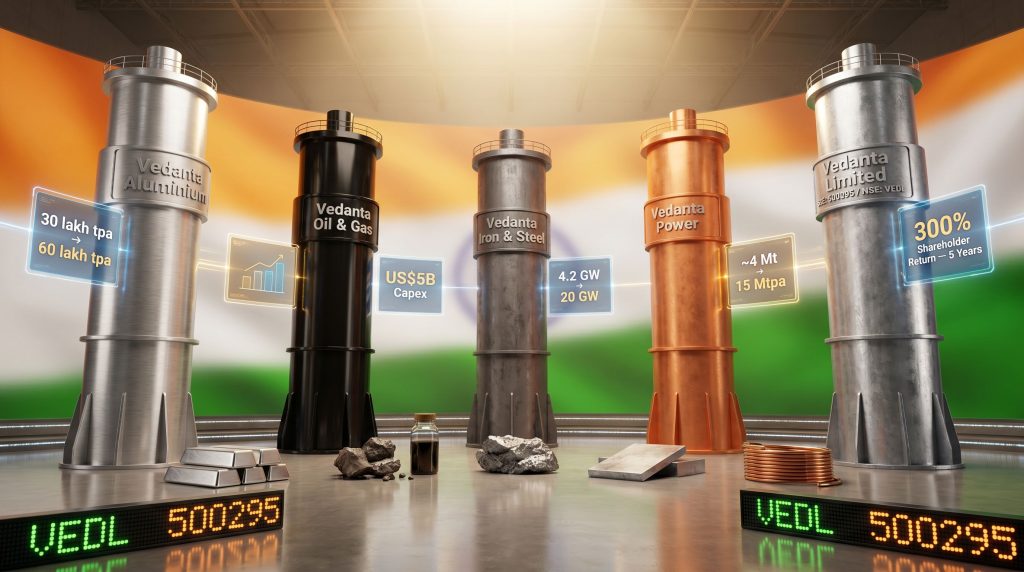
The post-demerger Vedanta ecosystem now comprises five separately listed companies, each with a defined sector mandate and independent capital structure:
| Entity | Primary Sector | Key Scale Metric | Capital Structure Note |
|---|---|---|---|
| Vedanta Aluminium | Aluminium production | 30 lakh tpa current; 60 lakh tpa target | Independent listing |
| Vedanta Oil & Gas | Hydrocarbon E&P | ~500,000 bpd production target | Debt-free at listing |
| Vedanta Iron & Steel | Steel manufacturing | ~4 Mt current; 15 Mtpa roadmap | Debt-free at listing |
| Vedanta Power | Thermal and future clean energy | 4.2 GW operational; 20 GW target | Brownfield expansion focus |
| Vedanta Limited | Critical minerals flagship | Hindustan Zinc anchor; nickel, copper, ferro alloys | BSE: 500295 / NSE: VEDL |
Each of these businesses addresses a structural gap in India's domestic supply chain. Taken individually, their investment cases are easier to underwrite, track, and value than they were when bundled inside a single entity.
Vedanta Aluminium: Building the World's Lowest-Cost Integrated Producer
From 1 Lakh Tonnes to a 60 Lakh Tonne Ambition
Vedanta Aluminium's origin story is instructive. What began as a modest 1 lakh tonne per annum operation at Bharat Aluminium Company (BALCO) has grown thirty-fold into a 30 lakh tonne per annum business anchored by the world's largest aluminium smelter at Jharsuguda in Odisha. That single facility is itself a globally significant industrial asset, and it forms the foundation for an announced plan to double capacity to 60 lakh tpa within three years.
The company currently ranks as India's largest aluminium producer and the third-largest globally outside China, a positioning that carries meaningful commercial significance in a world increasingly wary of supply chain dependence on a single geography. This trajectory broadly mirrors the scale of ambition seen in Hindalco metals expansion, which similarly targets integrated capacity growth across the aluminium value chain.
Why Aluminium Is a Critical Transition Metal
Aluminium's relevance extends far beyond construction and packaging. It is a structurally essential material for:
- Electric vehicle battery housings and structural frames, where its strength-to-weight ratio is unmatched by cheaper alternatives
- Solar panel mounting systems and transmission infrastructure, making it central to renewable energy build-out
- Aerospace applications where weight reduction directly translates to fuel efficiency
- High-density urban construction, where aluminium facades and structural elements are gaining ground against steel
India currently depends on imports to bridge a meaningful domestic production gap. Vedanta Aluminium's scale ambitions are consequently directly aligned with import substitution targets across several high-growth end markets. Furthermore, these ambitions align closely with Australia's own critical minerals strategy, which emphasises the interconnected nature of global aluminium and transition metal supply chains.
Vedanta Oil & Gas: A Debt-Free Entry Into India's Most Strategic Energy Sector
The Significance of a Clean Balance Sheet in a Capital-Intensive Business
Entering the public market without debt in the oil and gas sector is genuinely unusual. Upstream hydrocarbon businesses are typically among the most leveraged in the industrial world, given the multi-year capital cycles required before production reaches commercial scale. Vedanta Oil & Gas's debt-free balance sheet at listing therefore represents a structural advantage that is easy to understate.
The company has announced a committed investment programme of approximately US$5 billion over three to five years, targeting production of 500,000 barrels per day at globally competitive costs. That programme will span:
- Tight oil and shale gas assets, representing India's nascent unconventional resource sector
- Shallow-water and deep-water exploration acreage with longer-term production upside
- Satellite fields and incremental production opportunities in mature basins
- Significant acreage across Assam and the North-East, historically the cradle of Asian oil production
The Historical Significance of the North-East India Position
The Assam connection is more than geographic. Asia's first commercial oil well was drilled in the Digboi region of Assam in 1889, making North-East India's hydrocarbon heritage one of the oldest on the continent. Vedanta's operational presence in this region links one of India's most modern private energy producers to a basin with over a century of production history, but potentially significant remaining resource potential in formations that older extraction technologies could not efficiently access.
India currently imports approximately 85% of its crude oil requirements, exposing the economy to sustained price volatility in global energy markets. Domestic production growth at scale represents one of the few structural levers capable of reducing that dependence meaningfully.
Vedanta Iron & Steel: Resource Security as a Competitive Moat
Why Integrated Raw Material Control Defines the Steel Sector
In steel manufacturing, the difference between a commodity producer and a structurally advantaged business often comes down to raw material security. Producers dependent on spot iron ore and metallurgical coke markets face cost structures that can swing dramatically with commodity cycles. Vedanta Iron & Steel is positioned differently.
The company controls:
- Nearly 4 billion tonnes of iron ore resources across Goa, Odisha, and Karnataka, one of India's most substantial private iron ore positions
- Approximately 800,000 tonnes per annum of metallurgical coke supply security
- Direct access to gas pipeline infrastructure at existing operational sites
This integrated input security is a genuine competitive moat. It allows cost management in downcycles that merchant steel producers simply cannot replicate, and it provides the foundation for a 15 Mtpa expansion roadmap from a current base of approximately 4 Mt annually, also entering the market debt-free. For broader context on how these dynamics are playing out across the region, the steel and iron ore outlook for 2025 highlights significant structural pressures and opportunities shaping the global market.
Targeting Premium Steel Segments
The company's stated focus on green steel, electrical steel, and specialty steel segments reflects an understanding that commodity steel faces structural margin compression, while differentiated, specification-grade products command pricing power. Electrical steel, for instance, is critical for electric motor production and transformer manufacturing, both of which are experiencing demand acceleration globally as electrification deepens. However, as Indian steel price trends indicate, navigating domestic pricing volatility remains a key operational challenge even for integrated producers.
Vedanta Power: Baseload for the World's Fastest-Growing Major Economy
The Arithmetic of India's Power Demand Gap
India's power demand trajectory is among the most compelling structural investment narratives of this decade. Current operational capacity stands at approximately 240 GW nationally, with projections suggesting demand could exceed 460 GW within ten years. That near-doubling of required generation capacity creates a structural supply gap that renewable energy alone cannot bridge, given intermittency constraints.
Vedanta Power enters this environment as India's fifth-largest thermal power producer with:
- 4.2 GW of operational capacity supported by long-term power purchase agreements that provide revenue visibility
- Secure access to captive coal mines, reducing exposure to spot fuel cost volatility
- A defined roadmap toward 20 GW of total capacity, predominantly through brownfield expansion
If Vedanta Power achieves its 20 GW target against a projected national base of approximately 460 GW, it would represent roughly 4.3% of India's total generation capacity, a material position in a sector that is foundational to every other area of economic activity.
The Nuclear Evaluation: A Forward-Looking Strategic Signal
The company's publicly stated evaluation of nuclear energy opportunities as a clean baseload solution deserves attention. Nuclear power delivers reliable, around-the-clock generation without the carbon footprint of thermal alternatives, and India's nuclear programme has been expanding capacity in recent years. A private sector participant seriously evaluating nuclear entry signals a longer-term strategic horizon that extends well beyond the current brownfield thermal expansion. In addition, ongoing India coal market reforms may further shape the competitive economics of thermal power over the medium term.
The next major ASX story will hit our subscribers first
Vedanta Limited: The Critical Minerals Anchor in a Transition-Era Economy
Hindustan Zinc as a Global Benchmark Asset
Vedanta Limited, the group's flagship entity continuing to trade under BSE: 500295 and NSE: VEDL, is anchored by Hindustan Zinc, recognised as the world's largest integrated zinc producer and the third-largest silver producer globally. Silver's growing relevance in solar photovoltaic cell manufacturing gives this position additional strategic depth beyond its traditional monetary metal status.
The Nickel, Copper, Ferro Alloys, and Manganese Portfolio
Several lesser-known dimensions of Vedanta Limited's portfolio deserve specific attention:
- Nickel: Vedanta Limited is India's sole domestic nickel producer, with announced plans to scale output to 60,000 tpa. Nickel's role in lithium-ion battery chemistry and stainless steel production makes this a strategically valuable monopoly position within the domestic market.
- Copper: Operations contribute to domestic supply security at a time when electrification is accelerating copper intensity across infrastructure and mobility sectors.
- FACOR: Positioned to become India's largest producer of special-grade ferro chrome, with an emerging presence in manganese, a critical input for both battery manufacturing and high-strength steel.
- Fertilisers: A 1.5 Mt fertiliser plant under development through Hindustan Zinc represents a diversification into agricultural supply security, addressing India's strategic objective of reducing dependence on imported fertiliser inputs.
Shareholder Return Track Record: The Credibility Foundation
Five Years of Outperformance That Underpins the Demerger Case
Investor confidence in a demerger structure is partly a function of trust in the management team executing it. Vedanta's five-year total shareholder return exceeding 300%, representing approximately five times the return delivered by the Nifty index over the same period, provides that credibility foundation. A cumulative dividend yield exceeding 70% over the same timeframe demonstrates that capital returns were not sacrificed for growth investment, a combination that is genuinely uncommon in heavy industry.
How Demergers Unlock Value for Existing Shareholders
In the mechanics of an Indian demerger structure, existing shareholders in the parent entity typically receive proportional shareholdings in each newly listed company without additional capital outlay. This transforms a single portfolio position into a basket of five independently valued, sector-specific investments. The re-rating catalysts that can follow include:
- Sector-specific index inclusion events, which trigger passive fund buying
- Improved analyst coverage per entity, as specialist sector analysts engage with businesses now sized appropriately for dedicated research
- Institutional mandate alignment, as fund managers with specific sector briefs can now access previously inaccessible Vedanta divisions
- Improved debt market access for each entity on sector-specific terms
As ANI News reported, the four demerged businesses commenced trading on Indian stock exchanges in June 2026, marking a watershed moment for India's equity markets and confirming that Vedanta lists four independent companies on BSE and NSE as one of the most consequential structural events in recent corporate history.
The Import Dependence Opportunity Across All Five Sectors
India's Structural Supply Deficit as a Long-Term Demand Driver
| Sector | India's Approximate Import Dependence | Vedanta Entity Positioned |
|---|---|---|
| Crude Oil | ~85% | Vedanta Oil & Gas |
| Aluminium | Significant structural gap | Vedanta Aluminium |
| Specialty Steel | Moderate to high | Vedanta Iron & Steel |
| Baseload Power | Structural national deficit | Vedanta Power |
| Zinc, Nickel, Copper | Partial to high dependency | Vedanta Limited |
India's stated industrial ambition requires domestic production capacity across all five of these categories to grow substantially over the coming decade. The demerger consequently positions each Vedanta entity to pursue that growth independently, with dedicated management focus, sector-specific capital structures, and the operational clarity that comes from no longer sharing a balance sheet with businesses that have different cash flow profiles and investment cycles.
Frequently Asked Questions: Vedanta's Multi-Company Listing
What does a simultaneous dual-exchange listing on BSE and NSE mean in practice?
Listing on both exchanges simultaneously maximises liquidity and price discovery by exposing each entity to the broadest possible investor base. It also ensures compliance with both exchanges' governance frameworks from the outset, signalling institutional-grade operational standards.
How does this demerger affect existing Vedanta Limited shareholders?
Under Indian corporate law demerger structures, existing shareholders typically receive proportional allocations of shares in each newly listed entity based on their existing holdings, without additional cash consideration required.
Are the new Vedanta companies debt-free?
Vedanta Oil & Gas and Vedanta Iron & Steel have both been described as entering the market with debt-free balance sheets. Each entity's capital structure should be assessed individually as financial disclosures become available through exchange filings.
What is Vedanta Limited's stock ticker?
Vedanta Limited, the flagship entity continuing to trade independently, carries the identifiers BSE: 500295 and NSE: VEDL.
What does Vedanta Aluminium's global ranking mean competitively?
As the third-largest aluminium producer globally outside China and the operator of the world's largest single aluminium smelter, Vedanta Aluminium occupies a scale position that gives it meaningful cost advantages through operational leverage, energy procurement, and raw material sourcing relative to smaller regional producers.
Readers seeking broader context on global metals and minerals sector dynamics can explore related market intelligence and industry insights through the Mining Indaba Content Hub at miningindaba.com.
Want to Identify the Next Major Mineral Discovery Before the Market Does?
Discovery Alert's proprietary Discovery IQ model delivers real-time alerts on significant ASX mineral discoveries, instantly translating complex geological data into actionable investment insights for both short-term traders and long-term investors — explore historic discoveries and their returns to understand what early positioning can mean, then begin your 14-day free trial at Discovery Alert to secure your market-leading advantage.