July 14, 2026
India's Upstream Oil Crisis: Why a Decade of Decline Sets the Stage for Vedanta's Boldest Bet
The relationship between a nation's energy self-sufficiency and its economic resilience is rarely linear, but in India's case, the correlation has become impossible to ignore. For more than a decade, India's domestic crude oil production has moved in one direction while national demand has moved in the opposite one. The resulting gap, filled almost entirely by imported barrels, has quietly become one of the most consequential structural vulnerabilities in the Indian economy. Understanding why that gap exists, and what it would take to close it, is the essential context for evaluating what the Vedanta Oil $5 billion investment to boost output fivefold actually represents.
When big ASX news breaks, our subscribers know first
The Architecture of India's Import Dependency
India currently satisfies somewhere between 85% and 87% of its crude oil requirements through imports, placing it alongside Japan and South Korea as one of the most import-reliant major economies on earth. Domestic production hovers in the range of 700,000 to 800,000 barrels per day, a figure that has been declining steadily rather than keeping pace with demand growth from a population of 1.4 billion people.
The fiscal consequences are considerable. At Brent crude prices near $104 per barrel, India's annual crude import bill runs into hundreds of billions of dollars. This represents one of the single largest contributors to the country's current account deficit, creating a transmission mechanism by which global oil price volatility directly threatens rupee stability, inflation management, and the government's fiscal arithmetic. When oil prices spike, India's macroeconomic policy space shrinks almost automatically.
What makes this vulnerability particularly acute is its structural rather than cyclical nature. The decline in domestic output is not primarily a function of low oil prices discouraging investment, though price cycles have certainly played a role. It is fundamentally a reservoir maturity problem, concentrated in fields that have been producing for decades without sufficient investment in recovery optimisation or replacement discoveries.
Why Enhanced Oil Recovery Has Been Underutilised in Indian Fields
Mature field management is a specialised discipline, and India's upstream sector has historically lagged behind global best practice in deploying enhanced oil recovery techniques at scale. Waterflood programmes, chemical flooding, gas injection, and more advanced tertiary recovery methods can substantially extend the productive life of ageing reservoirs, but they require capital, technical expertise, and operational continuity that state-dominated upstream environments have not always provided efficiently.
The Rajasthan basin, which hosts the most productive assets currently operated by Vedanta Oil & Gas, is a case study in underperformance relative to geological potential. The basin's Barmer formation contains significant oil in place, but recovery factors from these reservoirs have not approached what comparable formations in other jurisdictions have achieved with more aggressive reservoir management. This is precisely the technical opportunity that the company's expansion strategy is attempting to exploit.
From Cairn India to a Standalone Listed Entity: The Corporate Transformation
The entity now known as Vedanta Oil & Gas did not emerge from a standing start. Its lineage traces back to Cairn India, which was one of the country's most significant upstream discoveries of the early 2000s. Chairman Anil Agarwal's acquisition of a controlling stake in Cairn India in 2011 brought the asset base into the Vedanta Group's orbit, and a subsequent merger consolidated the oil and gas operations under Vedanta Ltd.
The more recent transformation came in May 2026, when Vedanta Ltd. completed a demerger into five separately listed entities. Vedanta Oil & Gas, which had previously operated as the Cairn Oil & Gas division, began trading independently on Indian stock exchanges in June 2026. This structural change carries significant strategic implications beyond the cosmetic.
A separately listed entity with its own share register, capital structure, and management accountability operates under very different incentive dynamics than a division embedded within a diversified conglomerate. The market can directly price the oil and gas business on its own merits, analysts can benchmark it against pure-play upstream peers, and management compensation can be more directly tied to upstream-specific performance metrics.
Critically, the company entered the market in a debt-free position. This balance sheet characteristic is not merely a financial footnote. It provides the headroom to take on project-specific debt for the $5 billion expansion without triggering the kind of leverage concerns that have previously complicated Vedanta Group's capital market relationships. For a programme of this scale, the ability to borrow against a clean balance sheet is a material execution enabler.
Production History: Understanding the Scale of the Decline
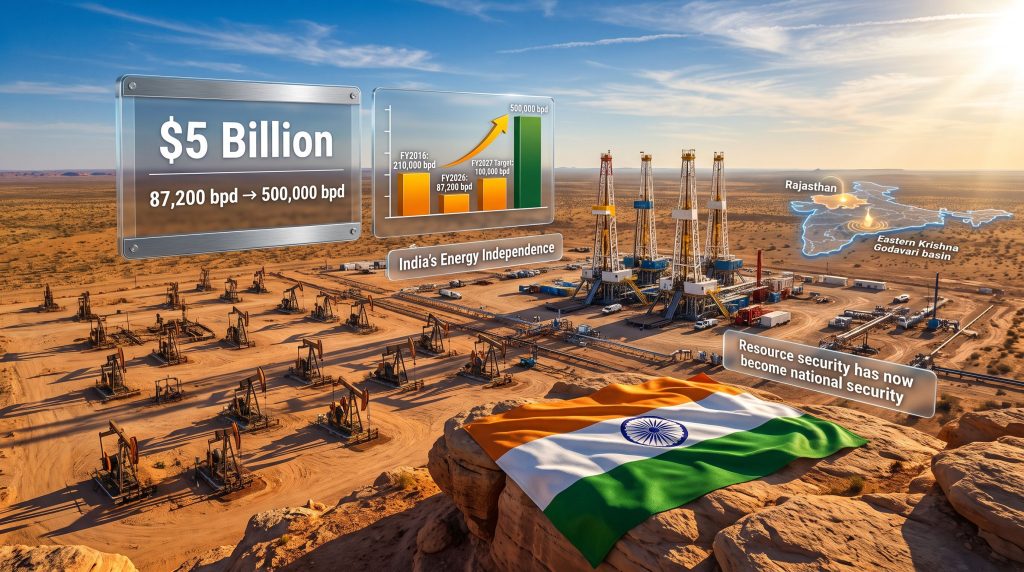
The numbers tell a stark story. At its operational peak in fiscal year 2016, the combined asset base was delivering more than 210,000 barrels per day. By the fiscal year ended March 31, 2026, that figure had fallen to a daily average of just 87,200 barrels of oil equivalent, representing a contraction of more than 58% over ten years.
| Production Metric | Figure |
|---|---|
| FY2016 peak production | >210,000 bpd |
| FY2026 average production | ~87,200 boepd |
| FY2027 near-term target | ~100,000 bpd |
| Five-year ambition | 300,000–500,000 bpd |
| Decade-long aspiration | ~1,000,000 bpd |
| Decline from peak to FY2026 | ~58% over 10 years |
This trajectory precisely mirrors the broader challenge facing India's upstream sector. Furthermore, this drilling activity decline pattern is not unique to India — similar dynamics have played out in other mature upstream markets globally. Oil and Natural Gas Corporation, the state-owned giant that dominates domestic production, has faced virtually identical pressures from mature field depletion. The difference is that a privately operated entity with direct capital market access and management flexibility has tools available to address the problem that a state-owned enterprise often cannot deploy with equivalent speed or agility.
Dissecting the $5 Billion Capital Commitment
The Vedanta Oil $5 billion investment to boost output fivefold is structured across a three-year deployment window, targeting both onshore and offshore project portfolios. The funding architecture combines internal cash generation, with EBITDA estimated at approximately $1 billion per year, alongside new borrowing facilities that the debt-free balance sheet enables.
According to Vedanta's published expansion plans, the company is also actively seeking a global partner to support the scale of capital deployment required. The investment priorities break down across several strategic pillars:
- Enhanced oil recovery programmes targeting the Rajasthan basin's mature reservoirs, applying waterflood optimisation and pressure maintenance to recover incremental barrels from existing productive formations
- New field development bringing undeveloped discoveries within the existing licensed acreage portfolio into commercial production
- Shale and tight oil resource development, which represents perhaps the highest-risk, highest-potential component of the programme given India's limited history of commercial shale production
- International technology partnerships, particularly with U.S.-based oilfield services companies that possess advanced drilling, completion, and reservoir management capabilities not currently available domestically at the required scale
The Three-Phase Production Growth Model
The operational path from 87,200 boepd to the 500,000 bpd ambition is not a single leap but a sequenced progression:
- Phase 1 (FY2027): Stabilise and grow current production to approximately 100,000 bpd through field optimisation and incremental workovers in existing wells, with minimal new greenfield development required
- Phase 2 (FY2028 to FY2029): Accelerate the drilling campaign across both Rajasthan and Krishna Godavari basin assets, targeting a production corridor of 200,000 to 300,000 bpd through a combination of mature field recovery improvement and initial contributions from new field development
- Phase 3 (FY2030 and beyond): Full commercial development of shale resources and offshore asset optimisation, with the goal of reaching 500,000 bpd and ultimately positioning the company to account for more than 50% of India's total domestic crude output
The near-term FY2027 production target of approximately 100,000 bpd will serve as the first credible signal of whether the company's execution machinery is capable of delivering on the larger ambition. Investors and analysts should treat this milestone as the critical early indicator.
Scenario Analysis: What Could Actually Happen?
No capital programme of this magnitude executes precisely according to plan. A structured scenario analysis provides a more realistic framework for evaluating outcomes.
| Scenario | Projected Output (5 Years) | Key Conditions |
|---|---|---|
| Optimistic | 400,000–500,000 bpd | Full EOR success, shale viability confirmed, partnerships secured within 18 months |
| Base Case | 200,000–300,000 bpd | Partial EOR gains, shale timelines extended, new fields online but delayed |
| Downside | 100,000–150,000 bpd | Reservoir complexity limits recovery, oil price weakness constrains capex, financing conditions tighten |
The optimistic scenario requires something approaching flawless execution across multiple simultaneous workstreams, including technology transfers that have not previously been deployed at this scale in India, regulatory processes that respond with unusual speed, and commodity prices that support strong internal cash generation throughout the investment period.
The base case is arguably the most instructive. A two-to-threefold production increase, while falling short of the headline fivefold ambition, would still represent a transformative contribution to India's domestic supply base and would generate returns sufficient to justify the capital programme on conventional investment metrics.
The downside scenario highlights a specific vulnerability: the circular dependency between oil prices, internal cash generation, and capex deployment. If Brent crude, currently trading near $104 per barrel with significant recent volatility, were to sustain levels below $80 per barrel for an extended period, the internal funding component of the $5 billion programme would be materially compressed, forcing a choice between slower deployment or higher leverage.
The Shale Dimension: India's Underdeveloped Resource Frontier
One of the less-discussed aspects of Vedanta Oil & Gas' expansion ambition is its shale component. India possesses meaningful shale and tight oil resources, but commercial development has lagged dramatically behind the United States, Canada, and Argentina. This is partly a regulatory story, partly a technical story, and partly an economic one.
The regulatory frameworks governing shale exploration and production in India are still evolving. Production sharing contract structures, which govern the commercial terms under which private operators produce and sell hydrocarbons, were designed primarily for conventional reservoirs. Adapting them for the very different cost structures, production profiles, and risk characteristics of shale development requires regulatory innovation that moves at policy timescales rather than commercial ones.
The technical challenge is equally significant. Shale development in North America benefited from decades of accumulated knowledge about hydraulic fracturing, horizontal drilling optimisation, and completion design. However, India's upstream sector would need to import that knowledge base through partnerships, technology transfer agreements, or direct hiring of experienced technical personnel. This is precisely where the U.S. oilfield services partnerships that Vedanta Oil & Gas is pursuing become strategically critical — not just operationally useful. In this context, faster permitting pathways in other jurisdictions offer a useful benchmark for what regulatory reform can achieve in accelerating upstream development.
The next major ASX story will hit our subscribers first
The National Energy Security Equation
If the production ambition is achieved, the macroeconomic consequences extend well beyond corporate financial performance. At 500,000 bpd of domestic production added to India's existing supply base, the avoided import expenditure at current oil prices would approach $18 billion per year. That figure is large enough to meaningfully move the needle on India's current account deficit and reduce the foreign exchange reserve drain that accompanies each upward move in global crude prices.
Furthermore, India's resource security strategy extends across multiple commodity sectors. India's resource security strategy in critical minerals such as lithium reflects the same structural logic — reducing dependency on imported supply chains through domestic development and targeted international partnerships. The India LNG import tax framework illustrates a parallel dimension of this challenge: the India LNG import tax structure directly shapes the relative economics of gas versus oil as competing domestic energy priorities.
Chairman Anil Agarwal's articulation that resource security has effectively become a dimension of national security reflects a geopolitical reality that energy analysts have been discussing for years but that corporate leaders in the Indian private sector have rarely articulated so directly. For a country that relies on seaborne crude imports transiting multiple chokepoints, domestic production capacity carries strategic value that extends well beyond its commercial economics.
Key Risks That Could Derail the Programme
Investors and analysts evaluating this capital commitment should monitor several specific risk categories:
- Execution risk: The drilling intensity required to reach 500,000 bpd is substantially beyond India's current domestic oilfield services capacity, making international contractor involvement not just desirable but essential. Supply chain constraints, rig availability, and skilled workforce gaps represent genuine near-term bottlenecks
- Commodity price risk: The programme's internal funding component is directly sensitive to Brent crude prices. Extended periods of sub-$80 per barrel pricing would compress cash generation and force capital allocation choices that could delay the production ramp
- Reservoir risk: Enhanced oil recovery outcomes in mature fields are inherently uncertain. Recovery factor improvements that appear achievable in reservoir simulation models do not always translate with the same efficiency into actual field results, particularly in formations with complex heterogeneity
- Regulatory risk: Shale development frameworks, field extension approvals, and environmental clearance processes will all influence the pace of capital deployment. Any tightening of profit petroleum terms or royalty structures could also affect project economics at the margin
- Technology transfer risk: The success of the partnership strategy with U.S. and international oilfield services companies depends on knowledge transfer that is genuinely effective rather than nominal, and on contract structures that align incentives appropriately across a multi-year development programme
Frequently Asked Questions: Vedanta Oil & Gas $5 Billion Expansion
What is Vedanta Oil & Gas and when did it begin trading?
Vedanta Oil & Gas Ltd. is a separately listed entity formed through the demerger of Vedanta Ltd.'s oil and gas operations in May 2026. Previously operating as Cairn Oil & Gas, it began independent trading on Indian stock exchanges in June 2026. Its core assets include onshore blocks in the Rajasthan basin and offshore positions in the Krishna Godavari basin.
What is the precise production target under the $5 billion programme?
The company is targeting approximately 100,000 bpd in the current fiscal year as a near-term milestone, scaling toward 300,000 to 500,000 bpd within five years. A longer-horizon aspiration of 1 million bpd over a decade has been referenced, though the $5 billion capital programme is anchored to the five-year target.
How will the $5 billion investment be financed?
Funding will come from a combination of internal cash generation, with annual EBITDA estimated at approximately $1 billion, and new debt facilities. The company's debt-free balance sheet at the time of its demerger provides significant headroom for project-specific borrowing without creating excessive leverage risk at the current stage of the programme.
Why has production declined so sharply over the past decade?
The decline from more than 210,000 bpd in FY2016 to approximately 87,200 boepd in FY2026 reflects natural reservoir depletion in mature fields, particularly within the Rajasthan basin, combined with insufficient investment in enhanced oil recovery programmes and limited new field development to replace declining base production.
Strategic Significance: A Privately Driven Shift in India's Upstream Landscape
Bloomberg's reporting on the $5 billion capex plan confirms that the Vedanta Oil $5 billion investment to boost output fivefold has attracted significant international attention, with observers noting that the ambition to displace ONGC as India's largest upstream producer marks a genuine structural turning point. If Vedanta Oil & Gas executes even a substantial portion of this programme, the competitive dynamics of India's upstream sector will shift in ways that have not previously been seen in the country's energy history.
That outcome is far from guaranteed. The base case scenario still implies a meaningful production contribution and a credible return on invested capital. However, the strategic framing of the $5 billion commitment reflects something beyond conventional oil company growth planning. It positions Vedanta Oil & Gas at the intersection of corporate ambition and national energy policy in a way that few private sector upstream programmes in any emerging market economy have previously achieved.
This article contains forward-looking information, production targets, and financial estimates that involve significant uncertainty. Actual outcomes may differ materially from projections depending on commodity prices, reservoir performance, regulatory developments, and financing conditions. Nothing in this article constitutes investment advice. Readers should conduct independent research and consult qualified financial advisers before making investment decisions.
Want to Stay Ahead of Major Resource Discoveries Before the Broader Market Catches On?
While Vedanta's $5 billion upstream expansion illustrates just how transformative large-scale resource developments can be, Discovery Alert's proprietary Discovery IQ model scans ASX announcements in real time — instantly identifying significant mineral discoveries and delivering actionable insights to subscribers ahead of the crowd. Explore historic examples of major discovery returns and begin your 14-day free trial today to position yourself at the forefront of the next major find.