July 26, 2026
Global energy markets operate within a complex web of interdependent relationships where political stability, resource availability, and international trade patterns converge to shape commodity pricing and supply security. The strategic positioning of major oil-producing nations creates cascading effects that extend far beyond regional boundaries, influencing everything from refinery operations to consumer energy costs worldwide.
Within this intricate system, the relationship between resource-rich nations and major consuming economies represents one of the most critical dynamics affecting global energy stability. When diplomatic relations deteriorate or economic sanctions disrupt established trade flows, market participants must rapidly adapt to new supply configurations, often at significant cost and with considerable uncertainty about long-term outcomes. Furthermore, the escalating tensions between Venezuela and the U.S. have created ripple effects throughout global energy markets, affecting pricing mechanisms and supply chain relationships far beyond the immediate participants.
Understanding Venezuela's Strategic Energy Position
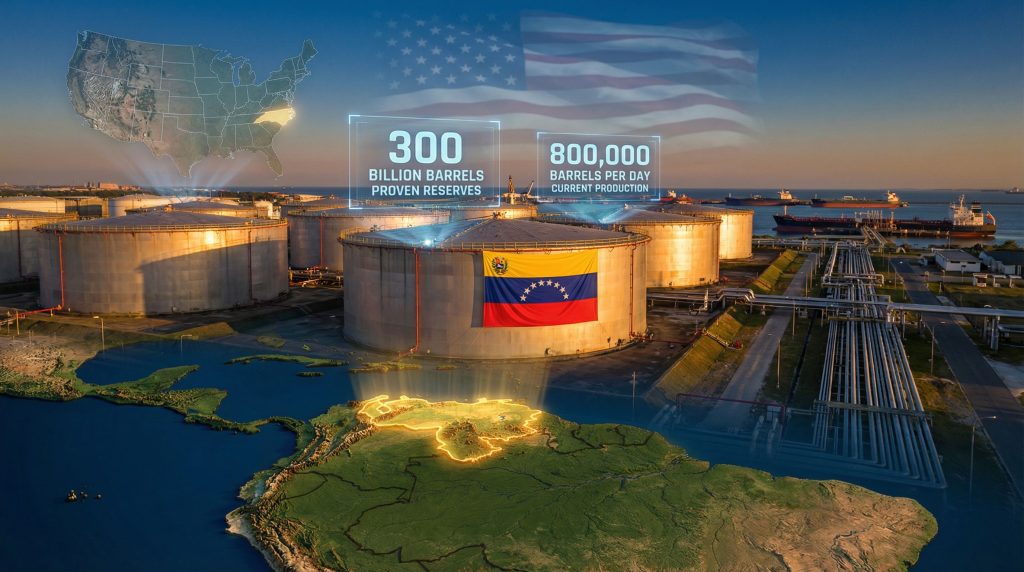
Venezuela's position in global energy markets stems from its extraordinary resource endowment combined with geographic advantages that create unique supply chain relationships. The country's proven oil reserves of approximately 303.8 billion barrels represent the world's largest known crude oil deposits, accounting for roughly 17.7% of global proven reserves according to the U.S. Energy Information Administration's 2024 statistics.
The Orinoco Belt, containing an estimated 235 billion barrels of extra-heavy crude oil, represents the cornerstone of this resource base. This geological formation produces crude oil with 7-14 degrees API gravity, classifying it as extra-heavy crude requiring specialised processing infrastructure that aligns particularly well with U.S. Gulf Coast refinery configurations.
Table: Venezuelan Oil Production Metrics
| Metric | Peak Production (1997-1998) | Current Level (2025) | Decline Percentage |
|---|---|---|---|
| Daily Production | 3.75 million bpd | 750,000-800,000 bpd | 78-80% |
| Export Capacity | 3.2 million bpd | 400,000 bpd | 87% |
| Revenue Impact | $45-50 billion annually | $8-10 billion annually | 78-82% |
The geographic proximity of Venezuelan reserves to major consuming markets in North America creates transportation cost advantages of $2-4 per barrel compared to Middle Eastern alternatives. This proximity, combined with the specialised nature of Venezuelan heavy crude, established deeply integrated supply relationships that proved difficult to replace when political tensions disrupted trade flows.
When big ASX news breaks, our subscribers know first
Economic Architecture of Heavy Crude Processing
The economic relationship between Venezuelan heavy crude and U.S. refining infrastructure represents billions of dollars in specialised capital investments designed specifically for processing extra-heavy crude grades. Gulf Coast refineries invested approximately $20-25 billion in coking and upgrading infrastructure between 1990 and 2015, creating facilities optimised for Venezuelan feedstock.
These specialised processing units include delayed coking units (DCU), fluid catalytic cracking (FCC) systems, and hydrotreating capacity configured for crude oil containing 3-4% sulfur by weight. The technical complexity of processing Venezuelan crude requires infrastructure that cannot easily accommodate lighter crude grades without significant efficiency losses and modification costs.
Processing Economics Comparison:
- Venezuelan heavy crude yield: 82-88% marketable products per barrel
- Light crude yield: 90-95% marketable products per barrel
- Heavy crude refining margin premium: $4-8 per barrel during scarcity periods
- Conversion efficiency loss: 7-13% when switching to alternative feedstocks
The specialised nature of this infrastructure creates what economists term "asset specificity," where investments optimised for particular input characteristics lose value when those inputs become unavailable. In addition, this dynamic explains why refineries configured for Venezuelan crude experienced declining margins as supply restrictions intensified after 2019.
Major refining companies including Valero Energy Corporation and Phillips 66 reported margin compression directly attributable to Venezuelan supply disruptions, forcing operational adjustments including reduced utilisation rates and higher-cost alternative crude procurement from Canadian oil sands and Mexican sources.
Sanctions Framework and Enforcement Mechanisms
The U.S. sanctions regime targeting Venezuela operates through multiple interconnected mechanisms designed to restrict both direct trade and third-party facilitation of Venezuelan oil exports. Initial sanctions targeting PDVSA commenced in January 2019, expanding progressively to encompass approximately 140+ entities on OFAC's Venezuela Sanctions List as of December 2024.
Primary Sanctions Components:
- Prohibition on PDVSA transactions with U.S. entities
- Blocking of Venezuelan government assets in the U.S. financial system
- Prohibition on provision of specialised refining chemicals and equipment
- Secondary sanctions targeting foreign entities facilitating Venezuelan oil trade
The enforcement mechanisms extend beyond simple trade prohibitions to create comprehensive barriers affecting transportation, financing, and technical services. Sanctions targeting foreign vessels used to transport Venezuelan crude create liability for vessel operators, ship owners, and insurance providers, effectively restricting available transport infrastructure.
Recent enforcement actions illustrate the practical impact of these measures. The December 2025 seizure of the oil tanker carrying approximately 2 million barrels of Venezuelan crude demonstrated active enforcement and created deterrent effects for shipping companies considering Venezuelan trade, highlighting how shadow fleets attempt to circumvent sanctions.
Quantified Impact of Sanctions:
- Venezuelan oil exports declined from 1.4 million bpd (January 2019) to 400,000 bpd (December 2024)
- Estimated annual revenue loss: $35-45 billion based on current price environment
- Third-party shipping companies reduced Venezuelan engagement by approximately 85%
As tensions between Venezuela and the U.S. continue escalating, enforcement mechanisms have become increasingly sophisticated, targeting not only direct trade but also complex financial arrangements and sanctions evasion schemes involving ship-to-ship transfers and intermediary entities.
Global Market Rebalancing Dynamics
When Venezuelan supply contracted, global crude markets underwent significant rebalancing as alternative suppliers expanded production and refineries adjusted feedstock sources. Canadian oil sands production increased from 2.9 million bpd (2015) to 3.8 million bpd (2024), partially offsetting Venezuelan supply loss while creating new trade flow patterns.
The market response illustrated both the flexibility and constraints within global oil systems. While substitution mechanisms exist, they operate with time lags and cost penalties that create temporary price volatility and permanent shifts in trade relationships. However, these developments also intersect with broader geopolitical tensions, including US-China trade tensions that affect global commodity flows.
Recent market analysis indicates that tensions between Venezuela and the U.S. are escalating, raising concerns about potential supply disruptions, while markets lack clear direction and oversupply concerns remain strong, according to senior economist Tsuyoshi Ueno at NLI Research Institute.
Alternative Supply Sources Response:
- Canadian oil sands: Increased exports to U.S. from 2.0 million bpd to 3.2 million bpd
- Mexican heavy crude: Limited substitution capacity due to declining domestic production
- Middle Eastern heavy grades: Increased market share in Asian markets previously supplied by Venezuela
- Russian Urals crude: Expanded presence in markets accessible despite sanctions
The geographic reorientation of Venezuelan exports toward China, India, and other Asian markets created additional transportation costs of $2-4 per barrel due to extended shipping distances. Consequently, this simultaneously opened market share for alternative suppliers in Western Hemisphere markets.
Alternative Partnership Development and Strategic Realignments
Venezuela's exclusion from traditional Western markets accelerated partnerships with China, Russia, and Iran through complex arrangements involving oil-for-loans deals, technical assistance programmes, and sanctions evasion mechanisms. Chinese lending to Venezuela totalled approximately $65-67 billion between 2007 and 2024, primarily through China Development Bank and Export-Import Bank of China.
Chinese Energy Investment Structure:
- Oil repayment commitments: 400,000-500,000 bpd at peak periods
- Floor pricing mechanisms: $35-45 per barrel when market prices exceed $60-80 per barrel
- Technical assistance and equipment provision for Orinoco Belt operations
- Long-term strategic positioning rather than short-term commercial returns
These asymmetric relationships operate differently from traditional commercial arrangements, with lending nations prioritising strategic positioning over immediate financial returns. The oil-for-loans mechanism effectively locks in production allocations at below-market prices, representing resource transfers to the Venezuelan government while securing long-term supply commitments for Chinese refineries.
Russian energy cooperation, whilst more limited than Chinese involvement, includes joint ventures in Orinoco Belt operations and technical assistance programmes. However, Russian sanctions imposed in 2022 have constrained further expansion of this cooperation.
Iranian collaboration involves documented oil and condensate trades estimated at 50,000-100,000 bpd at various periods, utilising similar sanctions evasion mechanisms including ship-to-ship transfers and intermediary trading entities. These developments reflect broader patterns of how US-Venezuela tensions continue reshaping global energy partnerships.
Infrastructure Vulnerabilities and Security Implications
Venezuela's energy infrastructure faces multiple challenges beyond sanctions, including maintenance backlogs estimated at $15-20 billion, technical expertise shortages following emigration of skilled workers, and security concerns affecting operations in remote production areas.
The deterioration of production infrastructure compounds the impact of economic sanctions on actual output capacity. Key challenges include:
Technical Infrastructure Issues:
- Aging drilling equipment requiring replacement parts subject to sanctions
- Electrical grid instability affecting production operations
- Transportation infrastructure deterioration limiting export capacity
- Water injection systems requiring maintenance for enhanced oil recovery
Security Considerations:
- Protection of offshore production facilities and export terminals
- Maritime security for tanker operations in Caribbean waters
- Pipeline security in remote inland production areas
- Protection of technical personnel and foreign contractors
Regional security implications extend beyond Venezuelan borders, with U.S. military positioning near Venezuelan waters creating additional market uncertainty. Energy traders must factor potential supply disruption scenarios into pricing models, contributing to increased volatility premiums in oil futures markets.
The next major ASX story will hit our subscribers first
Financial Market Risk Assessment and Pricing Mechanisms
Energy market participants incorporate Venezuelan geopolitical risk through various financial mechanisms, including volatility premiums in options markets, basis differentials in crude oil pricing, and credit risk assessments for energy companies with Latin American exposure.
Risk Premium Quantification:
- Options market volatility premiums: $2-5 per barrel during periods of heightened tension
- Credit default swap spreads for Venezuelan government debt: 4,000-6,000 basis points
- Regional energy company equity valuations: 15-25% discount for significant Venezuelan exposure
- Shipping insurance premiums: 200-400% increase for Venezuelan oil transport
Investment flow redirections have channelled energy capital away from Venezuela toward other heavy oil producing regions, affecting global capital allocation patterns. Moreover, the Canada energy transition creates additional complexity for oil sands projects that received increased investment as Venezuelan alternatives became unavailable, whilst Mexican heavy oil projects faced capital constraints due to declining domestic production.
The December 2025 oil price movements, with Brent crude futures rising 0.4% to $61.37 per barrel and WTI increasing 0.4% to $57.67 per barrel, illustrate how tensions between Venezuela and the U.S. continue influencing market sentiment despite Venezuelan production representing a relatively small percentage of global supply.
Technology Transfer and Infrastructure Recovery Scenarios
Venezuela's energy sector recovery would require substantial technological upgrades and infrastructure investments estimated at $50-80 billion over a 10-15 year period, creating significant opportunities for international energy service companies while potentially affecting global equipment and services markets.
Recovery Investment Requirements:
- Drilling and completion technology: $15-20 billion for modern equipment and techniques
- Processing and upgrading facilities: $20-25 billion for new and refurbished infrastructure
- Transportation infrastructure: $8-12 billion for pipelines and export terminals
- Electrical grid and utilities: $7-10 billion for reliable power supply
The specialised nature of Orinoco Belt production requires advanced enhanced oil recovery techniques, horizontal drilling capabilities, and heavy oil processing technology that Venezuela currently lacks access to due to sanctions restrictions.
International energy companies possess the technical expertise and capital resources necessary for Venezuelan recovery, but require political risk guarantees and sanctions relief before committing significant investments. Furthermore, the potential scale of these projects could influence global energy service market capacity and pricing.
Regional Integration and Energy Security Implications
Future normalisation of U.S.-Venezuela energy cooperation could dramatically reshape Western Hemisphere energy security, potentially reducing North American dependence on Middle Eastern oil imports by 800,000-1.2 million bpd based on Venezuelan production recovery scenarios.
Regional Energy Security Benefits:
- Reduced transportation costs and delivery times for North American refineries
- Enhanced supply chain resilience during Middle Eastern disruptions
- Improved energy trade balance for Western Hemisphere nations
- Strengthened regional economic integration through energy cooperation
The integration prospects extend beyond bilateral U.S.-Venezuela relationships to encompass broader Western Hemisphere energy frameworks. Venezuelan production recovery could support regional energy independence objectives whilst providing economic development opportunities throughout Latin America.
However, achieving these integration benefits requires resolution of fundamental political differences, establishment of transparent governance frameworks, and implementation of environmental and social standards consistent with international best practices.
Investment Strategy Implications and Market Psychology
The ongoing tensions between Venezuela and the U.S. create complex investment dynamics where traditional risk-return calculations must incorporate political scenario analysis and potential policy reversals. Energy investors must evaluate multiple timeline scenarios ranging from continued isolation to gradual normalisation to rapid political transition.
Investment Considerations:
- Canadian oil sands: Beneficiary of Venezuelan supply disruption but vulnerable to normalisation
- Mexican energy sector: Limited ability to substitute for Venezuelan heavy crude production
- U.S. Gulf Coast refineries: Asset stranding risk if specialised infrastructure remains underutilised
- Alternative heavy crude producers: Temporary market share gains subject to Venezuelan recovery
Market psychology around Venezuelan energy assets reflects extreme uncertainty, with potential returns ranging from total loss to extraordinary gains depending on political outcomes. This uncertainty creates opportunities for specialised distressed asset investors whilst deterring traditional energy investment capital.
The recent market movements, including the 4% slide in oil prices the previous week followed by recovery on Venezuelan tension concerns, illustrate the ongoing influence of political developments on energy market sentiment. In addition, these movements occur alongside broader concerns about trade war oil dynamics and US oil production decline even when Venezuelan production represents a small fraction of global supply.
Future Scenario Analysis and Strategic Planning
Energy market participants must prepare for multiple potential scenarios regarding Venezuelan production recovery, each carrying different implications for global supply balance, regional trade flows, and investment opportunities.
Scenario 1: Gradual Normalisation (5-10 year timeline)
- Venezuelan production recovery to 1.5-2.0 million bpd
- Staged sanctions relief tied to political and governance reforms
- International investment in infrastructure modernisation
- Gradual displacement of alternative heavy crude suppliers
Scenario 2: Rapid Political Transition (2-3 year timeline)
- Immediate sanctions relief and international recognition
- Venezuelan production recovery to 2.0-2.5 million bpd
- Massive international investment influx
- Significant disruption to existing heavy crude supply arrangements
Scenario 3: Continued Isolation (10+ year timeline)
- Persistent sanctions and political confrontation
- Venezuelan production decline to 400,000-600,000 bpd
- Permanent market share shifts to alternative suppliers
- Infrastructure deterioration requiring complete reconstruction
Each scenario requires different strategic responses from market participants, from refineries planning feedstock procurement to energy service companies evaluating market entry timing to investors assessing portfolio allocation strategies. Furthermore, these scenarios must account for broader geopolitical developments, including potential tariff policy effects that could reshape global energy trade patterns.
The ongoing evolution of tensions between Venezuela and the U.S. ensures that these scenarios remain dynamic, requiring continuous reassessment as political, economic, and technical factors develop.
Understanding these complex dynamics becomes essential for energy market participants, policymakers, and investors seeking to navigate an increasingly uncertain geopolitical environment where traditional supply relationships continue facing disruption from political considerations that extend far beyond purely commercial factors.
Ready to Capitalise on Energy Market Disruptions?
Discovery Alert's proprietary Discovery IQ model delivers real-time alerts on significant ASX mineral and energy discoveries, instantly empowering subscribers to identify actionable opportunities ahead of the broader market whilst geopolitical tensions reshape global supply chains. Understand why major mineral discoveries can lead to significant market returns and begin your 30-day free trial today to position yourself ahead of the market.