July 18, 2026
What Makes Venezuela a Critical Player in Global Energy Security?
The convergence of geopolitical instability and resource abundance has rarely been more pronounced than in Venezuela's oil and mining potential. While global markets grapple with supply chain vulnerabilities and energy transition pressures, one nation sits atop reserves that dwarf most competitors yet produces a fraction of its historical capacity. Furthermore, understanding Venezuela's strategic position requires examining not just the scale of untapped resources, but the complex interplay of infrastructure constraints, geopolitical dynamics, and economic transformation potential that could reshape regional energy markets. However, with oil price stagnation affecting global markets and tariffs impact on investment creating additional uncertainties, the nation's resource potential remains closely tied to broader geopolitical developments.
The Scale of Venezuela's Untapped Resource Base
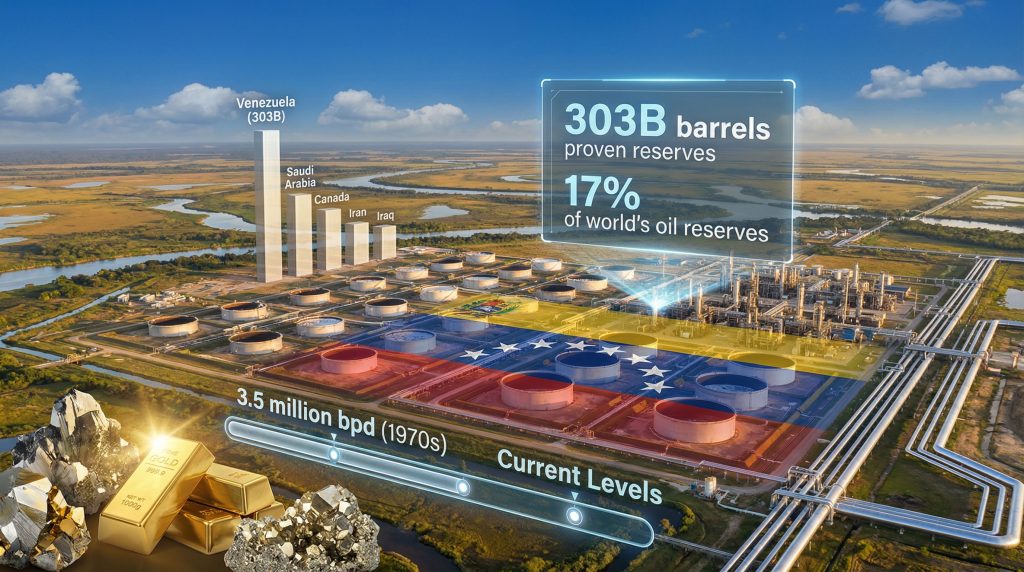
Venezuela commands 17% of the world's proven oil reserves, totalling approximately 303 billion barrels according to the London-based Energy Institute. This positions the South American nation ahead of traditional powerhouses in terms of raw resource endowment, creating a strategic asset that extends far beyond national borders.
| Country | Proven Oil Reserves (Billion Barrels) | Global Share (%) |
|---|---|---|
| Venezuela | 303 | 17.0 |
| Saudi Arabia | 298 | 16.7 |
| Canada | 170 | 9.5 |
| Iran | 158 | 8.8 |
| Iraq | 145 | 8.1 |
The concentration of these reserves in the Orinoco region creates both opportunity and complexity. Unlike conventional oil fields, Venezuela's heavy crude deposits require specialised extraction and processing techniques, yet the geological formation spans thousands of square kilometres with consistent resource density.
For Western Hemisphere energy independence calculations, Venezuelan production recovery could fundamentally alter import dependency patterns. The United States, which historically relied on Venezuelan crude before sanctions implementation, currently imports approximately 8-9 million barrels per day from various global sources. Consequently, Venezuelan production restoration could reduce this dependency by 15-30%, depending on recovery timelines and export allocation decisions.
Economic Impact of Resource Development on Regional Markets
Full resource utilisation would generate cascading economic effects extending beyond Venezuela's borders. Conservative estimates suggest capital requirements exceeding $200 billion for complete infrastructure modernisation, creating investment opportunities across multiple sectors and geographic regions.
Employment generation potential spans both direct and indirect categories. Historical precedent from Venezuela's peak production period in the 1970s suggests that every 100,000 barrels per day of additional production capacity supports approximately 15,000-20,000 direct jobs in extraction, processing, and transportation. At full recovery scenarios approaching 3 million barrels per day, total employment impact could reach 450,000-600,000 positions across the energy value chain.
The multiplier effects extend into regional manufacturing, services, and technology sectors. Countries with established oil services industries – including the United States, Canada, Norway, and the United Kingdom – would benefit from equipment, expertise, and engineering services demand. This creates a feedback loop where Venezuelan resource development strengthens global energy service capabilities whilst generating revenue streams for multiple economies.
When big ASX news breaks, our subscribers know first
How Do Venezuela's Oil Resources Compare to Global Benchmarks?
Production economics reveal both the potential and challenges inherent in Venezuelan crude development. While reserve volumes exceed most global competitors, extraction costs and refining requirements create unique investment considerations that distinguish Venezuelan resources from conventional oil plays.
Reserve Quality and Production Economics
Venezuela's heavy crude characteristics fundamentally alter production economics compared to lighter oil varieties. The Orinoco region's deposits, whilst technically relatively simple to extract according to the U.S. Department of Energy, carry higher processing costs due to their density and chemical composition.
Heavy crude from Venezuela's primary production regions requires specialised heating systems, enhanced pumping equipment, and diluent mixing to achieve pipeline-ready flow rates, distinguishing it from conventional crude extraction methodologies.
Production cost analysis reveals a $25-40 per barrel range for Venezuelan heavy crude, contrasting with $15-25 per barrel for conventional crude extraction. This differential reflects several technical factors:
- Viscosity Management: Heavy crude requires heating or dilution to achieve transportable consistency
- Enhanced Recovery: Secondary and tertiary recovery methods needed earlier in field life cycles
- Specialised Equipment: Pumping and processing systems designed for high-density crude varieties
- Extended Processing: Longer refinery residence times and additional hydroprocessing steps
Recovery rates from Orinoco Belt deposits typically range 10-15% compared to 25-35% for conventional crude fields. However, the sheer volume of resources means that even conservative recovery percentages yield substantial absolute production volumes.
Historical Production Capacity vs. Current Output
Venezuela's production trajectory illustrates both the scale of opportunity and the magnitude of infrastructure degradation. Peak production reached 3.5 million barrels per day during the 1970s, representing over 7% of global oil output at that time.
| Period | Production (Million bpd) | Global Market Share (%) | Status |
|---|---|---|---|
| 1970s Peak | 3.5 | 7+ | Historical maximum |
| 2010s Average | <2.0 | 3-4 | Decline phase |
| 2025 Current | 1.1 | 1 | Constrained output |
| Recovery Target | 2.5-3.0 | 2.5-3 | Speculative potential |
The 2.4 million barrel per day production loss represents a 68.6% decline from peak capacity. This reduction equals the entire current oil production of countries like Norway or Brazil, demonstrating the scale of global supply impact from Venezuelan underperformance.
Comparative analysis with similar resource-rich nations provides recovery timeline context. Iraq's post-2003 production restoration required approximately 15 years to approach pre-conflict levels, whilst Libya's post-2011 recovery remains incomplete and volatile. Jorge Leon from Rystad Energy emphasises that political instability creates sobering precedents where production recovery extends well beyond technical restoration timelines.
What Mining Assets Could Transform Venezuela's Economic Landscape?
Beyond petroleum resources, Venezuela's mineral endowment presents diversification opportunities that could reduce economic dependence on oil exports. The scale and variety of mineral assets, whilst complicated by classification ambiguities and operational challenges, represent potential alternative revenue streams worth tens of billions of dollars annually at full development.
Critical Mineral Inventory Assessment
Venezuela's 2018 minerals catalogue, despite terminological inconsistencies between reserves and resources, reveals substantial mineral diversity across multiple commodity categories:
| Commodity | Estimated Volume | Classification | Economic Significance |
|---|---|---|---|
| Coal | 3 billion metric tons | Reserve | Export and energy generation |
| Iron Ore | 14.68 billion metric tons | Resource* | Steel industry feedstock |
| Bauxite | 321.5 million metric tons | Resource* | Aluminium production |
| Gold | 644 metric tons | Resource* | Monetary and industrial applications |
| Nickel | 407,885 metric tons | Reserve | Stainless steel and battery sectors |
*Speculative estimates included in government resource calculations
The distinction between economically viable reserves and total resource estimates creates significant uncertainty in development planning. A reserve represents mineral volumes that can be economically extracted under current conditions, whilst resources encompass all identified mineral occurrences regardless of economic viability.
Coal production demonstrates both potential and current underperformance. Government targets called for more than 10 million metric tons of coal exports in 2025, compared to just 100,000 metric tons produced in 2019 from 731 million metric tons of identified reserves. This represents utilisation of less than 0.02% of available coal resources.
Historical production data reveals the extent of mining sector decline paralleling oil production deterioration:
- Bauxite: Declined from 550,000 metric tons (2017) to 250,000 metric tons (2021) = 54.5% reduction
- Aluminium metal: Dropped from 144,000 metric tons (2017) to 20,000 metric tons (2021) = 86.1% decline
- Alumina: Decreased from 240,000 metric tons (2017) to 80,000 metric tons (2021) = 66.7% reduction
Rare Earth and Critical Minerals Gap Analysis
Venezuela's mineral portfolio notably lacks substantial rare earth element deposits, creating strategic limitations for technology sector integration. Rare earth elements, comprising 17 specialised metals essential for electronics, renewable energy systems, and defence applications, remain concentrated in China, Australia, and select other locations.
However, alternative critical mineral opportunities exist within Venezuela's documented reserves:
- Nickel deposits support stainless steel production and emerging battery technologies
- Copper reserves (mapped but not quantified) serve electrical and renewable energy infrastructure
- Tungsten and molybdenum identified in 2021 mineral surveys provide specialised industrial applications
The absence of significant rare earth deposits limits Venezuela's potential role in technology supply chains, but substantial reserves of traditional industrial minerals create opportunities in infrastructure, construction, and manufacturing sectors. In addition, these resources could play a crucial role in the broader energy security transition as global markets seek diverse supply sources.
Which Infrastructure Challenges Limit Resource Development?
Infrastructure constraints represent the primary bottleneck preventing Venezuela's oil and mining potential from translating into economic output. Electricity production instability, transportation network deterioration, and processing facility degradation create cascading limitations across both oil and mining sectors.
Energy Grid and Operational Constraints
Electricity production failures have repeatedly hampered mining and oil operations according to industry assessments. Oil extraction requires consistent power for pumping systems, heating equipment, and processing facilities, whilst mining operations depend on reliable electricity for excavation, crushing, and beneficiation processes.
Key infrastructure bottlenecks include:
- Pipeline Network Deterioration: Corrosion and maintenance deficits reduce transport capacity and increase operational risks
- Refining Capacity Limitations: Processing facilities operate below optimal capacity due to equipment degradation and spare parts shortages
- Port and Transportation Logistics: Loading facilities and rail networks constrain export capabilities
- Power Generation Reliability: Intermittent electricity supply disrupts continuous operation requirements
The interconnected nature of these constraints creates multiplicative rather than additive effects. Pipeline capacity limitations force production curtailments even where extraction capability exists, whilst power grid instability affects both upstream production and downstream processing simultaneously.
Capital Investment Requirements for Full Development
Comprehensive infrastructure restoration requires capital commitments spanning multiple time horizons and technical specialisations. Conservative estimates suggest $200+ billion in total investment needs across integrated development programmes.
| Investment Category | Estimated Cost (USD Billions) | Primary Focus Areas |
|---|---|---|
| Oil Infrastructure | 80-120 | Drilling, pipelines, refining |
| Mining Development | 40-60 | Equipment, processing, transport |
| Power Grid Modernisation | 30-50 | Generation, distribution, reliability |
| Transportation Networks | 25-35 | Ports, railways, highways |
| Technology Integration | 15-25 | Automation, monitoring, optimisation |
Technology modernisation priorities centre on heavy crude processing capabilities, including hydrocracking units, coking facilities, and hydrogen production systems needed to upgrade Venezuelan crude to international specifications. These investments require 3-5 year construction timelines and specialised engineering expertise primarily available from established oil services companies.
Foreign direct investment frameworks must address both technical requirements and risk management considerations. International companies require regulatory certainty, contract enforceability, and currency convertibility guarantees before committing capital to long-term development projects.
How Would Geopolitical Changes Affect Global Energy Markets?
Geopolitical transformation scenarios create divergent implications for international energy markets, with Venezuelan production recovery potential affecting supply balances, pricing dynamics, and strategic relationships across multiple regions. Moreover, ongoing US‑China trade war impacts add further complexity to these calculations.
Supply Chain Implications for International Markets
Production recovery scenarios generate cascading effects throughout global energy supply chains. Arne Lohmann Rasmussen from Global Risk Management indicates that genuine political change could result in more oil on the market over time, though recovery timelines remain extended regardless of political developments.
Market share redistribution would affect OPEC dynamics significantly. Venezuela's return to full production capacity could add 1.5-2.4 million barrels per day to global supply, equivalent to removing a medium-sized OPEC producer from the market in reverse. This volume represents approximately 2-2.5% of current global oil consumption.
18-month production ramp-up scenarios under optimistic political and investment conditions could yield 1.4 million barrels per day additional output according to industry analysis. This timeline assumes:
- Immediate sanctions relief and international recognition
- Foreign investment commitment within 6 months
- Infrastructure repair completion within 12-15 months
- Gradual production increases over subsequent 12 months
North American energy security calculations would shift substantially under Venezuelan production recovery. Current U.S. crude imports of approximately 8-9 million barrels per day could potentially include 1-2 million barrels per day from Venezuela, reducing Middle Eastern import dependency by 15-25%.
Investment Flow Scenarios Under Different Political Frameworks
Foreign company re-entry strategies depend critically on regulatory framework evolution and contract terms. Chevron's continued operations during the sanctions period demonstrates that selective engagement remains possible under specific circumstances, providing precedent for expanded international participation.
European energy companies, including ENI and Total, maintain dormant Venezuelan interests that could reactivate under favourable political conditions. These relationships provide established frameworks for rapid investment deployment once regulatory barriers resolve.
Sanctions relief economic modelling suggests substantial near-term production increases. MST Marquee analyst Saul Kavonic indicates that Venezuelan exports could grow under sanctions removal and foreign investment return, though specific volume predictions remain speculative without detailed technical assessments. Furthermore, developments in Saudi exploration licenses could influence global investment patterns in the energy sector.
What Role Do Joint Ventures Play in Resource Development?
Joint venture structures represent the primary mechanism for international capital and expertise integration into Venezuelan resource development. Historical partnership models provide both successful precedents and cautionary examples for future collaboration frameworks.
Historical Partnership Models and Outcomes
Venezuela's oil industry nationalisation in the 1970s created Petroleos de Venezuela SA (PDVSA) as the dominant state entity. Subsequent policy evolution during the 1990s reopened foreign investment opportunities before PDVSA majority ownership requirements became mandatory in 1999.
Chevron's operational continuation during sanctions demonstrates selective engagement possibilities under restrictive conditions. The company maintained limited production activities through specific licensing arrangements, preserving technical expertise and operational infrastructure for potential future expansion.
Chinese and Russian investment partnerships represent $10+ billion in combined exposure, primarily through oil-for-loan arrangements. Venezuela owes approximately $10 billion to China following extensive lending programmes under previous administrations, with crude oil deliveries serving as collateral and repayment mechanism.
Asset expropriation precedents from the 2000s, affecting Exxon and Conoco operations, create risk assessment challenges for potential investors. These historical examples demonstrate both the potential for partnership termination and the legal complexities surrounding international investment protection.
Future Partnership Frameworks for International Development
Investment attraction requires balancing state control objectives with international capital requirements. Potential investor categories include:
| Investor Type | Strategic Advantages | Risk Considerations |
|---|---|---|
| Major Oil Companies | Technical expertise, capital scale | Regulatory uncertainty, asset protection |
| National Oil Companies | Political relationships, patience | Limited technology transfer |
| Service Companies | Operational flexibility, fee-based returns | Payment security, contract stability |
| Private Equity | Financial engineering, rapid deployment | Exit strategy limitations, political risk |
Service company opportunities through firms like Schlumberger and Halliburton provide lower-risk entry points compared to equity investments. Fee-for-service arrangements reduce political risk whilst enabling technical capability deployment and knowledge transfer.
Downstream integration possibilities include CITGO asset implications for U.S. market access. PDVSA's ownership of significant refining capacity outside Venezuela creates additional complexity and opportunity for integrated investment strategies.
The next major ASX story will hit our subscribers first
How Do Export Markets Shape Venezuela's Resource Strategy?
Export destination patterns and transportation logistics fundamentally determine the commercial viability of Venezuelan resource development. Trade route evolution and payment mechanisms reflect broader geopolitical realignments whilst constraining development strategies.
Trade Route Analysis and Destination Markets
China emerged as the primary crude destination following U.S. sanctions implementation, replacing historical American market relationships. This shift required logistical adaptations including specialised tanker fleets and extended transportation timelines.
Venezuelan crude exports to China utilise three very large crude carriers previously co-owned by Venezuela and China, with vessels serving dual functions as transportation assets and loan collateral under oil-for-debt arrangements.
Regional refining capacity utilisation creates additional constraints for heavy crude processing. Venezuelan crude requires specialised refining configurations not universally available, limiting potential buyer universes and affecting pricing dynamics.
Transportation economics significantly impact netback pricing for Venezuelan crude. Longer shipping distances to Asian markets increase transportation costs by $3-8 per barrel compared to historical U.S. Gulf Coast deliveries, directly reducing producer revenues.
Recent blockade developments create operational uncertainties for export continuity. About a dozen oil tankers loaded with Venezuelan crude and fuel reportedly left national waters in apparent defiance of announced restrictions, indicating ongoing commercial activity despite regulatory constraints.
Revenue Generation Models Across Commodity Sectors
Oil-for-loan repayment structures with China create precedent for alternative revenue mechanisms beyond traditional crude sales. These arrangements provide immediate capital access whilst securing long-term supply commitments, though they limit pricing flexibility and market diversification.
| Commodity | Export Revenue Potential (USD Billions/Year) | Market Constraints |
|---|---|---|
| Crude Oil (2.5M bpd) | 60-90 | Refining capacity, transportation |
| Iron Ore (50M tons) | 4-6 | Processing infrastructure, shipping |
| Coal (10M tons) | 0.8-1.2 | Environmental regulations, demand |
| Gold (20 tons) | 1.5-2.0 | Artisanal production, certification |
| Aluminium (200K tons) | 0.4-0.6 | Energy requirements, competition |
*Estimates based on current commodity pricing and full production scenarios
Currency and payment mechanism considerations become critical under international sanctions or diplomatic tensions. Barter arrangements, cryptocurrency experiments, and bilateral currency agreements provide alternative transaction frameworks whilst adding complexity and counterparty risk.
What Timeline Scenarios Exist for Full Resource Utilisation?
Production recovery pathways depend on coordinated resolution of political, technical, and financial constraints. Realistic timeline scenarios require sequential achievement of multiple prerequisites, with each phase building upon previous accomplishments.
Short-term Production Recovery Pathways (2-5 years)
Immediate production increases focus on existing infrastructure utilisation and critical bottleneck resolution. Step-by-step production ramp-up phases include:
- Months 1-6: Sanctions relief and regulatory framework establishment
- Months 6-12: Foreign investment commitment and preliminary infrastructure assessment
- Months 12-24: Critical infrastructure repairs and equipment procurement
- Months 24-36: Production capacity testing and gradual output increases
- Months 36-60: Sustained production growth toward 2+ million barrels per day
Critical path infrastructure repairs focus on highest-impact interventions including power grid stabilisation, pipeline integrity restoration, and port facility upgrades. These investments could enable 400,000-600,000 barrels per day of additional production within 18-24 months.
Regulatory framework establishment requires legislative action, international treaty modifications, and bilateral investment agreement negotiation. The complexity of these requirements suggests 12-18 month minimum timelines even under optimistic political scenarios.
Long-term Development Potential (5-15 years)
2.5 million barrels per day production target achievement represents a realistic long-term objective requiring comprehensive infrastructure development and sustained international investment. This production level would restore Venezuela to significant OPEC producer status whilst remaining below historical peak capacity.
Mining sector diversification timelines extend beyond oil recovery due to infrastructure requirements and market development needs. Full mining potential realisation could require 10-15 year development programmes including:
- Years 1-3: Geological surveys and resource confirmation
- Years 3-7: Mining infrastructure development and equipment installation
- Years 7-10: Production ramp-up and market penetration
- Years 10-15: Full-scale operations across multiple commodity sectors
Integration with regional energy and commodity markets requires bilateral and multilateral trade agreement negotiation. These frameworks could facilitate Venezuelan resource exports whilst providing investment protection and dispute resolution mechanisms for international partners.
Frequently Asked Questions About Venezuela's Resource Potential
How large are Venezuela's proven oil reserves compared to other countries?
Venezuela holds approximately 303 billion barrels of proven oil reserves, representing 17% of global reserves according to the London-based Energy Institute. This positions Venezuela marginally ahead of Saudi Arabia and significantly above other major oil-producing nations. However, Venezuela's reserves consist primarily of heavy crude concentrated in the Orinoco region, requiring specialised extraction and refining techniques that increase production costs compared to conventional crude oil.
What prevents Venezuela from maximising its resource production currently?
Multiple interconnected factors constrain Venezuelan resource production below potential levels. Electricity production instability repeatedly hampers mining and oil operations, whilst pipeline network deterioration, refining capacity limitations, and port facility constraints create bottlenecks throughout the value chain. International sanctions have limited foreign investment and technology access, whilst domestic economic conditions have reduced maintenance capabilities and technical expertise retention.
Which international companies could benefit from Venezuelan resource development?
Several categories of international companies could participate in Venezuelan resource recovery. Service companies like Schlumberger and Halliburton could provide technical services with lower political risk compared to equity investments. Major oil companies including Chevron (which maintained limited operations during sanctions), ENI, and Total possess existing relationships and technical capabilities for heavy crude development. Chinese and Russian companies already maintain significant investment exposure through existing loan arrangements and joint venture agreements.
How long would it take to restore full production capacity?
Production recovery timelines depend critically on political stability and investment availability. Short-term scenarios suggest 1.4 million barrels per day could be achievable within 18-24 months under optimistic conditions including immediate sanctions relief and foreign investment commitment. Full production recovery approaching 2.5-3.0 million barrels per day would require 5-10 years of sustained investment and infrastructure development. Historical precedents from Iraq and Libya suggest that political instability can extend recovery timelines significantly beyond technical restoration requirements.
In conclusion, realising Venezuela's oil and mining potential requires coordinated resolution of multiple complex challenges spanning political, technical, and financial domains. However, the scale of untapped resources suggests that successful development could fundamentally reshape global energy markets whilst providing substantial economic benefits to Venezuela and its international partners. The nation's strategic importance extends beyond its impressive reserve base to encompass its potential role in diversifying global supply chains and reducing regional energy dependencies.
Disclaimer: This analysis contains forward-looking projections and speculative scenarios based on publicly available information and expert assessments. Production recovery timelines, investment requirements, and economic impact estimates involve significant uncertainties and should not be considered investment advice. Actual outcomes may differ materially from projections due to political, technical, regulatory, and market factors beyond current analysis scope.
Looking to Capitalise on Major Commodity Discoveries Before the Market?
Discovery Alert's proprietary Discovery IQ model delivers instant alerts on significant ASX mineral discoveries, transforming complex geological announcements into actionable investment insights. With Venezuela's resource potential highlighting the global importance of mineral discovery timing, subscribers gain immediate access to opportunities that could generate substantial returns through early-stage positioning. Start your 30-day free trial today and discover why major mineral discoveries have historically delivered exceptional market returns for informed investors.