
May 20, 2026
Complex Financial Networks Behind Venezuela Mexican Oil Sanctions Échanges
Global energy markets have witnessed increasingly sophisticated methods of sanctions circumvention, with commodity exchanges disguised as humanitarian aid representing one of the most complex challenges facing international enforcement authorities. The intersection of geopolitical tensions, regulatory gaps, and commercial opportunism creates environments where traditional compliance frameworks struggle to maintain effectiveness. As sanctions regimes become more comprehensive, the adaptive responses from sanctioned entities and their intermediaries reveal fundamental vulnerabilities in cross-border financial surveillance systems.
The evolution of sanctions evasion mechanisms demonstrates how political legitimacy can be weaponised to obscure commercial intent. When regulatory frameworks rely heavily on transaction classifications rather than beneficial ownership verification, sophisticated actors can exploit humanitarian exceptions to facilitate large-scale commodity transfers. These dynamics become particularly pronounced in energy markets, where the fungible nature of crude oil and the complexity of international shipping networks create multiple opportunities for regulatory arbitrage.
Understanding these mechanisms requires examining specific case studies where sanctions evasion succeeded over extended periods, generating substantial financial flows while evading detection by multiple regulatory authorities. Furthermore, the patterns that emerge from these analyses reveal systematic weaknesses in current enforcement architectures and provide insights into the evolution of international compliance requirements.
When big ASX news breaks, our subscribers know first
Strategic Circumvention Through Humanitarian Classifications
Operational Framework for Sanctions Evasion
The architecture of sophisticated sanctions circumvention relies on creating legitimate-appearing frameworks that obscure commercial intent through humanitarian classifications. In the case of Venezuela Mexican oil sanctions échanges, this methodology involved establishing bilateral arrangements between Mexican intermediaries and Venezuelan state entities that were presented as government-sanctioned humanitarian assistance programs.
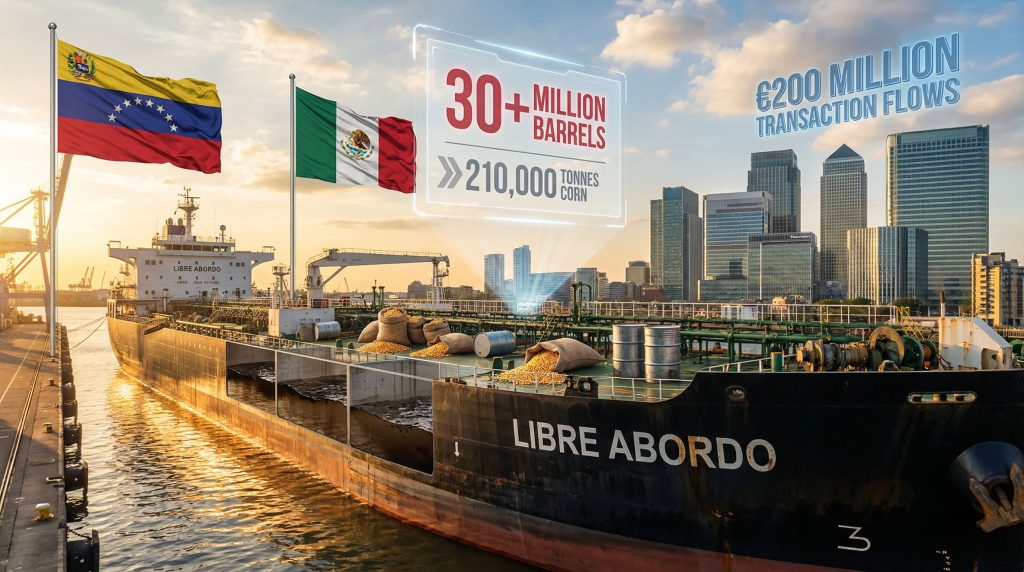
The operational framework began with the creation of intermediary entities positioned as Mexican government-nominated partners for humanitarian exchanges. Libre Abordo, the primary intermediary, was established with corporate documentation claiming authorisation from the Mexican government to execute oil-for-food programs supported by official agencies. This government backing assertion served as the foundational element enabling the arrangement to bypass standard commercial sanctions screening.
According to investigations by El País and Armando.info, the company positioned itself as an entity "named by the Government of Mexico for the humanitarian exchange program of oil for food with Venezuela" to facilitate food product sales between the two nations. The corporate presentation framework claimed that bilateral humanitarian exchanges were "forged through bilateral conversations between the two governments" and asserted that Seguridad Alimentaria Mexicana (Segalmex) had "instructions from the federal government to proceed" with the humanitarian assistance.
Transaction Volume Manipulation Through Price Justification
The mechanics of volume manipulation demonstrated how commodity price volatility could be exploited to justify dramatic increases in oil shipments while maintaining humanitarian classifications. The original agreement called for 2 million barrels of Venezuelan crude in exchange for 210,000 tonnes of corn and 1,000 tanker trucks of drinking water. However, actual oil shipments reached 30+ million barrels between November 2019 and May 2020, representing a 1,400% increase over the contracted volume.
The justification mechanism relied on global crude price declines during the operational period, with Libre Abordo claiming that barter arrangements required higher oil quantities to offset reduced commodity values. This mathematical framework effectively created a mechanism for unlimited volume expansion disguised as humanitarian price adjustment, enabling the extraction of substantial value while maintaining the appearance of charitable assistance.
The transaction value escalation from approximately $100 million to $300+ million occurred while humanitarian goods delivery remained largely unfulfilled. This disparity indicates that the primary transaction motive involved crude monetisation rather than genuine development assistance, with humanitarian framing serving as transactional window dressing for commercial profit extraction.
Network Integration with Government Entities
The sophistication of the sanctions evasion network included integration with official government entities to enhance legitimacy and provide political cover for commercial transactions. Documentation revealed meetings between Joaquín Leal, Libre Abordo's legal representative, and Maximiliano Reyes, then-Deputy Minister of Foreign Affairs for Latin America and the Caribbean, creating an appearance of official authorisation for the arrangement.
The involvement of Segalmex, the Mexican government food agency, provided additional legitimacy through claims of contractual roles in food procurement for humanitarian exchanges. These government entity connections created compliance ambiguity for financial institutions and enforcement authorities, who faced uncertainty regarding whether transactions represented legitimate government-to-government humanitarian assistance or commercial sanctions evasion.
Economic Architecture and Financial Flow Analysis
Quantitative Impact Assessment
The economic implications of the Venezuela Mexican oil sanctions échanges reveal the substantial financial magnitude that sophisticated evasion networks can achieve through regulatory exploitation. In addition, these networks demonstrate how oil price movements can be manipulated to justify increased transaction volumes while maintaining humanitarian classifications.
| Metric | Planned | Actual | Variance |
|---|---|---|---|
| Oil Volume (barrels) | 2,000,000 | 30,000,000+ | +1,400% |
| Corn Deliveries (tonnes) | 210,000 | Largely unfulfilled | -95%+ |
| Water Trucks | 1,000 | No documented delivery | -100% |
| Transaction Value | ~$100 million | $300+ million | +200% |
| Operational Duration | Unspecified | 7 months | N/A |
The operational timeline of November 2019 through May 2020 coincided with significant crude price volatility, creating mathematical justification for volume adjustments while obscuring the commercial nature of the transactions. During this period, global crude benchmarks experienced substantial declines, providing cover for the claimed necessity of increased oil quantities to maintain barter arrangement balance.
Price Arbitrage and Value Extraction Mechanisms
The barter arrangement structure enabled sophisticated arbitrage extraction through multiple mechanisms that converted humanitarian classifications into profit-generating vehicles. The intermediary position between PDVSA (requiring reduced compensation due to sanctions pressure) and international markets (demanding Venezuelan crude at discount rates) created substantial margin opportunities.
The unfulfilled humanitarian obligations represented approximately $20-30 million at 2020 commodity prices for the promised corn deliveries, while the additional 28 million barrels of oil shipped beyond the original contract generated estimated revenues exceeding $200 million. This value differential demonstrates how humanitarian framing functioned as a profit extraction mechanism rather than genuine development assistance.
The European banking system processed approximately €200 million in transaction flows related to these arrangements, utilising correspondent banking relationships that accepted humanitarian transaction classifications without enhanced due diligence on beneficial ownership or transaction purpose verification. The opec production impact on global oil markets during this period further complicated price verification mechanisms.
Market Impact and Secondary Distribution
The 30+ million barrels of Venezuelan crude that entered international markets through this network represented significant quantities relative to Venezuela's constrained export capacity under sanctions. The crude was processed through international shipping networks and ultimately sold to end-users who may have been unaware of the sanctions evasion origins of their purchases.
The secondary market distribution of this crude demonstrates how sanctions evasion networks can inject sanctioned commodities into legitimate supply chains through intermediary washing mechanisms. The fungible nature of crude oil enables this integration, making it extremely difficult for downstream purchasers to identify the ultimate source of their feedstock.
Regulatory Enforcement Failures and Systemic Gaps
Cross-Border Jurisdiction Fragmentation
The enforcement response to the Venezuela Mexican oil sanctions échanges revealed fundamental weaknesses in cross-border regulatory coordination and demonstrated how sophisticated evasion networks exploit jurisdictional fragmentation to maintain operations over extended periods.
The seven-month operational window (November 2019 to June 2020) before US Treasury sanctions were imposed illustrates the time delays inherent in international enforcement mechanisms. During this period, €200 million in suspicious transaction flows moved through European banking systems while enforcement authorities across multiple jurisdictions worked to identify and respond to the sanctions evasion network.
The jurisdictional challenges included several critical elements. First, US authority limitations meant OFAC could designate entities and individuals but possessed limited direct enforcement power over Mexican entities and European banking transactions. Second, Mexican regulatory constraints allowed the Financial Intelligence Unit (UIF) to investigate financial flows but faced judicial limitations in asset freezing and prosecution.
Third, European banking oversight gaps existed because financial institutions had no direct sanctions enforcement authority under US regimes and relied on correspondent banking relationships to trigger compliance protocols. These gaps contributed to broader global trade impact challenges affecting international commerce.
Banking Sector Due Diligence Breakdown
The processing of €200 million in transaction flows through European correspondent banking networks revealed systematic failures in Know Your Customer (KYC) protocols and beneficial ownership verification requirements. Financial institutions accepted transactions classified as humanitarian aid without conducting enhanced due diligence on several critical factors.
Key due diligence failures included beneficial ownership verification gaps where banks failed to identify the ultimate commercial beneficiaries behind humanitarian transaction classifications. Transaction purpose validation weaknesses meant no verification systems existed to confirm that humanitarian transactions actually delivered promised aid.
Correspondent banking relationship exploitation allowed European institutions to process transactions based on classification rather than underlying commercial substance. Finally, humanitarian aid classifications received reduced scrutiny compared to commercial transactions through enhanced screening protocol bypasses.
The humanitarian transaction classifications bypassed standard commercial sanctions screening protocols, creating a pathway for large-scale sanctions evasion that persisted for months before detection.
Asset Recovery and Enforcement Limitations
Following the June 18, 2020 OFAC designation of Libre Abordo and Joaquín Leal, enforcement efforts demonstrated the challenges of asset recovery in cross-border sanctions evasion cases. Despite the UIF investigation into substantial financial flows, reports indicated "limited progress in judicial action within Mexico" and minimal asset recovery from the €200 million in tracked suspicious transactions.
The enforcement limitations included asset distribution timing where substantial value had likely been distributed or hidden prior to sanctions designation. Mexican judicial system gaps meant expedited enforcement mechanisms were insufficient for rapid asset freeze and recovery.
International cooperation delays affected judicial cooperation between Mexican and US authorities, which remained inadequate for effective enforcement. Legal framework deficiencies also existed because Mexican legal systems lacked comprehensive provisions for sanctions-related asset recovery.
Post-Maduro Political Transformation and Market Evolution
Pre-Transition Market Dynamics
The political landscape that enabled sophisticated sanctions evasion networks like the Venezuela Mexican oil sanctions échanges was characterised by systematic isolation from legitimate international markets and reliance on shadow operations for crude oil exports.
Under the Maduro regime, Venezuelan oil exports operated through several constrained mechanisms. Shadow fleet operations involved vessel relabelling and flag-switching practices to obscure cargo origins. Chinese market dependency created heavy reliance on Chinese buyers willing to accept discounted sanctioned crude.
Production capacity constraints from infrastructure deterioration limited output to approximately 1 million barrels per day from pre-sanctions levels of 3+ million barrels per day. Discount pricing requirements meant Venezuelan crude traded at substantial discounts to international benchmarks due to sanctions risk.
Sanctions Architecture Transformation
The 2026 political transition in Venezuela has fundamentally altered the sanctions enforcement landscape, with selective rollback of restrictions under the new US administration creating opportunities for legitimate market reintegration. However, this transition also reveals the long-term infrastructure damage caused by years of sanctions pressure and economic mismanagement.
The transformation demonstrates how tariffs and global markets interconnect with energy sector sanctions to create complex enforcement challenges.
| Previous Market Structure | New Potential Framework | Strategic Implications |
|---|---|---|
| Asia-focused shadow exports | US Gulf Coast refinery access | Enhanced diesel feedstock supply |
| Mandatory discount pricing | Market-rate transaction potential | Revenue optimisation opportunities |
| Shadow fleet logistics | Legitimate shipping channels | Operational transparency requirements |
| Chinese buyer dependency | Diversified customer base | Market risk distribution |
Infrastructure Investment Requirements
The restoration of Venezuelan oil production capacity requires an estimated $100 billion in infrastructure investment over the next decade, representing one of the largest energy sector reconstruction projects in modern history. This investment requirement creates substantial opportunities for international energy companies while also presenting significant political and commercial risks.
Production capacity restoration targets include short-term goals of 2 million barrels per day within 24 months, medium-term targets of 3 million barrels per day within 5 years, and long-term potential of 4 million barrels per day within 10 years.
These targets assume successful infrastructure rehabilitation, political stability maintenance, and sustained international investment flows, all of which remain subject to substantial uncertainty given Venezuela's recent political history.
Heavy Crude Market Integration and Global Supply Dynamics
Venezuelan Heavy Crude Specifications and Refinery Requirements
Venezuelan crude oil consists primarily of heavy grades with API gravity ranging from 8 to 22 degrees, requiring specialised refinery configurations for efficient processing. These specifications create both market opportunities and constraints that influence the strategic value of Venezuelan supply restoration.
The technical characteristics of Venezuelan heavy crude include high sulfur content typically of 2-4% sulfur, requiring extensive desulfurisation processing. High metals content with elevated vanadium and nickel levels demand specialised treatment.
Low API gravity creates dense crude requiring diluent addition for pipeline transport. High processing costs necessitate complex refinery configurations for efficient conversion to finished products.
Global Heavy Crude Competition Analysis
The reintegration of Venezuelan heavy crude into global markets will occur within a competitive landscape that has evolved substantially during the sanctions period. Primary competitors for heavy crude market share include established suppliers with varying capabilities and market positions.
| Supply Source | Production Capacity | Quality Characteristics | Market Position |
|---|---|---|---|
| Canadian Oil Sands | 3.2 million b/d | API 20-22°, Lower metals | Established US market access |
| Mexican Heavy Crude | 800,000 b/d | API 18-22°, Moderate sulfur | Regional proximity advantage |
| Colombian Heavy | 400,000 b/d | API 15-25°, Variable quality | Limited volume availability |
| Venezuelan Potential | 4 million b/d | API 8-22°, High metals | Cost advantage, political risk |
Refinery Configuration and Processing Economics
The economic viability of Venezuelan heavy crude processing depends on refinery configurations specifically designed for high-conversion operations. US Gulf Coast refineries represent optimal processing locations due to their coking and hydrocracking capabilities, while European refineries generally lack sufficient heavy crude processing capacity.
Processing economics considerations include conversion costs of $8-12 per barrel additional processing costs compared to light crude. Product yield optimisation means heavy crude produces higher percentages of diesel and fuel oil relative to gasoline.
Infrastructure requirements involve specialised storage, heating, and blending facilities. Transportation costs arise from pipeline capacity limitations requiring marine transport or diluent addition.
The next major ASX story will hit our subscribers first
Enhanced Compliance Framework Development
Multi-Jurisdictional Enforcement Coordination Improvements
The lessons learned from Venezuela Mexican oil sanctions échanges have highlighted critical needs for enhanced international cooperation in sanctions enforcement, particularly regarding cross-border commodity trading networks that exploit regulatory gaps between jurisdictions.
Proposed coordination improvements include real-time information sharing protocols with automated data exchange systems between treasury departments, financial intelligence units, and banking regulators across key jurisdictions. Standardised beneficial ownership requirements would create unified standards for corporate transparency that prevent shell company structures from obscuring transaction participants.
Enhanced correspondent banking oversight would strengthen requirements for transaction purpose verification in correspondent banking relationships. Coordinated asset recovery procedures would streamline legal frameworks for rapid asset freezing and recovery across multiple jurisdictions.
Technology Solutions for Enhanced Sanctions Monitoring
The scale and complexity of modern sanctions evasion networks require technological solutions that can process vast quantities of transaction data and identify suspicious patterns in real-time. Advanced analytics and blockchain technologies offer potential solutions for enhanced monitoring capabilities.
Key technology applications include artificial intelligence pattern recognition through machine learning systems capable of identifying sanctions evasion networks through transaction flow analysis. Blockchain supply chain tracking would provide immutable ledger systems that can track commodity movements from origin to end-user.
Automated sanctions screening involves real-time screening systems that process transactions against continuously updated sanctions lists. Cross-platform data integration combines shipping data, banking records, and corporate ownership information for comprehensive network analysis.
Corporate Compliance Program Evolution
The sophistication demonstrated by sanctions evasion networks requires corresponding evolution in corporate compliance programs, particularly for companies engaged in international commodity trading or correspondent banking relationships.
Enhanced compliance program elements include enhanced due diligence procedures for comprehensive verification of counterparty beneficial ownership and transaction purposes. Third-party risk management involves systematic assessment of sanctions risks associated with intermediary relationships.
Board-level oversight responsibilities create executive accountability for compliance program effectiveness and sanctions violation prevention. Whistleblower protection enhancement strengthens protections for individuals reporting sanctions evasion activities.
Investment Risk Framework and Market Assessment
Political Risk Evaluation Methodologies
The Venezuela experience demonstrates the critical importance of political risk assessment in energy sector investments, particularly in jurisdictions with recent history of sanctions, political instability, or regime change. Investment decision-making requires sophisticated risk evaluation frameworks that account for multiple political transition scenarios.
Political risk assessment components include regulatory stability analysis to assess likelihood that current sanctions relief will persist through future political transitions. Contract enforcement evaluation analyses legal system capacity to enforce international commercial agreements.
Infrastructure security assessment evaluates physical security risks to energy infrastructure and personnel. Currency and capital controls assess foreign exchange restrictions and profit repatriation capabilities.
Political transitions in major energy-producing nations create both substantial opportunities and significant risks for international investors, requiring careful evaluation of regulatory stability, contract enforcement capabilities, and sanctions reversal sustainability.
Energy Security Implications for Importing Nations
The potential restoration of Venezuelan oil exports creates both opportunities and challenges for energy security planning in importing nations, particularly those seeking to diversify supply sources and reduce dependency on other potentially unstable regions. These considerations directly affect investment market effects across the energy sector.
Energy security considerations include supply diversification benefits where Venezuelan crude provides alternatives to Middle Eastern and Russian supply sources. Infrastructure compatibility requires assessment of whether existing refinery configurations in importing nations may require modification for Venezuelan heavy crude processing.
Strategic reserve considerations involve assessment of Venezuelan crude suitability for strategic petroleum reserve additions. Long-term reliability evaluation analyses Venezuela's capacity to maintain consistent export volumes over multi-decade timeframes.
The integration of Venezuelan crude into global energy security frameworks requires careful balancing of diversification benefits against political and operational risks associated with the country's recent instability and infrastructure challenges. According to sanctions documentation from various international bodies, these considerations remain central to policy development.
Furthermore, detailed analysis of US sanctions on Venezuela reveals the complexity of regulatory frameworks that must be navigated for successful market reintegration. These regulatory considerations continue to evolve as political circumstances change in both Venezuela and key importing nations.
Disclaimer: This analysis contains speculative elements regarding future political developments, market conditions, and regulatory changes. Investment decisions should not be based solely on this assessment and should incorporate comprehensive due diligence and professional financial advice. Political risk assessments are inherently uncertain and subject to rapid change based on evolving circumstances.
Looking to capitalise on complex geopolitical energy market shifts?
Discovery Alert's proprietary Discovery IQ model delivers real-time alerts on significant ASX mineral discoveries, instantly empowering subscribers to identify actionable opportunities across commodities markets that often respond to global supply chain disruptions and sanctions developments. Understand why historic discoveries can generate substantial returns by visiting Discovery Alert's dedicated discoveries page and begin your 30-day free trial today to position yourself ahead of the market.