
June 6, 2026
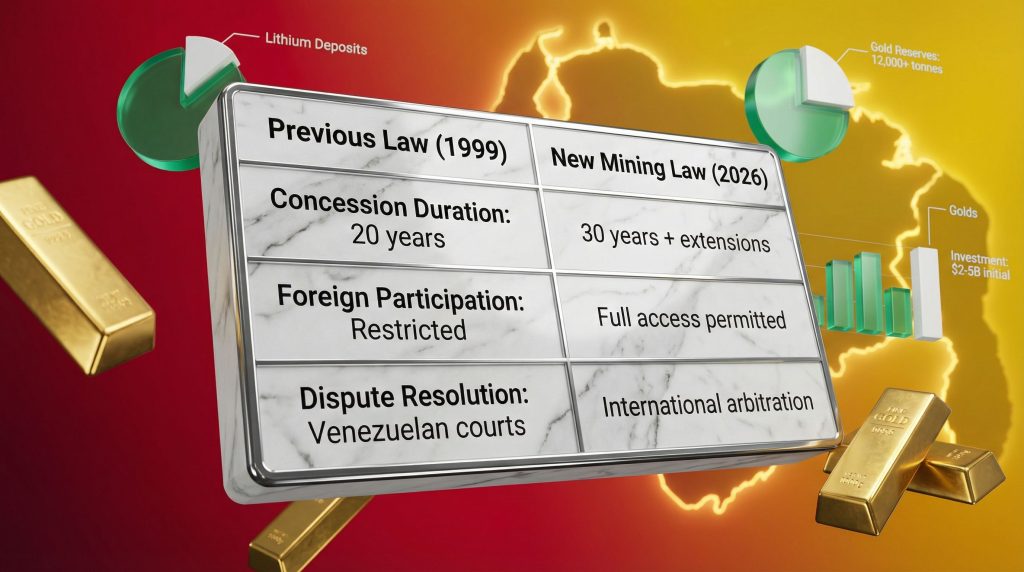
Regulatory Framework Evolution in Latin American Mining Jurisdictions
Mining investment decisions across Latin America increasingly depend on regulatory stability and legal predictability. While traditional mining powerhouses like Chile and Peru have established frameworks attracting billions in foreign capital, emerging jurisdictions face the challenge of balancing resource sovereignty with international investment requirements. The evolution of mining legislation in resource-rich nations reflects broader economic pressures and the growing global demand for strategic minerals essential to energy transition technologies.
Venezuela's position within this regional context presents unique considerations for international mining companies evaluating expansion opportunities. Understanding the interplay between legislative reform, investment protection mechanisms, and operational realities becomes crucial for strategic decision-making in today's volatile commodity markets. Recent developments in venezuela mining law private investment create new opportunities whilst addressing traditional barriers to foreign capital participation.
When big ASX news breaks, our subscribers know first
What Does Venezuela's New Mining Law Mean for Private Investment?
Key Legislative Changes That Transform Mining Access
The transformation of Venezuela's mining regulatory environment represents a significant departure from previous approaches to foreign investment in the extractive sector. Recent legislative developments aim to modernise the country's mining framework through several fundamental changes that could reshape the investment landscape.
Extended concession periods now provide operators with longer-term planning horizons, addressing a primary concern among international mining companies regarding project economics and capital recovery timeframes. The extension of mining rights duration reflects industry evolution trends observed in competitive mining jurisdictions worldwide.
International arbitration mechanisms represent perhaps the most significant change for foreign investors. This shift moves dispute resolution away from domestic court systems towards internationally recognised arbitration bodies, potentially providing greater confidence in contract enforcement and legal predictability.
Streamlined permitting processes aim to reduce bureaucratic delays that have historically complicated project development. The revised framework establishes clearer timelines and standardised procedures for various approval stages, though implementation effectiveness remains to be demonstrated. Furthermore, these improvements align with global mining permitting insights that emphasise regulatory efficiency.
The modified tax structure introduces specific royalty limitations and activity tax parameters designed to provide greater certainty for project economic modelling. These changes reflect efforts to align Venezuelan mining taxation with regional competitors whilst maintaining government revenue objectives, though companies must still navigate complex tax structure challenges common across emerging markets.
Comparison Table: Old vs. New Mining Framework
| Aspect | Previous Framework | Current Proposed Framework |
|---|---|---|
| Concession Duration | Limited terms | Extended periods with renewal options |
| Foreign Participation | Restricted access | Enhanced participation permitted |
| Dispute Resolution | Domestic courts | International arbitration provisions |
| Mineral Rights | Limited scope | Expanded to strategic minerals |
| Tax Structure | Variable rates | Defined royalty and tax parameters |
How Do International Arbitration Provisions Protect Foreign Miners?
Legal Framework Transformation for Investment Security
The introduction of international arbitration mechanisms marks a fundamental shift in how investment disputes would be resolved under the proposed legislative framework. This change addresses long-standing concerns about legal predictability and contract enforcement that have historically deterred foreign investment in Venezuelan mining projects.
International arbitration provides several advantages over domestic court systems for foreign investors. These mechanisms typically offer greater procedural transparency, access to specialised expertise in complex commercial disputes, and enforcement through recognised international treaties and conventions.
The framework establishes procedures aligned with global mining investment practices, potentially reducing perceived political risk associated with Venezuelan mining operations. However, the effectiveness of these provisions depends heavily on their implementation and the country's adherence to international arbitration awards.
Contract enforcement through recognised arbitration bodies could provide additional security for mining companies investing significant capital in long-term projects. The availability of international arbitration may also facilitate access to project financing from international lenders who require strong legal protections. These developments parallel mining permit reforms being implemented in other jurisdictions globally.
Risk Mitigation Strategies for International Investors
Despite legislative improvements, international investors considering Venezuelan mining opportunities must implement comprehensive risk assessment and mitigation strategies. Political risk remains a significant factor requiring careful evaluation and management.
Due diligence requirements under the new legal structure demand thorough analysis of both regulatory compliance and operational feasibility. Companies must assess not only the legal framework but also practical considerations such as infrastructure availability, skilled labour access, and supply chain reliability.
Insurance considerations for Venezuelan mining operations become particularly important given the country's economic and political volatility. Political risk insurance, operational coverage, and comprehensive liability protection represent essential components of any investment strategy.
Contract structuring best practices for emerging market exposure include careful attention to force majeure clauses, currency provisions, and exit mechanisms. These contractual elements can provide additional protection beyond the basic legal framework, particularly important when establishing a mining claims framework in uncertain regulatory environments.
Which Minerals Offer the Greatest Investment Potential Under the New Law?
Strategic Resource Priorities in Venezuelan Geology
Venezuela's geological endowment includes numerous minerals of strategic importance to global markets, though accurate assessment of reserves and development potential requires comprehensive geological surveys and feasibility studies. The country's mining potential spans multiple commodity categories, each presenting distinct opportunities and challenges.
High-Priority Mineral Targets:
- Lithium deposits in southeastern regions represent significant potential given growing battery market demand
- Gold reserves in the Bolívar State mining arc have historical production precedent
- Rare earth element concentrations align with global supply chain diversification efforts
- Diamond extraction opportunities exist in traditional mining areas
- Iron ore deposits benefit from existing infrastructure in some regions
The development potential for these resources depends heavily on factors beyond geological endowment, including infrastructure availability, environmental considerations, and market access logistics. Each commodity requires distinct technical expertise and capital investment profiles.
Production Capacity Analysis by Mineral Type
| Mineral Category | Development Considerations | Infrastructure Requirements | Market Access |
|---|---|---|---|
| Precious Metals | Established mining areas | Variable infrastructure | International markets |
| Battery Minerals | Early-stage exploration | Significant development needed | Growing demand |
| Base Metals | Historical production | Mixed infrastructure | Regional markets |
| Industrial Minerals | Artisanal activity | Limited commercial infrastructure | Domestic and export |
What Are the Fiscal Implications of Venezuela's Mining Tax Structure?
Revenue Sharing Models and Investor Returns
The proposed fiscal framework for Venezuelan mining operations introduces structured approaches to revenue sharing between the government and private operators. These arrangements aim to balance government revenue objectives with investment attractiveness for international companies.
Royalty calculations based on gross production value methodology provide transparency in government revenue determination, though the economic impact depends on commodity prices and production volumes. This approach aligns with international mining taxation practices whilst maintaining revenue predictability for government budgeting.
Primary activity tax applications and exemptions create additional considerations for project economics. The interaction between various tax components requires careful modelling to understand total fiscal impact on project returns and investment decisions.
Comparison with regional mining tax regimes reveals Venezuela's positioning relative to competitors like Colombia, Peru, and Chile. Understanding these competitive dynamics helps investors evaluate relative attractiveness across potential investment destinations.
Economic Incentives for Different Investment Scales
The legislative framework recognises that mining projects vary significantly in scale, capital requirements, and economic impact. Different incentive structures may apply depending on project characteristics and strategic importance.
Small-scale operation benefits could include simplified regulatory procedures and reduced administrative burden, though these operators may face limitations in terms of concession area and production capacity. The framework aims to support artisanal and small-scale mining whilst maintaining safety and environmental standards.
Large-scale development advantages may include access to extended concession terms, infrastructure development support, and streamlined approvals for significant capital investments. These projects typically require substantial upfront investment but offer greater production potential and economic impact.
Joint venture structures with state entities represent another option for foreign investors seeking to enter the Venezuelan market. These arrangements can provide local expertise and political risk mitigation whilst sharing development costs and operational responsibilities.
How Does Political Stability Affect Mining Investment Decisions?
Governance Risk Assessment Framework
Political stability represents a critical factor in mining investment decisions, particularly for projects requiring substantial upfront capital and extended development timeframes. Venezuela's political environment presents unique challenges that require careful assessment and ongoing monitoring.
Historical precedent analysis reveals patterns of policy changes that have affected foreign investment in Venezuelan extractive industries. Understanding these precedents helps investors evaluate the likelihood of regulatory continuity and contract enforcement under different political scenarios.
Institutional capacity for contract enforcement depends not only on legal frameworks but also on the practical ability of government institutions to implement and maintain consistent policies. This capacity varies across different levels of government and regulatory agencies.
Regulatory predictability under current administration requires assessment of policy priorities, economic pressures, and international relations. Changes in government leadership or economic conditions can significantly impact mining policy and investment climate. According to Reuters, Venezuela's National Assembly has approved mining legislation designed to open the sector to foreign investment, marking a significant policy shift.
Due Diligence Considerations for Mining Companies
Critical Risk Factors Requiring Evaluation:
- Asset nationalisation history and current legal protections against expropriation
- Currency controls and mechanisms for capital repatriation
- Infrastructure reliability and ongoing maintenance requirements
- Local community relations and social licence considerations
- Environmental compliance and restoration obligations
- Security concerns and operational safety requirements
Each of these factors requires specialised expertise and ongoing monitoring throughout the investment period. Risk assessment must consider both current conditions and potential future scenarios that could affect project viability.
The next major ASX story will hit our subscribers first
What Infrastructure Challenges Face Venezuelan Mining Development?
Transportation and Logistics Network Analysis
Infrastructure represents one of the most significant challenges for Venezuelan mining development, affecting both project economics and operational feasibility. The country's infrastructure has experienced substantial deterioration, requiring comprehensive assessment and potential investment for mining project success.
Port facilities capacity for mineral exports varies significantly across Venezuela's coastline, with some facilities requiring substantial renovation or expansion to handle large-scale mining operations. Access to international shipping routes remains available but may require infrastructure investment.
Railroad connectivity to major mining regions exists in some areas but requires evaluation of current condition and capacity. Rail transport can provide cost-effective bulk commodity movement when properly maintained and operated.
Road network conditions affect both construction and operational phases of mining projects. Many mining regions require improved road access for equipment transport and product evacuation, representing significant additional investment requirements.
Power grid reliability presents ongoing challenges for industrial operations requiring consistent electricity supply. Mining operations must evaluate grid stability and consider backup power generation or off-grid solutions.
Technology and Equipment Import Considerations
The importation of mining equipment and technology involves multiple regulatory and logistical considerations that can significantly impact project timelines and costs. Understanding these requirements is essential for project planning and budgeting.
Customs procedures for mining machinery require familiarity with Venezuelan import regulations, documentation requirements, and potential delays. These procedures can be complex and time-consuming, affecting project development schedules.
Local content requirements and sourcing options may apply to certain project components, requiring assessment of domestic supplier capability and capacity. Balancing local content obligations with technical requirements and quality standards presents ongoing challenges.
Technical expertise availability in the domestic market affects both construction and operational phases. International companies may need to provide training and technology transfer to develop local capabilities.
How Do Environmental Regulations Impact Mining Operations?
Compliance Framework Under New Mining Law
Environmental regulations represent a critical component of the proposed mining framework, establishing requirements for assessment, monitoring, and remediation throughout the project lifecycle. These requirements align with international standards whilst addressing Venezuela's specific environmental concerns.
Environmental impact assessment requirements establish procedures for evaluating potential effects of mining operations on local ecosystems and communities. These assessments must demonstrate compliance with environmental standards and propose mitigation measures for identified impacts.
Restoration and rehabilitation obligations extend beyond the operational phase, requiring long-term planning and financial provisioning for site closure and remediation. These obligations represent significant financial commitments that must be incorporated into project economics.
Water usage permits and monitoring systems address concerns about water resource protection and sustainable use. Mining operations must demonstrate responsible water management practices and ongoing environmental monitoring.
Indigenous territory considerations require consultation and agreement processes with affected communities. These requirements reflect international standards for indigenous rights and free, prior, and informed consent principles.
Sustainability Standards for International Investors
International mining companies increasingly face pressure from investors, lenders, and stakeholders to demonstrate compliance with environmental, social, and governance (ESG) standards. These requirements extend beyond regulatory compliance to encompass broader sustainability considerations.
ESG reporting requirements for foreign companies operating in Venezuela must align with both local regulations and international standards expected by global investors and lenders. This dual compliance requirement can create additional administrative burden and costs.
International certification standards applicability depends on specific commodity markets and customer requirements. Many mining products require certification of responsible sourcing and environmental compliance for access to premium markets.
Community development obligations represent an increasingly important component of mining project approval and social licence maintenance. Companies must demonstrate positive economic and social impact for local communities. As reported by BNamericas, whilst Venezuela opens mining to private players with new legislation, significant governance risks remain.
What Timeline Should Investors Expect for Mining Project Development?
Permitting and Approval Process Stages
Mining project development involves multiple sequential and overlapping phases, each with distinct regulatory requirements and approval processes. Understanding typical timelines helps investors plan capital deployment and project financing arrangements.
Initial exploration licence applications represent the first formal step in project development, involving geological assessment permissions and preliminary environmental review. This phase establishes basic project parameters and development potential.
Feasibility study requirements encompass detailed technical, economic, and environmental analysis demonstrating project viability and compliance with regulatory standards. These studies form the foundation for subsequent permitting and financing decisions.
Construction permits and environmental clearances require comprehensive documentation of project design, environmental impact mitigation, and operational procedures. These approvals typically represent the most complex and time-consuming portion of the permitting process.
Operational licensing and production startup involve final regulatory approval and commissioning of production facilities. This phase includes testing, training, and demonstration of compliance with operational standards.
Investment Deployment Phases and Capital Requirements
| Development Phase | Typical Duration | Capital Considerations | Key Risk Factors |
|---|---|---|---|
| Exploration | 2-4 years | Limited capital exposure | Geological uncertainty |
| Feasibility | 1-3 years | Moderate investment | Regulatory changes |
| Construction | 3-6 years | Major capital commitment | Cost escalation |
| Operations | 15-30 years | Ongoing capital needs | Commodity price volatility |
Frequently Asked Questions About Venezuela Mining Investment
Can Foreign Companies Own 100% of Mining Operations?
Foreign ownership structures under the proposed mining legislation allow for various arrangements depending on project characteristics and strategic importance. Whilst full foreign ownership may be possible in some cases, partnership arrangements with Venezuelan entities could provide operational advantages and risk mitigation.
Ownership structure options include wholly-owned subsidiaries, joint ventures with state or private entities, and concession arrangements with varying terms and conditions. Each structure presents distinct legal, financial, and operational implications requiring careful evaluation.
Control mechanisms for international investors must balance foreign company requirements for operational control with Venezuelan regulatory expectations and local stakeholder interests. These arrangements require careful negotiation and legal structuring.
How Are Mining Revenues Repatriated?
Revenue repatriation represents a critical consideration for international mining investments, particularly in countries with currency controls or foreign exchange restrictions. The proposed framework aims to provide greater clarity and predictability for capital movement.
Currency exchange mechanisms and procedures must comply with Venezuelan foreign exchange regulations whilst providing reasonable access to international markets for revenue conversion and repatriation. These mechanisms require ongoing monitoring and compliance management.
Central bank approval processes may apply to certain types of transactions or amounts, requiring understanding of regulatory requirements and timeline expectations. Companies must plan for potential delays or restrictions in approval processes.
What Happens to Existing Mining Concessions?
The transition from previous regulatory frameworks to new legislation requires careful consideration of existing rights and obligations. Grandfathering provisions and transition mechanisms aim to provide continuity for existing operations whilst implementing new standards.
Transition provisions for current licence holders establish procedures for converting existing rights to the new framework whilst maintaining operational continuity. These provisions aim to protect existing investments whilst implementing improved standards.
Renewal processes under the new legal framework provide opportunities for existing operators to extend operations under updated terms and conditions. These processes may offer advantages for companies demonstrating successful compliance and community relations.
Evaluating Venezuela's Mining Investment Landscape
Strategic Considerations for International Mining Companies
The decision to invest in Venezuelan mining opportunities requires comprehensive analysis of multiple factors beyond the basic legislative framework. Companies must evaluate risk-adjusted returns, portfolio implications, and long-term strategic objectives when considering market entry.
Risk-adjusted return calculations for Venezuelan projects must account for political, operational, and market risks that may not be present in more stable jurisdictions. These calculations require sensitivity analysis and scenario planning to understand potential outcomes under different conditions.
Portfolio diversification benefits and concentration risks depend on company-specific circumstances and existing geographic exposure. Venezuelan operations could provide commodity diversification or geographic exposure benefits whilst potentially increasing overall portfolio risk.
Timing considerations for market entry strategies must balance first-mover advantages with regulatory uncertainty and operational challenges. Companies may benefit from phased entry approaches that allow for learning and risk assessment before major capital commitments.
Long-term commitment requirements for successful operations extend beyond initial investment to encompass ongoing community relations, environmental stewardship, and regulatory compliance. Success in challenging jurisdictions typically requires sustained commitment and local relationship building. The venezuela mining law private investment reforms represent a significant shift towards greater foreign participation whilst addressing traditional barriers to international capital.
Disclaimer: This article discusses proposed legislative changes and potential investment opportunities based on publicly available information. Mining investments involve substantial risks including political, regulatory, operational, and market risks. Investors should conduct comprehensive due diligence and seek professional advice before making investment decisions. Past performance and government policy statements do not guarantee future results or regulatory stability.
Ready to Capitalise on Emerging Mining Opportunities?
Discovery Alert's proprietary Discovery IQ model delivers real-time alerts on significant ASX mineral discoveries, instantly empowering subscribers to identify actionable opportunities ahead of the broader market. Understand why major mineral discoveries can lead to substantial returns by exploring Discovery Alert's dedicated discoveries page, showcasing historic examples of exceptional outcomes, and begin your 14-day free trial today to position yourself ahead of the market.