June 30, 2026
Venezuela's Offshore Energy Potential Emerges as Regional Game-Changer
Deep beneath Venezuela's Caribbean seafloor lies an energy treasure that could fundamentally reshape South American geopolitics. While global attention fixates on the nation's renowned petroleum reserves, a growing coalition of industry strategists argues that natural gas represents the more immediate pathway to economic transformation. Venezuela's gas potential offers unprecedented opportunities for regional energy integration and economic diversification.
When big ASX news breaks, our subscribers know first
Market Dynamics Driving Regional Energy Leadership
Venezuela's offshore gas deposits represent one of the most underexploited hydrocarbon resources in the Western Hemisphere. Current production patterns reveal a striking contradiction between resource abundance and commercial utilisation, with the nation holding substantial reserves yet maintaining zero market share in liquefied natural gas exports.
The strategic positioning becomes clearer when examining regional consumption patterns. Colombia alone imports significant volumes of natural gas to meet domestic demand, while Caribbean nations rely heavily on costly fuel oil imports for power generation. This market structure creates immediate monetisation opportunities for Venezuelan gas development, particularly through cross-border pipeline systems and regional distribution networks.
Regional Gas Market Fundamentals:
• Trinidad and Tobago currently dominates Caribbean LNG exports
• Colombian gas demand exceeds domestic production capacity
• Caribbean power generation depends on expensive liquid fuel imports
• Regional processing infrastructure remains underutilised
Shell's recent commitment to the Dragon field development illustrates the commercial viability of these resources. The multinational energy company has structured its investment around existing Trinidad infrastructure, demonstrating how strategic partnerships can accelerate market entry while minimising capital requirements.
Furthermore, this development model aligns with broader global resources expo discussions regarding resource optimisation strategies.
Infrastructure Integration and Cross-Border Cooperation Models
The most compelling aspect of Venezuela's gas potential lies not in standalone development but in regional infrastructure optimisation. Trinidad and Tobago possesses established liquefaction terminals, export facilities, and distribution networks that could immediately accommodate Venezuelan gas volumes without major capital expansion.
This integration model offers several competitive advantages over traditional greenfield projects:
Operational Benefits:
• Reduced development timelines from years to months
• Lower capital intensity through shared infrastructure
• Established customer relationships and marketing channels
• Proven regulatory frameworks for international gas trade
The Dragon field serves as the primary test case for this cooperation model. Shell's 30-year production licence establishes the contractual foundation for bilateral energy integration, with Venezuela receiving approximately 45% of project revenues through taxes and royalties.
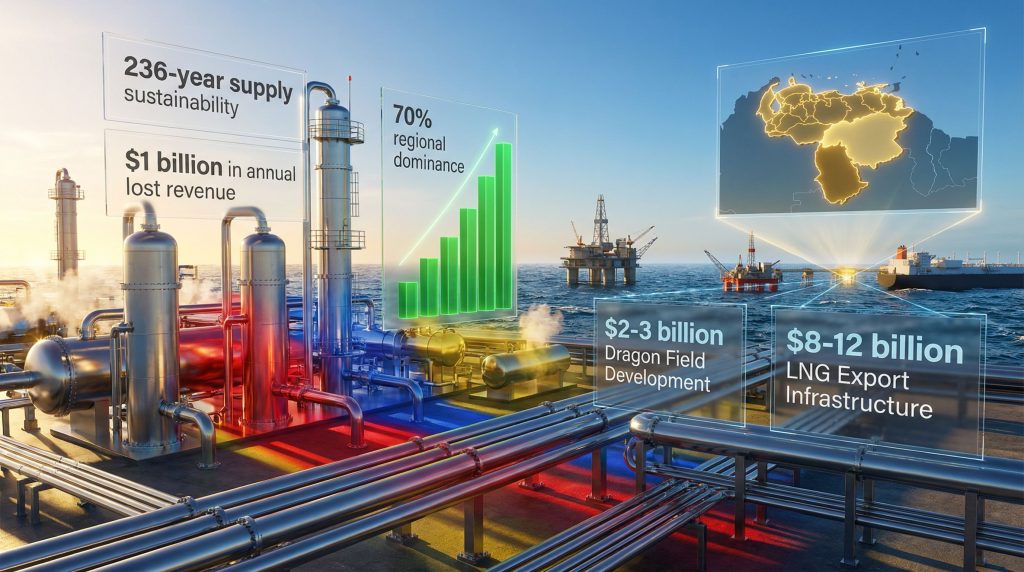
At current natural gas pricing, this arrangement generates roughly $500 million in annual total revenue, providing Venezuela with minimum guaranteed income of $225 million per year from a single field development.
Investment Requirements and Development Economics
Capital allocation strategies for Venezuelan gas development reveal significant variations depending on the chosen development pathway. Fast-track approaches utilising Trinidad's existing infrastructure require substantially lower initial investment compared to standalone Venezuelan facilities.
| Development Approach | Capital Investment | Timeline | Annual Revenue Potential |
|---|---|---|---|
| Dragon-Trinidad Integration | $2-3 billion | 18-24 months | $500 million |
| Colombian Pipeline Restoration | $800 million-1.2 billion | 12-18 months | $700-800 million |
| Independent LNG Terminal | $8-12 billion | 4-6 years | $2-4 billion |
The economic rationale for prioritising gas over oil becomes evident when examining development complexity. Venezuelan crude oil requires extensive refining infrastructure and faces quality challenges that increase processing costs. Natural gas, conversely, can be monetised through relatively straightforward processing and transportation systems.
Shell CEO Wael Sawan emphasised this advantage in recent investor communications, noting that Dragon field opportunities could potentially be activated within months rather than years, with production beginning in the next couple of years following initial investment. Additionally, these developments could influence broader US natural gas forecast patterns for 2025.
Processing Capacity Constraints and Technical Solutions
Venezuela's current inability to independently process and export natural gas creates both challenges and opportunities. The processing capacity deficit necessitates international partnerships but simultaneously enables rapid deployment through existing regional infrastructure.
Critical Infrastructure Gaps:
• Onshore processing and compression facilities
• LNG liquefaction terminal capacity
• Export pipeline network connectivity
• Storage and distribution systems
Trinidad's National Gas Company (NGC) involvement in the Shell licensing agreement demonstrates how bilateral partnerships can address these infrastructure limitations. Rather than constructing parallel Venezuelan facilities, the integration model leverages Trinidad's Point Lisas industrial complex and Atlantic LNG terminals.
This approach transforms infrastructure constraints into competitive advantages by reducing both capital requirements and operational complexity. The short pipeline connection between Dragon and Trinidad eliminates the need for extensive onshore Venezuelan infrastructure development.
Consequently, this model could create significant LNG supply opportunities throughout the region.
Strategic Partnership Frameworks and Regional Integration
Energy cooperation between Trinidad and Venezuela represents more than bilateral resource sharing. The partnership model establishes a framework for Caribbean-wide energy integration that could fundamentally alter regional energy security dynamics.
U.S. Energy Secretary Chris Wright characterised the collaboration as creating benefits spanning multiple stakeholders: Trinidad and Tobago gains additional feedstock for existing facilities, global LNG markets receive new supply sources, and Venezuela generates substantial export revenues.
Bilateral Partnership Benefits:
• Trinidad: Optimised utilisation of processing capacity
• Venezuela: Immediate market access without infrastructure investment
• Regional Markets: Diversified supply sources and enhanced energy security
• Global LNG Trade: Additional supply flexibility and price competition
However, successful implementation faces several political and operational challenges. Trinidad and Tobago has historically aligned with U.S. sanctions policies regarding Venezuelan energy, while language barriers and differing regulatory frameworks complicate operational integration.
The evolving U.S. sanctions environment creates new opportunities for energy cooperation. Recent Treasury Department guidance provides greater operational flexibility for international companies pursuing Venezuelan gas projects, as noted by Centre for a New American Security analyst Rachel Ziemba.
What Are the Colombian Market Integration Opportunities?
Colombia represents another critical market for Venezuelan gas exports, with existing cross-border pipeline infrastructure that could be rehabilitated and expanded. Historical gas trade between the countries demonstrates proven demand patterns and established commercial relationships.
Colombian gas consumption patterns reveal significant import requirements that Venezuelan supplies could fulfil. The country's industrial sector, power generation facilities, and residential markets collectively create demand exceeding domestic production capacity.
Market Integration Opportunities:
• Cross-border pipeline capacity expansion
• Industrial customer development programmes
• Power generation fuel switching initiatives
• Residential and commercial market penetration
Pipeline rehabilitation costs appear substantially lower than new infrastructure construction, making Colombian market access particularly attractive from an investment perspective. Estimated capital requirements of $800 million to $1.2 billion could generate annual export revenues of $700-800 million.
Moreover, these developments could significantly impact the Canada energy transition through enhanced North American energy security.
Production Optimisation and Waste Reduction Strategies
Current Venezuelan gas production practices result in significant economic waste through flaring and venting operations. Industry estimates suggest that flaring practices waste approximately 46% of associated gas production, representing lost revenue equivalent to Colombia's entire annual gas consumption.
According to research from Colombia's Energy Policy Institute, gas flaring in Venezuela destroys approximately $1 billion in potential annual revenue while simultaneously contributing to environmental degradation and carbon emissions.
Associated gas recovery from oil production operations offers immediate monetisation opportunities without major exploration investment. Enhanced capture and processing systems could rapidly increase available gas volumes for export markets.
Waste Reduction Technologies:
• Advanced separation and capture systems
• Gas-to-power conversion projects
• Carbon capture and utilisation initiatives
• Digital monitoring and optimisation platforms
The scale of current waste suggests that optimisation efforts alone could generate substantial additional gas volumes without new field development. This represents a particularly attractive opportunity given the minimal capital investment required for enhanced recovery systems.
Associated Gas Recovery and Enhanced Oil Recovery Integration
Venezuelan oil production generates substantial associated gas volumes that are currently underutilised. Integrated recovery systems could simultaneously increase oil production efficiency while capturing gas for commercial sale.
Enhanced oil recovery (EOR) techniques utilising captured gas create dual revenue streams from single operations. Gas injection systems can maintain reservoir pressure while excess volumes are diverted to processing and export facilities.
This integration model offers several operational advantages:
• Operational Synergies: Shared infrastructure and processing systems
• Revenue Diversification: Multiple product streams from single operations
• Environmental Benefits: Reduced flaring and improved resource utilisation
• Technical Efficiency: Optimised reservoir management and production profiles
Market Entry Scenarios and Competitive Positioning
International energy companies are positioning for Venezuelan gas development through various strategic approaches. Shell's Dragon field commitment represents the most advanced project, while BP pursues development opportunities in the Cocuina field.
These major company investments signal broader industry confidence in Venezuela's gas potential despite ongoing political uncertainties. The participation of established international operators provides technical expertise and financial resources that domestic companies cannot independently mobilise.
Competitive Landscape Analysis:
• Shell: Dragon field development with Trinidad integration
• BP: Cocuina field exploration and development planning
• Regional Players: Local partnerships and joint venture opportunities
• State Companies: Government participation and revenue optimisation
Market entry timing appears critical given evolving sanctions frameworks and regional energy demand patterns. Early movers may secure preferential terms and strategic positioning advantages as Venezuelan gas markets develop.
Export Market Development and Customer Acquisition
Venezuelan gas export success depends heavily on customer development and long-term contract negotiation. Regional markets offer immediate opportunities, while global LNG trade provides longer-term growth potential.
Caribbean power generation markets represent particularly attractive targets given current reliance on expensive liquid fuels. Natural gas conversion projects could provide significant cost savings while improving environmental performance.
Target Market Segments:
• Industrial customers requiring reliable gas supplies
• Power generation facilities seeking fuel cost optimisation
• LNG export markets demanding additional supply sources
• Regional distributors serving residential and commercial customers
Contract structures must balance price competitiveness with revenue stability. Take-or-pay agreements provide revenue certainty while spot market sales capture price upside during favourable market conditions.
The next major ASX story will hit our subscribers first
Economic Impact Assessment and National Transformation
Full development of Venezuela's gas potential could fundamentally transform the nation's economic structure. Current dependence on oil exports creates vulnerability to price volatility and market disruption, while gas development offers diversification benefits.
Economic modelling suggests that comprehensive gas development could generate substantial foreign exchange earnings while creating employment across multiple sectors. Upstream development, midstream processing, and downstream applications each contribute to economic activity and job creation.
Economic Development Impacts:
• Direct Employment: Exploration, production, and processing operations
• Indirect Employment: Supporting services and supply chain activities
• Government Revenue: Taxes, royalties, and participation agreements
• Foreign Investment: International capital and technology transfer
Gas revenue streams typically demonstrate greater stability than oil markets due to long-term contract structures and regional demand patterns. This stability could provide Venezuela with more predictable fiscal planning capabilities.
Furthermore, analysis from Franklin Templeton indicates that while Venezuela oil and gas optionality is large, the rebuild is capital-intensive.
Foreign Exchange Earnings and Balance of Payments Benefits
Natural gas exports would generate substantial foreign currency earnings that could support broader economic stabilisation efforts. Current account improvements from gas exports could strengthen currency stability and import capacity.
The timing of gas revenue generation appears particularly favourable given current global energy market conditions. LNG pricing remains elevated compared to historical averages, while regional demand continues expanding across multiple market segments.
Financial Benefits Analysis:
• Immediate foreign exchange generation from early projects
• Long-term revenue stability through contract structures
• Diversified export portfolio reducing oil dependence
• Enhanced creditworthiness for international financing
However, these developments could also be influenced by broader tariffs impact markets trends affecting global trade patterns.
Regulatory Environment and Investment Climate Considerations
Venezuelan gas development success requires supportive regulatory frameworks that encourage international investment while protecting national interests. Current policy evolution suggests growing recognition of gas sector potential.
Recent U.S. policy changes provide greater operational flexibility for international companies pursuing Venezuelan energy projects. Treasury Department guidance allows expanded business activities while maintaining oversight of sensitive technologies and financial transactions.
Policy Framework Requirements:
• Foreign investment protection mechanisms
• Technology transfer facilitation
• Environmental compliance standards
• Revenue sharing optimisation structures
Joint venture frameworks must balance international company requirements with Venezuelan sovereignty considerations. Successful structures typically provide operational control to international partners while ensuring appropriate government participation.
Sanctions Evolution and Investment Protection
The evolving U.S. sanctions framework creates both opportunities and uncertainties for Venezuelan gas development. Current licensing approaches provide operational flexibility while maintaining oversight capabilities.
Investment protection mechanisms become critical for major capital commitments in uncertain political environments. International arbitration frameworks and political risk insurance can help mitigate investor concerns while facilitating project financing.
Risk Mitigation Strategies:
• International arbitration clause inclusion
• Political risk insurance coverage
• Phased investment approaches with milestone-based commitments
• Diversified partnership structures spreading political exposure
Future Market Positioning and Strategic Outlook
Venezuela's gas potential as a significant LNG exporter could challenge established market dynamics. Geographic proximity to major consuming regions provides competitive advantages over distant suppliers.
Western Hemisphere gas markets are experiencing supply tightening as traditional sources mature and new project development faces various constraints. Venezuelan entry could provide supply diversity and price competition benefits for regional consumers.
Strategic Market Positioning:
• Geographic Advantages: Proximity to U.S. Gulf Coast and Caribbean markets
• Supply Diversification: Alternative to North American and Middle Eastern sources
• Cost Competitiveness: Lower transportation costs to regional markets
• Timing Opportunities: Market entry during supply constraint periods
Long-term success requires sustained investment in exploration, development, and infrastructure expansion. Initial projects like Dragon provide proof-of-concept demonstrations that could attract additional international investment.
How Could Venezuela Impact Global LNG Markets?
Venezuelan gas development could impact global LNG market balance by adding significant new supply capacity. Current market tightness creates favourable conditions for new supply sources, particularly those offering geographic and political diversification.
The scale of potential Venezuelan gas resources suggests the country could eventually rank among major global LNG exporters. However, realising this potential requires sustained political stability, continued international investment, and progressive infrastructure development.
Market Impact Projections:
• Regional supply diversification benefits
• Enhanced price competition in Western Hemisphere markets
• Reduced dependence on traditional Middle Eastern suppliers
• Improved energy security for importing nations
In conclusion, the transformation of Venezuela into a regional gas powerhouse could create ripple effects throughout global energy markets, offering both opportunities and challenges for established players and emerging economies alike.
Disclaimer: This analysis is based on publicly available information and industry estimates. Actual development outcomes may vary significantly due to political, technical, and market factors. Investors should conduct independent due diligence and consider professional advice before making investment decisions.
Looking to Capitalise on South American Energy Transitions?
Discovery Alert's proprietary Discovery IQ model provides instant notifications when ASX-listed companies announce significant discoveries in energy commodities and critical minerals, helping investors position themselves ahead of major market movements. Explore historic examples of how major discoveries have delivered substantial returns, then begin your 14-day free trial to gain immediate access to real-time alerts and actionable investment insights.