August 6, 2026
The Geopolitics of Heavy Oil: Why Venezuela's Return Changes Everything
The global oil market has spent years reconfiguring itself around absence. When a nation holding the largest proven reserves on earth effectively drops out of the compliant supply system, refiners adapt, shipping routes shift, and pricing differentials widen to absorb the gap. What happens when that nation re-enters? The answer is not simply a volume story. It is a structural realignment that touches refinery economics, tanker markets, geopolitical risk premiums, and the long-term investment calculus of every major international oil company with exposure to heavy crude.
That realignment is now underway in Venezuela. The Venezuela oil deals and exports rebound of 2026 represents one of the most consequential supply-side developments of the decade, not because of the barrels already flowing, but because of what the trajectory implies for markets, rivals, and the architecture of Western energy strategy in Latin America.
When big ASX news breaks, our subscribers know first
How a Superproducer Became a Ghost: The Structural Collapse of Venezuela's Oil Sector
At its peak in the late 1990s, Venezuela produced approximately 3.2 million barrels per day, making it one of the most significant oil exporters in the Western Hemisphere. By late 2025 and early 2026, that figure had contracted to somewhere between 498,000 and 666,000 barrels per day, a collapse so severe it effectively removed Venezuela from the list of consequential global suppliers.
The deterioration was not a single event but a compounding sequence of failures. PDVSA, Venezuela's state oil company, suffered chronic underinvestment across its upstream infrastructure, pipeline network, and upgrader facilities over more than a decade. Sanctions imposed during the first Trump administration severed access to U.S. financial systems, technology, and equipment. International oil companies with existing Venezuelan operations quietly reduced exposure or exited entirely as the legal and compliance environment became unmanageable.
What filled the void was a network of shadow-fleet tankers: older, often uninsured vessels operating outside conventional maritime insurance frameworks and banking channels. These ships allowed minimal export volumes to continue flowing, primarily to buyers willing to accept the legal ambiguity, but they imposed a ceiling on production incentives. When legitimate infrastructure investment cannot enter and compliant buyers cannot participate without sanctions exposure, there is no commercial logic for expanding output.
The dark fleet sustained Venezuela as an oil exporter in a technical sense while simultaneously ensuring the sector could not grow. Furthermore, the Venezuela and PDVSA policy shift under the Trump administration created the conditions necessary for the eventual reopening of compliant channels.
The Political Break: January 2026 and the Normalisation Trigger
The political transition that removed Nicolás Maduro from power on January 3, 2026, and established acting President Delcy Rodríguez as the interim head of government served as the critical inflection point for the sector. Within weeks, major international oil companies were already seeking U.S. Treasury licences to re-engage with Venezuelan projects. Shell and BP moved almost immediately, signalling interest in offshore gas developments that had been stalled for years.
The transition from shadow shipping to legally insured, bank-cleared tanker logistics was not automatic, but it was rapid. Once the compliance environment shifted, institutional capital could move. Trading houses, which had absorbed the reputational and legal risks of Venezuelan crude during the sanctions period, found themselves joined by the very majors they had effectively replaced.
"The barrels were always there. What changed was the legal infrastructure enabling their compliant movement to market."
Venezuela's Export Surge: What the Numbers Actually Show
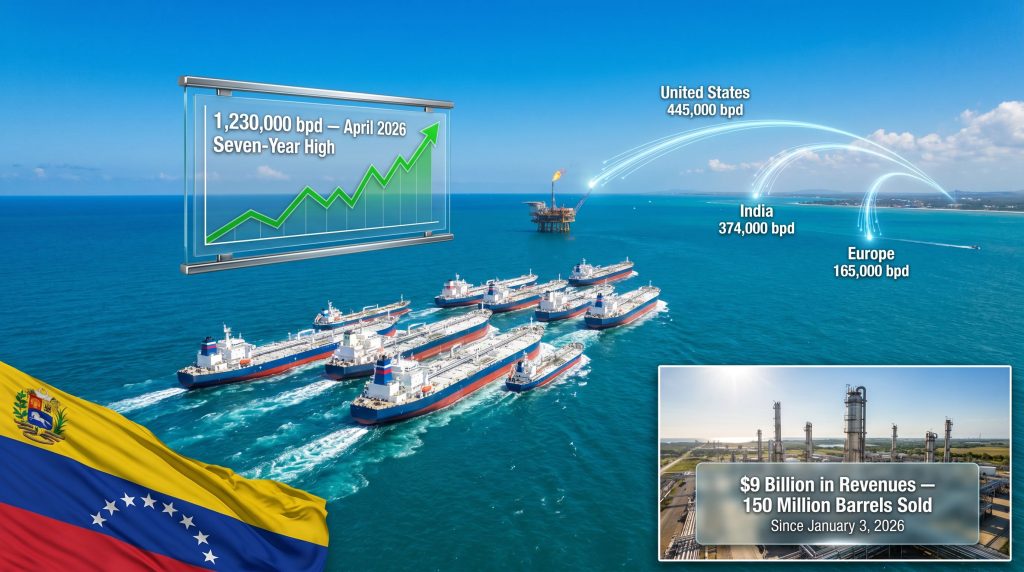
Venezuela's crude exports averaged 1.23 million barrels per day in April 2026, the highest level recorded in more than seven years and a 14% increase from March volumes. The trajectory since the political transition has been steep and consistent. According to shipping data tracking Venezuela's export climb, April's figures confirmed a breakout from the trough conditions of 2025.
| Metric | February 2026 | March 2026 | April 2026 |
|---|---|---|---|
| Total Crude Exports (bpd) | ~737,000 | ~1,090,000 | 1,230,000 |
| Month-on-Month Change | — | +48% | +14% |
| Benchmark Reference | — | — | Highest since pre-sanctions era |
The acceleration from February to March, at approximately 48%, reflects the initial reopening of compliant shipping channels and the return of established buyers. The moderation to 14% growth in April is consistent with the natural constraints of scaling production in an infrastructure-limited environment, not a signal of demand weakness.
The Naphtha Dependency: An Underappreciated Technical Constraint
One of the least-discussed dimensions of the Venezuela oil deals and exports rebound is the diluent dependency. Orinoco Belt crude is classified as extra-heavy oil, meaning it has an API gravity typically below 10 degrees and viscosity far too high to flow through pipelines or load onto tankers without blending with a lighter hydrocarbon. Naphtha, a refined petroleum product, is the primary diluent used in Venezuelan operations.
In April 2026, naphtha imports reached approximately 141,000 barrels per day, a figure that reflects both the scale of export operations and a structural vulnerability. Every barrel of naphtha imported represents a cost, a supply chain dependency, and a potential bottleneck. If naphtha supply is disrupted, upstream production cannot reach loading terminals regardless of reservoir conditions or workforce availability. This dependency functions as an invisible ceiling on export growth.
The Companies Betting Billions on Venezuela's Comeback
The return of international capital to Venezuela has been broad-based and, in some cases, surprisingly aggressive. The following companies have made formal commitments since January 2026:
| Company | Origin | Key Asset | Resource Scale |
|---|---|---|---|
| Shell | Netherlands/UK | Dragon Field (offshore gas) | ~4.5 trillion cubic feet |
| BP | UK | Cocuina-Manakin + Loran exploration | ~1 tcf (Cocuina-Manakin); 7.3 tcf Venezuelan share of Loran-Manatee |
| Eni | Italy | Junin-5 (Orinoco Belt) | 35 billion barrels certified in place |
| Repsol | Spain | Orinoco heavy crude blocks | Current 45,000 bpd; tripling targeted over 3 years |
| Chevron | United States | Expanded joint ventures | ~25% of April 2026 export volumes handled |
| Hunt Overseas Oil | United States | Monagas, Anzoategui, Barinas | Heavy crude and associated gas |
| Crossover Energy | United States | Monagas, Anzoategui, Barinas | Associated gas to power generation |
The scale of these commitments is remarkable, particularly given the billions in oil deals that international players are now racing to secure across Venezuela's upstream landscape.
Shell's Dragon Field: Stranded Gas Becomes Atlantic LNG
Dragon is an offshore natural gas field straddling the maritime boundary between Venezuela and Trinidad and Tobago, containing an estimated 4.5 trillion cubic feet of recoverable natural gas. Shell's strategy is commercially elegant: extract Venezuelan gas, pipe or transport it to its Atlantic LNG facility in Trinidad and Tobago, liquefy it, and sell it as globally tradeable LNG cargoes into Atlantic Basin markets.
This structure converts what was previously a geopolitically stranded asset into a resource integrated into global LNG supply chains. In the context of the broader global LNG supply outlook, Dragon's development trajectory matters well beyond Venezuela itself, particularly for European buyers seeking post-Russia diversification.
BP's Dual-Track Gas Commitment: Cocuina-Manakin and Loran
BP signed a formal agreement with PDVSA to jointly develop the Cocuina-Manakin field, estimated to hold approximately 1 trillion cubic feet in reserves. The field sits along the maritime border between Venezuela and Trinidad and Tobago, which introduces both an opportunity and a complexity: any development agreement requires coordinated jurisdiction across two sovereign legal systems and potentially two separate fiscal regimes.
The larger prize is the Loran-Manatee deposit, a shared accumulation in which Venezuela holds approximately 7.3 trillion cubic feet and Trinidad and Tobago approximately 2.7 trillion cubic feet. BP's exploration agreement covering the Loran area positions the company to access this resource, but the cross-border financing and revenue-sharing structures required to commercialise it will demand careful structuring.
Eni and Junin-5: The Heavy Oil Megaproject Equation
Eni's recommitment to Junin-5 in the Orinoco Belt is perhaps the most significant single project announcement in the Venezuela oil deals and exports rebound narrative. The block contains 35 billion barrels of certified oil in place, making it one of the largest undeveloped heavy crude accumulations anywhere on earth.
Production at Junin-5 began in 2013 but was progressively constrained by sanctions exposure, capital withdrawal, and PDVSA operational deterioration. Eni CEO Claudio Descalzi's April 2026 visit to Caracas and his meeting with President Delcy Rodríguez, followed by the signing of a joint development agreement with PDVSA and the Venezuelan oil ministry, signals genuine operational recommitment rather than speculative positioning.
Repsol's Production Tripling Ambition: Realistic or Aspirational?
Repsol currently produces approximately 45,000 barrels per day from its existing Venezuelan operations. The company has announced plans to increase output by 50% in the near term and to triple total production over three years. Tripling from 45,000 bpd would imply reaching approximately 135,000 bpd, a scaling exercise that depends on:
- Reservoir condition and recoverability after years of suboptimal operation
- Consistent diluent supply for Orinoco-grade crudes
- PDVSA's capacity to co-invest and meet operational commitments
- Continued U.S. Treasury licensing without revocation or restriction
- Workforce rehabilitation after years of talent attrition from the Venezuelan oil sector
The U.S. Companies and the Orinoco Belt
The entry of Hunt Overseas Oil Company and Crossover Energy into Venezuela carries geopolitical significance beyond their operational footprint. Both deals were signed in the presence of Jarrod Agen, President Trump's energy adviser and executive director of the National Energy Dominance Council, who arrived in Venezuela at the end of April 2026 on the first direct Miami-to-Caracas commercial flight in nearly a decade.
Both companies will focus on the Monagas, Anzoategui, and Barinas areas of the Orinoco Belt. Crossover Energy's associated gas utilisation model is particularly notable: converting flared or stranded gas from heavy crude production into power generation directly addresses Venezuela's chronic electricity crisis. Solving the power problem improves upstream operational reliability, creating a feedback loop that benefits the entire sector's output trajectory.
The Fiscal Architecture Enabling the Return
The Venezuela oil deals and exports rebound has been enabled not only by political change but by a revised fiscal framework designed to attract international capital. Royalty caps have been set at 30% with project-specific flexibility, a deliberate departure from the more punitive terms that characterised the Maduro era. The $1.4 billion investment target for 2026 serves as the benchmark against which the new legal framework's credibility will be measured.
International operators are navigating a dual-layer compliance environment: U.S. Treasury Office of Foreign Assets Control licensing on one side and Venezuelan domestic hydrocarbon law on the other. This creates procedural complexity but also a degree of predictability that was entirely absent during the sanctions period.
Approximately 150 million barrels were sold between January 3 and late April 2026, generating an estimated $9 billion in revenues at the Q1 2026 average crude price of approximately $60.48 per barrel. If export growth continues at the current pace, annual revenues could rise from an estimated $18.2 billion in 2025 to approximately $22 billion in 2026, a trajectory that would provide meaningful fiscal space to the interim government and to PDVSA's capital reinvestment programme.
How Venezuelan Supply Reshapes Global Market Dynamics
The timing of Venezuela's export rebound is not incidental. Global oil inventories, according to Goldman Sachs data, have fallen to an eight-year low, meaning Venezuelan barrels are entering a market with limited buffer capacity. In this environment, additional compliant heavy crude supply does not suppress prices so much as it fills a structural niche that other producers are not positioned to serve at scale. However, the broader oil price rally dynamics and the trade war impact on oil prices remain important contextual factors shaping how Venezuelan barrels are received by global markets.
The Strait of Hormuz context is equally important. With approximately 15 million barrels per day transiting the Hormuz chokepoint annually, representing roughly 44% of flows to China and India, Middle Eastern supply disruption risk has become a central variable in energy security planning. Venezuelan crude, loaded at Caribbean and Atlantic ports, reaches U.S. Gulf refineries and transatlantic destinations entirely outside the Hormuz corridor. For energy security planners and refinery operators, this geographic bypass has tangible risk-management value.
The tanker market has already registered the shift. Aframax tanker rates, the vessel class most commonly used for Venezuelan crude cargoes, were trading at approximately $51,400 per day, reflecting increased cargo activity on Venezuelan trade routes. The broader implication is that Venezuelan reintegration creates demand pull across compliant shipping capacity, insurance markets, and port infrastructure, all of which had contracted during the sanctions era.
The Trading House Displacement Effect
One underappreciated consequence of the Venezuela oil deals and exports rebound is what it means for commodity trading firms. During the sanctions period, trading houses built significant Venezuelan book positions precisely because majors could not participate directly. They now handle more than 50% of Venezuelan export volumes. As Shell, BP, Eni, Repsol, and Chevron expand their direct operational presence, the share handled by intermediaries is likely to compress, redistributing margins back into integrated major company structures. Furthermore, OPEC's influence on oil markets will increasingly need to account for Venezuela's growing export capacity as a variable in global supply balancing.
The next major ASX story will hit our subscribers first
Key Risk Scenarios: What Could Derail the Recovery?
No analysis of Venezuela's oil sector is complete without a serious treatment of downside scenarios. The country's history of contract renegotiation, asset nationalisation, and political volatility makes risk-adjusted scenario planning essential for any investor or operator with exposure.
Scenario 1: Sustained Normalisation (Base Case)
Continued U.S. Treasury licensing, stable interim governance, and progressive investment inflows support export growth toward 1.5 million bpd by end of 2026. PDVSA infrastructure reinvestment gains momentum and international majors commit to second-phase capital expenditure.
Scenario 2: Partial Rollback (Moderate Risk)
U.S. domestic political shifts or Venezuelan governance instability trigger partial licence revocations. Export volumes plateau at 1.0 to 1.2 million bpd as investment hesitancy delays project execution. Trading houses maintain market share and major oil company projects stall at feasibility stage.
Scenario 3: Accelerated Collapse (Tail Risk)
A return to effective sanctions conditions, triggered by governance breakdown or geopolitical realignment, causes rapid export contraction. International companies suspend operations, PDVSA reverts to shadow-fleet dependency, and production retreats toward 2025 trough levels within 12 to 18 months.
Disclaimer: The scenarios above represent analytical frameworks for risk assessment purposes and should not be construed as investment advice or forecasts. Venezuela's political environment remains highly uncertain, and outcomes may differ materially from any scenario modelled here.
The base case is currently supported by the volume, seniority, and commercial specificity of signed agreements, as well as the pattern of high-level U.S. diplomatic engagement including Energy Secretary Chris Wright's February 2026 visit and Interior Secretary Doug Burgum's March 2026 engagement. However, scenario planning for partial or full rollback remains a necessary discipline given Venezuela's track record.
The Five-Year Outlook: Ceiling, Constraints, and Strategic Implications
Independent analysis suggests Venezuela could sustainably reach 1.5 to 2.0 million barrels per day within three to five years with consistent investment, well below its historical peak of approximately 3.2 million bpd but representing a supply addition large enough to influence global heavy crude differentials, refinery economics, and OPEC+ strategic calculations.
The critical variable is not the reservoir. The Orinoco Belt's resource base is not in question: fields like Junin-5 with 35 billion barrels certified in place represent generational development opportunities. The binding constraints are above ground:
- PDVSA's operational credibility and co-investment reliability
- Power generation stability across upstream operating areas
- Diluent import logistics and supply chain security
- Continued U.S. Treasury licensing and political continuity
- Workforce capacity rebuilding after more than a decade of talent attrition
Venezuela's reintegration into compliant global oil markets also raises a deeper strategic question. The country holds the world's largest proven reserves by official estimate, exceeding 300 billion barrels, and it is accelerating development at precisely the moment when global oil demand trajectories are being actively contested in the energy transition debate. How Venezuela's production growth intersects with long-term demand scenarios will shape its fiscal sustainability and the return profiles of every company currently signing deals in Caracas.
For now, the Venezuela oil deals and exports rebound is generating real volumes, real revenues, and real institutional commitment. Whether that momentum compounds into a durable production recovery or becomes another chapter in Venezuela's long history of resource promise unfulfilled will depend on forces that no oil company boardroom fully controls.
Want to Track the Next Major Commodity Shift Before the Market Does?
Discovery Alert's proprietary Discovery IQ model delivers real-time alerts on significant ASX mineral discoveries — turning complex resource data into actionable investment insights the moment they hit the exchange. Explore why early-stage discoveries have historically generated substantial returns on Discovery Alert's dedicated discoveries page, and begin your 14-day free trial today to position yourself ahead of the broader market.