June 10, 2026
The Geopolitics of Heavy Crude: Why Venezuela's Oil Trade Realignment Is Reshaping Global Energy Markets
Global oil markets rarely reset overnight. The forces that redirect crude flows between continents typically unfold across years of negotiation, infrastructure development, and incremental policy adjustment. Yet periodically, a geopolitical rupture compresses that timeline dramatically, creating supply corridors that simply did not exist months earlier. The re-emergence of Venezuela oil exports to the US and India as a dominant commercial reality in early 2026 is precisely such a moment, and understanding it requires examining the structural mechanics of heavy crude markets, the strategic incentives of buyer nations, and the fragile political architecture underpinning the entire arrangement.
When big ASX news breaks, our subscribers know first
What the April 2026 Export Data Actually Tells Us
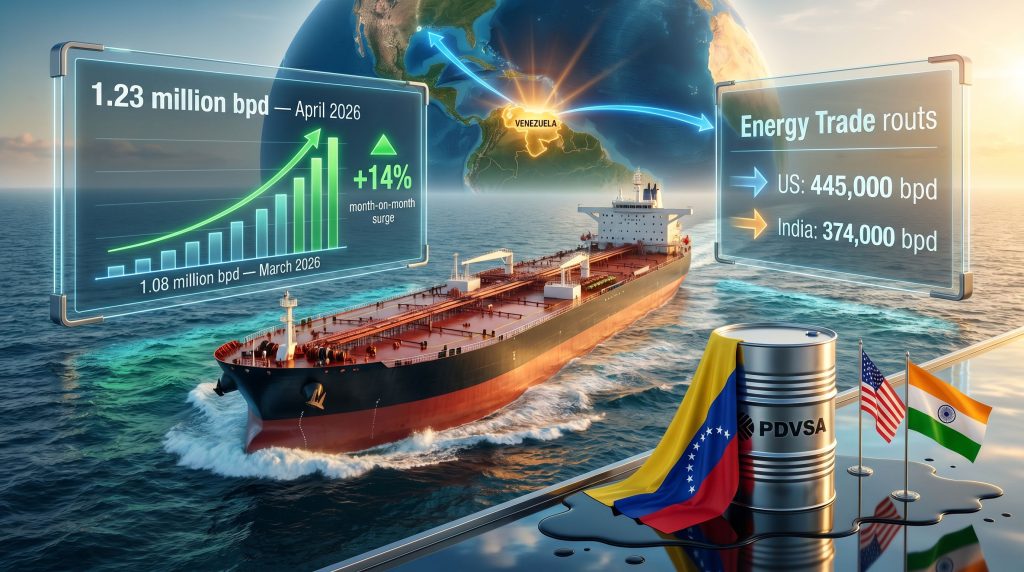
Venezuela's state oil company PDVSA recorded total crude and refined product exports of 1.23 million barrels per day (bpd) in April 2026, according to shipping data and internal PDVSA documents reported by Reuters via ET EnergyWorld. That figure represents a 14% month-on-month increase from approximately 1.08 million bpd in March and marks the highest monthly export volume recorded since late 2018, before US sanctions originally curtailed the country's energy trade.
66 vessels departed Venezuelan waters in April, compared with 61 in the prior month, a logistical scale-up that reflects both improved port operations and rising buyer demand across multiple regions.
The April 2026 export breakdown by destination paints a clear picture of where Venezuelan crude is flowing:
| Destination | March 2026 (bpd) | April 2026 (bpd) | Monthly Change |
|---|---|---|---|
| United States (direct) | 363,000 | 445,000 | +23% |
| India | 342,000 | 374,000 | +9% |
| Europe | 144,000 | 165,000 | +15% |
| Caribbean Storage Terminals | (included above) | 187,000 | Buffer stock |
| Total Exports | ~1.08 million | 1.23 million | +14% |
On the buyer-side breakdown, the data reveals two dominant commercial actors:
- Chevron (US): Responsible for approximately 25% of total exports, or 308,000 bpd, up from 267,000 bpd in March, a 15% increase.
- Commodity trading houses (Vitol and Trafigura): Collectively handled 56% of total exports, or 691,000 bpd, underscoring how critical independent trading firms are to Venezuela's re-integration into mainstream crude markets.
Disclaimer: Export statistics cited throughout this article are derived from tanker tracking data and PDVSA shipping documents as reported by Reuters via ET EnergyWorld (May 2, 2026). These figures reflect real-time cargo tracking estimates and may not align precisely with official government-reported production or export statistics.
The Political Trigger: How a Geopolitical Transition Unlocked an Energy Corridor
The catalyst for Venezuela's export resurgence was not a commodity price cycle or infrastructure investment programme. It was a political transition in Caracas. Following the US capture of President Nicolas Maduro in January 2026, an interim government was established under Delcy Rodriguez, setting the stage for a bilateral supply agreement between Washington and Caracas.
According to Reuters, this pact, combined with US licences easing sanctions on Venezuela's energy sector, enabled PDVSA's joint-venture partners and trading houses including Vitol and Trafigura to legally receive and distribute Venezuelan cargoes to refiners across the US, Europe, and Asia. The US policy shift on PDVSA fundamentally transformed the commercial architecture of Venezuelan oil exports from an informal, largely opaque network of intermediaries into a regulated, documented supply chain operating under US Treasury Department oversight.
Critically, the US continues to control Venezuelan oil sale proceeds through Treasury Department-supervised accounts, a mechanism that preserves Washington's financial leverage even as commercial activity resumes. This arrangement creates an unusual dynamic in global energy markets. Venezuela is simultaneously re-integrated as a legitimate crude supplier and financially supervised by the nation that was, until recently, its primary sanctions enforcer.
The durability of this arrangement depends heavily on the stability of both the Venezuelan interim government and the consistency of US foreign policy, variables that commodity analysts and energy market participants should monitor closely given their direct impact on supply continuity.
Venezuela Oil Exports to the US: The Heavy Crude Supply Chain Logic
Why American Refiners Require Venezuelan Crude
The surge in Venezuela oil exports to the US, reaching 445,000 bpd in April 2026, the largest single-destination share of total Venezuelan exports, is not a discretionary purchasing decision driven purely by price. It reflects a structural refinery configuration reality that has persisted for decades.
A significant portion of US Gulf Coast refining capacity was built and subsequently upgraded specifically to process heavy, high-sulphur crude grades of the type Venezuela predominantly produces. These facilities, equipped with coking units and hydrocrackers designed for dense, sulphur-rich feedstocks, cannot simply substitute domestic US light tight oil from shale formations. The chemical properties are fundamentally incompatible with certain processing configurations, making Venezuelan heavy crude a near-necessity for specific refinery operations rather than a convenience.
When US sanctions curtailed Venezuelan supply after 2018, Gulf Coast refiners sourcing this crude type faced a substitution problem. Canadian oil sands crude and select Middle Eastern heavy grades partially filled the gap, but with higher logistics costs and, in some cases, less optimal refinery margins. Furthermore, the broader dynamics of oil geopolitics and supply meant that alternative sourcing strategies carried their own geopolitical and pricing risks. Venezuela's re-entry addresses that substitution gap directly.
Chevron's Anchoring Role and Market Legitimacy
Chevron's position as the dominant direct US buyer, accounting for 25% of total Venezuelan exports at 308,000 bpd, carries significance beyond the volume itself. As a major US energy company operating under a highly visible US Treasury licence, Chevron's active participation signals to the broader international energy community that Venezuelan supply chains have reached a threshold of commercial viability and legal clarity.
For smaller or more risk-averse trading counterparties, the presence of a US supermajor purchasing Venezuelan crude openly and at scale functions as a form of de facto market validation.
Caribbean Storage: The Flexible Buffer Layer
An often-overlooked element of the Venezuela-to-US trade flow is the role of Caribbean storage terminals, which absorbed approximately 187,000 bpd of Venezuelan crude and fuel in April. These facilities act as a logistical buffer, allowing cargoes to be accumulated, blended, or redistributed to multiple final destinations, including US Gulf Coast ports and European terminals, based on real-time refining demand and pricing signals. This intermediate storage layer adds flexibility to Venezuelan crude distribution that direct port-to-port shipping alone cannot provide.
Venezuela Oil Exports to India: The Asian Demand Strategy
India's Crude Diversification Imperative
India's interest in expanding Venezuelan crude purchases operates within a broader national energy security framework. A substantial share of India's crude oil imports originates from Middle Eastern producers, creating a structural concentration risk centred on the Strait of Hormuz, a critical maritime chokepoint subject to recurring geopolitical tension.
Venezuela's re-emergence as a reliable supplier offers Indian refiners a Western Hemisphere alternative that addresses this geographic concentration without requiring a complete supply chain overhaul. The commercial logic was further conditioned by India's experience sourcing heavily discounted Russian Urals crude following the 2022 sanctions and oil trading landscape. Indian refiners developed a procurement model oriented toward competitive pricing and non-mainstream supply sources. Venezuelan crude, also priced at a discount to Brent, fits naturally within this procurement framework.
Why Venezuelan Crude Suits Indian Refinery Infrastructure
Venezuela predominantly produces heavy, high-sulphur crude grades that are technically analogous in key respects to Russian Urals crude, a grade Indian refiners have processed at significant volumes. India's major refining complexes, including those operated by Reliance Industries at Jamnagar, one of the largest refining sites in the world, have invested in secondary processing units including cokers and hydrocrackers specifically configured for these dense, sulphur-rich crude types.
This makes Venezuelan barrels a technically compatible feedstock, minimising the configuration costs or yield losses that lighter crude grades would create in these facilities.
Reliance Industries: The Strategic Lead Buyer
Among Indian purchasers, Reliance Industries emerged as the primary buyer of Venezuelan crude in April 2026. Shipping data documented Reliance receiving a large direct PDVSA cargo alongside multiple trader-sourced parcels. More significantly, LSEG ship monitoring data confirmed that at least three supertankers (VLCCs) chartered by Reliance were waiting to load at Venezuelan ports as of late April 2026, indicating that purchasing activity was not a one-time event but an ongoing, scaled procurement strategy.
The deployment of VLCCs, which typically carry 2 million barrels per voyage, signals that Reliance is treating Venezuelan crude as a long-term strategic supply source rather than an opportunistic spot purchase.
The India Import Trajectory: A Six-Year High
The scale of India's April 2026 Venezuelan crude purchases represents a six-year peak. The trajectory of this trade relationship illustrates how completely sanctions disrupted what had been a mature, functional supply corridor:
| Period | Approximate Volume | Context |
|---|---|---|
| Pre-2019 | ~300,000-400,000 bpd | Established trade relationship |
| 2019-2025 | Near zero | Effectively suspended under sanctions |
| March 2026 | 342,000 bpd | Rapid re-engagement post-pact |
| April 2026 | 374,000 bpd | Six-year import high |
| May 2026 (projected) | Increasing | Three VLCCs confirmed for loading |
Disclaimer: Forward-looking projections regarding Indian import volumes are based on confirmed VLCC charter bookings as reported by LSEG ship monitoring data (cited via Reuters, May 2026). Actual volumes may differ due to operational, weather, or commercial variables.
Understanding PDVSA's Operational Constraints
Inventory Drawdown Versus Sustainable Production Growth
A critical distinction that commodity analysts must understand when interpreting Venezuela's April 2026 export surge is the difference between inventory liquidation and genuine production recovery. The Reuters report explicitly noted that Venezuela has been draining oil inventories accumulated during the sanctions era as part of the export volume increase. Inventory drawdown is a finite process. Once accumulated stocks are sold, sustaining elevated export volumes requires underlying production to keep pace.
This distinction matters enormously for assessing the durability of current export levels. A one-time inventory release can temporarily flatter export data without representing a structural improvement in Venezuela's production capacity. Consequently, investors and energy market participants should treat near-term export volume data as a partial measure of recovery rather than a confirmed trajectory toward higher sustained output.
The Naphtha Import Dependency Signal
One of the less-discussed but structurally important data points in the April 2026 figures is Venezuela's continued import of naphtha, a light hydrocarbon used as a diluent to blend with and transport the country's ultra-heavy Orinoco Belt crude grades. In April 2026, Venezuela imported approximately 141,000 bpd of naphtha, down from 155,000 bpd in March.
While the slight month-on-month decline is mildly positive, the continued reliance on large-scale naphtha imports underscores a core operational constraint: Venezuelan crude in its natural state is often too viscous to transport through pipelines or load onto tankers without significant blending. This naphtha dependency also carries cost implications, compressing the revenue available for infrastructure reinvestment.
PDVSA's Infrastructure Challenge
Years of underinvestment, sanctions-induced capital scarcity, and operational attrition have left PDVSA's production and processing infrastructure in a severely degraded state. Pipeline corrosion, ageing separation and processing facilities, and workforce depletion represent compounding operational vulnerabilities that cannot be resolved quickly regardless of the commercial or political environment.
The gap between Venezuela's theoretical production potential, given its position as the holder of the world's largest certified oil reserves at approximately 303 billion barrels, and its actual sustainable output capacity reflects the cumulative cost of this prolonged underinvestment.
The next major ASX story will hit our subscribers first
Byproducts, Petrochemicals, and the Broader Export Picture
Beyond crude, Venezuela exported 360,000 metric tons of oil byproducts and petrochemicals in April 2026, slightly below the 382,000 metric tons recorded in March. While this represents a modest sequential decline, the scale of petrochemical exports demonstrates that Venezuela's commercial re-integration extends beyond crude oil alone. Byproduct exports contribute additional revenue streams that can partially offset PDVSA's ongoing operational costs and diluent import expenses.
Scenario Analysis: Three Pathways for Venezuela's Production Trajectory
The medium-term outlook for Venezuela oil exports to the US and India will be shaped by how three structural variables evolve: political stability in Caracas, the pace of infrastructure rehabilitation at PDVSA, and the consistency of US sanctions policy under the Trump administration and any successors.
Scenario 1: Sustained Growth Toward 1.5 Million bpd
If the political settlement underpinning the Trump-Rodriguez supply pact holds, and if international investment in Venezuela's Orinoco Belt begins materialising in earnest, exports could progressively increase toward and potentially beyond 1.5 million bpd over a multi-year horizon. This scenario would add meaningful volumes of heavy crude to global markets, placing downward pressure on heavy crude differentials and benefiting Gulf Coast and Indian refiners as feedstock costs decline. Competing heavy crude exporters, including Canada, Mexico, and Iraq, would face increased pricing competition.
However, OPEC's market influence adds another layer of complexity, as a recovering Venezuela would need to reconcile its national production ambitions with broader OPEC+ quota discipline frameworks.
Scenario 2: Plateau and Partial Reversal
Venezuela has experienced multiple false production recovery cycles across recent decades. Political fragility, infrastructure failures, and policy reversals have consistently truncated recovery trajectories before they could consolidate. In this scenario, export volumes plateau around current levels as inventory drawdowns are exhausted, infrastructure bottlenecks re-emerge, and political uncertainty suppresses new investment. Exports stabilise but fail to reach pre-2018 levels on a sustained basis.
Scenario 3: Accelerated Integration
A more optimistic pathway involves a successful, durable political transition in Venezuela, inflows of international capital into Orinoco Belt development, and a formal, comprehensive end to remaining US sanctions. In addition, the broader context of trade war oil impacts on global supply chains could further accelerate Venezuela's strategic importance to both American and Asian buyers. This scenario would unlock Venezuela's full reserve base over a multi-decade horizon, introducing structural implications for OPEC+ cohesion that commodity analysts should factor into long-term supply models.
Disclaimer: The scenario projections presented above are analytical frameworks based on publicly reported information and historical precedent. They do not constitute investment advice or price forecasts. Actual outcomes will depend on political, operational, regulatory, and market variables that cannot be predicted with certainty.
Key Risks for Market Participants to Monitor
Understanding the risks embedded in Venezuela's export recovery is as important as understanding the opportunity it presents:
- Political risk: The interim government's legitimacy and the bilateral supply pact both depend on a political settlement that remains untested over a sustained period. Any breakdown in Caracas, or a shift in US foreign policy posture, could rapidly reverse the current trade architecture.
- Operational risk: PDVSA's degraded infrastructure creates ongoing vulnerability to production interruptions, pipeline failures, and processing bottlenecks that could curtail export volumes with little warning.
- Inventory depletion risk: As accumulated onshore oil inventories are drawn down, sustaining current export levels will require genuine production growth, which demands capital investment that PDVSA has limited independent capacity to finance under Treasury account supervision.
- Compliance risk for international buyers: Non-US refiners, including Indian and European companies, must navigate complex US sanctions compliance requirements. Secondary sanctions exposure is a real legal risk for entities operating outside the licensed framework.
- Naphtha supply risk: Any disruption to Venezuela's naphtha import supply chain could directly constrain heavy crude export capacity, given the diluent dependency described above.
Frequently Asked Questions: Venezuela Oil Exports to the US and India
How much oil did Venezuela export to the United States in April 2026?
Venezuela exported approximately 445,000 bpd directly to the United States in April 2026, representing the single largest destination for Venezuelan crude and the highest US-bound volume since sanctions were originally imposed in 2018.
Why is India purchasing Venezuelan crude in increasing volumes?
India's refining sector is expanding Venezuelan crude purchases for three primary reasons: technical compatibility between Venezuelan heavy crude grades and Indian refinery configurations, the strategic need to reduce dependence on Middle Eastern supply routes running through the Strait of Hormuz, and Venezuelan crude's competitive pricing relative to alternative heavy crude sources.
What is PDVSA's role in Venezuela's oil exports?
PDVSA is Venezuela's state-owned oil company and the central entity coordinating all crude production and export logistics. Under the current sanctions relief framework, PDVSA's joint-venture partners and licensed trading houses, including Vitol and Trafigura, manage cargo distribution to international buyers.
Are Venezuela's current export volumes sustainable?
Current export volumes partly reflect the release of accumulated onshore inventories built up during the sanctions era. Sustaining or increasing exports beyond 1.23 million bpd over the medium term will require substantial capital investment in PDVSA's degraded infrastructure, a process that would take years to deliver results even under favourable conditions.
Which companies are the principal buyers of Venezuelan oil?
The principal buyers identified in April 2026 data include Chevron (US, 308,000 bpd), Reliance Industries (India, multiple cargo parcels plus three chartered VLCCs), and commodity trading houses Vitol and Trafigura (collectively 691,000 bpd, or 56% of total exports).
How does the US maintain oversight of Venezuelan oil revenues?
Under the current supply pact framework, Venezuela's oil export sale proceeds flow through accounts supervised by the US Treasury Department. This mechanism enables commercial trade to proceed while preserving Washington's ongoing financial leverage over the Venezuelan government.
Want To Stay Ahead of the Next Major Resource Discovery?
While geopolitical shifts reshape global energy supply chains, Discovery Alert's proprietary Discovery IQ model delivers real-time alerts on significant ASX mineral discoveries — instantly translating complex data across 30+ commodities into actionable insights for investors at every level. Explore how historic discoveries have generated substantial returns and begin your 14-day free trial today to position yourself ahead of the broader market.