June 4, 2026
Understanding the profound implications of institutional collapse on environmental protection, the Venezuela oil industry environmental disaster exemplifies how economic pressures can trigger systematic regulatory abandonment with devastating ecological consequences. When regulatory frameworks collapse, the consequences extend far beyond immediate environmental damage to create systemic risks that threaten entire regional economies and global energy markets.
How Did Regulatory Breakdown Create South America's Worst Industrial Disaster?
The Collapse of Environmental Oversight Systems
The institutional breakdown followed a predictable sequence that began with the 2014 oil price collapse, when international Brent crude benchmark plummeted below $30 per barrel by January 2016. This price shock directly precipitated capital expenditure cuts across Venezuela's petroleum sector, where oil revenues comprised over 50% of fiscal income.
Furthermore, the US oil production decline in other regions created additional pressure on global supply chains. PDVSA deliberately abandoned environmental monitoring and spill reporting protocols in 2016, marking a critical transition from passive regulatory neglect to active compliance system discontinuation.
The regulatory collapse accelerated through several interconnected mechanisms:
• Institutional knowledge exodus: Tens of thousands of skilled oil industry professionals departed following President Hugo Chávez's early 2000s crackdown on dissent
• Budget reallocation patterns: Capital expenditures for essential maintenance and refurbishment spiraled ever lower as the economic crisis intensified
• Vicious cycle amplification: Infrastructure breakdown caused production declines, forcing further budget cuts and accelerating the deterioration process
International Sanctions vs. Environmental Protection
U.S. sanctions created an unintended regulatory gap by limiting Venezuela's access to international energy and financial markets. This isolation prevented normal industry best practices from being implemented and removed international compliance monitoring systems.
However, the tariffs and market impact demonstrate how trade restrictions can inadvertently incentivize regulatory arbitrage. PDVSA resorted to cutting corners and discontinued environmental and safety regulations as part of efforts to boost economically crucial oil production.
Financial isolation impacts on maintenance standards:
• Restricted access to international environmental technology suppliers
• Limited availability of specialized equipment for spill prevention and remediation
• Reduced foreign investment in environmental compliance infrastructure
• Elimination of international technical assistance programs
When big ASX news breaks, our subscribers know first
Which Ecosystems Face the Greatest Regulatory Protection Gaps?
Lake Maracaibo: A Case Study in Policy Abandonment
Lake Maracaibo represents the most extensively documented example of complete environmental regulatory failure. NASA satellite imagery from 2003 onwards shows large-scale oil slicks and algal blooms across this ancient water body, which sits at the heart of Venezuela's oil industry.
The lake is crisscrossed by thousands of miles of petroleum pipelines, storage facilities and derricks. Most of which have degraded so severely they have been leaking hydrocarbons for decades.
Pre-2000 vs. Current Environmental Standards Comparison:
| Regulatory Category | Pre-2000 Period | Current Status | Impact Metrics |
|---|---|---|---|
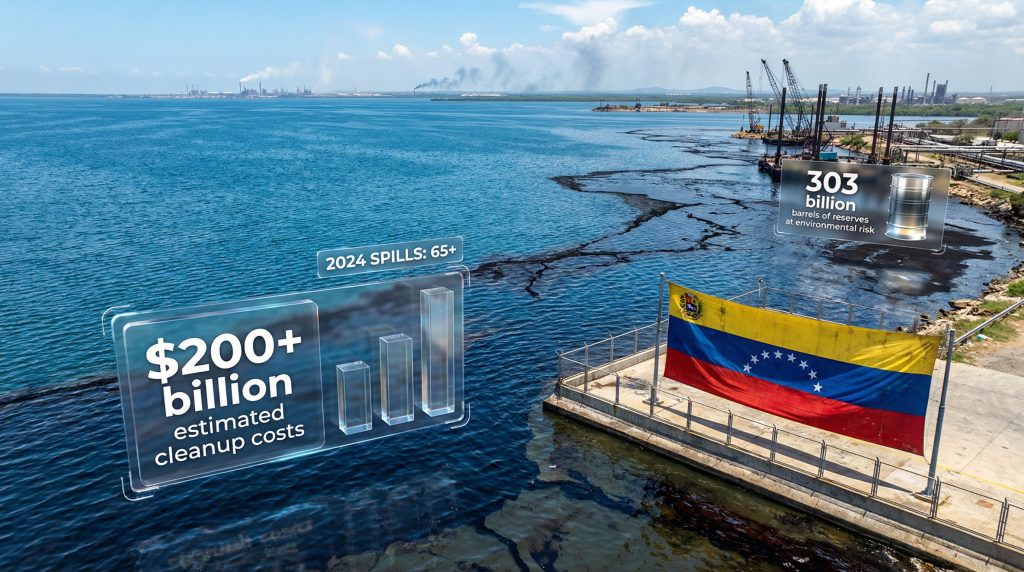
| Spill Reporting Requirements | Mandatory within 24 hours | Abandoned since 2016 | 65+ unreported spills in 2024 |
| Water Quality Monitoring | Quarterly assessments | No active monitoring | Toxic algal blooms widespread |
| Marine Stock Protection | Fishing quotas enforced | No enforcement mechanisms | Fish/shrimp catches declining for decades |
| Infrastructure Inspections | Annual safety audits | Discontinued | Heavily corroded wellheads/pipelines leaking |
The transformation of Lake Maracaibo into what observers describe as a giant noxious pool of petroleum waste demonstrates the irreversible nature of prolonged regulatory abandonment. Fishermen report declining marine stocks with catches shrinking progressively smaller.
The Orinoco Belt: Where Industrial Policy Meets Conservation
The Orinoco Belt spans approximately 20,000 square miles and accounts for 70% of Venezuela's total oil production. This makes it simultaneously the country's most economically vital region and its greatest environmental liability.
Moreover, mine reclamation innovations developed for other industries could potentially be adapted for oil sector remediation. OPEC estimates Venezuela's oil reserves at 303 billion barrels, with the majority located in this ecologically sensitive area.
Enhanced recovery techniques multiply environmental risks:
• High-pressure drilling with long shaft extensions required for viscous, tar-like oil extraction
• Waterflooding and gas injection processes involving chemical-intensive operations
• Diluent additives such as naptha or condensate that multiply potential environmental damage
• Constant flaring operations creating chemical runoff and atmospheric emissions
The Orinoco Delta, recognised internationally as a biodiversity hotspot, faces severe contamination from decades of chronic oil spills and leaks from heavily corroded infrastructure.
What Are the Legal Implications for International Oil Companies?
Environmental Liability Assessment Framework
International oil companies face unprecedented legal exposure when considering Venezuelan operations. They would potentially inherit liability for decades of environmental damage with immense volumes of petroleum waste scattered across multiple contaminated sites.
In addition, the oil price rally dynamics could influence investment decisions despite environmental risks. The total estimated cleanup cost exceeds $200 billion, with Lake Maracaibo remediation alone requiring a minimum of $2.5 billion.
Due diligence requirements encompass several critical risk categories:
• Contaminated asset liability: Assessment of existing hydrocarbon contamination in soil, waterways, and wetlands
• Infrastructure condition evaluation: Analysis of ramshackle petroleum infrastructure
• Community health obligations: Potential compensation for hydrocarbon-related health complaints
• Transboundary pollution exposure: International environmental law obligations
Compliance Cost Modeling for Market Entry
The economic analysis reveals a fundamental conflict between production profitability and environmental remediation costs. Industry experts note that it is difficult to see private energy companies investing billions of dollars in unprofitable environmental remediation.
Investment risk assessment indicates:
| Cost Category | Estimated Range | Timeframe | Regulatory Risk Level |
|---|---|---|---|
| Infrastructure Reconstruction | $100 billion | 5-10 years | High |
| Environmental Remediation | $200+ billion | 15-20 years | Very High |
| Lake Maracaibo Cleanup | $2.5 billion minimum | 8-12 years | Extreme |
| Orinoco Belt Restoration | $50+ billion | 10-15 years | Very High |
The regulatory uncertainty creates additional investment risks. The rush to attract foreign drillers through regulatory framework reforms could well result in further catastrophic environmental damage.
How Do International Environmental Standards Apply to Venezuelan Operations?
UN Framework Convention Obligations
Venezuela remains bound by international environmental treaties despite its domestic regulatory collapse. This creates potential liability exposure for international companies operating within its territory.
Furthermore, US-China trade tensions illustrate how geopolitical relationships affect environmental cooperation frameworks. The UN Framework Convention on Climate Change establishes baseline environmental protection requirements that cannot be waived through domestic regulatory changes.
Transboundary pollution responsibilities present particular legal complexity:
• Cross-border contamination liability: Environmental damage affecting neighbouring countries' water systems
• International maritime pollution: Contamination through river systems and coastal runoff
• Regional ecosystem protection: Obligations to protect migratory species and shared biodiversity resources
• Climate change commitment compliance: Emissions reporting and reduction obligations
Industry Best Practices vs. Current Reality
A comparative analysis with North Sea operations reveals the magnitude of Venezuela's regulatory gap. North Sea petroleum extraction operates under comprehensive environmental oversight including mandatory environmental impact assessments and continuous monitoring systems.
Venezuelan operations currently function with virtually no environmental oversight. This creates liability exposure unprecedented in modern international petroleum development.
Technology transfer requirements for cleanup operations would necessitate:
• Implementation of modern spill detection and response systems
• Installation of real-time environmental monitoring networks
• Adoption of enhanced recovery techniques with environmental safeguards
• Establishment of community health monitoring and compensation programs
What Regulatory Reforms Could Prevent Future Environmental Disasters?
Proposed Oversight Mechanisms
Effective regulatory reform requires establishing international monitoring bodies with enforcement capabilities independent of domestic political pressures. The Venezuelan case demonstrates that regulatory frameworks must be insulated from economic crisis pressures.
Essential oversight mechanisms include:
• International environmental monitoring body with satellite surveillance capabilities
• Mandatory environmental impact assessments linked to production licensing requirements
• Technology transfer requirements for foreign investors
• Community compensation frameworks providing direct remediation funding
Policy Integration Strategies
Successful regulatory reform must integrate environmental performance directly into production licensing and economic incentive structures. The traditional approach of treating environmental compliance as a separate regulatory requirement has proven vulnerable to economic pressure.
Integrated policy framework components:
• Production licence contingency: Environmental performance standards directly linked to extraction permits
• Cleanup investment incentives: Tax and royalty structures that reward environmental remediation investment
• Performance bonding requirements: Financial guarantees for environmental restoration
• Community engagement mandates: Local participation requirements in environmental monitoring
How Does Venezuela's Crisis Compare to Global Environmental Disasters?
Regulatory Response Comparison Analysis
Venezuela's environmental crisis differs fundamentally from other major petroleum disasters in its systematic regulatory abandonment rather than isolated incident response failures. Unlike the Exxon Valdez or Deepwater Horizon disasters, Venezuela's crisis represents ongoing institutional collapse.
Comparative regulatory response analysis:
| Disaster | Initial Response Time | Regulatory Changes | Cleanup Investment | Institutional Outcome |
|---|---|---|---|---|
| Exxon Valdez (1989) | 3-5 days | Oil Pollution Act of 1990 | $3.8 billion | Enhanced oversight systems |
| Deepwater Horizon (2010) | 12-18 hours | BSEE establishment | $65 billion | Strengthened regulatory framework |
| Niger Delta (Ongoing) | Variable/inadequate | Limited enforcement | $1 billion (insufficient) | Weak institutional capacity |
| Venezuela (2016-present) | No coordinated response | Regulatory abandonment | Minimal/none | Complete institutional collapse |
Lessons from International Remediation Programs
Successful cleanup policy models demonstrate the critical importance of immediate regulatory response, sustained political commitment, and adequate financial resource allocation. Extensive environmental damage in Venezuela represents the inverse scenario where regulatory abandonment creates compounding environmental degradation.
Key success factors from international programs:
• Immediate institutional response: Regulatory agencies must maintain capacity during economic stress
• Sustained funding mechanisms: Long-term financial commitments independent of commodity price cycles
• Community engagement integration: Local stakeholder participation in monitoring and remediation planning
• Technology transfer facilitation: Access to modern environmental protection and cleanup technologies
The next major ASX story will hit our subscribers first
What Are the Economic Implications of Environmental Compliance?
Cost-Benefit Analysis of Immediate vs. Delayed Action
Economic modelling demonstrates that delayed environmental response creates exponentially increasing remediation costs while generating cascading negative economic impacts across multiple sectors. The Venezuelan case illustrates how initial environmental compliance cost avoidance has resulted in cleanup liability exceeding $200 billion.
Long-term economic impact projections indicate:
• Healthcare cost implications: Hydrocarbon-related health complaints requiring ongoing medical treatment
• Tourism industry losses: Complete elimination of eco-tourism potential in affected regions
• Fishing industry collapse: Declining marine stocks eliminating traditional livelihoods
• Agricultural sector impacts: Soil and water contamination reducing agricultural productivity
Investment Risk Assessment Framework
Environmental liability quantification requires comprehensive risk assessment methodologies that account for both direct cleanup costs and indirect economic impacts. Insurance implications for international operators include potential exclusions for pre-existing environmental damage.
Regulatory uncertainty impacts on project financing:
• Higher insurance premiums: Environmental liability coverage costs increase substantially
• Restricted lending terms: International financial institutions may impose environmental compliance requirements
• Elevated due diligence costs: Comprehensive environmental assessments require significant upfront investment
• Political risk insurance: Additional coverage needed for regulatory framework stability
Frequently Asked Questions About Venezuela's Environmental Regulations
What environmental laws currently govern Venezuelan oil operations?
Venezuela's environmental legal framework remains technically in place through constitutional and statutory provisions. However, enforcement mechanisms have been systematically abandoned since 2016. The country maintains formal environmental protection laws but PDVSA discontinued compliance monitoring systems during the economic crisis.
This creates a legal paradox where environmental obligations exist on paper but lack any practical enforcement mechanism.
How do U.S. sanctions affect environmental cleanup efforts?
U.S. sanctions create significant barriers to environmental cleanup efforts by restricting access to specialised remediation technologies. They also limit international technical assistance programs and prevent normal commercial relationships with environmental services companies.
However, sanctions regulations typically include humanitarian and environmental protection exceptions that could potentially authorise cleanup activities. The challenge lies in obtaining specific regulatory guidance for large-scale remediation projects.
What international legal mechanisms exist for transboundary pollution?
International environmental law provides several mechanisms for addressing transboundary pollution. These include the UN Convention on the Law of Non-Navigational Uses of International Watercourses and various regional environmental protection agreements.
However, enforcement typically requires political cooperation and institutional capacity that may be limited in cases of domestic institutional collapse. International arbitration mechanisms exist but require sustained political commitment.
How are local communities protected under current regulatory frameworks?
Local community protection under current Venezuelan regulatory frameworks is essentially non-existent due to the systematic abandonment of environmental oversight systems. Communities affected by hydrocarbon contamination have limited legal recourse through domestic institutions.
They must potentially rely on international human rights mechanisms or future international legal proceedings for protection and compensation. Community health monitoring systems have been discontinued.
The Path Forward: Regulatory Solutions for Environmental Recovery
Short-term Policy Interventions
Immediate regulatory interventions must focus on halting ongoing environmental damage while establishing foundations for long-term institutional rebuilding. Emergency response protocols should prioritise the most severe contamination sites while creating international oversight mechanisms.
Critical short-term measures include:
• Emergency spill response protocol establishment: International technical assistance for immediate containment
• Community protection frameworks: Direct health monitoring and medical assistance for affected populations
• International technical assistance programs: Technology transfer for basic environmental monitoring
• Satellite monitoring systems: Independent environmental oversight using NASA and European Space Agency resources
Long-term Institutional Rebuilding
Sustainable environmental recovery requires comprehensive institutional reconstruction that integrates environmental protection directly into petroleum industry governance structures. This rebuilding process must be designed to withstand future economic pressures and political instability.
Institutional rebuilding roadmap components:
• Environmental agency reconstruction: Establishing independent environmental oversight bodies
• International oversight integration: Permanent international monitoring and enforcement mechanisms
• Sustainable development goal alignment: Integration of environmental recovery with broader economic development planning
• Community-based monitoring systems: Local participation in environmental oversight and decision-making processes
The Venezuela oil industry environmental disaster represents one of the most comprehensive regulatory failures in modern industrial history, with cleanup costs exceeding $200 billion and environmental damage affecting critical ecosystems including Lake Maracaibo and the Orinoco Delta. The crisis demonstrates how economic pressure can trigger systematic regulatory abandonment, creating environmental liabilities that far exceed the short-term costs of maintaining compliance systems. International oil companies considering Venezuelan operations face unprecedented environmental liability exposure, while the affected ecosystems and communities continue to suffer from decades of institutional decay and environmental neglect.
Disclaimer: This analysis is based on available information and should not be considered as investment or legal advice. Environmental liability assessments and regulatory compliance requirements involve complex legal and technical considerations that require professional consultation. The estimates and projections discussed are subject to significant uncertainty and may change based on future political, economic, and regulatory developments.
Looking to Stay Ahead of Emerging Market Opportunities in Natural Resources?
Discovery Alert's proprietary Discovery IQ model delivers instant notifications on significant ASX mineral discoveries, empowering investors to identify actionable opportunities ahead of the broader market during times of regulatory and environmental uncertainty. Begin your 14-day free trial today to position yourself advantageously as global energy markets navigate complex geopolitical and environmental challenges.