August 4, 2026
The global energy transition has fundamentally altered investment patterns across oil-producing regions, creating a new competitive landscape where production costs, regulatory stability, and crude quality determine capital allocation decisions. As international operators reassess their portfolio strategies, furthermore, traditional assumptions about regional energy dominance are being challenged by emerging production hubs and evolving market dynamics. The venezuela oil production outlook reflects these broader market forces that shape capital allocation decisions across Latin America.
What Drives Venezuela's Oil Production Recovery Timeline?
Venezuela's path to meaningful production increases faces structural constraints that differentiate it from competing South American oil producers. Current projections suggest the country may contribute approximately 300,000 barrels per day from new recovery initiatives by 2026, representing roughly 30% of the combined production additions expected from Brazil, Argentina, and Guyana during the same period.
Infrastructure Rehabilitation vs. New Field Development
The Venezuelan oil sector presents a unique capital allocation challenge between rehabilitating existing assets versus developing new producing regions. However, decades of underinvestment have created widespread infrastructure decay affecting multiple production systems:
Primary Production Systems:
- Wellbore blockages and corrosion damage
- Pump jack failures and surface equipment deterioration
- Pipeline integrity issues including leakage and pressure losses
- Estimated rehabilitation timeline: 6-18 months per major producing asset
Tertiary Recovery Systems:
- Steamflood facilities requiring boiler maintenance and steam line integrity restoration
- Polymer injection infrastructure needing chemical plant operations and injection well performance optimisation
- Estimated restart timeline: 12-24 months with adequate capital investment and technical planning
This rehabilitation requirement contrasts sharply with greenfield development opportunities available in competing regions. Consequently, operators can deploy proven technologies on new assets without legacy infrastructure constraints.
Capital Allocation Priorities in Post-Sanctions Environment
Recent policy shifts supporting increased U.S. investment in Venezuelan oil assets have not fundamentally altered the economic calculus facing international operators. Furthermore, Radhika Bansal from Rystad Energy notes that while Venezuelan oil production recovery could become economically rational in higher oil price environments, more attractive investment opportunities remain available across the region.
The concentration of Latin American shale investment illustrates this dynamic, with approximately $11 billion targeted for 2026, representing a 17% increase from the previous year's $9.4 billion. However, this capital flows primarily toward Argentina's Vaca Muerta basin, where established development models provide more predictable returns on investment.
Investment capital requirements for Venezuelan recovery present significant scale challenges:
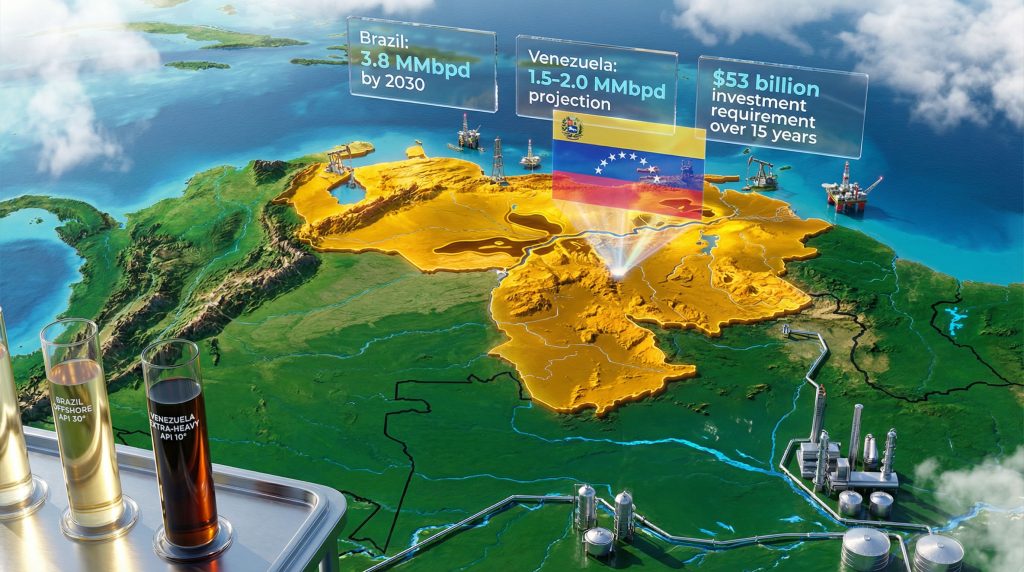
Industry analysis suggests Venezuela requires $53 billion over 15 years to achieve sustainable 1.1 million barrels per day production, with total investment needs of $183 billion to reach historical 3 million barrels per day capacity by 2040.
Technical Constraints of Extra-Heavy Crude Operations
Venezuelan extra-heavy crude from the Orinoco Belt (API gravity 8-12 degrees) creates operational complexities that extend beyond extraction to processing and transportation. In addition, these technical factors systematically increase costs compared to lighter crude alternatives:
Viscosity Management Requirements:
- Dilution with lighter stocks or synthetic crude blending
- Pipeline heating systems and flow assurance engineering
- Specialised tanker equipment for transportation
- Higher per-barrel logistics costs
Processing Infrastructure Dependencies:
- Hydrotreating capacity for sulfur removal
- Hydrocracking or delayed coking for conversion to lighter products
- Integration with blending infrastructure
- Environmental compliance systems for sulfur content standards
These technical requirements create structural cost disadvantages relative to conventional crude production from regional competitors, where standard refining processes can handle lighter feedstocks without specialised equipment.
When big ASX news breaks, our subscribers know first
How Does Venezuela Compare to Regional Production Leaders Through 2030?
Regional production dynamics reveal significant competitive advantages for Brazil, Argentina, and Guyana that extend beyond current political considerations affecting Venezuelan assets. Total Latin American oil output is projected to exceed 8.8 million barrels per day in 2026, with production leadership concentrated among countries offering superior economic returns.
Brazil's Deepwater Advantage and Sustained Growth Trajectory
Brazilian pre-salt fields represent the most technically advanced oil development projects in South America, operating at depths of 2,000-3,000 metres in subsalt reservoirs. These operations produce light to medium crude (API 20-35 degrees) that commands premium pricing in international markets while requiring less specialised refining infrastructure.
Key advantages of Brazilian production include:
- Established supply chain through Petrobras operations and services infrastructure
- Lower technical execution risk compared to ultra-deepwater exploration
- Premium pricing for light crude grades
- Proven deepwater expertise transferable across multiple fields
The predictability of Brazilian deepwater development has attracted sustained international investment. Furthermore, this supports production growth projections that position the country as South America's dominant oil producer through 2030.
South American Oil Production Projections (2026-2030)
| Country | 2026 Est. (MMbpd) | 2030 Projection (MMbpd) | Key Growth Drivers |
|---|---|---|---|
| Brazil | 3.2 | 3.8 | Pre-salt developments |
| Argentina | 0.9 | 1.4 | Vaca Muerta expansion |
| Guyana | 0.6 | 1.2 | Offshore discoveries |
| Venezuela | 1.1-1.3 | 1.5-2.0 | Infrastructure recovery |
Argentina's Shale Revolution in Vaca Muerta Basin
Argentina's Vaca Muerta basin has emerged as South America's premier unconventional shale play, located in the Neuquén Basin of Patagonia. The development model employs horizontal drilling with multi-stage hydraulic fracturing, providing faster initial production ramp capabilities than conventional or deepwater projects.
Vaca Muerta's competitive advantages include:
- Lower per-barrel capex compared to offshore deepwater development
- Established supply chain and services infrastructure
- Proven scalability through modular drilling programmes
- Conventional crude quality eliminating processing complications
The region's success has attracted the majority of Latin American shale investment. Consequently, an estimated $8-9 billion of the total $11 billion regional allocation is targeted for 2026, reflecting operator confidence in the technical execution and economic returns available from Argentine shale development.
Guyana's Rapid Offshore Development Model
Guyana's emergence as a major oil producer exemplifies the rapid deployment capabilities that international operators prioritise in capital allocation decisions. The Liza field development timeline demonstrates this acceleration potential:
Liza Field Development Milestones:
- Discovery: 2015
- First production: December 2019
- Current production capacity: 340,000 barrels per day
- Development timeline: 4 years from discovery to commercial production
This timeline contrasts dramatically with Venezuelan infrastructure rehabilitation requirements, which typically demand 2-3 years minimum for technical planning and infrastructure assessment before production increases materialise.
Guyana's offshore development model offers:
- Shallow-water production (1,000-3,000 metre depths)
- Light crude production (API 30-35 degrees)
- Lower infrastructure complexity versus ultra-deepwater projects
- Established international operator management (ExxonMobil, Hess, CNOOC joint ventures)
What Are the Economic Fundamentals Behind Venezuela's Recovery Challenges?
The economic framework governing the venezuela oil production outlook reflects fundamental market forces that extend beyond political considerations. International oil companies have implemented increasingly disciplined capital allocation frameworks in Latin America, with marked preference for projects meeting specific return thresholds and risk profiles.
Investment Risk Premium in Emerging Market Oil Assets
Venezuelan assets face structural disadvantages in capital competition due to historical precedents and current market conditions. Political and regulatory uncertainty creates enterprise risk premiums that increase the cost of capital relative to competing jurisdictions with established legal frameworks.
Key risk factors affecting Venezuelan investment include:
- Historical asset expropriation during PDVSA nationalisation periods (2003-2012)
- Regulatory uncertainty regarding long-term contract enforcement
- Infrastructure decay requiring rehabilitation capital before revenue generation
- Limited operational autonomy for international operators
These factors contrast with the regulatory environments in Brazil, Argentina, and Guyana. However, established legal frameworks provide greater contract certainty and property rights protection for international operators.
Heavy Crude Pricing Dynamics and Refinery Requirements
Venezuelan extra-heavy crude faces systematic market disadvantages that affect project economics independent of political considerations. The gravity discount for heavier crude typically results in pricing at WTI benchmark minus $10-25 per barrel, depending on refinery specifications and market conditions.
Comparative Crude Quality Analysis:
- Brazilian pre-salt crude: API 20-35 degrees, low sulfur content, premium pricing
- Argentine conventional production: API 30-40 degrees, standard processing requirements
- Venezuelan extra-heavy: API 8-12 degrees, high viscosity, specialised refining needs, pricing discount 15-30%
The processing requirements for Venezuelan crude create additional economic challenges:
Refinery Configuration Dependencies:
- Hydrocracking or delayed coking capabilities
- Synthetic crude production facilities
- Blending stock integration for transportation
- Environmental compliance systems for emissions standards
These specialised requirements limit the potential customer base for Venezuelan crude. Furthermore, they create transportation cost premiums that further erode project economics compared to lighter crude alternatives.
Global Oil Market Oversupply Impact on New Production
Current global oil market dynamics favour low-cost, high-quality production over complex recovery projects requiring significant capital investment. With regional competitors offering more attractive production opportunities, Venezuelan projects must compete for capital allocation in an environment where operators prioritise near-guaranteed returns.
The investment capital flowing into Latin American oil markets consolidates around projects with proven development models:
- Greenfield projects in Guyana and Suriname offering lower technical complexity
- Argentina's Vaca Muerta shale expansion providing scalable development opportunities
- Brazil's deepwater pre-salt fields leveraging established offshore expertise
This competitive dynamic creates a challenging environment for Venezuelan recovery projects. Consequently, these require higher capital intensity and longer development timelines to achieve commercial production rates.
Which Structural Factors Limit Venezuela's Near-Term Production Gains?
The constraints limiting Venezuelan production acceleration extend beyond infrastructure rehabilitation to encompass regulatory, technical, and human capital factors. These differentiate the country's recovery challenges from competing production regions.
Regulatory Framework Transformation and Private Investment Access
International oil companies require specific regulatory conditions to justify major capital commitments in emerging market oil assets. However, the Venezuelan regulatory environment presents challenges across multiple dimensions that increase investment risk premiums:
Essential Regulatory Requirements:
- Long-term contract certainty with minimum 20-30 year production-sharing agreements
- Property rights protection preventing arbitrary asset expropriation
- Fiscal regime stability enabling accurate NPV calculations
- Operational autonomy for technical decisions and maintenance schedules
Current Venezuelan regulatory frameworks present uncertainties on these fundamental requirements. Furthermore, this creates cost of capital disadvantages relative to Brazil, Argentina, and Guyana, where established legal systems provide greater investor protection and contract enforcement capabilities.
Technical Workforce and Knowledge Transfer Requirements
The scale of Venezuelan production decline from approximately 3 million barrels per day in 2010 to current levels of 1.1-1.3 million barrels per day implies significant workforce attrition and institutional knowledge loss. This human capital constraint affects operational capabilities across multiple technical areas:
Critical Workforce Gaps:
- Experienced petroleum engineers and drilling specialists
- Production technicians familiar with extra-heavy crude operations
- Maintenance personnel for complex processing equipment
- Technical training institution capacity for knowledge transfer
The emigration of technical personnel due to economic conditions has concentrated institutional knowledge among remaining PDVSA employees. Consequently, this creates operational risk for new projects that require expanded workforce capacity and technical expertise transfer from international operators.
Supply Chain Dependencies for Heavy Oil Operations
Venezuelan extra-heavy crude operations require specialised supply chains that have degraded during the extended production decline period. Rebuilding these supply chain capabilities presents logistical and timing challenges that affect production ramp schedules:
Critical Supply Chain Components:
- Chemical supplies for enhanced oil recovery operations
- Specialised drilling equipment for extra-heavy crude wells
- Diluent supplies for crude transportation and processing
- Maintenance parts and equipment for aging infrastructure
The time required to reestablish reliable supply chain operations adds complexity to production recovery timelines. In addition, this is particularly challenging compared to regions like Argentina's Vaca Muerta or Guyana's offshore developments, where established supply chains support rapid production scaling.
How Do Geopolitical Dynamics Shape Venezuela's Oil Sector Outlook?
The intersection of geopolitical considerations and market economics creates a complex environment for the venezuela oil production outlook that extends beyond traditional investment analysis. While recent policy shifts have encouraged international investment, the fundamental economic and technical challenges remain largely unchanged.
U.S. Administrative Policy and Sanctions Relief Framework
Recent U.S. administrative approaches have emphasised acceleration of American investment in Venezuelan oil assets following political transitions in the country. However, the policy support does not address the underlying economic factors that influence private sector capital allocation decisions.
The gap between policy encouragement and market-driven investment decisions reflects the persistence of economic fundamentals in determining project viability:
- Infrastructure rehabilitation requirements remain unchanged regardless of policy framework
- Heavy crude quality and pricing disadvantages persist independent of political considerations
- Technical execution risks continue to affect project economics and timeline certainty
Understanding these dynamics is crucial for assessing both oil price rally analysis and the broader trade war oil impact on regional energy markets.
Regional Competition for Energy Investment Capital
The competitive landscape for Latin American energy investment capital has intensified as operators focus on projects offering superior risk-adjusted returns. This competition occurs across multiple dimensions that favour established production regions:
Investment Allocation Factors:
- Technical execution certainty and development timeline predictability
- Crude quality premiums and downstream market access
- Regulatory stability and contract enforcement capabilities
- Infrastructure readiness and supply chain availability
Brazilian deepwater projects, Argentine shale development, and Guyanese offshore fields offer advantages across these factors. Furthermore, these create structural competition for Venezuelan recovery projects seeking international investment capital.
International Oil Company Risk Assessment Criteria
Major international oil companies have implemented standardised risk assessment frameworks that evaluate potential investments across political, technical, and economic dimensions. Venezuelan projects face challenges meeting established criteria in several key areas:
Risk Assessment Categories:
- Political Risk: Contract stability and property rights protection
- Technical Risk: Infrastructure condition and operational complexity
- Economic Risk: Return on investment and capital efficiency
- Execution Risk: Timeline certainty and supply chain reliability
The cumulative effect of elevated risk scores across multiple categories increases the required rate of return for Venezuelan projects. Consequently, this makes them less competitive against alternative investment opportunities in the region.
What Investment Scenarios Could Accelerate Venezuelan Production?
Despite structural challenges, specific investment models could potentially accelerate Venezuelan production recovery by addressing key constraints through risk-sharing arrangements and technical expertise transfer. These scenarios require alignment between international operator capabilities and Venezuelan regulatory frameworks.
Joint Venture Models with International Operators
Joint venture structures could address multiple constraints simultaneously by combining international technical expertise with local knowledge and regulatory access. However, successful models would need to allocate risks and rewards appropriately between Venezuelan national entities and international partners.
Potential Joint Venture Benefits:
- Risk distribution between international operators and local partners
- Technology transfer for enhanced recovery techniques
- Capital contribution sharing for infrastructure rehabilitation
- Operational expertise application to complex extra-heavy crude systems
Nevertheless, joint venture success depends on regulatory certainty regarding profit-sharing arrangements, operational control allocation, and long-term contract enforcement capabilities that remain areas of uncertainty in the current Venezuelan framework.
Technology Transfer Agreements for Enhanced Recovery
Venezuelan extra-heavy crude reserves could benefit significantly from advanced enhanced oil recovery technologies that international operators have developed for similar geological conditions. Technology transfer agreements could accelerate production recovery without requiring full asset ownership by international companies.
Key Technology Applications:
- Steam-assisted gravity drainage (SAGD) for extra-heavy crude extraction
- Polymer flooding and chemical enhanced oil recovery techniques
- Digital reservoir management and optimisation systems
- Advanced drilling and completion technologies for challenging formations
The effectiveness of technology transfer approaches depends on adequate technical workforce capacity. Furthermore, regulatory frameworks must protect intellectual property rights whilst enabling knowledge sharing between international operators and Venezuelan technical personnel.
Infrastructure Modernisation Partnerships
Targeted infrastructure modernisation partnerships could address specific production bottlenecks without requiring comprehensive asset rehabilitation across entire producing regions. This approach allows for phased investment and risk management while demonstrating project viability.
Production Recovery Scenarios
| Scenario | Timeline | Investment Required | Production Target |
|---|---|---|---|
| Conservative | 2-3 years | $10-15 billion | 1.3-1.4 MMbpd |
| Moderate | 5-7 years | $25-35 billion | 1.8-2.2 MMbpd |
| Optimistic | 10-15 years | $50-75 billion | 2.5-3.0 MMbpd |
These scenarios assume varying degrees of regulatory stability, international cooperation, and technical execution success. The investment requirements reflect the cumulative capital needed for infrastructure rehabilitation, new field development, and operational capacity building.
The next major ASX story will hit our subscribers first
Why Do Heavy Oil Quality Issues Affect Venezuela's Market Position?
The fundamental characteristics of Venezuelan extra-heavy crude create persistent market positioning challenges that influence long-term competitiveness regardless of production volume recovery. These quality-related factors affect pricing, transportation, and downstream processing in ways that differentiate Venezuelan crude from regional competitors.
Refinery Configuration Requirements for Extra-Heavy Crude
Venezuelan crude quality demands specialised refining infrastructure that limits potential customer base and affects pricing dynamics. The API gravity range of 8-12 degrees requires processing capabilities that many refineries lack, creating market access constraints.
Essential Refining Capabilities:
- Hydrocracking units for heavy crude conversion to lighter products
- Delayed coking systems for residue processing
- Hydrotreating capacity for sulfur removal and quality improvement
- Blending infrastructure for synthetic crude production
U.S. Gulf Coast refineries historically configured for Venezuelan heavy crude processing (Valero, Chevron, ExxonMobil facilities) represent the primary target market. However, these refineries now optimise feedstock allocation based on crude quality, price differentials, and logistics costs, creating competition with alternative heavy crude sources.
Blending Stock Availability and Transportation Costs
The high viscosity of Venezuelan extra-heavy crude requires dilution for pipeline transportation and processing optimisation. This blending requirement creates additional costs and supply chain dependencies that affect project economics:
Blending Requirements:
- Synthetic crude blending or naphtha addition for viscosity reduction
- Pipeline heating systems for flow assurance
- Specialised tanker equipment for marine transportation
- Storage and handling infrastructure for blending operations
These transportation and handling complexities increase the delivered cost of Venezuelan crude to refinery customers. Consequently, this creates pricing pressure that reduces wellhead economics compared to conventional crude that can be transported and processed with standard infrastructure.
Environmental Compliance Standards in Target Markets
Evolving environmental regulations in key refining markets create additional challenges for extra-heavy crude that typically contains higher sulfur content and requires more energy-intensive processing. Furthermore, carbon intensity regulations and emissions standards increasingly favour lighter crude grades.
Environmental Compliance Factors:
- Sulfur content standards in refined products
- Carbon intensity regulations for transportation fuels
- Emissions standards for refinery operations
- Environmental impact assessments for heavy crude processing
These regulatory trends create long-term market access risks for extra-heavy crude production. Consequently, they may limit the economic attractiveness of major capital investments in Venezuelan recovery projects.
What Role Does Regional Energy Security Play in Venezuela's Strategy?
Regional energy security considerations provide additional context for evaluating the venezuela oil production outlook beyond purely commercial factors. The country's potential contribution to South American energy independence and regional supply chain resilience offers strategic value that may influence investment and policy decisions.
South American Energy Integration Opportunities
Venezuela's geographic position and existing pipeline infrastructure create opportunities for regional energy integration that could enhance the strategic value of production recovery beyond export market economics. Furthermore, integration with regional partners could provide alternative revenue streams and market access.
Regional Integration Potential:
- Pipeline connections to Colombian and Brazilian markets
- Joint refining ventures for heavy crude processing
- Regional supply chain development for enhanced oil recovery
- Technical cooperation agreements with established regional producers
However, regional integration success requires political stability and regulatory frameworks that support long-term commercial relationships with neighbouring countries and their national oil companies.
Caribbean Refining Hub Potential
Venezuelan heavy crude could supply Caribbean refining facilities that have historically processed similar crude grades. This creates regional value chains that reduce transportation costs and provide market access advantages, potentially differentiating Venezuelan crude from global heavy crude competition.
Caribbean refining integration offers potential benefits:
- Reduced transportation costs compared to U.S. Gulf Coast delivery
- Regional supply chain development and technical expertise sharing
- Market access to Caribbean and Central American refined product demand
- Strategic positioning for regional energy security enhancement
The effectiveness of Caribbean integration depends on refinery modernisation capabilities and regional demand growth. Furthermore, this can support additional heavy crude processing capacity.
Strategic Petroleum Reserve Considerations
Venezuelan production recovery could contribute to regional strategic petroleum reserve capabilities, providing energy security benefits that extend beyond commercial market participation. This strategic value may influence policy support and investment frameworks.
Strategic reserve potential includes:
- Regional emergency supply capacity development
- Crisis response capabilities for supply disruption events
- Strategic inventory management for price volatility mitigation
- Regional cooperation frameworks for energy security enhancement
These considerations must be evaluated alongside potential OPEC production impact and broader US oil production decline trends affecting global supply dynamics.
How Will Global Energy Transition Trends Impact Venezuela's Long-Term Outlook?
The global energy transition creates both challenges and opportunities for the venezuela oil production outlook that will influence the long-term viability of major recovery investments. Understanding these trends is essential for evaluating the strategic rationale for Venezuelan production development.
Peak Oil Demand Scenarios and Heavy Crude Vulnerability
Peak oil demand projections suggest that global crude consumption may plateau within the next 10-15 years as renewable energy adoption accelerates and transportation electrification advances. Heavy crude grades face particular vulnerability in declining demand scenarios due to higher processing costs and carbon intensity.
Heavy Crude Vulnerability Factors:
- Higher carbon intensity compared to light crude processing
- Greater refining complexity and energy consumption requirements
- Limited market flexibility during demand contraction periods
- Potential stranding risk for high-cost production assets
These demand transition risks create uncertainty regarding the long-term economic viability of major capital investments in Venezuelan extra-heavy crude development. This is particularly relevant for projects requiring extended payback periods.
Carbon Intensity Regulations and Market Access
Evolving carbon intensity regulations in major consuming markets may create additional barriers for extra-heavy crude that requires energy-intensive processing. Low carbon fuel standards and carbon border adjustment mechanisms could affect market access and pricing.
Regulatory Trends Affecting Heavy Crude:
- Low carbon fuel standards in California and European markets
- Carbon border adjustment mechanisms for imported energy products
- Corporate ESG commitments reducing heavy crude consumption
- Environmental impact assessment requirements for new crude sources
These regulatory developments favour light crude production and renewable energy alternatives. Consequently, they create long-term competitive disadvantages for Venezuelan extra-heavy crude in key markets.
Renewable Energy Competition in Regional Markets
South American renewable energy development creates regional competition for energy investment capital that may limit resources available for oil sector recovery. Solar and wind projects offer shorter development timelines and regulatory advantages that attract international capital.
Regional Renewable Energy Trends:
- Brazilian solar and wind capacity expansion programmes
- Argentine renewable energy auction mechanisms
- Regional electricity grid integration projects
- International climate finance supporting renewable development
This competition for capital and technical expertise may limit the resources available for Venezuelan oil recovery. Furthermore, it provides alternative energy supply options that reduce regional dependence on oil production increases.
Industry analysts continue to monitor these trends alongside potential scenarios for an oil price crash analysis, which could fundamentally alter the economics of Venezuelan recovery projects. According to JP Morgan's commodity outlook, the intersection of energy transition policies and traditional oil market dynamics creates unprecedented complexity for long-term planning in the Venezuelan energy sector.
This analysis is based on publicly available information and industry research. Investment decisions should consider additional due diligence regarding political risk, regulatory changes, and market conditions. Oil production forecasts and investment scenarios involve inherent uncertainty and should not be considered investment advice.
Ready to Capitalise on Global Energy Market Shifts?
While Venezuelan oil faces structural challenges, savvy investors recognise that market transitions create opportunities across the entire energy sector. Discovery Alert's proprietary Discovery IQ model delivers instant notifications on significant ASX mineral discoveries, helping subscribers identify actionable opportunities in critical energy transition minerals and traditional resources before the broader market reacts. Start your 14-day free trial today to position yourself ahead of evolving market dynamics.