June 11, 2026
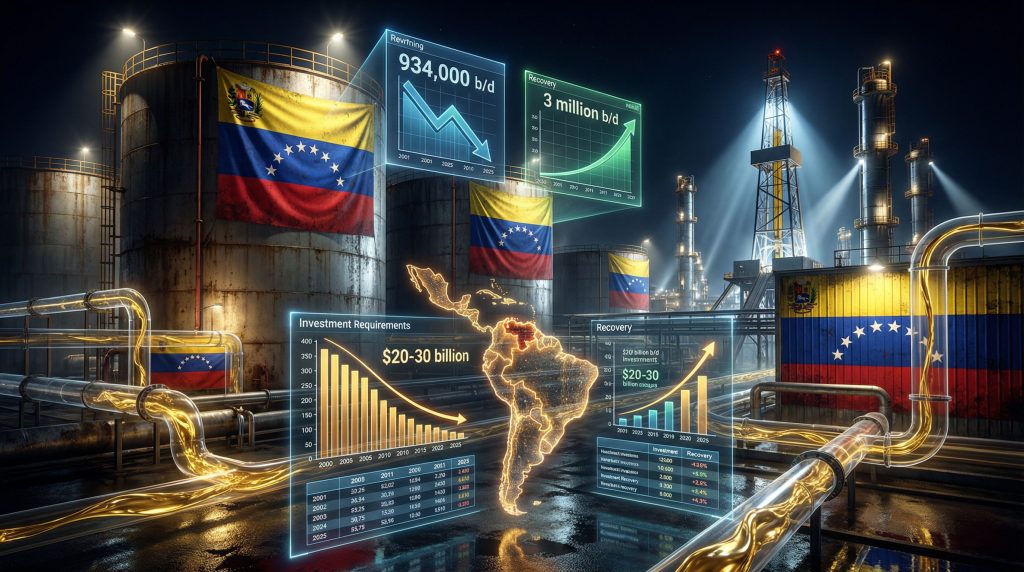
Venezuela's oil production trajectory represents one of the most dramatic collapses in global energy history. The South American nation currently operates at approximately 934,000 barrels per day (b/d) as of November 2025, marking a catastrophic decline from historical peaks that once exceeded 3 million b/d in the early 2000s. This Venezuela oil production outlook uncertain situation stems from a complex web of factors that have fundamentally reshaped the country's energy landscape over two decades, contributing to broader oil price movements across global markets.
Understanding Venezuela's Production Baseline and Historical Context
The magnitude of this production decline cannot be overstated. Venezuela has lost roughly 70% of its production capacity since its peak years, transforming from a major global oil supplier into a constrained producer struggling with operational challenges. This collapse reflects systematic underinvestment in critical infrastructure, operational inefficiencies across the petroleum sector, and prolonged international sanctions that have isolated the country from global markets and technology transfers.
Furthermore, this decline contrasts sharply with the US oil production decline trends observed in other major producing nations, highlighting the unique challenges facing Venezuelan energy infrastructure.
Historical Production Analysis by Decade
| Time Period | Production Level | Primary Contributing Factors |
|---|---|---|
| Early 2000s | ~3.0 million b/d | Pre-nationalization peak performance |
| 2010-2015 | 2.5-2.8 million b/d | Declining but relatively stable operations |
| 2016-2020 | 1.5-2.0 million b/d | Initial sanctions impact becomes evident |
| 2021-2025 | 0.9-1.1 million b/d | Current heavily constrained production levels |
The early 2000s represented Venezuela's golden era of oil production, when the country maintained sophisticated extraction operations and benefited from substantial foreign investment and technological expertise. However, the nationalization program initiated under former president Hugo Chavez fundamentally altered the industry's structure, leading to the gradual exodus of international oil companies and their associated technical capabilities.
During the 2010-2015 period, production remained relatively robust despite emerging challenges. The Venezuelan oil sector still maintained much of its core infrastructure and operational expertise, allowing for sustained output levels that kept the country among the world's significant crude producers. This period represented the last phase of relatively stable production before more severe disruptions began.
The 2016-2020 timeframe marked the beginning of accelerated decline as international sanctions began to bite. The Venezuela oil production outlook uncertain became increasingly apparent as the country faced mounting difficulties accessing international markets, securing technological upgrades, and maintaining critical infrastructure. Export limitations and financial sector restrictions compounded operational challenges.
When big ASX news breaks, our subscribers know first
Political Transition Scenarios and Production Implications
The Venezuela oil production outlook uncertain hinges critically on political developments that could unfold through multiple distinct pathways. Each scenario carries profound implications for production capacity, international investment flows, and market positioning over both near-term and extended timeframes.
Continuity Scenario Analysis
Under a continuity scenario, gradual sanctions relief might occur within existing governance frameworks. This pathway would likely involve incremental policy adjustments and limited international re-engagement rather than dramatic structural changes. Production recovery would remain constrained by existing institutional limitations and ongoing international skepticism regarding long-term stability.
Key characteristics of this scenario include:
- Slow-paced sanctions relief negotiations spanning multiple years
- Limited foreign direct investment due to persistent political risk concerns
- Gradual infrastructure rehabilitation at modest investment levels
- Production increases of approximately 200,000-400,000 b/d over 3-5 years
Transition Scenario Framework
A political transition scenario would enable accelerated international re-engagement and potentially dramatic shifts in production capacity. This pathway assumes significant governance changes that address international concerns about transparency, rule of law, and contract sanctity.
Critical elements of this scenario encompass:
- Comprehensive debt restructuring agreements with international creditors
- Return of major international oil companies with substantial investment commitments
- Technology transfer partnerships restoring operational capabilities
- Production recovery potential reaching 1.5-2.0 million b/d within 5-7 years
Fragmentation Risk Assessment
Internal fragmentation represents the most challenging scenario for Venezuela's oil production outlook uncertain. Political instability could further disrupt operations, damage infrastructure, and deter any remaining international engagement. This pathway would likely result in continued production declines and extended market isolation.
Recent developments highlight fragmentation risks, with internal divisions emerging between administration officials following recent political upheavals. Interior minister positions conflicting with interim leadership arrangements demonstrate the potential for destabilizing internal conflicts that could severely impact operational continuity.
Infrastructure Degradation and Capital Requirements
Venezuela's oil infrastructure faces critical bottlenecks extending far beyond political considerations. The technical challenges represent decades of deferred maintenance, equipment degradation, and operational inefficiencies that require massive capital investment to address comprehensively.
Power Grid Instability Impact
Electrical power reliability represents perhaps the most fundamental constraint on Venezuelan oil production capacity. Oil extraction, processing, and transportation operations require consistent electrical supply, yet the national power grid suffers from chronic instability. Power outages regularly disrupt pumping operations, refinery processes, and pipeline systems.
The power sector challenges include:
- Aging generation equipment lacking spare parts and maintenance
- Transmission infrastructure suffering from corrosion and component failures
- Limited backup power systems at critical oil facilities
- Insufficient investment in renewable energy alternatives
Pipeline and Processing Facility Deterioration
Venezuela's extensive pipeline network shows severe signs of degradation after years of minimal maintenance investment. Corrosion, leak detection system failures, and pump station breakdowns regularly interrupt crude oil transportation from production fields to export terminals and refineries.
Processing facility conditions are equally concerning:
- Refinery throughput capacity reduced by approximately 60% from design levels
- Distillation units operating with reduced efficiency due to equipment wear
- Safety systems compromised by lack of spare parts and qualified maintenance personnel
- Environmental compliance systems functioning below international standards
Infrastructure Investment Requirements: Industry analysts estimate that restoring Venezuelan oil infrastructure to full operational capacity requires $20-30 billion in capital investment over 5-7 years, representing one of the largest infrastructure rehabilitation projects in global energy sector history.
Technology Gap Analysis
The technological isolation experienced by Venezuela's oil sector has created substantial gaps in operational capabilities. Modern extraction techniques, digital monitoring systems, and enhanced recovery methods remain largely inaccessible due to sanctions restrictions and limited capital availability.
Critical technology deficiencies include:
- Horizontal drilling and hydraulic fracturing capabilities
- Advanced reservoir monitoring and modeling systems
- Digital automation and control systems
- Environmental monitoring and remediation technologies
Sanctions Impact on Recovery Timelines
International sanctions regimes create multilayered constraints that extend far beyond simple export restrictions. The Venezuela oil production outlook uncertain reflects the complex interaction between financial sector isolation, technology transfer limitations, and logistics complications that compound operational challenges.
Financial Sector Isolation Effects
Banking sector restrictions prevent Venezuelan oil entities from accessing international financial systems essential for large-scale operations. This isolation affects everything from equipment purchases to routine maintenance contracts, creating cascading operational impacts.
Financial constraints manifest through:
- Limited access to trade finance for equipment imports
- Restricted ability to establish letters of credit for international suppliers
- Complications in processing payments for technical services
- Reduced capacity to secure project financing for infrastructure development
These financial barriers, coupled with broader tariff impact on investments considerations, create additional challenges for international companies seeking to engage with Venezuelan oil projects.
Technology Transfer Restrictions
Sanctions specifically targeting technology transfers prevent Venezuelan operators from accessing advanced extraction and processing technologies. These restrictions limit operational efficiency improvements and constrain production optimization efforts.
Shipping and Insurance Complications
International shipping companies and marine insurers face significant compliance challenges when handling Venezuelan crude oil. These complications reduce available transportation options and increase logistics costs, further constraining export capabilities.
Recent data illustrates these challenges:
- Kpler estimates: December exports at 827,000 b/d, up 52,000 b/d from November
- Vortexa tracking: December exports at 556,000 b/d, down 282,000 b/d from November
- Export data discrepancies highlight tracking difficulties due to sanctions evasion tactics
Sanctions Relief Scenario Modeling
| Relief Timeline | 2026 Production Projection | 2028 Production Projection | Required Investment |
|---|---|---|---|
| Immediate Comprehensive Relief | 1.2 million b/d | 1.8 million b/d | $15 billion |
| Gradual 3-Year Phased Relief | 1.0 million b/d | 1.4 million b/d | $12 billion |
| Continued Current Restrictions | 0.9 million b/d | 1.0 million b/d | $5 billion |
International Investment Frameworks and Risk Assessment
Major international oil companies face complex strategic decisions regarding Venezuelan market re-entry. The Venezuela oil production outlook uncertain creates challenging risk-reward calculations that must account for political volatility, regulatory uncertainty, and substantial capital requirements.
Risk-Adjusted Investment Thresholds
International operators require comprehensive risk mitigation frameworks before committing significant capital to Venezuelan projects. These frameworks typically include political risk insurance, long-term contract guarantees, and regulatory stability assurances that may be difficult to secure under current conditions.
Heavy Crude Technical Challenges
Venezuela's extra-heavy crude reserves present unique technical and financial challenges that complicate investment decisions. The Orinoco Belt contains some of the world's largest oil reserves, but extraction and processing require specialized technologies and substantial upfront investment.
Technical considerations include:
- Upgrading Infrastructure: Complex refining processes requiring specialized equipment investments
- Enhanced Recovery Methods: Advanced extraction technologies for heavy oil deposits
- Transportation Networks: Pipeline and port facility modernization to handle heavy crude volumes
- Environmental Compliance: Advanced systems to meet international environmental standards
International Operator Positioning
Chevron currently maintains operations in Venezuela under sanctions waivers, importing approximately 120,000 b/d to the United States in December 2025. This arrangement provides insight into operational possibilities under constrained conditions, though production levels remain well below historical capacity.
ConocoPhillips holds the largest expropriation claim at $12 billion, with resolution pending through the auction of state-owned refining company Citgo. The Elliott Investment Management affiliate Amber Energy submitted a winning $5.9 billion bid, though final completion remains subject to legal proceedings.
ExxonMobil and other previously active operators maintain expropriation claims through international tribunals, creating additional complexity for any future re-engagement scenarios.
Global Market Impact and Price Dynamics
Changes in Venezuelan oil production carry significant implications for global energy markets, despite the country's reduced market share compared to historical levels. The Venezuela oil production outlook uncertain creates both upside and downside price pressures depending on production trajectory developments.
In addition, the potential for significant Venezuelan production changes occurs within the broader context of US-China trade impact on global commodity markets, adding another layer of complexity to price forecasting.
Market Impact Modelling Analysis
Financial institutions have developed sophisticated models to assess Venezuelan production changes on global crude prices. Goldman Sachs analysis indicates that a 400,000 b/d production increase could reduce Brent crude prices by approximately $2 per barrel, highlighting continued market sensitivity to Venezuelan supply changes.
This price sensitivity reflects several factors:
- Venezuela's heavy crude characteristics provide specific refining value
- Geographic proximity to major refining centres in the United States and Caribbean
- Potential displacement of other crude sources in regional markets
- Psychological market impact of major production changes from historically significant suppliers
Supply Context and Competitive Dynamics
Venezuelan production recovery occurs within a complex global supply environment featuring multiple competing factors:
- OPEC+ Production Management: Coordinated production policies affecting global supply levels
- U.S. Shale Production Flexibility: Rapid response capabilities to price signals
- Emerging Regional Suppliers: Guyana and other developing production sources
- Seasonal Demand Variations: First-quarter weakness affecting market absorption capacity
Moreover, market analysts have noted that Venezuelan supply fluctuations can interact with broader market volatility, as demonstrated in previous oil price crash analysis studies examining the intersection of geopolitical factors and market dynamics.
Price Elasticity Assessment
| Production Change Magnitude | Estimated Brent Price Impact | Market Adjustment Timeline |
|---|---|---|
| +400,000 b/d increase | -$2.00/barrel | 6-12 months |
| +800,000 b/d increase | -$4.00/barrel | 12-18 months |
| -200,000 b/d decrease | +$1.50/barrel | 3-6 months |
These price impact estimates assume normal market conditions and may vary significantly during periods of geopolitical tension, seasonal demand variations, or major supply disruptions elsewhere in the global system.
The next major ASX story will hit our subscribers first
Regional Energy Security Implications
Venezuelan oil production changes carry strategic implications extending beyond immediate market impacts. The Venezuela oil production outlook uncertain affects regional energy security calculations, particularly in the Western Hemisphere where geographical proximity creates natural trading relationships.
Western Hemisphere Energy Balance
Successful Venezuelan production recovery could fundamentally alter regional energy dynamics through multiple channels:
- Reduced U.S. Import Dependency: Additional heavy crude supply could displace imports from more distant sources
- Enhanced Regional Security: Diversified supply sources reducing vulnerability to distant supply disruptions
- Transportation Cost Advantages: Shorter shipping distances reducing logistics costs and supply chain risks
- Refining Optimisation: Heavy crude characteristics suited to existing U.S. Gulf Coast refining configurations
China-Venezuela Energy Partnership Evolution
Venezuela's oil-for-loans program with China represents a critical component of current export arrangements. Any significant production changes would affect this relationship and potentially alter broader China-Latin America energy cooperation frameworks.
Current arrangements include:
- Long-term crude supply commitments to Chinese state-owned enterprises
- Infrastructure development projects financed through oil revenues
- Technology transfer initiatives in energy sector development
- Strategic cooperation agreements extending beyond pure commercial arrangements
Technology Modernisation Requirements
Sustainable Venezuelan production recovery requires comprehensive technology modernisation addressing decades of isolation from international best practices. The Venezuela oil production outlook uncertain reflects not only political and financial constraints but also substantial technological gaps that must be addressed through systematic investment and knowledge transfer programs.
Digital Transformation Needs
Modern oil operations rely heavily on digital monitoring systems, predictive maintenance technologies, and automated control systems that remain largely absent from Venezuelan facilities. Implementing these technologies requires both capital investment and extensive personnel training programs.
Priority digital transformation areas include:
- Real-time reservoir monitoring and production optimisation systems
- Predictive maintenance programs reducing equipment failure risks
- Automated safety systems meeting international standards
- Environmental monitoring and compliance tracking capabilities
Enhanced Recovery Techniques
Venezuela's heavy oil resources particularly benefit from enhanced recovery techniques that remain underutilised due to technological constraints. Steam injection, chemical flooding, and other advanced methods could significantly increase recovery rates from existing fields.
Environmental Compliance Technology
International re-engagement likely requires substantial improvements in environmental performance, necessitating investment in pollution control systems, waste management technologies, and ecosystem protection measures.
Operational Efficiency Requirements: Modern drilling techniques, digital monitoring systems, and environmental compliance technologies represent essential components of any sustainable production growth strategy, requiring coordinated implementation across multiple technical disciplines.
Market Monitoring and Performance Indicators
Tracking Venezuelan oil production recovery requires monitoring multiple performance indicators that provide insight into both immediate operational status and longer-term trajectory prospects. The Venezuela oil production outlook uncertain demands sophisticated analytical frameworks addressing political, technical, and market dimensions.
Production and Export Tracking Metrics
Monthly Export Volume Analysis: Actual shipment data provides the most reliable indicator of operational capacity, though sanctions evasion tactics complicate accurate tracking. Recent export estimates show significant variation between different tracking services, highlighting methodology challenges.
Investment Commitment Announcements: Foreign direct investment announcements, joint venture formations, and technology partnership agreements signal international confidence levels and capital availability for sector development.
Infrastructure Restoration Progress: Power grid stability measurements, pipeline integrity assessments, and refinery throughput data provide concrete indicators of operational capacity improvements.
Regulatory Framework Evolution: Changes in foreign investment laws, contract enforcement mechanisms, and international arbitration cooperation signal institutional development progress.
Forward Market Signals
Forward curve pricing for Venezuelan crude provides real-time market sentiment regarding production recovery probability and timeline expectations. Price differentials between Venezuelan heavy crude and benchmark grades reflect market assessments of supply reliability and quality considerations.
Financial Market Indicators
Credit default swap spreads, sovereign bond pricing, and currency exchange rates provide broader economic context affecting oil sector development prospects. These indicators often signal market confidence before production changes become apparent in physical markets.
Long-term Strategic Outlook and Risk Management
The Venezuela oil production outlook uncertain requires market participants to develop robust scenario planning frameworks addressing multiple possible development trajectories. Successful navigation of this uncertainty depends on understanding the interplay between political developments, technical constraints, and market dynamics over extended timeframes.
Acceleration Factors for Recovery
Several developments could accelerate Venezuelan production recovery beyond base-case expectations:
- Comprehensive Debt Restructuring: Resolution of outstanding international obligations reducing investment barriers
- Multilateral Development Bank Engagement: International development finance supporting infrastructure rehabilitation
- Technology Partnership Agreements: Strategic alliances with major international operators transferring advanced capabilities
- Streamlined Investment Frameworks: Simplified regulatory processes reducing bureaucratic obstacles to foreign investment
Potential Delay Factors
Conversely, various factors could extend recovery timelines or prevent meaningful production increases:
- Continued Political Instability: Internal conflicts disrupting operational continuity and deterring investment
- Infrastructure Security Concerns: Sabotage risks or civil unrest affecting facility operations
- Environmental Compliance Requirements: International pressure for stringent environmental standards requiring substantial additional investment
- Regional Geopolitical Tensions: Broader Latin American political developments affecting international cooperation
Investment Risk Mitigation Strategies
Successful engagement with Venezuelan oil markets requires sophisticated risk management approaches addressing multiple uncertainty sources:
- Political Risk Insurance: Comprehensive coverage protecting against expropriation, political violence, and regulatory changes
- Staged Investment Approaches: Gradual capital deployment allowing for adjustment based on evolving conditions
- Diversified Partnership Structures: Multiple international participants sharing both risks and returns
- Flexible Contract Terms: Arrangements accommodating changing political and economic circumstances
The timeline for meaningful Venezuelan production recovery extends well beyond immediate political changes, reflecting deep structural challenges that require sustained commitment and substantial resources to address effectively. Market participants must prepare for continued volatility while developing frameworks to identify and respond to genuine progress indicators.
What factors will determine Venezuela's oil production trajectory?
Multiple interconnected factors will shape Venezuela's production outlook including political stability and transition pathways, infrastructure restoration progress, sanctions relief timeline, and international investment levels. Technical challenges requiring substantial capital investment compound political uncertainties.
How long would production recovery take under optimal scenarios?
Even under the most favourable conditions involving comprehensive sanctions relief and political transition, meaningful production recovery would likely require 5-7 years to reach 1.5-2.0 million b/d. This timeframe reflects the extensive infrastructure rehabilitation and technology modernisation requirements necessary for sustainable operations.
Navigating Production Uncertainty
Venezuela's oil production trajectory represents one of the most complex energy sector challenges in global markets today. While the country possesses substantial hydrocarbon reserves theoretically capable of supporting significant production increases, realising this potential requires addressing interconnected political, technical, and financial constraints that have developed over more than two decades.
The Venezuela oil production outlook uncertain reflects fundamental uncertainties extending across multiple dimensions. Political transition scenarios range from gradual evolution to dramatic restructuring, each carrying distinct implications for production capacity and international re-engagement possibilities. Technical challenges require massive infrastructure investment and comprehensive technology modernisation that may take years to implement effectively.
International sanctions regimes create additional complexity through financial isolation, technology transfer restrictions, and logistics complications that compound operational difficulties. Even with comprehensive sanctions relief, production recovery would require substantial time and investment to address infrastructure degradation and technological gaps.
Market participants should prepare for extended uncertainty while monitoring key performance indicators that signal genuine progress toward sustainable production growth. The ultimate trajectory will depend on coordinated political stability, sustained international re-engagement, and massive infrastructure investment requirements that extend far beyond any single policy change or political development.
Furthermore, Venezuelan developments leave room for supply increases according to international energy analysts, though the timeline remains highly uncertain given the complex challenges outlined above.
Looking to Navigate Oil Market Volatility?
Discovery Alert's proprietary Discovery IQ model identifies real-time opportunities in ASX-listed energy and resource companies, helping investors capitalise on market movements while Venezuela's production uncertainty creates ongoing global supply dynamics. Transform complex commodity market data into actionable trading insights by exploring Discovery Alert's proven track record and begin your 30-day free trial today to secure your market-leading advantage.