June 24, 2026
What Are the Real Capital Requirements for Venezuela's Oil Revival?
The energy sector stands at a pivotal moment as Venezuela's oil reserves present one of the largest untapped opportunities in the Western Hemisphere. Industry experts estimate that VEN oil revival funding will require unprecedented capital deployment, fundamentally reshaping how international energy markets approach resource development financing. Furthermore, this massive undertaking could significantly influence the broader oil price rally dynamics across global markets.
When big ASX news breaks, our subscribers know first
Breaking Down the $100+ Billion Investment Timeline
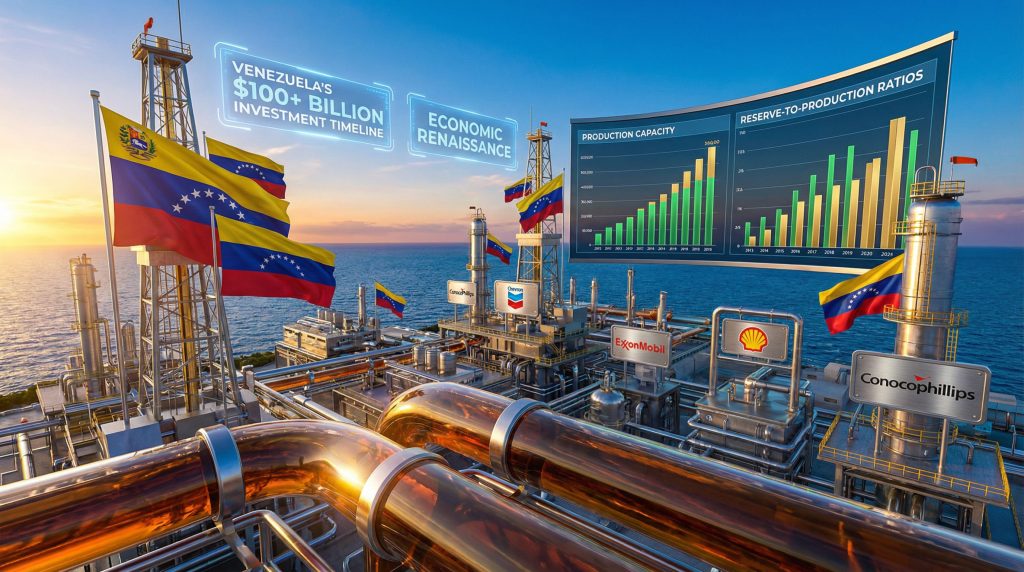
According to Interior Secretary Doug Burgum, Venezuela's oil sector revival will require $100+ billion in capital investment over the next decade. This massive financial commitment represents one of the largest energy infrastructure reconstruction projects in modern history, dwarfing many traditional oil province developments.
The investment timeline reflects the complexity of rebuilding decades of deteriorated infrastructure. Capital deployment must address multiple phases simultaneously:
• Immediate infrastructure assessment and emergency repairs (Years 1-2)
• Major production facility reconstruction (Years 3-5)
• Full-scale development and expansion (Years 6-10)
• Long-term optimization and modernization (Years 8-10)
Market analysis suggests that maintenance capital expenditures will dominate early-phase investments, with growth capital allocation increasing substantially as production capacity stabilizes. The scale of this undertaking exceeds typical offshore development projects, requiring sustained financial commitment across multiple economic cycles. In addition, the timing coincides with concerns about US oil production decline that could affect global supply dynamics.
| Investment Category | Estimated Timeframe | Priority Level |
|---|---|---|
| Emergency Infrastructure Repair | 2025-2027 | Critical |
| Production Facility Rebuild | 2026-2029 | High |
| Pipeline Network Restoration | 2027-2031 | High |
| Refinery Modernization | 2028-2033 | Medium |
| Capacity Expansion | 2030-2035 | Growth-Focused |
Infrastructure Rebuild Cost Categories
Venezuela's oil infrastructure has experienced significant deterioration, requiring comprehensive reconstruction across all operational categories. Wellhead and production facility restoration represents the most immediate capital requirement, as these systems form the foundation for any meaningful production recovery.
Pipeline and transportation networks require extensive rebuilding to connect restored production facilities with export terminals and domestic refineries. The existing pipeline infrastructure has suffered from years of deferred maintenance, creating bottlenecks that could limit production even after wellhead capacity returns online.
Refinery modernization presents perhaps the most complex technical challenge, as Venezuela's heavy crude characteristics require specialized processing capabilities. Upgrading aging refinery units to handle increased throughput while meeting modern environmental standards will demand significant capital allocation and technical expertise.
How Will Private Capital Markets Drive Venezuela's Energy Comeback?
The financing architecture for VEN oil revival funding represents a fundamental shift from traditional government-sponsored reconstruction models. Private capital markets are emerging as the primary funding mechanism, driven by the resource's inherent economic attractiveness rather than public sector subsidies. However, this approach must consider the potential impact of OPEC production impact on global pricing and investment returns.
Major Oil Company Investment Strategies
Energy Secretary Chris Wright revealed that companies have shown overwhelming interest in Venezuelan opportunities, stating he has been "deluged with companies interested to go to Venezuela." This unprecedented level of industry engagement suggests that major oil companies view Venezuela as a strategic priority despite political and operational risks.
The investment appeal stems from Venezuela's massive resource base, which Interior Secretary Burgum characterised as "so significant and so large that it's going to be attractive for people to go in and develop." This resource quality appears sufficient to justify private investment without government subsidies, indicating robust expected returns on invested capital.
Risk-adjusted return models for Venezuela market entry focus on several key factors:
• Resource quality and production potential
• Political stability and regulatory framework certainty
• Operational security and workforce availability
• Infrastructure reconstruction timelines
• Export market access and transportation capacity
Portfolio allocation strategies among international energy majors are evolving to incorporate Venezuela as a significant growth opportunity. Companies are reportedly seeking operational security guarantees rather than financial subsidies, suggesting confidence in the underlying economics of Venezuelan oil development.
Alternative Financing Mechanisms Beyond Government Funding
Energy Secretary Wright identified the U.S. Export-Import Bank as a potential source of credit support for Venezuelan energy projects. This trade finance mechanism could provide crucial backing for large-scale infrastructure investments while maintaining the private sector focus of VEN oil revival funding.
Export-Import Bank credit facilities offer several advantages for energy infrastructure development:
• Risk mitigation for long-term capital projects
• Competitive financing rates for qualifying investments
• Political risk coverage for international operations
• Support for U.S. equipment and service exports
Project finance structures for large-scale energy infrastructure development enable companies to manage capital deployment risk while accessing necessary funding. These mechanisms allow for staged investment based on operational milestones, reducing exposure during the critical early phases of infrastructure reconstruction.
Joint venture models between U.S. and international energy companies are likely to play a crucial role in risk distribution and capital efficiency. By sharing development costs and operational expertise, partnerships can accelerate project timelines while managing individual company exposure to Venezuelan market risks. For instance, investors are closely monitoring Venezuela's progress given concerns about potential oil price crash analysis scenarios affecting global markets.
What Political and Regulatory Factors Shape Investment Decisions?
The political landscape surrounding Venezuelan energy development presents both opportunities and challenges that directly impact investment decision-making. Companies seeking to participate in VEN oil revival funding must navigate complex regulatory frameworks while managing geopolitical risks.
Sanctions Framework Evolution and Business Implications
Current licensing requirements for Venezuelan energy operations continue to evolve as political conditions change. The transition from the Maduro government creates opportunities for expanded energy sector access, but companies require clear regulatory pathways for long-term capital commitments.
Oil company executives have specifically sought "assurances on physical and financial security amid concerns about the stability of a post-Nicolás Maduro government," highlighting the critical importance of regulatory certainty for investment planning. These concerns reflect the substantial capital requirements and long-term nature of oil sector development projects.
Investment Security Considerations: Companies require clear legal frameworks that protect long-term capital commitments and ensure operational continuity throughout political transitions.
The regulatory pathway for expanded energy sector access must address multiple stakeholder interests while providing sufficient certainty for private investment. Legal security provisions need to account for the decade-long investment timeline required for full oil sector revival.
Geopolitical Risk Assessment for Energy Investors
Post-transition government stability represents the primary geopolitical concern for energy investors. The $100+ billion capital requirement necessitates political stability that extends well beyond immediate transition periods, requiring sustained policy consistency across multiple electoral cycles.
International diplomatic coordination requirements add complexity to investment planning, as energy companies must navigate relationships between multiple governments while ensuring operational compliance. Security infrastructure needs for operational continuity represent a key area where U.S. government support could facilitate private investment.
Interior Secretary Burgum emphasised that government support would focus on providing "a secure, stable environment," positioning security as the critical public sector contribution to private sector success. This approach aligns with industry preferences for operational security rather than financial subsidies, particularly given the current focus on oil prices & geopolitics in global energy markets.
Which Companies Are Positioned to Lead Venezuela's Oil Sector Recovery?
The competitive landscape for Venezuelan energy development involves multiple tiers of companies with varying capabilities and risk tolerances. Energy Secretary Wright's observation about being "deluged with companies interested to go to Venezuela" suggests broad industry participation across multiple business segments.
Tier-1 Energy Majors: Capital Capacity and Strategic Interest
Major international oil companies possess the financial resources and technical capabilities required for large-scale Venezuelan energy development. Chevron's existing operational experience in Venezuela provides valuable insights into local conditions and regulatory requirements that could prove advantageous for expanded operations.
ExxonMobil and ConocoPhillips represent significant potential participants, particularly given their historical presence in Venezuelan energy markets. Both companies have the capital capacity to participate meaningfully in the $100+ billion investment requirement while bringing advanced technical capabilities to complex heavy oil development challenges.
European energy companies including Shell, Eni, and Repsol bring international perspectives and diverse funding sources to Venezuelan opportunities. Their global heavy oil experience and established Latin American operations position them as potential leaders in specific project segments. According to Bloomberg reporting, these companies are actively evaluating Venezuelan investment opportunities as political conditions stabilise.
Key factors influencing Tier-1 company participation include:
• Available capital allocation within existing investment portfolios
• Technical expertise in heavy crude oil development
• Risk management capabilities for emerging market operations
• Existing relationships with Venezuelan energy infrastructure
• Regulatory approval capacity in home jurisdictions
Service Sector and Trading House Participation
Oilfield services companies like Halliburton and other sector leaders will play crucial roles in the technical execution of Venezuelan energy revival. These companies provide specialised equipment and expertise that are essential for restoring production capacity across degraded infrastructure.
Commodity trading firms including Trafigura and Vitol bring critical market access capabilities that connect Venezuelan production with global energy markets. Their role extends beyond traditional trading to include infrastructure financing and supply chain management services that support production development.
Downstream players focused on refining capacity and crude processing represent another essential component of the Venezuelan energy ecosystem. The heavy crude characteristics of Venezuelan oil require specialised processing capabilities that align with specific refinery configurations.
The next major ASX story will hit our subscribers first
How Do Venezuela's Oil Reserves Compare to Global Investment Opportunities?
Venezuela's position in global energy markets reflects the massive scale of its oil reserves and the unique characteristics that differentiate it from other investment opportunities. The resource base that Interior Secretary Burgum described as "so significant and so large" represents one of the world's largest proven oil reserves.
Resource Quality and Development Economics
Venezuelan heavy crude presents distinct characteristics that require specialised development approaches and refining capabilities. The resource quality influences both production costs and market value, creating specific economic dynamics that affect investment returns and project viability.
Heavy crude development economics typically involve higher initial capital requirements but can provide sustained production over extended periods. The reservoir characteristics and geological conditions in Venezuela support long-term production profiles that justify the substantial upfront investment required for infrastructure development.
Production cost structures vary significantly across Venezuelan oil provinces, with some areas offering competitive development economics compared to alternative global opportunities. Reserve-to-production ratios suggest decades of development potential, supporting the long-term investment horizons required for infrastructure reconstruction.
| Reserve Category | Estimated Resource | Development Timeline |
|---|---|---|
| Proven Reserves | ~300 billion barrels | 10+ years full development |
| Heavy Oil Deposits | Majority of total | Specialised processing required |
| Conventional Light Oil | Smaller portion | Faster development potential |
| Enhanced Recovery Potential | Significant upside | Advanced technology dependent |
Market Access and Export Infrastructure Analysis
Caribbean refining hub integration opportunities provide strategic advantages for Venezuelan oil development. The geographic proximity to established refining centres creates natural market connections that reduce transportation costs and improve project economics.
U.S. Gulf Coast processing capacity alignment offers substantial opportunities for Venezuelan heavy crude processing. Many existing refineries are specifically configured for heavy crude inputs, creating natural market demand for Venezuelan production once political conditions stabilise.
Global heavy crude market dynamics favour countries with large, reliable production capacity. Venezuela's potential to restore significant production volumes positions it as a major player in international heavy crude markets, particularly as other heavy crude producers face depletion challenges. Furthermore, Yahoo Finance analysis suggests that investors are increasingly optimistic about Venezuela's long-term production potential.
What Are the Key Investment Risks and Mitigation Strategies?
Investment risks in Venezuelan energy development span multiple categories, from political and regulatory uncertainties to operational and technical challenges. Understanding and mitigating these risks represents a critical component of successful VEN oil revival funding strategies.
Financial Risk Management Approaches
Currency exposure represents a significant concern for long-term capital investments in Venezuelan energy projects. Companies must develop robust hedging strategies and contractual protections to manage exchange rate volatility over decade-long investment timelines.
Local content requirements and workforce development obligations create additional financial considerations that affect project economics. These requirements must be balanced against operational efficiency and cost management objectives while supporting local economic development goals.
Debt resolution frameworks for legacy obligations require careful navigation to ensure clear title and operational rights. Historical claims and unresolved financial obligations could impact new investment projects without proper legal resolution mechanisms.
Insurance and political risk coverage options provide essential protection for large-scale energy investments. These products can mitigate specific risks related to political transitions, regulatory changes, and operational disruptions that could affect project viability.
Operational Risk Factors
Workforce development and technical capability gaps present immediate challenges for energy sector revival. Years of economic disruption have created skills shortages that require systematic training and development programmes to support large-scale operations.
Environmental compliance and remediation costs add complexity to project development budgets. Existing environmental conditions and regulatory requirements for restoration work must be incorporated into comprehensive project planning and cost estimation.
Supply chain security and equipment procurement challenges affect both project timelines and costs. Establishing reliable supply chains for specialised equipment and materials requires advance planning and alternative sourcing strategies.
Critical operational risk mitigation strategies include:
• Phased development approaches that allow for operational learning
• Partnership with experienced local operators and service providers
• Comprehensive security planning for personnel and assets
• Redundant supply chain arrangements for critical equipment
• Advanced training programmes for local workforce development
Timeline Scenarios: When Will Major Capital Deployment Begin?
The deployment timeline for VEN oil revival funding reflects the complex sequencing required for successful energy sector reconstruction. Companies are scheduled to meet with Trump administration officials to formalise investment planning discussions, indicating that formal engagement has already commenced.
Near-term Investment Phase (2025-2027)
Immediate infrastructure assessment represents the critical first step in capital deployment planning. Companies require comprehensive technical evaluations of existing facilities and infrastructure to develop accurate cost estimates and project timelines.
Pilot project development during this phase allows for operational testing and risk assessment before larger capital commitments. These initial projects provide valuable data on local conditions, regulatory requirements, and technical challenges that inform larger-scale development decisions.
Regulatory framework establishment and licensing processes must advance in parallel with technical planning to ensure that companies can proceed with confidence once infrastructure assessments are complete. Clear regulatory pathways are essential for companies to commit significant capital resources.
Near-term Phase Milestones:
• Q1-Q2 2025: Infrastructure assessment and technical due diligence
• Q3-Q4 2025: Regulatory framework clarification and licensing
• Q1-Q2 2026: Pilot project initiation and workforce development
• Q3-Q4 2026: First major capital deployment decisions
• 2027: Full-scale project planning and final investment decisions
Large-Scale Development Phase (2028-2035)
Full-field development programmes represent the core of the $100+ billion investment timeline. This phase encompasses major production facility construction, pipeline development, and processing capacity expansion across multiple Venezuelan oil provinces.
Midstream infrastructure construction and commissioning require coordination across multiple companies and project segments. Pipeline networks, storage facilities, and transportation systems must develop in parallel with upstream production capacity to avoid bottlenecks.
Export capacity expansion and market integration complete the development cycle by connecting Venezuelan production with global energy markets. This phase requires coordination with international trading partners and refining facilities to ensure market access for increased production volumes.
The large-scale development timeline spans nearly a decade, reflecting the massive infrastructure requirements and technical complexity of restoring Venezuela's oil sector to full production capacity.
Economic Impact Analysis: Venezuela Oil Revival Investment Returns
The economic implications of Venezuelan oil sector revival extend far beyond direct investment returns, encompassing energy security, regional economic development, and global market dynamics. The scale of VEN oil revival funding creates ripple effects across multiple economic sectors and geographic regions.
Macro-Economic Benefits for Stakeholder Countries
U.S. energy security enhancement through Venezuelan oil development provides strategic benefits that extend beyond commercial returns. Diversified oil supply sources reduce dependence on other international suppliers while strengthening hemispheric energy relationships.
Regional economic development throughout Latin America and the Caribbean benefits from increased Venezuelan energy production. Supply chain opportunities, service sector growth, and infrastructure development create employment and economic activity across multiple countries.
Global oil market supply balance implications favour increased production capacity from reliable suppliers with large resource bases. Venezuelan production revival could provide price stability and supply security for international energy markets facing declining production from aging fields elsewhere.
Key Economic Impact Areas:
• Direct employment creation: 100,000+ jobs across energy sector
• Indirect economic activity: Supply chain and service sector expansion
• Regional infrastructure development: Transportation and logistics improvements
• Technology transfer: Advanced extraction and processing techniques
• Energy security enhancement: Reduced import dependence for key markets
Corporate Financial Performance Projections
Expected returns on invested capital for participating companies must justify the substantial risk profile and long-term capital commitment required for Venezuelan energy development. The administration's confidence that private markets will fund the revival without subsidies suggests robust return projections underpin company interest.
Cash flow generation timelines reflect the long-term nature of oil sector development, with initial capital deployment focused on infrastructure reconstruction before meaningful production returns begin. Companies must model decade-long investment horizons with staged returns as production capacity comes online.
Payback periods for Venezuelan energy investments likely extend 7-10 years for initial projects, depending on resource quality and infrastructure requirements. However, the long-term production potential supports extended cash flow generation that can justify initial capital requirements.
Dividend and shareholder value creation potential depends on successful execution of reconstruction plans and sustained political stability. Companies that successfully navigate early development phases could generate substantial long-term returns from Venezuelan energy assets.
Disclaimer: Investment projections and economic impact assessments involve significant uncertainties related to political conditions, commodity prices, and operational execution. Actual results may vary substantially from projections.
Frequently Asked Questions About Venezuela Oil Revival Funding
Will U.S. Taxpayers Fund Venezuela's Oil Industry Recovery?
No, according to Trump administration officials. Interior Secretary Doug Burgum explicitly stated that capital will come from capital markets and energy companies rather than U.S. government funding. While President Trump initially suggested potential reimbursement, subsequent clarifications from cabinet officials emphasise private sector financing as the primary funding mechanism for VEN oil revival funding.
Energy Secretary Chris Wright confirmed that companies are not requesting direct financial support, stating that no participating companies have asked for money. Instead, companies seek U.S. government support for creating stable business conditions and operational security rather than financial subsidies.
How Long Will It Take to Restore Venezuela's Oil Production Capacity?
Full restoration of Venezuelan oil production capacity will require approximately a decade of sustained investment and development. The $100+ billion capital requirement will be deployed over this timeframe, with initial production increases beginning within 2-3 years and full capacity restoration occurring by the mid-2030s.
The timeline reflects the extensive infrastructure reconstruction required after years of deferred maintenance and limited investment. Technical complexity, workforce development needs, and regulatory framework establishment contribute to the extended development period.
What Role Will International Energy Companies Play in the Revival?
International energy companies will serve as the primary drivers of Venezuelan oil sector revival through direct investment, technical expertise, and operational management. Major oil companies possess the capital resources, technical capabilities, and global market access required for large-scale energy development projects.
Service sector companies will provide specialised equipment and expertise for infrastructure reconstruction, while trading houses will facilitate market access and supply chain management. The combination of upstream, midstream, and downstream participants creates a comprehensive industry ecosystem for Venezuelan energy development.
How Will Venezuela Oil Revival Affect Global Energy Markets?
Venezuelan oil production revival will increase global heavy crude supply, potentially affecting international oil prices and market dynamics. The substantial production capacity could provide price stability and supply security for international energy markets while reducing dependence on other major oil exporters.
Caribbean refining hubs and U.S. Gulf Coast refineries specifically configured for heavy crude processing will benefit from increased Venezuelan production. The regional supply chain integration will strengthen hemispheric energy relationships and reduce transportation costs for energy trade.
Disclaimer: Market impact projections involve significant uncertainties related to global economic conditions, geopolitical developments, and competitive supply sources. Actual market effects may differ substantially from current expectations.
Ready to Capitalise on the Next Major Energy Discovery?
As Venezuela's oil revival unfolds with over $100 billion in private investment, savvy investors are positioning themselves for similar transformative opportunities across global energy markets. Discovery Alert's proprietary Discovery IQ model delivers instant notifications on significant ASX mineral discoveries, turning complex exploration data into actionable insights that help investors identify the next potential energy or commodities breakthrough before the broader market catches on.