August 10, 2026
Understanding the Strategic Context for Venezuelan Energy Development
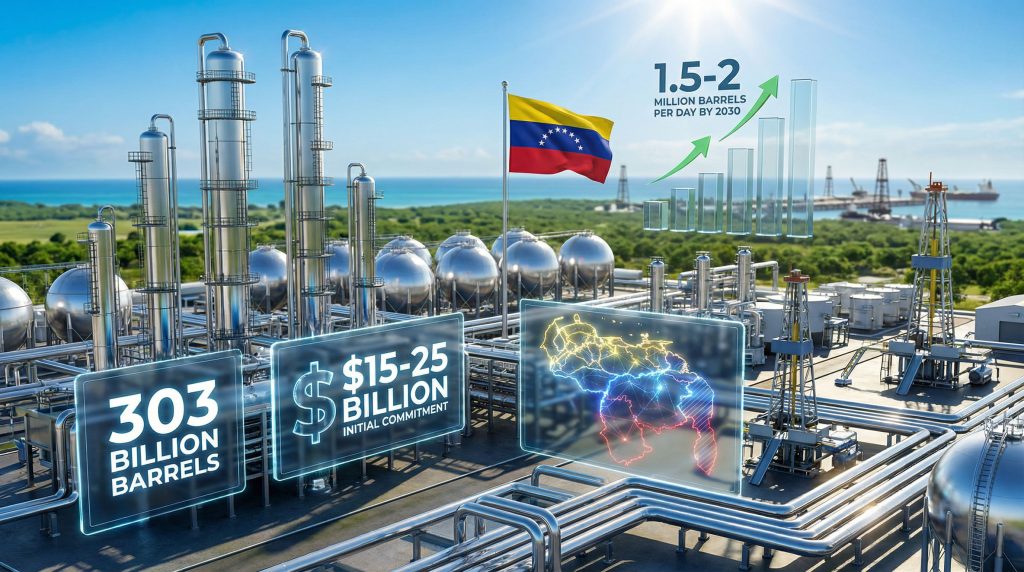
Global energy markets have entered an era of heightened uncertainty, where strategic resource control increasingly shapes international economic relationships. The world's energy infrastructure landscape reflects decades of underinvestment in certain regions, creating opportunities for nations capable of deploying substantial capital and technical expertise. Within this broader context, Venezuela's energy sector represents one of the most significant untapped resource bases in the Western Hemisphere, holding approximately 303 billion barrels of proven crude oil reserves according to the U.S. Energy Information Administration.
This massive resource endowment, representing roughly 17 percent of global reserves, contrasts sharply with the country's current production capacity. Venezuelan oil output has declined from approximately 3 million barrels per day in the late 1990s to less than 800,000 barrels per day by 2023, according to industry estimates. This dramatic reduction reflects the compound effects of infrastructure degradation, technical expertise drain, and systemic underinvestment across the entire energy production chain.
The strategic implications of USA rebuilding Venezuela oil infrastructure extend far beyond bilateral relationships, potentially reshaping Western Hemisphere energy security frameworks. Such reconstruction efforts would involve unprecedented capital deployment, technological integration, and operational coordination across multiple industry segments. Understanding these dynamics requires examining both the technical complexities of large-scale energy infrastructure rehabilitation and the broader geopolitical implications of strategic resource control.
When big ASX news breaks, our subscribers know first
The Scale and Complexity of Venezuelan Oil Infrastructure Reconstruction
Technical Challenges in Heavy Crude Processing Systems
Venezuelan oil reserves consist predominantly of heavy crude oil concentrated in the Orinoco Belt, characterised by API gravity ratings between 8-12 degrees. This extremely heavy crude requires specialised processing infrastructure that differs substantially from conventional oil refining systems. The technical complexity of handling such dense crude oil means that any reconstruction effort must address not only equipment replacement but also fundamental processing methodology upgrades.
Traditional refining infrastructure cannot efficiently process Venezuelan heavy crude without significant modifications or complete replacement with advanced heavy oil processing systems. These specialised facilities require hydrogen production units, delayed coking systems, and hydrocracking capabilities that substantially increase capital requirements compared to conventional refinery construction. Industry cost estimates suggest that modernising Venezuela's major refineries, including the Amuay facility (645,000 barrels per day capacity) and Cardón refinery (310,000 barrels per day capacity), would require approximately $8-12 billion in combined investment.
The integrated nature of oil production systems creates additional complexity. Upstream production facilities, midstream transportation infrastructure, and downstream refining capacity must function as coordinated systems rather than independent components. Venezuela's current infrastructure degradation affects all three segments simultaneously, meaning that production increases require synchronised investment across the entire value chain rather than targeted improvements in specific areas.
Capital Investment Requirements and Financial Frameworks
Large-scale oil infrastructure reconstruction typically follows established financial models that balance private sector capital deployment with government security guarantees. The USA rebuilding Venezuela oil infrastructure would likely employ a hybrid approach combining direct private investment, revenue-sharing agreements, and political risk insurance mechanisms.
Historical precedent from major oil sector reconstructions provides insight into potential investment scales. The Iraq oil infrastructure rehabilitation following 2003 involved estimated total investments exceeding $75 billion across a decade-long period. Libya's post-2011 reconstruction efforts, though interrupted by ongoing instability, initially projected $40-50 billion in infrastructure investment requirements. These examples demonstrate that meaningful oil infrastructure reconstruction requires sustained capital deployment over extended periods rather than short-term investment bursts.
Private sector participation in Venezuelan reconstruction would likely follow Production Sharing Agreement (PSA) models or long-term service contracts that provide guaranteed returns on invested capital. These arrangements typically allocate 60-80 percent of initial revenues to private operators during intensive reconstruction phases, declining to 20-40 percent after production stabilisation. Such revenue-sharing mechanisms balance the high upfront capital requirements with long-term profitability expectations for participating companies.
Production Scenarios and Global Market Impact
Conservative Reconstruction Pathways
A conservative approach to Venezuelan oil infrastructure rehabilitation would focus on restoring production to 1-1.5 million barrels per day within a 3-5 year timeframe. This scenario would require approximately $10-20 billion in targeted investment concentrated on the highest-potential producing regions and critical refining capacity. Such an approach would prioritise rapid production increases over comprehensive modernisation, potentially achieving meaningful output improvements while minimising initial capital requirements.
This production level would represent a doubling of current Venezuelan output, adding approximately 500,000-700,000 barrels per day to global supply. Within the context of global crude oil production of approximately 100 million barrels per day, this increase would represent a 0.5-0.7 percent expansion in worldwide supply. While seemingly modest in percentage terms, this additional supply would occur within the Western Hemisphere, potentially reducing transportation costs and supply chain risks for North American consumers.
The technical feasibility of achieving these production levels depends largely on rehabilitating existing infrastructure rather than building entirely new capacity. Venezuela's existing well network, pipeline systems, and refining facilities provide a foundation that, with substantial investment and maintenance, could support moderate production increases without requiring complete reconstruction of the entire system.
Aggressive Modernisation Scenarios
A comprehensive modernisation approach would target restoration of Venezuelan production to 2.5 million barrels per day, approaching the country's historical peak capacity. This ambitious scenario would require estimated investment of $40-60 billion deployed over a 6-7 year period, involving complete reconstruction of major production facilities, comprehensive refinery modernisation, and extensive pipeline network rehabilitation.
Achieving this production level would add approximately 1.7-1.9 million barrels per day to global oil supply, representing nearly a 2 percent increase in worldwide production. Such an increase would have substantial implications for global oil price movements, potentially reducing crude oil prices by $5-10 per barrel under normal market conditions. However, actual price impacts depend on simultaneous supply and demand developments in other regions.
The technological requirements for this scenario extend beyond simple infrastructure repair to include implementation of enhanced oil recovery techniques, advanced drilling technologies, and state-of-the-art refining processes. Major international oil companies possess the technical expertise and capital resources necessary for such comprehensive reconstruction, though deployment would require sustained political stability and regulatory predictability throughout the investment period.
Geopolitical Implications and International Response Patterns
Strategic Energy Security Considerations
USA rebuilding Venezuela oil infrastructure would fundamentally alter Western Hemisphere energy security dynamics. Venezuelan oil production restoration would create a substantial counterweight to Middle Eastern production within regional supply chains, potentially reducing dependence on trans-Atlantic crude oil imports. This geographic advantage becomes particularly significant during periods of international tension that affect traditional shipping routes through strategic chokepoints.
The integration of Venezuelan production into U.S. energy supply chains would also provide leverage in international energy trade relationships. Increased Western Hemisphere production capacity would strengthen the United States' position in global energy markets while providing alternative supply sources for international customers seeking to diversify their import portfolios away from traditional Middle Eastern and Russian suppliers.
Regional energy integration opportunities emerge from substantial Venezuelan production restoration. Caribbean nations, Central American countries, and South American economies could benefit from access to nearby crude oil supplies with reduced transportation costs compared to distant suppliers. Such regional integration could strengthen economic and political relationships throughout the Western Hemisphere while reducing collective dependence on extra-regional energy sources.
International Stakeholder Responses
Major oil-consuming nations would likely respond positively to increased Venezuelan production, as additional supply generally contributes to price stability and supply security. China and other Asian economies, despite potential political disagreements with reconstruction methodologies, would benefit from access to additional crude oil supplies in global markets. European nations facing energy security challenges would similarly benefit from increased global supply diversity and potential price moderation.
Traditional oil-producing nations, particularly OPEC members, might view Venezuelan production restoration as potentially disruptive to existing market management strategies. Furthermore, the oil price crash analysis reveals how global oil markets respond to supply disruptions. Growing global energy demand over coming decades could accommodate increased Venezuelan supply without necessarily displacing other producers' market shares. OPEC+ coordination mechanisms have demonstrated flexibility in adjusting production quotas to maintain price stability while incorporating supply changes from non-member producers.
Russian and Chinese energy companies, which have existing investments and relationships in Venezuela, might seek to negotiate continued participation in reconstructed energy infrastructure rather than complete displacement by U.S. companies. Historical precedent suggests that major international energy projects often accommodate multiple national participants through joint ventures or consortium arrangements that balance political considerations with technical and financial requirements.
Economic Development and Regional Integration Effects
Employment and Industrial Development
Large-scale oil infrastructure reconstruction generates substantial employment across multiple skill levels and industrial sectors. Direct employment in oil and gas operations typically ranges from 10-15 jobs per 1,000 barrels of daily production capacity, suggesting that restoration of Venezuelan production to 2 million barrels per day could create 20,000-30,000 direct industry jobs. Indirect employment effects in supporting industries, logistics, and services typically generate 2-3 additional jobs for each direct oil sector position.
The technical complexity of modern oil operations requires extensive workforce development and skills training programs. International oil companies participating in Venezuelan reconstruction would likely implement comprehensive training initiatives to develop local technical expertise in advanced drilling techniques, refining operations, and maintenance procedures. Such knowledge transfer provides long-term economic benefits extending beyond the immediate reconstruction period.
Supply chain development opportunities emerge from major oil infrastructure projects, as local companies can potentially provide goods and services to international operators. Historical examples from other oil sector reconstructions demonstrate that domestic supplier development can create lasting industrial capacity that serves both energy sector needs and broader economic development objectives.
Fiscal and Monetary Stabilisation
Restored oil production would generate substantial government revenues through taxation, royalty payments, and direct participation in oil operations. Venezuelan government revenue from oil operations could potentially reach $20-40 billion annually under optimistic production scenarios, assuming crude oil prices in the $60-80 per barrel range. Such revenue levels would provide fiscal resources for infrastructure development, social programmes, and economic diversification initiatives.
Currency stabilisation represents another significant economic benefit of restored oil production. Oil export revenues provide foreign currency earnings that support exchange rate stability and reduce inflationary pressures. Countries with substantial oil export capacity typically experience greater monetary stability compared to import-dependent economies, though this benefit depends on sound fiscal and monetary policy implementation.
The multiplier effects of restored oil revenues extend throughout the economy through increased government spending, private investment, and consumer demand. Economic research on oil-producing economies suggests that each dollar of oil export revenue generates approximately $1.50-2.00 in total economic activity through these multiplier effects, though the magnitude depends on domestic economic structure and policy frameworks.
Technical and Operational Considerations
Advanced Recovery Technologies
Venezuelan heavy crude extraction increasingly requires enhanced oil recovery (EOR) techniques that differ substantially from conventional drilling methods. Steam injection, chemical flooding, and thermal recovery processes can significantly increase production from existing wells while accessing previously unrecoverable reserves. These technologies require specialised equipment and expertise that international oil companies possess through decades of experience in similar geological formations worldwide.
The implementation of advanced recovery technologies could potentially increase Venezuelan reserve recovery rates from current levels of approximately 10-15 percent to industry-standard rates of 25-35 percent. Such improvements would effectively expand the recoverable resource base without requiring new exploration and could support sustained production over decades rather than rapid depletion of easily accessible reserves.
Horizontal drilling and hydraulic fracturing techniques, while controversial in some contexts, offer potential for accessing previously uneconomic Venezuelan reserves. The geological characteristics of Venezuelan formations may provide opportunities for these advanced drilling methods, though environmental considerations and regulatory frameworks would influence implementation decisions.
Environmental and Regulatory Frameworks
Modern oil operations incorporate environmental protection standards that significantly exceed historical practices in Venezuelan oil development. International oil companies operating under USA rebuilding Venezuela oil infrastructure would likely implement contemporary environmental management systems including emissions monitoring, water treatment, and biodiversity protection measures.
Regulatory framework development represents a critical component of sustainable oil sector reconstruction. Clear, predictable regulations covering environmental protection, safety standards, and operational requirements provide the stability necessary for long-term private investment whilst ensuring responsible resource development. International best practices in petroleum regulation could serve as models for Venezuelan regulatory modernisation.
Carbon capture and storage technologies are increasingly integrated into major oil operations as companies address climate change concerns and regulatory requirements. Venezuelan reconstruction projects could potentially incorporate these advanced environmental technologies, positioning the restored oil sector for long-term sustainability under evolving global environmental standards.
The next major ASX story will hit our subscribers first
Risk Assessment and Mitigation Strategies
Political and Security Risk Management
Large-scale oil infrastructure investment requires comprehensive risk mitigation strategies addressing political instability, security threats, and regulatory changes. Political risk insurance through government agencies and international organisations provides financial protection against losses from political events, though such coverage typically requires substantial premiums that increase project costs.
Security considerations for oil operations in post-conflict or politically unstable environments necessitate specialised protection measures including personnel security, facility protection, and emergency evacuation capabilities. The costs of comprehensive security measures can add 10-20 percent to total project expenses, though such investments are essential for protecting personnel and infrastructure.
Operational continuity planning addresses potential disruptions from political events, natural disasters, or security incidents. Redundant systems, alternative supply routes, and emergency response capabilities help ensure continued operations during adverse conditions whilst minimising production losses and safety risks.
Financial and Market Risk Considerations
Oil price volatility represents a primary financial risk for large-scale infrastructure investments that require extended payback periods. Long-term oil price projections vary substantially, with analyst estimates ranging from $50-100 per barrel over the coming decade depending on global economic conditions, energy transition progress, and geopolitical developments.
Currency exchange rate fluctuations affect both investment costs and revenue streams in international oil operations. Projects involving substantial U.S. dollar investment with revenues potentially denominated in local currencies face exchange rate risks that require financial hedging strategies or revenue structure adjustments to manage effectively.
Market access risks include potential changes in export regulations, international sanctions, or trade restrictions that could limit the ability to sell oil production in international markets. Consequently, diversified export strategies and multiple customer relationships help mitigate market access risks whilst maximising revenue opportunities.
Long-Term Strategic Implications
Western Hemisphere Energy Independence
Successful Venezuelan oil infrastructure reconstruction would contribute significantly to Western Hemisphere energy self-sufficiency. Combined with U.S. shale production, Canadian oil sands, and Brazilian offshore development, restored Venezuelan capacity could theoretically meet most Western Hemisphere oil consumption without trans-Atlantic imports. Such regional energy independence would reduce exposure to Middle Eastern political instability and global shipping disruptions.
The development of integrated regional energy markets could provide additional benefits through coordinated supply management, shared infrastructure development, and collective bargaining power in international energy trade. Regional energy cooperation agreements could facilitate investment flows, technology sharing, and market integration whilst strengthening economic and political relationships among participating nations.
Energy security benefits extend beyond oil production to include refined product supply, petrochemical development, and natural gas integration. Comprehensive energy sector reconstruction could position Venezuela as a regional energy hub serving multiple markets throughout the Americas whilst providing strategic alternatives to traditional energy suppliers.
Global Energy Market Restructuring
Venezuelan production restoration would occur within the context of global energy transition trends including renewable energy expansion, electric vehicle adoption, and carbon reduction policies. While oil demand may eventually peak and decline over coming decades, substantial oil consumption is likely to continue for transportation, petrochemicals, and industrial applications that have limited alternative energy options.
The timing of Venezuelan reconstruction relative to global energy transition trends could influence long-term project viability. Early restoration that captures remaining decades of strong oil demand would provide better returns than delayed development that coincides with accelerated demand reduction. Market timing considerations may influence both investment decisions and reconstruction pace strategies.
Competition with renewable energy sources and alternative fuels could affect long-term oil prices and project economics. However, Venezuelan heavy crude oil serves specific refining and petrochemical applications that may maintain demand even as transportation fuel consumption declines, potentially providing market niches less affected by energy transition trends.
What Are the Implications for Regional Trade Dynamics?
The restoration of Venezuelan oil production would significantly impact regional trade patterns across the Western Hemisphere. US‑China trade impacts demonstrate how energy security considerations influence broader commercial relationships. Venezuelan oil availability could provide U.S. allies with alternatives to Chinese energy partnerships, potentially reshaping diplomatic and economic alliances throughout Latin America.
Furthermore, the Venezuela PDVSA policy changes would need careful coordination with existing trade agreements and regional economic frameworks. Caribbean and Central American nations currently dependent on Venezuelan petroleum products through existing agreements would benefit from increased supply reliability and potentially improved terms.
The integration of Venezuelan production into regional supply chains would also affect capital raising strategies for energy companies throughout the hemisphere. Local firms could access new partnership opportunities and investment flows, whilst regional stock exchanges might see increased activity in energy sector listings and financings.
How Would Environmental Standards Be Implemented?
Modern environmental requirements for oil operations have evolved significantly since Venezuela's infrastructure was originally developed. According to Reuters analysis, "International oil companies are being pushed to adopt the most stringent environmental standards as a condition for participating in Venezuelan reconstruction efforts".
Implementation of contemporary environmental standards would require comprehensive environmental impact assessments, continuous monitoring systems, and remediation programs for existing contamination. These requirements would add substantial costs to reconstruction efforts but are essential for sustainable development and international compliance.
Water treatment facilities, emissions control systems, and biodiversity protection measures would need integration into all major facilities. Such environmental infrastructure investments could add 15-25 percent to total project costs but would ensure long-term operational sustainability and regulatory compliance.
Conclusion and Strategic Assessment
The prospect of USA rebuilding Venezuela oil infrastructure represents one of the most significant potential developments in global energy markets over the coming decade. The scale of required investment, estimated at $15-60 billion depending on reconstruction ambitions, would rank among the largest energy infrastructure projects in modern history. Success would depend on sustained political stability, continuous capital availability, and effective coordination between multiple international stakeholders.
The technical feasibility of Venezuelan reconstruction is well-established through historical precedent and current industry capabilities. Major international oil companies possess the expertise, capital resources, and risk tolerance necessary for large-scale infrastructure rehabilitation. However, the compressed timelines suggested for some scenarios may prove optimistic given the comprehensive nature of required improvements across upstream, midstream, and downstream operations.
Market impacts from successful Venezuelan reconstruction would extend far beyond bilateral U.S.-Venezuelan relationships to affect global oil pricing, regional energy security, and international economic relationships. Additional supplies of 0.5-2.0 million barrels per day would provide meaningful contributions to global energy security whilst potentially moderating oil prices and reducing supply chain risks for Western Hemisphere consumers.
According to Yahoo Finance, "Trump's Venezuela oil revival plan could reshape global energy markets more dramatically than any single policy initiative since the shale revolution". Such transformation would require unprecedented coordination between government agencies, international corporations, and regional stakeholders to manage the complex technical, financial, and political challenges involved.
The ultimate success of USA rebuilding Venezuela oil infrastructure will depend on factors extending beyond technical and financial considerations to include political stability, international cooperation, and integration with broader regional development strategies. While the resource potential and technical feasibility are clearly established, the complex interplay of economic, political, and strategic variables will determine whether this ambitious undertaking achieves its intended objectives or encounters the delays and complications that have affected similar large-scale reconstruction efforts in other regions.
Disclaimer: This analysis involves projections and scenarios that are inherently speculative. Oil infrastructure reconstruction projects carry substantial risks including political instability, cost overruns, and technical challenges. Actual outcomes may differ significantly from projected scenarios, and readers should conduct independent research before making investment or policy decisions based on this information.
Are You Positioning for Strategic Energy Market Opportunities?
Discovery Alert's proprietary Discovery IQ model delivers real-time alerts on significant ASX mineral discoveries, instantly empowering subscribers to identify actionable opportunities ahead of the broader market. Understand why major mineral discoveries can lead to significant market returns by exploring Discovery Alert's dedicated discoveries page, showcasing historic examples of exceptional outcomes, then begin your 30-day free trial today to position yourself ahead of the market.