May 13, 2026
Strategic Framework Analysis of Venezuelan Energy Market Reopening
The global energy landscape experiences continuous shifts driven by geopolitical realignments, regulatory changes, and market access modifications. Within this dynamic environment, US sanctions lifted on Venezuela oil represent sophisticated policy instruments that balance national security objectives with economic pragmatism. These frameworks enable controlled market reintegration while maintaining oversight capabilities, creating new paradigms for international energy cooperation.
Understanding how such mechanisms operate requires examination of multiple analytical dimensions: legal structures, operational protocols, financial controls, and strategic implications. Furthermore, the intersection of these elements creates complex scenarios where traditional market forces interact with geopolitical constraints, generating unique investment and operational environments that influence oil price movements across global markets.
When big ASX news breaks, our subscribers know first
Understanding the Sanctions Relief Architecture
What Legal Mechanisms Enable Venezuelan Oil Market Re-entry?
The Treasury Department's Office of Foreign Assets Control (OFAC) framework establishes distinct operational pathways for Venezuelan oil sector engagement through a series of general licenses. These authorization structures create controlled corridors for energy companies to resume various operational activities while maintaining regulatory oversight.
Key Authorization Framework:
- Operational Scope: Production, refining, transportation, and marketing activities
- Geographic Coverage: Venezuela's major oil basins and offshore territories
- Technology Transfer: Equipment and software for exploration activities
- Financial Controls: Supervised revenue management systems
The licensing architecture incorporates multiple authorization levels, from broad operational permits to specific project approvals. This tiered approach enables regulatory authorities to maintain granular control over market participation while providing operational clarity for companies seeking market re-entry.
Which Companies Gain Immediate Market Access?
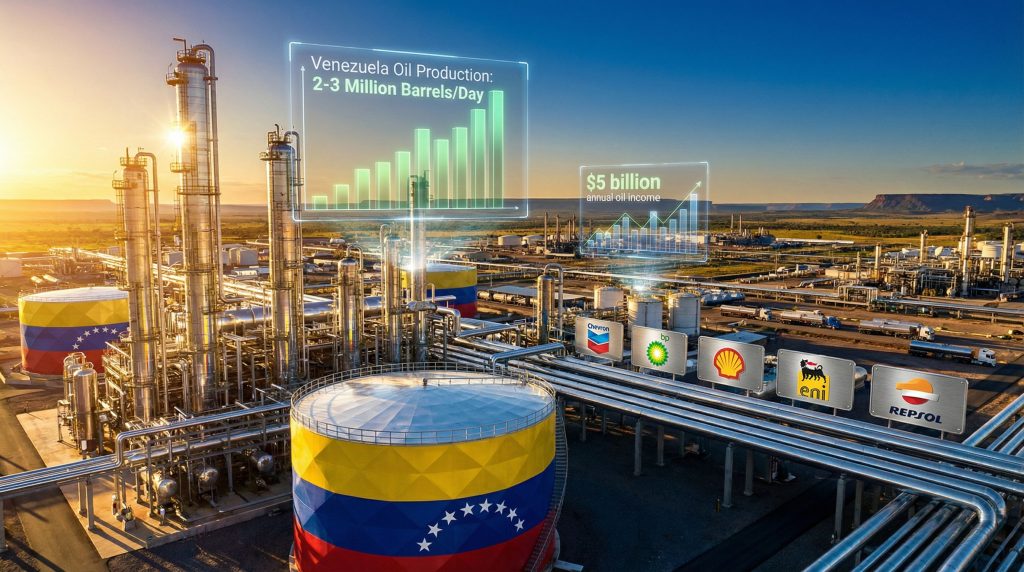
Major international oil corporations receive preferential positioning under the new licensing structure. Companies with established Venezuelan operations, including Chevron, BP, Shell, Eni, and Repsol, secure expanded operational mandates enabling both existing project scaling and new venture negotiations.
Strategic Positioning by Company Type:
| Company Category | Operational Status | Investment Capacity | Market Advantage |
|---|---|---|---|
| US Majors | Full operational licenses | Immediate deployment | Regulatory familiarity |
| European Majors | Conditional access | Phased re-entry | Technical expertise |
| Service Providers | Equipment/technology only | Limited scope | Specialised capabilities |
| Regional Players | Case-by-case review | Variable access | Local market knowledge |
The selective authorisation process creates competitive advantages for companies maintaining compliance records and existing operational infrastructure. These organisations possess the technical capabilities and financial resources necessary for rapid deployment under the revised regulatory framework.
Geopolitical Risk Assessment Models
How Do Geopolitical Exclusions Shape Market Dynamics?
The sanctions architecture deliberately excludes entities from specific nations, creating strategic market segmentation that affects approximately 40% of Venezuela's historical energy partnerships. This exclusion framework prevents certain international companies from participating in the reopening phase, fundamentally altering competitive dynamics.
Exclusion Impact Analysis:
- Chinese NOCs: Loss of existing investment positions
- Russian Energy Companies: Suspension of joint venture operations
- Alternative Partnerships: Redirection toward Western energy alliances
- Technology Transfer: Limitations on certain equipment categories
These restrictions create market concentration effects, channelling opportunities toward approved operators while potentially increasing costs through reduced competition. However, the Trump tariffs implications further complicate international trade relationships, requiring companies from excluded jurisdictions to evaluate alternative partnership structures or indirect participation mechanisms.
What Revenue Control Mechanisms Protect Oversight Interests?
Venezuelan oil proceeds flow through controlled financial channels, establishing unprecedented oversight of energy revenues. This mechanism enables monitoring of approximately $5 billion in potential annual oil income while maintaining leverage over future policy decisions.
Critical Insight: Revenue escrow arrangements represent an innovative model for sanctions relief that maintains financial oversight while enabling market participation, potentially influencing future policy approaches toward other sanctioned energy producers.
The financial control structure includes multiple oversight layers: transaction monitoring, revenue allocation approval, and expenditure authorisation. In addition, this framework ensures that energy sector revenues contribute to approved economic activities while preventing diversion to restricted purposes. The US eases sanctions on Venezuelan oil industry demonstrates how these mechanisms create controlled pathways for market reintegration.
Operational Reactivation Scenarios
Which Production Assets Offer Immediate Restoration Potential?
Venezuela's oil infrastructure requires strategic prioritisation based on restoration costs, production capacity, and technical complexity. The Orinoco Heavy Oil Belt presents the highest volume potential but demands significant diluent supply chains and upgrading facilities.
Asset Prioritisation Matrix:
- Conventional Fields: Lower restoration costs, immediate production potential
- Heavy Oil Projects: High volume capacity, complex processing requirements
- Offshore Developments: Advanced technology needs, higher investment thresholds
- Refining Infrastructure: Critical for domestic supply and export optimisation
Assessment indicates that conventional field operations could resume within 6-12 months of authorisation, while heavy oil projects require 18-36 months for meaningful production increases. Infrastructure degradation varies significantly across regions, with some facilities requiring complete reconstruction.
How Will Service Sector Mobilisation Accelerate Recovery?
Major oilfield service companies including SLB, Halliburton, and Baker Hughes position for rapid deployment under the new licensing framework. These organisations maintain the technical capabilities essential for infrastructure restoration and production optimisation.
Service Sector Deployment Timeline:
- Immediate (0-3 months): Assessment and planning phases
- Short-term (3-12 months): Equipment mobilisation and basic repairs
- Medium-term (1-3 years): Major infrastructure reconstruction
- Long-term (3-5 years): Advanced technology implementation and optimisation
Service companies possess specialised equipment and expertise unavailable to local operators, making their participation critical for efficient recovery operations. Furthermore, their mobilisation capabilities could accelerate production restoration by 12-18 months compared to alternative approaches.
Market Integration Challenges
What Infrastructure Bottlenecks Constrain Production Growth?
Venezuela's oil sector faces systematic infrastructure degradation affecting production, transportation, and export capabilities. Power grid instability, pipeline corrosion, and port facility deterioration create operational constraints requiring coordinated restoration efforts.
Infrastructure Assessment:
- Production Facilities: 60-70% operational capacity
- Transportation Networks: Significant pipeline maintenance needs
- Export Terminals: Limited throughput capacity
- Refining Complex: Reduced processing capabilities
The infrastructure challenge extends beyond individual facilities to encompass integrated systems: power generation, water treatment, transportation networks, and communications systems. Consequently, recovery requires coordinated investment across multiple sectors, potentially totalling $15-25 billion over five years.
How Do Regulatory Reforms Support Foreign Investment?
Venezuela's revised Hydrocarbons Law creates enhanced operational autonomy for private operators while maintaining state oversight through the Ministry of Petroleum. The legislation enables asset transfers, subcontracting flexibility, and modified fiscal frameworks designed to attract international capital.
Regulatory Enhancement Features:
- Contract Flexibility: Revised terms for production sharing and joint ventures
- Fiscal Adjustments: Modified tax structures with potential rebates
- Operational Autonomy: Reduced direct state control requirements
- Asset Mobility: Simplified transfer and partnership mechanisms
The regulatory framework introduces production sharing contracts as alternatives to traditional joint venture structures, enabling companies to maintain operational control while sharing revenues with the state. This approach addresses historical concerns about state interference in commercial operations while supporting the broader context of US sanctions lifted on Venezuela oil.
Investment Risk-Reward Analysis
What Financial Returns Justify Venezuelan Market Re-entry?
International oil companies evaluate Venezuelan opportunities against global portfolio alternatives, considering political risk premiums, infrastructure restoration costs, and long-term production potential. Heavy oil projects typically require $15-25 billion in development capital but offer substantial reserve bases.
Investment Evaluation Criteria:
- Break-even Oil Prices: $45-60 per barrel for most projects
- Political Risk Premiums: 15-25% above standard project returns
- Infrastructure Investment: $10-30 billion sector-wide restoration needs
- Production Potential: 2-3 million barrels per day medium-term capacity
The investment calculus incorporates multiple risk factors: regulatory stability, currency controls, infrastructure reliability, and political continuity. Moreover, companies must evaluate these risks against potential returns from accessing one of the world's largest oil reserve bases, particularly as OPEC meeting impact continues to influence global production strategies.
How Do ESG Considerations Influence Corporate Strategies?
Environmental, social, and governance factors create additional complexity for companies evaluating Venezuelan operations. Heavy oil production generates higher carbon emissions while social licence considerations require community engagement and environmental remediation programmes.
Strategic Consideration: Companies must balance resource access opportunities against ESG commitments and stakeholder expectations in their Venezuelan market strategies, potentially requiring innovative approaches to environmental impact mitigation.
ESG Challenge Areas:
- Environmental Impact: Heavy oil extraction and processing emissions
- Social Licence: Community relations and local employment
- Governance Standards: Transparency and anti-corruption measures
- Stakeholder Expectations: Investor and consumer ESG requirements
The next major ASX story will hit our subscribers first
Long-term Strategic Implications
What Regional Energy Balance Shifts Result from Venezuelan Integration?
Venezuelan oil market reintegration affects Caribbean and South American energy dynamics, potentially reducing regional dependence on alternative suppliers while creating new transportation and refining partnerships. Trinidad and Tobago emerges as a strategic gas export corridor under proposed development frameworks.
The regional impact extends beyond direct oil exports to encompass refined product supply, petrochemical feedstock availability, and energy security considerations. Countries previously dependent on alternative suppliers could redirect purchases toward Venezuelan sources, altering established trade patterns.
How Does This Model Influence Future Sanctions Policy?
The Venezuelan approach establishes precedents for conditional sanctions relief that maintains oversight while enabling market participation. This framework could influence future policy approaches toward other sanctioned energy producers, creating new diplomatic and economic tools.
Policy Innovation Elements:
- Revenue Escrow Systems: Financial control without complete market exclusion
- Selective Company Authorisation: Strategic partnership management
- Technology Transfer Controls: Maintaining competitive advantages
- Gradual Market Integration: Phased approach to full normalisation
The conditional relief model demonstrates how economic sanctions can evolve beyond binary enforcement toward sophisticated control mechanisms that balance multiple policy objectives simultaneously. For instance, the US policy change on PDVSA represents this nuanced approach to sanctions management.
Operational Deployment Strategies
What Technical Capabilities Enable Rapid Production Scaling?
Successful Venezuelan market re-entry requires companies to deploy specialised technical capabilities adapted to heavy oil production and degraded infrastructure conditions. Enhanced oil recovery techniques, horizontal drilling capabilities, and advanced water treatment systems represent critical operational requirements.
Technical Deployment Priorities:
- Heavy Oil Processing: Diluent supply chains and upgrading facilities
- Enhanced Recovery: Steam injection and chemical flooding systems
- Infrastructure Rehabilitation: Pipeline integrity and facility restoration
- Digital Integration: Production optimisation and remote monitoring systems
Companies possessing these technical capabilities gain significant competitive advantages in project development timelines and operational efficiency. The complex nature of Venezuelan oil production creates high barriers to entry for operators lacking specialised expertise, particularly when considering the broader context of Saudi exploration licenses that compete for international investment.
How Do Supply Chain Considerations Affect Project Viability?
Venezuelan operations require comprehensive supply chain restructuring to support resumed production activities. Equipment procurement, maintenance services, and logistics networks must be rebuilt after years of limited activity under sanctions restrictions.
Supply Chain Critical Elements:
- Equipment Availability: Specialised heavy oil production machinery
- Maintenance Support: On-site technical services and spare parts inventory
- Transportation Networks: Pipeline, trucking, and maritime logistics
- Technology Services: Software support and cybersecurity systems
The supply chain challenge extends to skilled workforce availability, with many experienced personnel having left the country during the sanctions period. Consequently, companies must invest in training programmes and knowledge transfer initiatives to rebuild operational capabilities. The Treasury Department's comprehensive sanctions guidance provides crucial clarity for companies navigating these complex operational requirements.
Conclusion
The US sanctions lifted on Venezuela oil represents a significant shift in global energy policy, creating unprecedented opportunities for international oil companies while establishing innovative oversight mechanisms. This conditional relief framework balances economic pragmatism with geopolitical objectives, potentially influencing future sanctions policy approaches worldwide.
The Venezuelan market reopening presents substantial opportunities alongside considerable challenges. Companies must navigate complex regulatory frameworks, infrastructure constraints, and geopolitical risks while considering ESG commitments and stakeholder expectations. Success requires sophisticated deployment strategies, significant capital investment, and long-term commitment to market development.
Disclaimer: This analysis is based on publicly available information and industry assessments. Investment decisions should consider additional due diligence and professional advice. Political and regulatory conditions in Venezuela remain subject to change, potentially affecting the viability of energy sector investments.
Are You Tracking High-Impact Energy Sector Developments?
Discovery Alert's proprietary Discovery IQ model continuously scans for significant ASX mineral and energy discoveries, providing subscribers with instant notifications about companies capitalising on global energy market shifts like Venezuelan oil reopening. Explore Discovery Alert's discoveries page to understand how major resource discoveries have delivered exceptional returns for early investors, then begin your 14-day free trial today.