August 7, 2026
Complex Refining Infrastructure and Venezuelan Heavy Crude Processing
Modern petroleum refining operates as a sophisticated hierarchy of technological capabilities, where the ability to process challenging heavy crude grades separates complex facilities from standard operations. Venezuelan oil and the limits of U.S. refining capacity represent a critical intersection of technical expertise and market demand, as the specialized infrastructure requirements create both opportunities and constraints for domestic refiners.
Heavy crude processing demands fundamentally different approaches compared to lighter oil grades. The molecular complexity of Venezuelan Merey crude from the Orinoco Belt requires thermal cracking systems capable of breaking carbon-carbon bonds under extreme conditions. These heavy molecules contain elevated sulfur concentrations and minimal hydrogen content, necessitating hydroprocessing units that can restructure the molecular composition.
Processing Technology Requirements:
• Delayed coking units for carbon rejection and residue conversion
• Fluid catalytic cracking systems for molecular breakdown
• Hydrotreating facilities for sulfur removal and hydrogen addition
• Vacuum distillation towers for heavy fraction separation
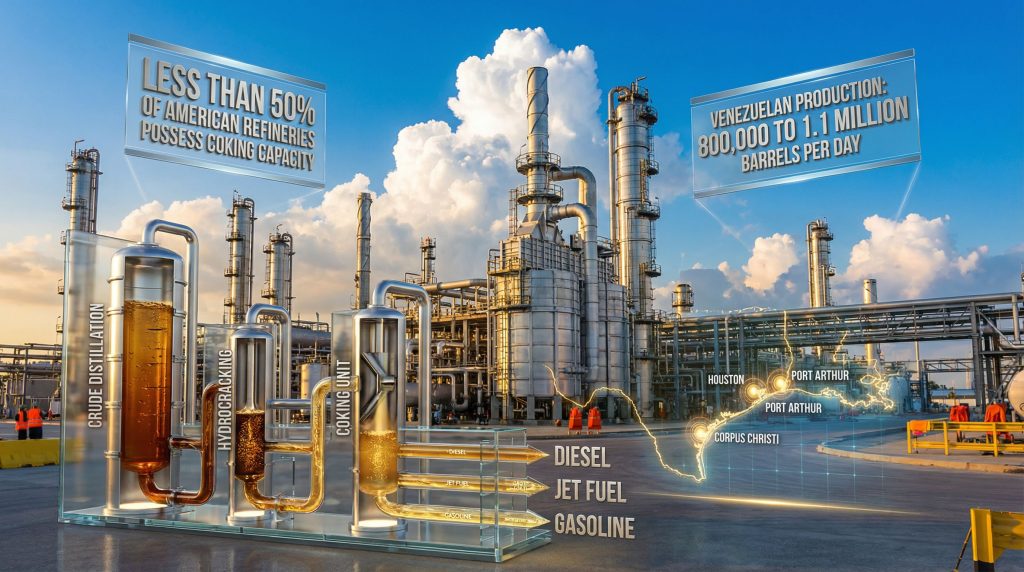
The technical specifications reveal why fewer than half of American refineries possess adequate coking infrastructure. These facilities require substantial capital investment and operational expertise that many refiners have avoided due to historical feedstock preferences for lighter crude grades.
Coking Technology Applications
Delayed coking represents the primary methodology for converting heavy Venezuelan crude into marketable products. This thermal conversion process operates at temperatures exceeding 900°F, decomposing heavy hydrocarbons through carbon rejection mechanisms. The solid petroleum coke byproduct creation allows refiners to extract maximum liquid yield from challenging feedstock.
The economic advantage becomes apparent when examining distillate yields: complex refiners achieve 33% distillate production compared to 30% for medium-complexity plants. This 3-percentage-point differential translates into millions of dollars in additional revenue for facilities processing Venezuelan crude effectively.
Hydrocracking technology provides complementary capabilities through high-pressure hydrogen utilisation. Operating at pressures reaching 2,000 psi with specialised catalysts, these units chemically restructure heavy molecules while producing cleaner fuel specifications. The hydrogen addition process reduces sulfur content and improves product quality beyond thermal cracking capabilities alone.
When big ASX news breaks, our subscribers know first
Strategic Refinery Positioning for Venezuelan Crude Integration
Geographic and technological factors converge to create advantageous positioning for select U.S. refineries capable of processing Venezuelan oil efficiently. Furthermore, Gulf Coast facilities maintain structural advantages through proximity to import terminals and historical heavy crude processing experience developed over decades of Canadian and Mexican heavy oil imports.
Primary Processing Leaders:
• Valero Energy Corporation: Multiple Gulf Coast facilities with substantial coking capacity
• ExxonMobil: Baytown and Beaumont complexes featuring advanced hydroprocessing
• Chevron: Pascagoula refinery with dedicated heavy crude infrastructure
• Marathon Petroleum: Garyville facility optimised for heavy oil processing
• Phillips 66: Lake Charles complex with extensive coking capabilities
• PBF Energy: Delaware City refinery configured for heavy crude operations
These refineries represent the technological elite capable of maximising value extraction from Venezuelan feedstock. Their combined processing capacity creates the foundation for potential Venezuelan oil absorption, though individual facility capabilities vary significantly in scale and efficiency. Additionally, understanding oil price rally insights provides context for market conditions affecting these operations.
East Coast Processing Advantages
Atlantic Coast refineries offer unique positioning advantages for Venezuelan crude imports despite smaller individual capacities compared to Gulf Coast megafacilities. Transportation logistics favour East Coast operations through reduced shipping distances and established tanker infrastructure connecting to Venezuelan export terminals.
Philadelphia Energy Solutions historically demonstrated successful Venezuelan crude processing before its 2019 closure, illustrating both the potential and challenges facing East Coast refiners. The facility's bankruptcy stemmed from market dynamics rather than processing limitations, highlighting how external factors influence refinery viability regardless of technical capabilities.
Current Capacity Constraints Limiting Venezuelan Oil Absorption
Nationwide refining capacity faces unprecedented pressure from facility closures, regulatory compliance costs, and maintenance deferrals accumulated during recent low-margin periods. The 2026 capacity outlook projects a 3% decline in total U.S. processing capability, creating tighter margins for Venezuelan crude integration. This situation aligns with broader US oil production decline trends affecting the domestic market.
| Capacity Metric | 2025 Baseline | 2026 Projection | Net Change |
|---|---|---|---|
| Total U.S. Capacity | 18.1 million bpd | 17.6 million bpd | -500,000 bpd |
| Heavy Crude Capable | 12.7 million bpd | 12.3 million bpd | -400,000 bpd |
| Coking Capacity | 8.9 million bpd | 8.6 million bpd | -300,000 bpd |
| Utilization Rate | 87% | 91% | +4 percentage points |
Regional Processing Bottlenecks
California exemplifies regional capacity constraints affecting Venezuelan oil integration potential. Refinery capacity declining to 1.48 million barrels per day against consumption of 1.40 million barrels daily creates minimal surplus capacity vulnerable to operational disruptions or unplanned maintenance events.
The Phillips 66 Los Angeles refinery closure eliminates 139,000 barrels per day of West Coast processing capacity, while Valero Benicia's mid-2026 shutdown removes an additional 165,000 barrels per day. These closures represent 20% capacity loss since 2020, driven primarily by California's Assembly Bill X2-1 compliance requirements mandating reduced carbon intensity.
West Coast Capacity Constraints:
• Chevron Richmond: 245,000 bpd capacity with heavy crude capabilities
• Marathon Martinez: 161,000 bpd processing primarily Canadian imports
• PBF Torrance: 155,000 bpd focused on regional gasoline production
• Shell Martinez: 165,000 bpd with limited heavy crude infrastructure
The remaining West Coast facilities operate near maximum utilisation rates, limiting flexibility for Venezuelan crude integration without displacing existing feedstock sources or reducing product output.
Venezuelan Oil Absorption Capacity Assessment
Current Venezuelan production operates between 800,000 and 1.1 million barrels per day, with export potential reaching approximately 750,000 barrels daily after domestic consumption requirements. U.S. refinery absorption capacity depends on displacement patterns rather than incremental demand growth. However, Venezuelan oil and the limits of U.S. refining capacity continue to create strategic considerations for energy security.
Short-Term Integration Scenarios:
• Immediate restoration: 300,000-350,000 additional barrels requiring minimal capital investment
• Current export capacity: 750,000 barrels per day available for international markets
• U.S. policy targets: 30-50 million barrel marketing arrangements with Gulf Coast refiners
• Displacement volumes: Primarily Canadian WCS, Mexican Maya, and Middle Eastern heavy grades
Norwegian energy consultancy Rystad Energy analysis indicates production beyond 1.4 million barrels per day requires substantial sustained investment exceeding quick-restoration capabilities. The infrastructure limitations prevent immediate scaling to historical production levels without multi-billion dollar reconstruction projects.
Corporate Positioning Analysis
Chevron maintains the strongest immediate positioning for Venezuelan crude processing through existing joint venture operations producing approximately 200,000 barrels per day. Company executives indicate 100% expansion capability essentially immediately, reflecting operational readiness and infrastructure availability.
Corporate Investment Perspectives:
• ExxonMobil: "Uninvestable" assessment under current legal frameworks due to historical asset seizures
• ConocoPhillips: Reluctance based on previous $2 billion loss during Chavez-era nationalisation
• Hilcorp Energy: Expressed readiness for infrastructure rebuilding investments
• Marathon Petroleum: Evaluating opportunities contingent on regulatory clarity
The divergent corporate responses reflect risk tolerance variations and historical experience with Venezuelan operations. Consequently, companies previously experiencing asset seizures demonstrate understandable caution despite potential processing advantages, particularly given tariffs and investment impacts on international operations.
Technical Processing Advantages of Complex Refineries
Complex refineries employing both coking and hydrocracking technologies maximise value extraction from Venezuelan heavy crude through complementary processing pathways. The combination allows refiners to optimise product yields while managing solid waste generation and hydrogen consumption requirements.
Coking Process Benefits:
• Thermal carbon rejection methodology requiring minimal hydrogen input
• Solid petroleum coke byproduct creation providing additional revenue streams
• Heavy molecule breakdown capability for challenging feedstock
• Lower operating pressure requirements compared to hydrocracking alternatives
Hydrocracking Technology Advantages:
• High-pressure hydrogen utilisation for molecular restructuring
• Catalyst-driven processes producing superior product specifications
• Reduced solid waste generation through liquid product maximisation
• Enhanced sulfur removal capabilities for cleaner fuel production
The technological combination creates competitive advantages particularly valuable as global refining capacity shifts toward simpler configurations. New international capacity emerging from 2024-2028 totalling 2.6-4.9 million barrels per day emphasises light crude processing rather than heavy oil specialisation.
Product Yield Optimisation
Complex refineries achieve superior economics through enhanced product slate flexibility when processing Venezuelan crude. The ability to produce premium gasoline, ultra-low sulfur diesel, and jet fuel from heavy feedstock creates margin advantages unavailable to simpler refining configurations.
Distillate yield improvements from 30% to 33% represent significant value creation when processing large volumes. For instance, a 300,000 barrel per day Venezuelan crude processing facility realises an additional 9,000 barrels daily of valuable distillate products, translating into millions of dollars in annual revenue enhancement.
Market Dynamics Affecting Venezuelan Oil Integration
Venezuelan crude availability primarily affects existing heavy oil supply chains rather than creating new demand patterns. Canadian Western Canadian Select, Mexican Maya heavy crude, and select Middle Eastern grades face potential displacement as Venezuelan exports increase. These dynamics intertwine with broader US–China trade tensions affecting global energy markets.
Primary Displacement Patterns:
• Canadian crude: 80% of output continues flowing to U.S. markets despite Trans Mountain expansion
• WCS pricing: Remains tied to U.S. refinery demand and alternative heavy grade availability
• Mexican Maya: Competes directly with Venezuelan Merey for Gulf Coast refinery slots
• Middle Eastern heavy: Faces reduced U.S. market share as Western Hemisphere supplies increase
The displacement effects create ripple impacts throughout North American crude markets. Increased WCS discounts benefit Mid-continent refiners including those operated by BP and HF Sinclair, while Gulf Coast facilities capture margin improvements from feedstock diversification.
Supply Chain Optimisation
Venezuelan crude integration affects transportation patterns, storage requirements, and blending operations throughout the U.S. refining system. Gulf Coast refineries benefit from established Venezuelan crude handling infrastructure developed during previous decades of imports.
Tanker scheduling, port capacity, and storage terminal availability create logistical considerations beyond pure processing capabilities. Venezuelan crude requires specialised handling due to high viscosity and heating requirements, limiting storage and transportation flexibility compared to lighter crude grades.
The next major ASX story will hit our subscribers first
Infrastructure Bottlenecks Constraining Venezuelan Oil Revival
Satellite intelligence analysis reveals Venezuelan energy infrastructure operates in what experts describe as a "catastrophic state" following decades of underinvestment and equipment cannibalisation. The infrastructure decay extends beyond production facilities to encompass storage, transportation, and processing systems. These challenges also affect regional energy exports challenges throughout global markets.
Critical Infrastructure Assessment:
• Storage terminals: Bajo Grande and Puerto Miranda facilities show extensive corrosion damage
• Refinery operations: Amuay and Cardón complexes function primarily as storage centres
• Pipeline network: 2,139 miles operational versus UAE's 9,000 kilometres for similar output
• Processing equipment: Over 50 years without major technological updates
One-third of Venezuelan storage capacity remains inactive due to tank corrosion, maintenance deferrals, and operational safety concerns. The storage limitations create bottlenecks affecting both domestic consumption and export capability regardless of production restoration efforts.
Investment Requirements Analysis
Venezuelan oil sector revival demands unprecedented capital investment across multiple infrastructure categories. Pipeline network restoration alone requires over $100 billion according to leaked PDVSA documents, while total sector reconstruction approaches $183 billion for full historical capacity restoration.
Investment Timeline Projections:
• Phase 1 (Immediate): $5-10 billion for 300,000-350,000 bpd quick restoration
• Phase 2 (5-10 years): $53 billion total for sustained 1.1 million bpd production
• Phase 3 (15+ years): $183 billion for 3+ million bpd historical peak restoration
The investment magnitude equals entire North American upstream capital expenditure for multiple years, illustrating the challenge facing Venezuelan oil sector rehabilitation. International financing, political stability, and regulatory frameworks remain uncertain variables affecting investment feasibility. Moreover, experts note that Venezuelan oil faces significant infrastructure challenges that extend beyond immediate technical solutions.
How Does Venezuelan Oil Compare to Other Heavy Crudes?
Venezuelan oil and the limits of U.S. refining capacity become clearer when comparing feedstock characteristics across different heavy crude grades. Venezuelan Merey crude contains API gravity of 16-18 degrees and sulfur content of 2.5-3.5%, positioning it as moderately challenging compared to Canadian oil sands bitumen but more complex than Mexican Maya.
Heavy Crude Comparison:
• Venezuelan Merey: 16-18 API, 2.5-3.5% sulfur, moderate processing requirements
• Canadian WCS: 18-22 API, 3.2-4.1% sulfur, extensive upgrading needed
• Mexican Maya: 22-24 API, 3.3-3.8% sulfur, established processing infrastructure
• Saudi Heavy: 28-30 API, 2.8-3.2% sulfur, lighter processing requirements
The comparison reveals Venezuelan crude occupies a middle position requiring substantial processing capabilities without demanding the most extreme technological solutions.
Processing Economics Evaluation
Venezuelan crude processing economics benefit from established Gulf Coast infrastructure and historical operational experience. However, the long-term viability depends on consistent supply availability and competitive pricing relative to alternative heavy crude sources.
Processing margins for Venezuelan crude historically achieved $8-12 per barrel premiums over light crude operations, reflecting the value-added nature of complex refining capabilities. However, these margins fluctuate based on product demand, alternative feedstock pricing, and operational efficiency factors.
Venezuelan oil integration into U.S. refining systems faces technical, economic, and infrastructure constraints that limit immediate impact potential. While complex refineries maintain processing advantages for heavy crude utilisation, the broader capacity limitations and investment requirements suggest gradual rather than transformative market integration over the near term.
Investment Disclaimer: The financial projections and investment requirements discussed represent estimates based on publicly available industry analysis. Actual costs may vary significantly based on technological developments, regulatory changes, and economic conditions. Potential investors should conduct independent due diligence before making investment decisions related to Venezuelan energy sector opportunities.
Are You Tracking the Latest Oil Market Developments?
Discovery Alert's proprietary Discovery IQ model delivers real-time alerts on significant ASX mineral and energy discoveries, instantly empowering subscribers to identify actionable opportunities ahead of the broader market. Understand why major resource discoveries can lead to substantial market returns by exploring Discovery Alert's dedicated discoveries page, showcasing historic examples of exceptional outcomes, or begin your 30-day free trial today to position yourself ahead of the market.