July 20, 2026
Venezuelan naphtha flows to Venezuela have become increasingly complex as global energy markets operate within interconnected systems where supply disruptions in one region can cascade across continents, reshaping trade patterns and investment strategies. The complexity of heavy crude oil transportation creates unique dependencies that transcend traditional commodity trading relationships, forcing market participants to navigate technical requirements alongside geopolitical constraints.
Understanding Venezuela's Critical Diluent Dependencies
Venezuela's crude oil production operates under fundamental physical constraints that make naphtha imports essential rather than optional. The country produces extra-heavy crude oil with API gravities ranging from 8-14°API, significantly denser than global benchmarks of 30-35°API. This extreme density creates viscosity levels that can exceed 1,000 centipoise, making the crude impossible to transport through pipelines without dilution.
What makes naphtha essential for Venezuelan crude production?
The technical requirements for Venezuelan crude transportation demand specific naphtha grades that provide adequate viscosity reduction. Heavy virgin naphtha and full-range N+A (naphtha and aromatics) serve as primary diluents due to their low aromatic content and specific gravity characteristics. Typical mixing ratios range from 30-40% naphtha to 60-70% crude oil by volume, depending on crude grade and transportation distance.
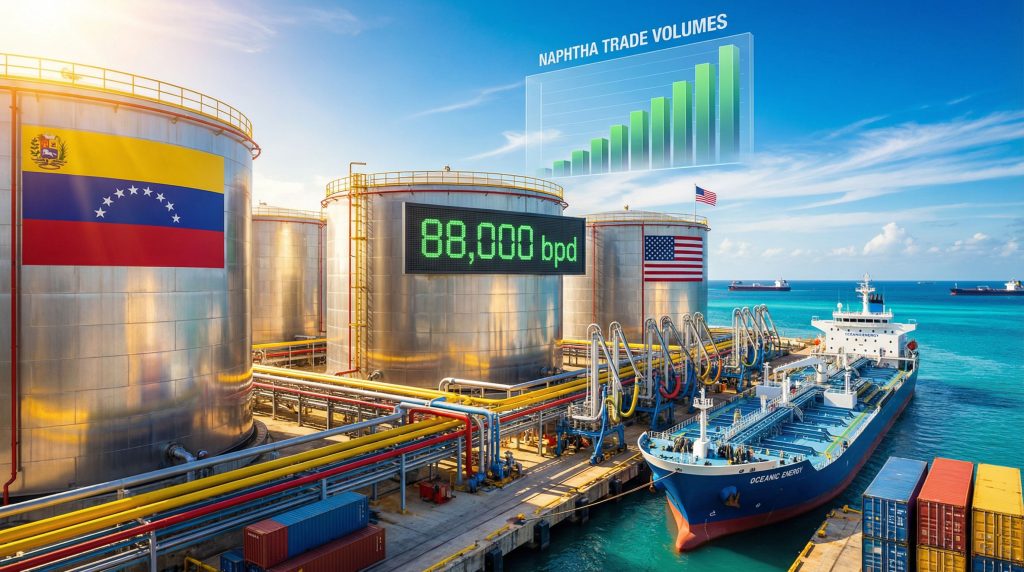
Venezuela requires approximately 88,000 barrels per day of naphtha imports to maintain operational crude oil production and export capability. This baseline represents a non-negotiable operational constraint rather than variable market demand. Without sufficient naphtha supplies, Venezuelan crude remains essentially unmovable from production facilities to export terminals.
The diluent requirement varies across Venezuelan crude types, with major grades including Merey, Boscan, and Cerro Negro each requiring specific dilution specifications. Furthermore, the Orinoco Belt's extra-heavy production particularly depends on consistent naphtha availability to achieve transportable viscosity levels for offshore blending operations.
How do supply disruptions impact Venezuela's export capacity?
Supply chain disruptions in naphtha create cascading effects throughout Venezuela's export infrastructure. Each 10,000 bpd shortfall in naphtha supplies results in approximately 25,000-30,000 bpd reduction in exportable crude production, calculated from standard diluent requirement ratios. This amplification effect occurs because production adjustments must happen at the wellhead when blending capacity becomes constrained.
Venezuelan crude oil production collapsed from approximately 3 million barrels per day in the early 2000s to below 1 million bpd in 2024, with oil price stagnation and naphtha supply constraints contributing significantly to this decline. Storage capacity limitations mean sustained naphtha supply disruptions force production curtailment within 15-30 days, as floating storage and onshore facilities cannot accommodate extended inventory buildup.
The technical specifications for acceptable naphtha grades further complicate supply security. Only heavy virgin naphtha and certain full-range naphthas meet Venezuelan crude transport requirements. Lighter naphtha grades prove insufficient for viscosity reduction of extra-heavy crudes, limiting the pool of potential suppliers geographically to refineries with appropriate hydrotreating and separation capacity.
Recent data indicates the fragility of current supply arrangements:
- US supplied 47% of Venezuela's 88,000 bpd naphtha requirement in 2025 (approximately 41,000 bpd)
- Russia supplied 41% (approximately 36,000 bpd)
- China supplied 8% (approximately 8,000 bpd)
Why traditional supplier relationships have evolved since 2019
The evolution of Venezuelan naphtha supplier relationships represents strategic adaptation to sanctions constraints rather than economic optimization. Prior to 2019, Venezuela imported naphtha almost exclusively from US Gulf Coast refineries due to geographic proximity, cost efficiency, and established contractual relationships.
Comprehensive US sanctions on the Venezuelan oil sector intensified in 2019, with key executive orders prohibiting transactions with state-owned PDVSA. This regulatory shift forced Venezuelan crude buyers and PDVSA traders to actively cultivate alternative supply sources despite cost disadvantages and extended transportation routes.
Russian suppliers entered the Venezuelan market as a sanctions workaround, leveraging established trade relationships and less restrictive regulatory environments. Chinese traders and intermediaries similarly expanded market share through intermediary trading structures designed to circumvent direct OFAC scrutiny.
The January 2026 loading of 460,000 barrels on the Hellespont Protector from Pasadena, Texas to Port of Jose demonstrates recent re-establishment of direct US-Venezuela naphtha flows following policy changes. This single shipment represents approximately 5-6 days of baseline naphtha requirements, indicating the frequency of vessel movements required to maintain supply continuity.
When big ASX news breaks, our subscribers know first
Economic Drivers of Venezuelan Naphtha Import Markets
Market dynamics in Venezuelan naphtha imports operate under unique constraints where traditional supply-demand economics intersect with geopolitical risk management and technical requirements. The concentration of supplier relationships creates single-point-of-failure risks that influence pricing structures across regional markets.
Analyzing the 88,000 bpd import requirement baseline
The 88,000 bpd baseline represents minimum viable import requirements rather than variable demand signals. This hard operational constraint means Venezuelan crude cannot be transported without adequate diluent supply, creating inflexible demand that suppliers can leverage for pricing advantages.
Current supply concentration creates vulnerability exposure:
| Supplier Region | Daily Volume (bpd) | Market Share | Key Characteristics |
|---|---|---|---|
| United States | 41,000 | 47% | Geographic proximity, policy constraints |
| Russia | 36,000 | 41% | Alternative routing, sanctions workaround |
| China | 8,000 | 8% | Intermediary structures, limited capacity |
| Total | 88,000 | 100% | Baseline requirement |
US traders project capacity to supply an additional 30,000-40,000 bpd of naphtha to Venezuela, indicating current under-utilization of available US Gulf Coast production capacity. This spare capacity represents potential market expansion if regulatory frameworks permit increased trade volumes.
Cost implications of sourcing from multiple geographic regions
Geographic diversification in naphtha sourcing creates complex cost structures that extend beyond basic commodity pricing. Heavy virgin naphtha prices at the US Gulf Coast surged by more than 10¢/USG in early January 2026 as suppliers anticipated Venezuelan demand resumption, demonstrating rapid market repricing following policy announcements.
HVN differentials gained 1.75¢/USG against the Nymex RBOB pricing basis on January 7, 2026, as many sellers withheld offers in anticipation of renewed export opportunities. This price movement indicates how concentrated Venezuelan demand affects regional naphtha markets even before actual trade resumption.
Transportation cost differentials between supplier regions create ongoing economic inefficiencies:
- US Gulf Coast routes: 2-3 day transit times, established infrastructure, direct shipping
- Russian supply routes: 15-20 day transit times, Arctic constraints, intermediate ports
- Chinese trading routes: 25-30 day transit times, multiple transshipments, higher intermediary costs
The development of contango structures in Nymex RBOB pricing basis for US N+A naphtha discourages prompt selling at lower outright values, creating bullish indicators for naphtha prices when Venezuelan demand uncertainty exists.
How inventory management affects production continuity
Inventory management for Venezuelan naphtha imports operates under unique constraints where storage limitations intersect with production planning requirements. Floating storage and onshore storage capacity limitations mean sustained supply disruptions force production curtailment within 15-30 days.
The technical requirement for specific naphtha grades complicates inventory management strategies. Venezuela cannot substitute lighter naphtha grades during supply shortages, unlike conventional refined product markets where grade flexibility exists. This constraint forces precise demand forecasting and safety stock planning.
Recent trade resumption patterns demonstrate inventory management challenges. The 460,000 barrel shipment in January 2026 represents approximately one week of national consumption, indicating frequent vessel scheduling requirements. Moreover, storage infrastructure degradation increases naphtha requirements beyond baseline levels due to blending inefficiencies at export terminals.
Impact of US-Venezuela Naphtha Trade on Regional Markets
The resumption of US-Venezuela naphtha trade flows creates ripple effects across regional energy markets, influencing pricing structures from the Gulf Coast to Asia-Pacific markets. Historical trade patterns and current geopolitical constraints combine to reshape traditional supply chain relationships.
Historical context and market evolution
Pre-2019 trade volumes exceeded 55,000 bpd according to Vortexa analytics, reflecting traditional supplier dominance when US companies maintained unrestricted access to Venezuelan markets. This historical baseline demonstrates the natural economic advantage of US Gulf Coast refineries due to geographic proximity and established logistics infrastructure.
The six-month sanctions waiver from October 2023 to April 2024 provided temporary trade resumption, while Chevron's special license issued in July 2025 allowed limited naphtha export activity several months after creation. These regulatory adjustments created intermittent supply patterns that contributed to market volatility.
According to Argus Media reports, US naphtha exports to Venezuela fell to just over 40,000 bpd in 2025 from above 55,000 bpd in the previous year, with shipments declining particularly in the second half as policy uncertainty affected trading relationships. No visible US naphtha exports reached Venezuela in early 2026 prior to the January resumption.
Current trade flow analysis
Trading company Vitol is positioned to export nearly 500,000 barrels of naphtha to Venezuela under new government agreements, while Trafigura has also secured transaction capabilities. These arrangements represent expansion beyond baseline maintenance toward incremental supply growth.
Chevron imported approximately 120,000 bpd of crude from Venezuela to the US in December 2025 under its special license, demonstrating operational trade relationships despite broader sanctions constraints. This crude import volume correlates with naphtha export requirements for diluent supply.
Volume capacity analysis of US Gulf Coast naphtha exports indicates significant unutilized potential:
- Current Venezuelan supply: 41,000 bpd (47% market share)
- Additional capacity: 30,000-40,000 bpd available
- Total potential: 70,000-80,000 bpd maximum Venezuelan supply
- Regional production: Sufficient capacity for expanded trade
Transportation logistics favour US suppliers through established shipping routes between Gulf Coast ports and Venezuelan terminals. The Hellespont Protector's January 11, 2026 loading from Pasadena, Texas to Port of Jose demonstrates active shipping lane utilisation and port infrastructure capability.
Competitive positioning versus alternative suppliers
US suppliers maintain competitive advantages over Russian and Chinese alternatives despite regulatory constraints. Geographic proximity provides 2-3 day transit times compared to 15-30 days for alternative suppliers, reducing inventory carrying costs and supply chain risks.
Russian suppliers captured 41% market share (36,000 bpd) during US sanctions periods, demonstrating significant alternative capacity. However, Russian naphtha requires longer transportation routes and additional transshipment points, increasing total delivered costs despite potentially lower FOB prices.
Chinese market participation remains limited at 8% share (8,000 bpd), primarily through intermediary trading structures rather than direct supply relationships. Chinese suppliers face similar transportation disadvantages while operating through additional trading layers that increase transaction costs.
Quality specifications favour US suppliers producing heavy virgin naphtha with appropriate characteristics for Venezuelan crude dilution. Not all global naphtha production meets Venezuelan technical requirements, providing natural market protection for qualified suppliers.
Strategic Implications for Global Naphtha Markets
Venezuelan naphtha demand patterns influence global market structures beyond direct bilateral trade relationships. The country's position in heavy crude production creates interconnected effects on Asia-Pacific pricing, supply chain optimisation, and competitive dynamics among international suppliers.
Venezuela's position in global heavy crude production
Venezuela sits atop the world's largest proven oil reserves, with production potential significantly exceeding current output levels below 1 million bpd. This reserve base represents long-term supply potential that could reshape global heavy crude markets if political and regulatory constraints resolve.
The concentration of Venezuelan heavy crude production in the Orinoco Belt creates unique technical requirements that extend beyond simple crude oil extraction. The region's extra-heavy crude requires continuous naphtha supply to maintain any meaningful production levels, linking Venezuelan output directly to global naphtha availability.
Production capacity scenarios range from current sub-1 million bpd levels to potential 2-3 million bpd if infrastructure investment occurs. Each 100,000 bpd increase in Venezuelan crude production requires approximately 35,000-40,000 bpd additional naphtha imports, creating multiplicative effects on global naphtha demand.
Regional refinery configurations in the Caribbean and US Gulf Coast were historically designed to process Venezuelan heavy crude grades. Many US Gulf Coast refineries maintain coking capacity specifically suited to Venezuelan crude processing, creating natural market linkages despite current trade constraints.
Impact on Asia-Pacific naphtha pricing dynamics
Venezuelan crude supply patterns directly influence Asia-Pacific naphtha markets through multiple transmission mechanisms. Reduced Venezuelan crude exports to Asia-Pacific markets affect regional refinery feedstock availability and subsequent naphtha production levels.
Chinese refineries historically processing Venezuelan crude must substitute alternative feedstocks when Venezuelan supplies redirect to US markets. This substitution increases Chinese demand for straight-run fuel oil as refinery feedstock, creating secondary market effects on global product balances.
Singapore and Malaysia traditionally received approximately one-third of Venezuelan HSFO exports totalling about 150,000 bpd. Potential redirection of Venezuelan crude away from Asia toward US refineries would reduce Asian HSFO availability while increasing US HSFO production from heavier refinery yields.
Naphtha pricing in Asia-Pacific markets reflects these supply chain realignments through:
- Reduced regional naphtha production from declining Venezuelan crude processing
- Increased demand for substitute naphtha imports to replace lost domestic production
- Price premium development for naphtha grades suitable for heavy crude dilution
- Arbitrage opportunities between Atlantic and Pacific basin markets
Supply-side competitive analysis
US refinery capacity for naphtha production provides significant competitive advantages in serving Venezuelan demand. Gulf Coast refineries operate hydrotreating and separation units capable of producing heavy virgin naphtha specifications required for Venezuelan crude dilution.
Russian export capabilities face logistical constraints despite apparent market access advantages. Arctic shipping routes and limited ice-free port access create seasonal supply variations that complicate long-term contract structures. Russian suppliers must also navigate international banking restrictions that increase transaction complexity.
Chinese market positioning in Latin American trade reflects broader geopolitical strategy rather than pure economic optimisation. Chinese traders operate through intermediary structures designed to provide sanctions circumvention capabilities while maintaining political relationship flexibility.
Comparative analysis of supplier capabilities:
| Supplier | Production Capacity | Transportation | Quality | Regulatory Risk |
|---|---|---|---|---|
| US Gulf Coast | High (expandable) | Optimal (2-3 days) | Compliant | Medium (policy-dependent) |
| Russian | Medium (constrained) | Limited (seasonal) | Variable | High (sanctions) |
| Chinese | Low (intermediary) | Poor (30+ days) | Unknown | High (compliance) |
Political Changes and Long-Term Supply Agreements
Political developments in US-Venezuela relations create multiple scenario pathways that affect long-term naphtha supply agreements and investment planning. Energy companies must evaluate decision frameworks that account for regulatory volatility while positioning for potential market normalisation.
Scenario planning for market participants
Best-case scenarios involve normalised US-Venezuela trade relations with comprehensive sanctions removal and stable regulatory frameworks. Under these conditions, US naphtha exports could reach 70,000-80,000 bpd to Venezuela while Venezuelan crude imports to US refineries could exceed historical levels.
This normalisation scenario assumes political stability in both countries and resolution of outstanding arbitration claims from companies including ExxonMobil and ConocoPhillips. Energy Secretary Chris Wright's negotiations with Caracas to indefinitely take over PdV oil sales suggest potential pathways toward comprehensive trade resumption.
Moderate scenarios maintain current sanctions with expanded exemptions for specific activities and licensed operators. Under these conditions, naphtha flows to Venezuela would continue through intermediary structures while remaining subject to periodic policy reviews and license renewals.
Worst-case scenarios involve complete supply disruption through renewed sanctions tightening or political instability in Venezuela. Such scenarios would force Venezuelan production curtailment and require rapid alternative supplier activation from Russian or Chinese sources.
Investment decision framework
Risk assessment criteria for energy trading companies must incorporate multiple variables including political risk, operational risk, and market risk factors. The capture of Venezuelan President Nicolas Maduro by US forces represents the type of rapid political change that affects all scenario planning assumptions.
Infrastructure requirements for sustained supply chains include:
- Storage capacity expansion at both US and Venezuelan terminals
- Shipping fleet availability for regular vessel scheduling
- Quality control systems ensuring naphtha grade compliance
- Financial infrastructure for sanctions-compliant transactions
Regulatory compliance considerations require specialised legal frameworks capable of navigating OFAC licensing requirements while maintaining operational flexibility. Companies must establish compliance programmes that adapt quickly to policy changes without disrupting supply continuity.
Due diligence frameworks for Venezuelan market entry require assessment of:
- Counterparty risk evaluation for PDVSA and affiliated entities
- Contract enforceability under changing regulatory environments
- Insurance availability for political risk coverage
- Exit strategy planning for rapid market withdrawal scenarios
Market Opportunities from Supply Chain Realignment
Supply chain realignment in Venezuelan naphtha flows creates arbitrage opportunities and strategic positioning advantages for energy companies capable of navigating regulatory complexity while maintaining operational flexibility.
Strategic positioning for energy companies
Arbitrage opportunities in regional price differentials emerge from the geographic disconnect between Venezuelan demand concentration and global naphtha production centres. US Gulf Coast producers can leverage proximity advantages while Asian suppliers face transportation cost disadvantages.
The 10¢/USG price surge in heavy virgin naphtha following policy announcements demonstrates rapid market repricing that creates trading opportunities for positioned participants. HVN differentials gaining 1.75¢/USG against Nymex RBOB indicates sustained premium development for Venezuelan-compliant grades.
Long-term contract structuring in volatile environments requires innovative approaches to risk allocation:
- Force majeure provisions covering sanctions-related supply interruptions
- Price adjustment mechanisms reflecting regulatory compliance costs
- Volume flexibility clauses accommodating policy-driven demand variations
- Alternative supplier arrangements for supply security maintenance
Technology solutions for supply chain visibility become critical when regulatory constraints limit traditional market mechanisms. Companies investing in advanced logistics tracking and compliance monitoring systems gain operational advantages over competitors relying on conventional approaches.
Regional market development potential
The Caribbean basin represents an alternative supply hub with potential for intermediate storage and blending operations. Islands including Trinidad and Tobago, Curacao, and Aruba possess existing petroleum infrastructure that could support Venezuelan naphtha import operations while providing sanctions compliance benefits.
Brazil and Colombia emerge as regional trading partners capable of facilitating triangular trading arrangements. These countries maintain diplomatic relationships with Venezuela while operating under different sanctions frameworks, creating potential for intermediary trading structures.
Mexico's role in North American energy integration provides additional strategic options for Venezuelan naphtha supply. Mexican refineries produce naphtha grades suitable for Venezuelan requirements while operating under USMCA trade frameworks that could facilitate licensed transactions.
Regional development scenarios include:
- Caribbean storage hub development for naphtha accumulation and distribution
- Brazilian intermediary trading through established energy company relationships
- Colombian pipeline infrastructure for overland naphtha transportation
- Mexican refinery partnerships for naphtha production expansion
The next major ASX story will hit our subscribers first
Price Dynamics and Market Uncertainty
Venezuelan naphtha demand creates unique price dynamics that reflect the intersection of technical requirements, geopolitical constraints, and supply chain optimisation. Market participants must navigate volatility patterns while developing risk management strategies for exposure to supply disruptions.
Volatility patterns and trading strategies
Heavy virgin naphtha price movements respond rapidly to policy announcements affecting Venezuelan trade prospects. The more than 10¢/USG surge in HVN prices demonstrates how concentrated demand sources create amplified price responses to supply-side news.
Market signals indicate structural changes in naphtha pricing relationships. The steepened contango in Nymex RBOB pricing basis for US N+A naphtha discourages prompt selling at lower outright values, creating bullish price indicators even before actual demand materialisation.
Correlation analysis with crude oil pricing reveals Venezuelan-specific demand patterns that deviate from traditional naphtha market relationships. While conventional naphtha demand correlates with gasoline blending requirements, Venezuelan demand creates independent price pressure that operates regardless of gasoline market conditions.
Furthermore, oil price movements influence broader market sentiment, while the global tariff impact on trade flows affects regional naphtha distribution patterns.
Trading strategies must account for:
- Policy announcement timing and market preparation periods
- Seasonal shipping constraints affecting alternative suppliers
- Grade-specific demand limiting substitute product availability
- Concentration risk from limited buyer base
Risk management approaches
Hedging strategies for Venezuelan supply risk exposure require specialised instruments that account for political risk alongside traditional commodity price risk. Standard petroleum product hedges may not provide adequate protection against sanctions-related supply disruptions.
Portfolio diversification across supplier regions becomes essential when serving Venezuelan demand. Companies maintaining supply relationships with US, Russian, and Chinese sources can respond rapidly to regulatory changes affecting specific trade routes.
Financial instruments for political risk management include:
- Political risk insurance covering sanctions-related losses
- Force majeure derivatives providing compensation for supply interruptions
- Currency hedging for multi-jurisdictional transaction exposure
- Letters of credit structured for sanctions compliance requirements
The concentrated nature of Venezuelan naphtha demand means traditional market depth assumptions do not apply. Risk models must incorporate the possibility of complete demand disappearance rather than normal price volatility patterns.
Future Prospects for Venezuela-US Energy Trade
The trajectory of Venezuela-US energy trade depends on multiple factors including political stability, regulatory framework development, and infrastructure investment capacity. Long-term projections must account for both optimistic normalisation scenarios and continued constraints.
Medium-term market projections
Production capacity scenarios for Venezuelan crude range from current sub-1 million bpd levels to potential restoration of 2-3 million bpd output over 3-5 years with adequate investment. Each production increase scenario requires proportional naphtha import expansion, creating multiplicative effects on trade volumes.
US refinery demand patterns for heavy crude processing support expanded Venezuelan crude imports given existing infrastructure capacity. Phillips 66 operates refineries capable of processing about 200,000 bpd of Venezuelan oil if supply availability and economics support utilisation.
Considering the US economic implications of trade policy changes, the three PDVSA-owned Citgo refineries represent additional Venezuelan crude processing capacity totalling 813,000 bpd combined capacity across Lake Charles, Corpus Christi, and Lemont facilities. All three refineries maintain high coking capacity suitable for heavy crude slates.
Infrastructure investment requirements for sustained trade include:
- $100 billion estimated investment for Venezuelan oil sector revival according to Trump administration projections
- Pipeline rehabilitation for crude transportation from production areas
- Terminal expansion for increased export capacity
- Storage facility reconstruction for inventory management
Strategic recommendations for market participants
Monitoring regulatory developments across multiple jurisdictions becomes essential given the complex sanctions landscape affecting Venezuelan trade. Companies must track OFAC licensing requirements, EU sanctions policies, and individual country trade restrictions.
Building flexible supply chain networks provides competitive advantages when regulatory changes occur rapidly. Companies maintaining relationships with multiple naphtha suppliers and transportation providers can adapt quickly to policy shifts.
Operational readiness for rapid market changes requires pre-positioned assets and established procedures for trade resumption. The January 2026 naphtha cargo loading within days of policy announcements demonstrates the importance of advance preparation.
Risk-adjusted return calculations for Venezuelan exposure must incorporate:
- Base case scenarios with continued sanctions and limited trade
- Upside scenarios with comprehensive trade normalisation
- Downside scenarios with complete market closure
- Timeline considerations for different political administrations
Exit strategy planning for changing political landscapes ensures companies can withdraw from Venezuelan exposure if conditions deteriorate. This planning includes contract termination procedures, asset redeployment options, and alternative market development.
Additionally, understanding OPEC market influence becomes crucial as Venezuela's production capacity could significantly impact global oil balances once political and infrastructure constraints resolve.
The evolving nature of naphtha flows to Venezuela reflects broader trends in global energy trade where geopolitical considerations increasingly influence traditional market relationships. Companies successfully navigating these complexities will position themselves advantageously as regulatory frameworks continue evolving and new opportunities emerge from supply chain realignment.
Disclaimer: This analysis involves forecasts and speculative elements regarding future political and economic developments. Market participants should conduct independent due diligence and consult legal and financial advisors before making investment decisions related to Venezuelan energy trade.
Ready to Capitalise on Energy Market Disruptions?
Discover how Discovery Alert's proprietary Discovery IQ model identifies actionable opportunities when global supply chain disruptions create volatility in energy and commodity markets. The service delivers instant notifications on significant ASX mineral and energy discoveries, transforming complex market data into clear investment insights powered by advanced AI technology. Begin your 30-day free trial today to position yourself ahead of emerging market opportunities.