August 22, 2026
The global energy landscape stands at a critical juncture where Venezuelan oil supply uncertainties represent one of the most significant variables affecting market stability. While markets routinely absorb production fluctuations from established producers, the potential reintegration of Venezuelan crude oil represents a fundamental shift that could reshape pricing mechanisms, trade flows, and strategic reserves worldwide. Understanding this complexity requires examining the structural factors that transformed Venezuela from a dominant oil producer into a marginal market participant.
Understanding the Venezuelan Oil Crisis Through Economic Fundamentals
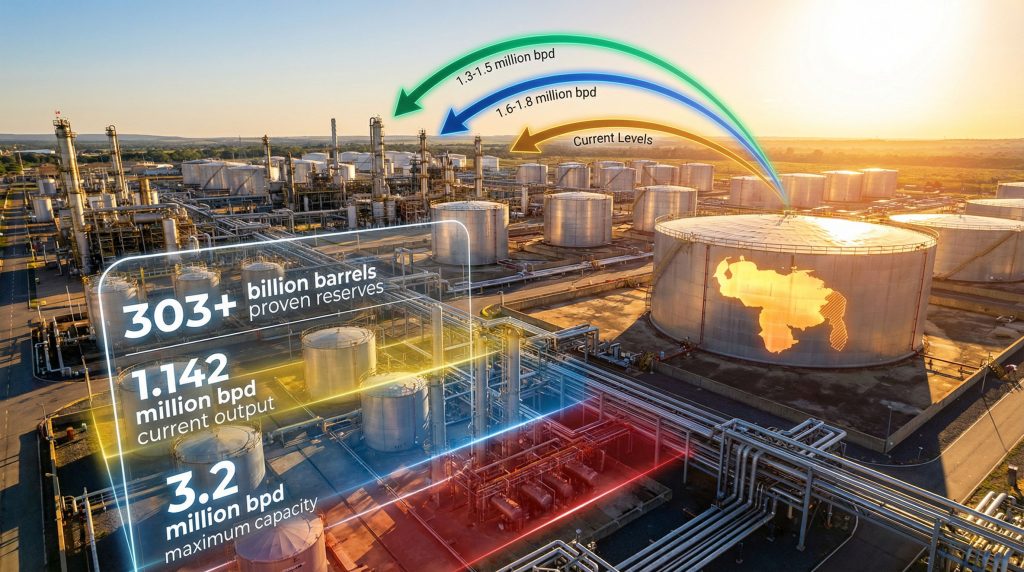
Venezuela commands the world's largest proven oil reserves at 303 billion barrels, positioning the nation as a potential game-changer in global energy security calculations. This massive resource base dwarfs even Saudi Arabia's proven reserves, creating significant implications for long-term market dynamics and strategic planning by international energy companies.
The country's oil production capacity tells a story of dramatic decline and potential recovery. Historical peak production reached 3.5 million barrels per day during the early 2000s, when Venezuela ranked among the world's top five oil producers. Current output hovers around 1.1 million barrels per day based on 2025 averages, representing a staggering 70% decline from peak capacity levels.
As a founding member of the Organization of Petroleum Exporting Countries (OPEC), Venezuela traditionally wielded considerable influence over global oil pricing strategies. Furthermore, the nation's geopolitical significance extends beyond production volumes, encompassing critical shipping routes through the Caribbean and serving as a key supplier to regional refineries specifically designed to process heavy crude grades.
Venezuelan heavy crude oil possesses unique characteristics that complicate both production economics and market positioning. These high-sulfur, high-viscosity reserves require specialised refining infrastructure and enhanced recovery techniques, creating both opportunities and challenges for potential investors. The heavy crude grades typically trade at discounts to benchmark oils but offer higher yields of valuable products like diesel and heating oil.
What Makes Venezuelan Oil Supply So Critical to Global Markets?
Economic analysis reveals that Venezuela's current production levels fall significantly below the 1.8 million barrels per day threshold required for economic sustainability. This break-even point reflects the minimum output needed to generate sufficient revenue for infrastructure maintenance, debt servicing, and basic operational requirements.
Infrastructure capacity constraints represent the most immediate bottleneck limiting production growth. Pre-sanctions capacity reached approximately 2.8 million barrels per day, but years of underinvestment and equipment deterioration have severely compromised this potential. Upgrader facilities, pipeline networks, and offshore platforms require comprehensive rehabilitation to approach historical capacity levels.
However, the maximum sustainable capacity ceiling of 3.2 million barrels per day represents the upper boundary of Venezuelan production potential under optimal conditions. Achieving this level would require massive capital investment, technology transfer, and workforce development spanning multiple decades.
| Production Metric | Current Level | Economic Potential | Investment Required |
|---|---|---|---|
| Daily Output | 1.142 million bpd | 1.8 million bpd | $15-25 billion |
| Infrastructure Capacity | Severely degraded | 2.8 million bpd | $65-85 billion |
| Maximum Sustainable | Limited by sanctions | 3.2 million bpd | $180+ billion |
| Break-even Production | Below threshold | 1.8 million bpd | $25-40 billion |
When big ASX news breaks, our subscribers know first
Political Transition Scenarios and Economic Implications
Market analysts have identified three primary scenarios for Venezuelan oil production evolution through 2026, each carrying distinct probability assessments and economic implications for global energy markets. Consequently, these scenarios directly influence global oil price movements and trade war dynamics.
What Are the Three Primary Economic Scenarios for 2026?
Scenario 1: Gradual Sanctions Relief (40% probability)
This moderate scenario envisions a phased approach to sanctions removal, allowing for controlled production increases over 6-12 months. Production targets range from 1.3 to 1.5 million barrels per day by Q4 2026, requiring investment commitments of $15-25 billion over three years.
Key characteristics include:
- Limited initial foreign direct investment
- Phased equipment rehabilitation programmes
- Gradual workforce retraining initiatives
- Conservative infrastructure upgrade timeline
- Measured approach to international partnerships
Scenario 2: Accelerated Political Transition (25% probability)
An optimistic scenario assuming rapid political normalisation and immediate sanctions lifting. Production targets reach 1.6 to 1.8 million barrels per day by end-2026, demanding foreign direct investment commitments exceeding $40 billion.
Critical success factors include:
- Immediate access to international capital markets
- Fast-track equipment procurement and installation
- Rapid deployment of technical expertise
- Streamlined regulatory approval processes
- Comprehensive debt restructuring agreements
Scenario 3: Continued Uncertainty (35% probability)
A pessimistic outlook maintaining current production constraints through 2026. Limited international investment continues, prolonging infrastructure degradation and constraining output growth potential.
Characteristics encompass:
- Persistent political instability
- Continued sanctions enforcement
- Limited access to international financing
- Ongoing brain drain and workforce challenges
- Minimal infrastructure investment
How Would Each Scenario Impact Global Oil Price Dynamics?
The magnitude of price impacts reflects the global oil market's sensitivity to supply additions, particularly from low-cost production sources. Venezuelan crude reentry would compete directly with higher-cost producers, potentially forcing market share adjustments and pricing strategy modifications across the industry.
Price Impact Analysis: Scenario 1 could generate $3 to $5 per barrel downward pressure on Brent crude pricing, while Scenario 2 might create $8 to $12 per barrel negative pressure. Scenario 3 would likely maintain neutral to slightly supportive pricing dynamics.
According to energy market analysts, Venezuelan oil supply uncertainties create complex pricing dynamics. As noted by Reuters in early 2026, expectations point toward adequate global oil supply throughout the year regardless of Venezuelan production changes, suggesting that additional Venezuelan output would primarily displace higher-cost production rather than address supply shortages.
Infrastructure Recovery Economics and Investment Requirements
What Are the Key Bottlenecks Limiting Venezuelan Production Growth?
Venezuela's oil infrastructure faces systemic challenges that extend far beyond simple equipment replacement. The upgrader facilities at Petrocedeno, Petromonagas, and Petro Roraima require comprehensive rehabilitation to process heavy crude into marketable products. These facilities represent critical chokepoints where even modest capacity increases demand substantial capital investment.
Pipeline network modernisation presents another significant bottleneck. The existing transportation infrastructure suffers from decades of deferred maintenance, creating capacity constraints that limit production growth even when upstream facilities operate efficiently. Corrosion, pressure limitations, and pumping station failures compound these challenges.
The workforce rebuilding requirement cannot be understated. Years of economic crisis triggered massive emigration of skilled oil workers, creating knowledge gaps that persist despite remaining infrastructure. Technical expertise in heavy oil production, upgrading processes, and offshore operations requires years to develop and deploy effectively.
Moreover, power grid stability emerges as an overlooked but critical factor limiting oil operations. Venezuelan oil facilities require reliable electricity for pumping, processing, and safety systems. Grid instability forces production shutdowns and equipment damage, creating cascading effects throughout the production system.
How Much Capital Investment Would Different Recovery Levels Require?
Investment requirements scale exponentially with production targets, reflecting the compound complexity of infrastructure rehabilitation. Initial investment phases focus on repairing existing facilities and restoring basic operational capacity. Higher production targets require new field development, advanced recovery technologies, and comprehensive facility upgrades.
| Production Target | Investment Required | Timeline | Primary Focus Areas |
|---|---|---|---|
| 1.5 million bpd | $25 billion | 3 years | Basic infrastructure repair |
| 2.0 million bpd | $65 billion | 5 years | Upgrader rehabilitation |
| 2.5 million bpd | $110 billion | 7 years | New field development |
| 3.0 million bpd | $180 billion | 10 years | Comprehensive modernisation |
The $25 billion threshold for reaching 1.5 million barrels per day represents the minimum viable investment for meaningful production growth. This investment level addresses critical infrastructure repairs, basic equipment replacement, and essential safety system upgrades without expanding production capacity significantly.
Advanced production targets exceeding 2.0 million barrels per day require transformational investment approaching $65-110 billion. These investment levels enable comprehensive facility modernisation, new field development, and advanced recovery technology deployment across the Venezuelan oil system.
Global Supply Chain and Market Structure Implications
Which International Oil Companies Could Benefit from Venezuelan Re-entry?
Chevron Corporation maintains a unique position among international oil companies through its existing Petropiar upgrader operations. Despite sanctions constraints, Chevron has preserved operational knowledge and infrastructure familiarity that positions the company for rapid expansion under normalised conditions.
European oil majors including Shell, Total, and Eni bring extensive historical Venezuelan experience spanning decades of operations. These companies possess technical expertise in heavy oil processing, established relationships with local contractors, and proven capabilities in complex regulatory environments.
Chinese state-owned enterprises face distinct advantages through existing debt arrangements with Venezuelan entities. These financial relationships could facilitate rapid investment deployment while providing natural hedging mechanisms for capital recovery through oil deliveries.
In addition, independent refiners specialising in heavy crude processing represent another beneficiary category. Companies with existing heavy oil refining capacity could capitalise on discounted Venezuelan crude pricing while optimising refinery utilisation rates.
How Would Increased Venezuelan Output Affect OPEC+ Dynamics?
Venezuelan oil production growth could strain OPEC+ production quota agreements by introducing uncontrolled supply increases outside the coordinated management framework. Venezuela's OPEC membership complicates quota enforcement while the country's production recovery proceeds independently of cartel coordination.
Saudi Arabia and Russia, as OPEC+ leaders, face strategic decisions regarding market share protection versus price stability maintenance. Increased Venezuelan output could force these producers to reduce their own production to maintain price targets, creating internal coalition tensions. This dynamic particularly affects the OPEC production impact on global oil markets.
Spare capacity calculations across OPEC+ would require fundamental revision to incorporate Venezuelan production potential. Current spare capacity estimates exclude Venezuelan potential, but production recovery could shift global supply cushions significantly.
Furthermore, global crude oil trade flows face potential reshuffling as Venezuelan production targets traditional export markets. Caribbean refineries, US Gulf Coast facilities, and Asian heavy oil processors could redirect purchasing patterns based on Venezuelan crude availability and pricing.
Regional Economic Ripple Effects
What Would Venezuelan Oil Recovery Mean for Latin American Economies?
Colombia stands to benefit substantially from Venezuelan oil sector normalisation through cross-border trade restoration and infrastructure sharing opportunities. The two countries share extensive pipeline networks, refining capacity, and technical expertise that could support mutual development initiatives.
Brazil's sophisticated refining sector possesses significant heavy crude processing capabilities that align with Venezuelan production characteristics. Petrobras and other Brazilian refiners could optimise operations through discounted Venezuelan crude access while providing technical services and equipment.
Caribbean nations would experience improved energy security through reliable, proximate oil supply access. Many Caribbean economies depend on Venezuelan fuel subsidies and supply agreements, making production recovery critical for regional economic stability.
Regional currency stability could improve as Venezuelan oil exports generate hard currency revenues, supporting trade settlement and reducing foreign exchange pressures across Latin American economies with Venezuelan trade relationships.
How Could This Impact North American Energy Markets?
US Gulf Coast refineries possess extensive heavy crude processing infrastructure specifically designed for Venezuelan-type oil grades. These facilities could optimise operations through Venezuelan crude access while reducing dependence on alternative heavy oil sources from Canada or Mexico.
Canadian oil sands producers face increased competitiveness pressure from recovered Venezuelan production. Both sources target similar refinery configurations, creating direct market competition that could pressure Canadian oil pricing and profitability. This trend could exacerbate the broader US oil production decline concerns facing North American energy markets.
Mexico's energy security strategy requires heavy crude imports to optimise its refining system. Venezuelan production recovery could provide alternative supply sources while reducing Mexico's dependence on other international suppliers.
Strategic Petroleum Reserve policy implications include potential Venezuelan crude integration into US emergency stockpiles. The compatibility of Venezuelan heavy crude with existing SPR infrastructure could influence storage strategy and emergency response capabilities.
Risk Assessment and Market Volatility Factors
What Are the Primary Downside Risks to Venezuelan Oil Recovery?
Political stability challenges remain the most significant risk factor constraining Venezuelan oil recovery potential. Even with leadership changes, institutional capacity limitations and governance framework weaknesses could impede effective industry management and international investment confidence.
Infrastructure security threats encompass both deliberate sabotage and operational safety failures. Oil facilities represent high-value targets for political opposition or criminal organisations, while aging infrastructure increases accident risks that could trigger major production disruptions.
International sanctions reimposition possibilities create ongoing investment uncertainty. Political developments could trigger renewed sanctions enforcement, stranding international investments and forcing rapid divestment from Venezuelan operations.
Environmental compliance requirements under international standards could delay production recovery and increase costs significantly. Decades of deferred environmental maintenance have created extensive remediation obligations that must be addressed before major production expansion.
However, skilled workforce migration continuation perpetuates technical expertise shortages despite improved economic conditions. Brain drain effects require years to reverse through training programmes and expatriate return incentives.
How Should Energy Markets Price Venezuelan Supply Uncertainty?
Volatility premium calculations for crude oil futures must incorporate Venezuelan oil supply uncertainties as a persistent risk factor. Options markets typically price political risk through elevated implied volatility levels, but Venezuelan uncertainty creates asymmetric risk profiles favouring downside price movements.
Currency hedging considerations become critical for companies contemplating Venezuelan operations. The Venezuelan bolivar's instability necessitates comprehensive foreign exchange risk management strategies that could significantly impact investment returns.
Insurance and political risk assessment frameworks require fundamental revision to address Venezuelan exposure. Traditional political risk insurance models may not adequately capture the complexity of Venezuelan political and economic transition scenarios.
Energy sector investment strategies must balance Venezuelan opportunity potential against downside risks through diversified exposure approaches. Pure-play Venezuelan investments carry excessive concentration risk, while diversified energy portfolios can capture upside potential while limiting downside exposure.
The next major ASX story will hit our subscribers first
Long-term Strategic Implications for Global Energy Security
What Role Could Venezuelan Oil Play in Energy Transition Economics?
Heavy crude production faces declining global refining capacity as environmental regulations tighten and renewable energy adoption accelerates. Venezuelan oil development must navigate this transition while competing for reduced heavy oil processing infrastructure globally.
Carbon intensity considerations place Venezuelan production at a disadvantage compared to conventional oil sources. The energy-intensive upgrading processes required for heavy oil create higher carbon footprints that conflict with global decarbonisation objectives.
Renewable energy investment opportunities in Venezuela could complement oil sector development by providing clean electricity for production operations. Solar and wind resources could support oil infrastructure while positioning Venezuela for post-hydrocarbon economic development.
Natural gas potential remains largely undeveloped in Venezuela despite significant reserves. LNG export possibilities could provide additional revenue streams while supporting global natural gas transition strategies during the renewable energy adoption period.
How Might This Reshape Global Energy Geopolitics by 2030?
US energy diplomacy strategy must evolve to address Venezuelan reintegration while maintaining relationships with traditional regional allies. Balancing Venezuelan engagement with existing partnerships in Colombia, Brazil, and Mexico requires sophisticated diplomatic coordination, particularly considering trump tariffs and oil rally implications.
China's energy security diversification strategy could benefit significantly from Venezuelan oil access, reducing dependence on Middle Eastern suppliers while strengthening Latin American relationships. Long-term supply agreements could provide mutual benefits for both countries.
European energy independence pathways face new complexity as Venezuelan oil provides alternative supply sources to Russian and Middle Eastern imports. Diversification benefits must be balanced against political risk considerations and environmental compliance requirements.
Middle Eastern oil producers anticipate market share pressure from recovered Venezuelan production. Saudi Arabia, UAE, and other Gulf producers may need to adjust production strategies and investment priorities to maintain market positions.
Investment Strategy Framework for Energy Sector Exposure
Which Sectors Could See the Greatest Impact from Venezuelan Oil Developments?
Upstream oil and gas sectors show high positive correlation with Venezuelan oil developments through direct investment opportunities in production, infrastructure, and services. Companies with heavy oil expertise and emerging market experience face the strongest positioning for Venezuelan market entry.
The refining sector presents mixed impacts depending on facility configurations and crude oil processing capabilities. Refineries designed for heavy crude processing benefit significantly, while light crude facilities face minimal impact or potential negative effects from changing crude availability patterns.
| Sector | Impact Level | Direction | Primary Drivers |
|---|---|---|---|
| Upstream Oil & Gas | High | Positive | New project opportunities |
| Refining | Mixed | Variable | Crude slate optimisation |
| Petrochemicals | Moderate | Positive | Feedstock availability |
| Shipping/Tankers | High | Positive | Increased trade volumes |
| Alternative Energy | Low | Negative | Competitive pressure |
Petrochemical industries could benefit moderately from increased Venezuelan production through improved feedstock availability and pricing stability. Heavy oil processing generates significant petrochemical precursors that support downstream chemical manufacturing.
Shipping and tanker sectors face highly positive correlation with Venezuelan oil recovery through increased trade volume requirements. Venezuelan oil exports necessitate significant transportation capacity, benefiting vessel operators and maritime service providers.
What Metrics Should Investors Monitor for Early Warning Signals?
Venezuelan rig count and drilling activity indicators provide leading signals for production recovery potential. Sustained increases in active drilling rigs suggest serious commitment to production expansion and infrastructure investment.
Export terminal utilisation rates and shipping data reveal actual production levels versus reported figures. Terminal loading patterns and vessel departure frequencies provide independent verification of production recovery progress.
International oil company capital expenditure allocation announcements signal industry confidence in Venezuelan investment opportunities. Major IOC capex commitments indicate substantial improvement in investment risk profiles and regulatory clarity.
OPEC+ meeting outcomes and quota adjustment decisions reflect cartel response to Venezuelan production changes. Quota modifications or enforcement discussions provide insight into market management strategies addressing Venezuelan supply additions.
Advanced monitoring should track Venezuelan government bond yields and credit ratings as proxies for political stability and economic management competence. Improving sovereign credit profiles typically precede significant foreign investment inflows in extractive industries. For broader market context, investors should consider consulting a comprehensive investment strategy guide to understand how Venezuelan developments fit within global portfolio allocation decisions.
According to industry experts, as reported by The Wall Street Journal, Venezuelan oil supply uncertainties continue to influence market sentiment despite broader supply adequacy concerns. This underscores the importance of maintaining vigilant monitoring systems for Venezuelan developments.
Disclaimer: This analysis contains forward-looking statements and speculative projections based on current market conditions and available information. Venezuelan oil sector development involves significant political, economic, and operational risks that could materially differ from projections presented. Investment decisions should consider comprehensive risk assessment and professional financial advice. Production forecasts, investment requirements, and market impact estimates represent analytical scenarios rather than guaranteed outcomes.
Interested in Capitalising on Venezuelan Oil Market Opportunities?
Discovery Alert's proprietary Discovery IQ model delivers real-time notifications on significant ASX mineral discoveries, empowering subscribers to identify actionable opportunities ahead of broader market movements while Venezuelan energy developments create global investment volatility. Begin your 30-day free trial today to secure your market-leading advantage in the evolving energy and commodities landscape through Discovery Alert's comprehensive discoveries platform.